(C) Different fractions of crude oil in petroleum industry
(III) Distillation at reduced pressure
(D) Chloroform-Aniline mixture
(IV) Steam distillation
Choose the correct answer from the options given below:
A.(A)-(IV), (B)-(III), (C)-(II), (D)-(I)
B.(A)-(I), (B)-(II), (C)-(III), (D)-(IV)
C.(A)-(III), (B)-(IV), (C)-(I), (D)-(II)
D.(A)-(II), (B)-(I), (C)-(IV), (D)-(III)
Solution & Explanation
### Core Logic
Evaluating standard NCERT laboratory purification matches:
- **(A) Aniline from aniline-water mixture:** Aniline is steam volatile and immiscible with water, so it is separated via **Steam distillation (IV)**.
- **(B) Glycerol from spent-lye in soap industry:** Glycerol decomposes at or below its boiling point, hence it is separated via **Distillation at reduced pressure (III)**.
- **(C) Different fractions of crude oil:** Separated using their small differences in boiling points via **Fractional distillation (II)**.
- **(D) Chloroform-Aniline mixture:** Separated due to a substantial boiling point difference via **Simple distillation (I)**.
### Pattern Recognition
Match key words directly: Glycerol/spent-lye always links to reduced pressure (vacuum distillation). Crude oil always couples to fractional columns. Aniline + water implies steam injection.
### Evaluation Rubric / Model Answer
null
### Chapter Mix
Class 11 Chemistry: Some Basic Principles of Organic Chemistry
Keywords:#purification of organic compounds#JEE Main 2025 Evening Q34#glycerol distillation reduced pressure#steam distillation aniline water
More Some Basic Principles of Organic Chemistry Previous-Year Questions — Page 9
Q39jee_main_2025_24_jan_eveningDirective Influence of Functional Groups
Identify the correct statement/s from the following options:
(A) -mathrmOCH_3$-\mathrm{OCH}_{3}$ and -mathrmNHCOCH_3$-\mathrm{NHCOCH}_{3}$ are activating groups
(B) -mathrmCN$-\mathrm{CN}$ and -mathrmOH$-\mathrm{OH}$ are meta directing groups
(C) -mathrmCN$-\mathrm{CN}$ and -mathrmSO_3mathrmH$-\mathrm{SO}_{3}\mathrm{H}$ are meta directing groups
(D) Activating groups act as ortho- and para- directing groups
(E) Halides are activating groups
Choose the correct answer from the options given below :
A. \text{(A), (C) and (D) only}
B. \text{(A), (B) and (E) only}
C. \text{(A) only}
D. \text{(A) and (C) only}
Solution
### Core Logic
Let's evaluate each statement based on electrophilic aromatic substitution guidelines:
* Statement (A): Both -mathrmOCH_3$-\mathrm{OCH}_{3}$ and -mathrmNHCOCH_3$-\mathrm{NHCOCH}_{3}$ have lone pairs on the atom directly attached to the benzene ring. These lone pairs undergo resonance delocalization into the ring, increasing electron density and activating it toward substitution. This statement is true.
* Statement (B): While -mathrmCN$-\mathrm{CN}$ is a deactivating meta-directing group, -mathrmOH$-\mathrm{OH}$ is a strongly activating ortho/para-directing group due to resonance. This statement is false.
* Statement (C): Both -mathrmCN$-\mathrm{CN}$ and -mathrmSO_3mathrmH$-\mathrm{SO}_{3}\mathrm{H}$ withdraw electron density via inductive and resonance effects (-I, -M$-I, -M$). This deactivates the ring and directs substitution to the meta position. This statement is true.
* Statement (D): Activating groups increase electron density primarily at the ortho and para positions via resonance, directing incoming electrophiles to those sites. This statement is true.
* Statement (E): Halogens are an exception: they are deactivating due to their strong inductive effect (-I$-I$), but ortho/para-directing due to resonance (+M$+M$). This statement is false.
Therefore, statements (A), (C), and (D) are correct, which matches Option (1).
### Pattern Recognition
Groups that activate the aromatic ring by donating electrons via resonance always direct incoming electrophiles to the ortho and para positions. Halogens are a unique exception: they deactivate the ring but still direct to the ortho and para positions.
### Evaluation Rubric / Model Answer
null
### Chapter Mix
Class 11 Chemistry: Hydrocarbons
Class 12 Chemistry: Haloalkanes and Haloarenes
Q47jee_main_2025_24_jan_eveningIsomerism
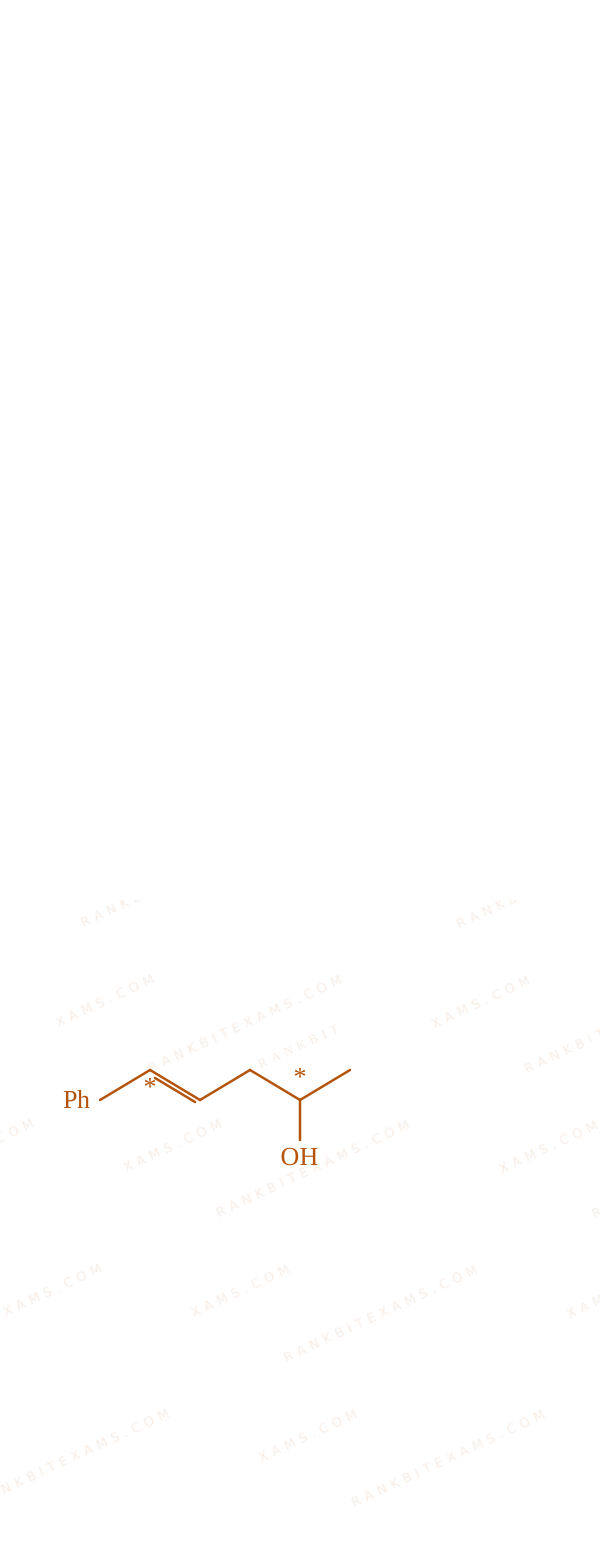
The possible number of stereoisomers for 5-phenylpent-4-en-2-ol is .
Numerical Answer.Answer: 4 to 4
Solution
### Related Formula
For an unsymmetrical molecule with n$n$ distinct stereogenic units (chiral centers or stereogenic double bonds):
textTotal Stereoisomers = 2^n$$\text{Total Stereoisomers} = 2^n$$
### Core Logic
Let's examine the structure of 5-phenylpent-4-en-2-ol:
mathrmPh-CH=CH-CH_2-CH(OH)-CH_3 $$\mathrm{Ph-CH=CH-CH_2-CH(OH)-CH_3} $$
Identify the stereogenic units:
1. **Double Bond (mathrm-CH=CH-$\mathrm{-CH=CH-}$):** Positioned between carbons 4 and 5, this alkene group can exist in 2 distinct geometric configurations: *cis* (Z$Z$) or *trans* (E$E$).
2. **Chiral Carbon Center (*mathrmC$*\mathrm{C}$):** Carbon-2 is attached to four distinct groups: -mathrmH$-\mathrm{H}$, -mathrmOH$-\mathrm{OH}$, -mathrmCH_3$-\mathrm{CH}_3$, and -mathrmCH_2-CH=CH-Ph$-\mathrm{CH_2-CH=CH-Ph}$. This asymmetric carbon center can exist in 2 distinct optical configurations: (R$R$) or (S$S$).
Since the molecule is unsymmetrical, the two stereogenic units behave independently (n = 2$n = 2$):
textTotal Stereoisomers = 2^2 = 4$$\text{Total Stereoisomers} = 2^2 = 4$$
### Visual Mapping
The structural tracking confirms the presence of these stereogenic sites:
Isomerism solution diagram for Q47 - JEE Main 2025 Evening
### Pattern Recognition
Always break the molecule down to count chiral centers and stereogenic double bonds independently. Since the molecule has asymmetric ends, you can safely use the simplified 2^n$2^n$ formula without worrying about meso configurations.
### Evaluation Rubric / Model Answer
null
### Chapter Mix
Class 11 Chemistry: Organic Chemistry - Some Basic Principles and Techniques
Q49jee_main_2025_24_jan_eveningDegree of Unsaturation
The hydrocarbon (X) with molar mass 80 g mol ^-1$^{-1}$ and 90% carbon has ____ degree of unsaturation.
Numerical Answer.Answer: 3 to 3
Solution
### Related Formula
For a hydrocarbon with the molecular formula mathrmC_x mathrmH_y$\mathrm{C}_x \mathrm{H}_y$, the Double Bond Equivalent (DBE) or Degree of Unsaturation (DU) is given by:
textDU = x + 1 - fracy2$$\text{DU} = x + 1 - \frac{y}{2}$$
### Core Logic
1. Calculate the mass of carbon in 1 mole of the hydrocarbon:
textMass of Carbon = 80text g cdot 90\% = 72text g$$\text{Mass of Carbon} = 80\text{ g} \cdot 90\% = 72\text{ g}$$
2. Find the number of carbon atoms (x$x$):
x = frac7212 = 6$$x = \frac{72}{12} = 6$$
3. Find the mass and number of hydrogen atoms (y$y$):
textMass of Hydrogen = 80text g - 72text g = 8text g$$\text{Mass of Hydrogen} = 80\text{ g} - 72\text{ g} = 8\text{ g}$$y = frac81 = 8$$y = \frac{8}{1} = 8$$
Thus, the molecular formula of hydrocarbon (X) is mathrmC_6mathrmH_8$\mathrm{C}_{6}\mathrm{H}_{8}$.
4. Calculate the degree of unsaturation:
textDU = 6 + 1 - frac82 = 7 - 4 = 3$$\text{DU} = 6 + 1 - \frac{8}{2} = 7 - 4 = 3$$
### Pattern Recognition
First, use the percentage composition and total molar mass to determine the exact number of carbon and hydrogen atoms. Once you have the molecular formula, plug it into the standard textDU = x + 1 - fracy2$\text{DU} = x + 1 - \frac{y}{2}$ equation to find the total number of rings and/or pi bonds.
### Evaluation Rubric / Model Answer
null
### Chapter Mix
Class 11 Chemistry: Organic Chemistry - Some Basic Principles and Techniques
In Carius method of estimation of halogen, 0.25 g of an organic compound gave 0.15 g of silver bromide (AgBr). The percentage of Bromine in the organic compound is ____ times 10^-1$\times 10^{-1}$ % (Nearest integer).
(Given : Molar mass of Ag is 108 and Br is 80 g mol ^-1$^{-1}$)
Numerical Answer.Answer: 255 to 255
Solution
### Related Formula
\% text Bromine = fractextMolar Mass of BrtextMolar Mass of AgBr cdot fractextMass of AgBr formedtextMass of Organic Sample cdot 100$$\% \text{ Bromine} = \frac{\text{Molar Mass of Br}}{\text{Molar Mass of AgBr}} \cdot \frac{\text{Mass of AgBr formed}}{\text{Mass of Organic Sample}} \cdot 100$$
### Core Logic
1. Calculate the molar mass of silver bromide (mathrmAgBr$\mathrm{AgBr}$):
textMolar Mass of AgBr = 108 + 80 = 188text g/mol$$\text{Molar Mass of AgBr} = 108 + 80 = 188\text{ g/mol}$$
2. Substitute the given values into the Carius quantitative formula:
* textMass of AgBr = 0.15text g$\text{Mass of AgBr} = 0.15\text{ g}$
* textMass of sample = 0.25text g$\text{Mass of sample} = 0.25\text{ g}$\% mathrmBr = frac80188 cdot frac0.150.25 cdot 100$$\% \mathrm{Br} = \frac{80}{188} \cdot \frac{0.15}{0.25} \cdot 100$$\% mathrmBr = frac80188 cdot 0.6 cdot 100 = frac48188 cdot 100 = 25.5319\%$$\% \mathrm{Br} = \frac{80}{188} \cdot 0.6 \cdot 100 = \frac{48}{188} \cdot 100 = 25.5319\%$$
3. Convert the percentage to match the requested output units (times 10^-1\%$\times 10^{-1}\%$):
25.5319\% = 255.319 cdot 10^-1\% approx 255 cdot 10^-1\%$$25.5319\% = 255.319 \cdot 10^{-1}\% \approx 255 \cdot 10^{-1}\%$$
Rounding to the nearest integer gives 255.
### Pattern Recognition
Pay close attention to the final multiplier units requested in the blank (times 10^-1\%$\times 10^{-1}\%$). Always calculate the raw percentage first, then adjust the decimal place to match the required format.
### Evaluation Rubric / Model Answer
null
### Chapter Mix
Class 11 Chemistry: Organic Chemistry - Some Basic Principles and Techniques
Q29jee_main_2025_24_jan_morningStability of Carbocations
### Core Logic
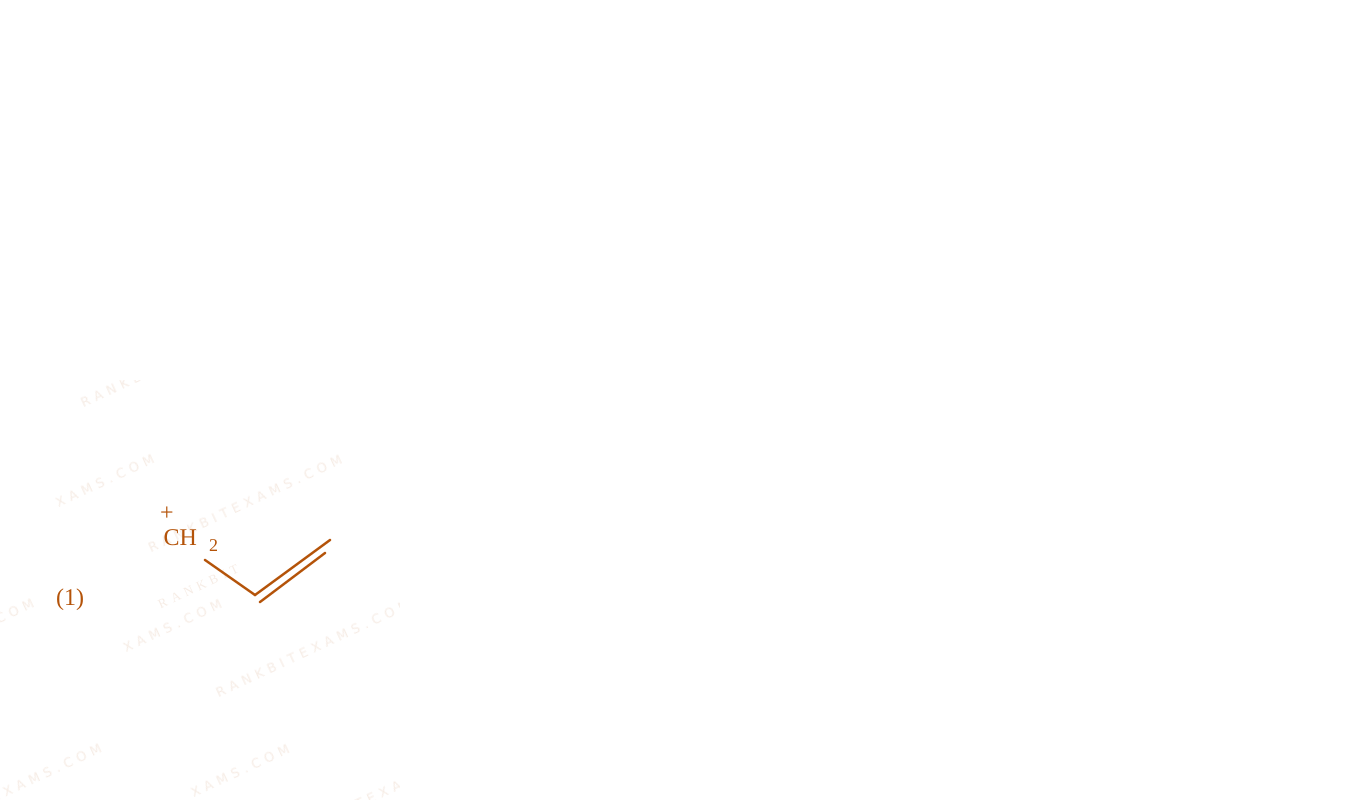
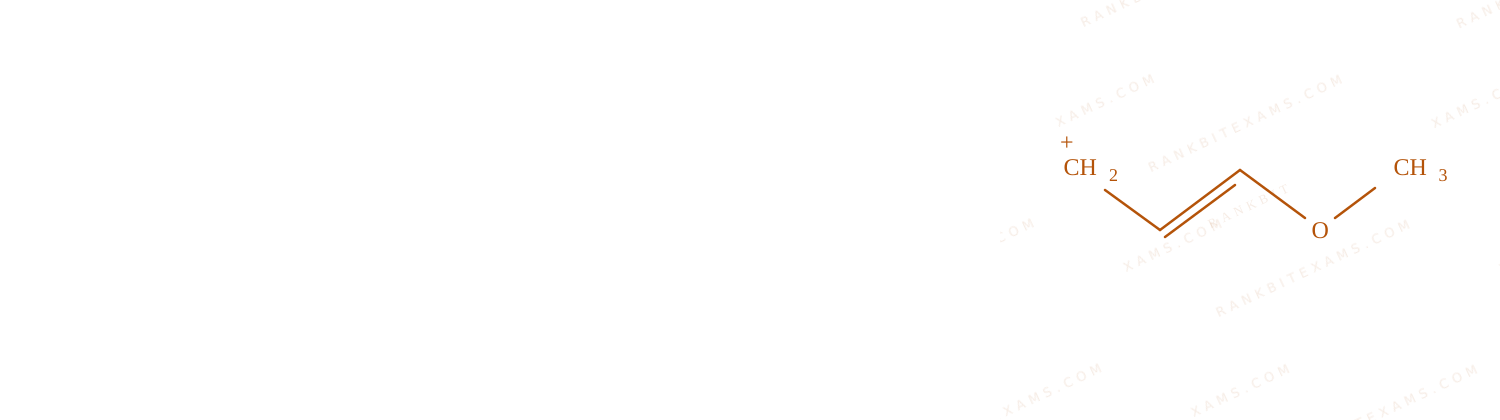
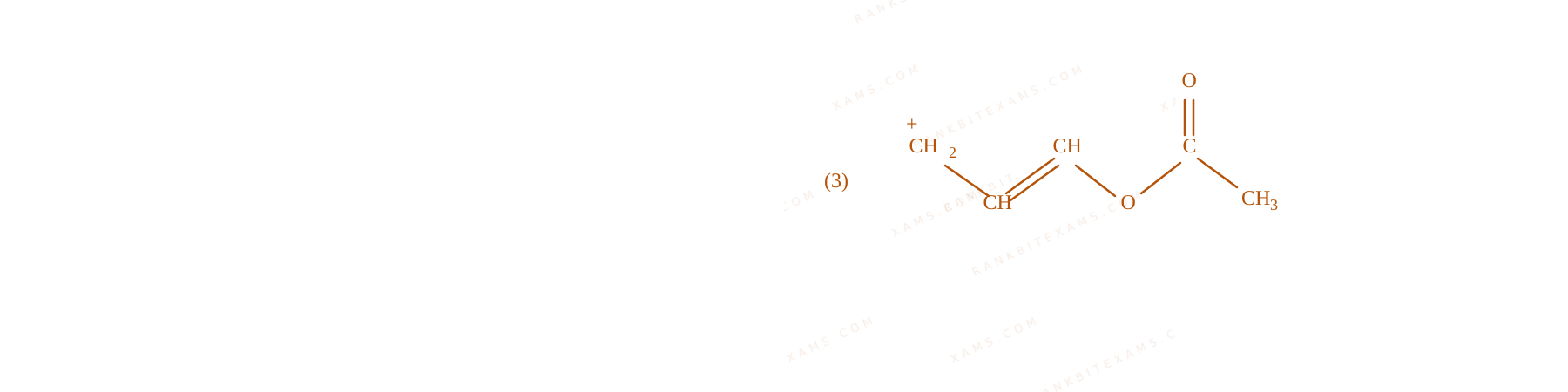
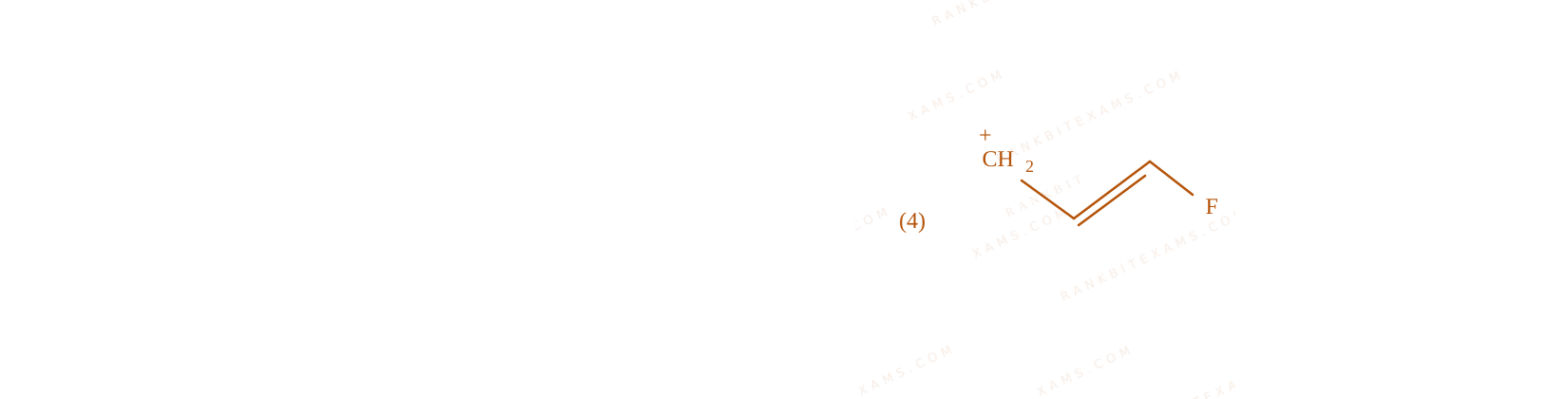
Carbocations are stabilized by structural factors such as the inductive effect (+I$+I$), mesomeric effect (+M$+M$), and hyperconjugation.
In Structure (2), the carbocation center is situated directly adjacent to a strong electronic donor methoxy group (-OCH_3$-OCH_3$). This configuration allows highly effective lone pair donation into the vacant p-orbital of the carbocation via the structural +M$+M$ mesomeric path, rendering it exceptionally stable.
### Pattern Recognition
An adjacent heteroatom with a lone pair (O, N$O, N$) triggers dynamic back-bonding stability (+M$+M$), which fundamentally outweighs basic hyperconjugation trends.
### Evaluation Rubric / Model Answer
null
### Chapter Mix
Class 11 Chemistry: Organic Chemistry - Some Basic Principles and Techniques
More Some Basic Principles of Organic Chemistry Questions — jee_main_2025_04_april_evening
We Map Every Repeating Question in Competitive Exams.
Say goodbye to generic mock test fatigue. RankBit uses smart analysis to group past exam questions into their foundational Repeating Question Types. Find chapter weightage, track repeating questions, and score higher with targeted practice.
Select Your Target Exam
Choose an exam track below to find formulas per chapter and patterns.
Syncing Exam Intelligence
Mapping formulas and patterns across all tracks…
PATH A — FULL LENGTH PRACTICE
Full Mock Test Hub
Simulate real NTA exam conditions with fully tracked mocks. Time yourself against past papers.
Practice past-year questions one chapter at a time. Pick an exam → subject → chapter and get every PYQ for that topic — pulled together from all past papers — with the chapter's key formulas alongside.