(C) Different fractions of crude oil in petroleum industry
(III) Distillation at reduced pressure
(D) Chloroform-Aniline mixture
(IV) Steam distillation
Choose the correct answer from the options given below:
A.(A)-(IV), (B)-(III), (C)-(II), (D)-(I)
B.(A)-(I), (B)-(II), (C)-(III), (D)-(IV)
C.(A)-(III), (B)-(IV), (C)-(I), (D)-(II)
D.(A)-(II), (B)-(I), (C)-(IV), (D)-(III)
Solution & Explanation
### Core Logic
Evaluating standard NCERT laboratory purification matches:
- **(A) Aniline from aniline-water mixture:** Aniline is steam volatile and immiscible with water, so it is separated via **Steam distillation (IV)**.
- **(B) Glycerol from spent-lye in soap industry:** Glycerol decomposes at or below its boiling point, hence it is separated via **Distillation at reduced pressure (III)**.
- **(C) Different fractions of crude oil:** Separated using their small differences in boiling points via **Fractional distillation (II)**.
- **(D) Chloroform-Aniline mixture:** Separated due to a substantial boiling point difference via **Simple distillation (I)**.
### Pattern Recognition
Match key words directly: Glycerol/spent-lye always links to reduced pressure (vacuum distillation). Crude oil always couples to fractional columns. Aniline + water implies steam injection.
### Evaluation Rubric / Model Answer
null
### Chapter Mix
Class 11 Chemistry: Some Basic Principles of Organic Chemistry
Keywords:#purification of organic compounds#JEE Main 2025 Evening Q34#glycerol distillation reduced pressure#steam distillation aniline water
More Some Basic Principles of Organic Chemistry Previous-Year Questions — Page 10
Q34jee_main_2025_24_jan_morningQuantitative Analysis of Organic Compounds
Given below are two statements I and II.
Statement I: Dumas method is used for estimation of "Nitrogen" in an organic compound.
Statement II: Dumas method involves the formation of ammonium sulphate by heating the organic compound with conc mathrmH_2mathrmSO_4$\mathrm{H}_2\mathrm{SO}_4$
In the light of the above statements, choose the correct answer from the options given below
A. Both Statement I and Statement II are true.
B. Statement I is false but Statement II is true
C. Both Statement I and Statement II are false.
D. Statement I is true but Statement II is false
Solution
### Core Logic
Statement I is fully accurate: Dumas method is standardly applied for estimating elemental nitrogen across structural compounds.
Statement II is incorrect: The reaction leading to ammonium sulphate generation by intense thermal heating alongside concentrated mathrmH_2mathrmSO_4$\mathrm{H}_2\mathrm{SO}_4$ describes the **Kjeldahl method**, not the Dumas strategy. The Dumas process instead relies on burning carbonaceous compounds explicitly with copper oxide to convert nitrogen cleanly into free gas (N_2$N_2$).
### Pattern Recognition
Dumas method collects element gas N_2$N_2$ via volumetric analysis; Kjeldahl maps digestions via standard (mathrmNH_4)_2mathrmSO_4$(\mathrm{NH}_4)_2\mathrm{SO}_4$ pathways.
### Evaluation Rubric / Model Answer
null
### Chapter Mix
Class 11 Chemistry: Organic Chemistry - Some Basic Principles and Techniques
Q31jee_main_2025_28_jan_eveningPurification of Organic Compounds
The purification method based on the following physical transformation is :
textSolid xrightarrow[(textX)]textHeat textVapour xrightarrow[(textX)]textCool textSolid$$\text{Solid} \xrightarrow[(\text{X})]{\text{Heat}} \text{Vapour} \xrightarrow[(\text{X})]{\text{Cool}} \text{Solid}$$
A. Sublimation
B. Distillation
C. Crystallization
D. Extraction
Solution
### Related Formula
Direct phase transition without passing through an intermediate liquid phase defines sublimation:
textSolid rightleftharpoons textVapour$$\text{Solid} \rightleftharpoons \text{Vapour}$$
### Core Logic
The schematic diagram represents a solid turning directly into vapor on heating, which then reverts back to a solid phase upon cooling. This distinct behavior isolates sublimable solids from non-sublimable impurities.
### Step 1: Identification
This transformation perfectly defines the laboratory purification process known as **Sublimation**.
### Pattern Recognition
Look for the skipping of the liquid state entirely: Solid rightarrow$\rightarrow$ Vapour rightarrow$\rightarrow$ Solid. Common examples include camphor, naphthalene, benzoic acid, and iodine.
### Evaluation Rubric / Model Answer
null
### Chapter Mix
Class 11 Chemistry: Organic Chemistry - Some Basic Principles and Techniques
Q44jee_main_2025_28_jan_eveningIsomerism
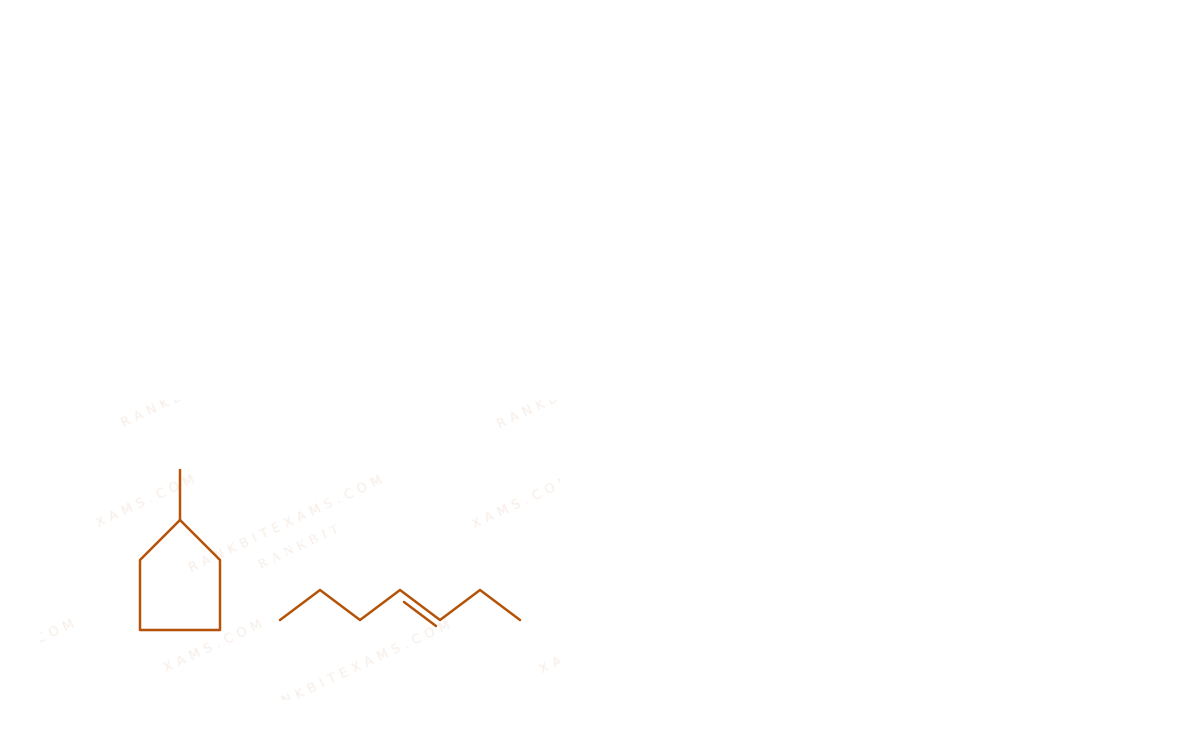
Given below are two statements:
Statement (I): Oxacyclobutane and prop-2-en-1-ol are isomeric compounds.
Statement (II): Propan-1-amine and N-methylethanamine are functional group isomers.
In the light of the above statements, choose the correct answer from the options given below :
A. Both Statement I and Statement II are false
B. Both Statement I and Statement II are true
C. Statement I is true but Statement II is false
D. Statement I is false but Statement II is true
Solution
### Related Formula
Isomers share an identical molecular formula but differ in structural arrangement or functional groups:
textSame M_f neq textSame structural layout$$\text{Same } M_f \neq \text{Same structural layout}$$
### Core Logic
Evaluating the structural parameters:
- **Statement I**: Oxacyclobutane (a cyclic ether) and prop-2-en-1-ol (an unsaturated alcohol) both possess the molecular formula C_3H_6O$C_3H_6O$. They are functional/ring-chain isomers, so Statement I is true.
- **Statement II**: Propan-1-amine (1^circ$1^\circ$ amine) and N-methylethanamine (2^circ$2^\circ$ amine) both share the molecular formula C_3H_9N$C_3H_9N$. Because primary, secondary, and tertiary amines contain different functional groups, they act as functional group isomers. Thus, Statement II is true.
### Step 1: Conclusion Match
Since both structural statements are valid, both Statement I and Statement II are true.
Skeletal representations for the specified organic isomers
### Pattern Recognition
Always remember that 1^circ$1^\circ$, 2^circ$2^\circ$, and 3^circ$3^\circ$ amines are classified as *different functional groups* in IUPAC nomenclature. Consequently, structural shifts between them with a constant carbon count represent functional group isomerism.
### Evaluation Rubric / Model Answer
null
### Chapter Mix
Class 11 Chemistry: Organic Chemistry - Some Basic Principles and Techniques
Qjee_main_2025_29_jan_morningNucleophiles and Electrophiles
Total number of nucleophiles from the following is :-
mathrm N H _ 3, mathrm P h S H, (mathrm H _ 3 mathrm C) _ 2 mathrm S, mathrm H _ 2 mathrm C = mathrm C H _ 2, stackrel ominus mathrm O mathrm H, mathrm H _ 3 mathrm O ^ oplus, (mathrm C H _ 3) _ 2 mathrm C O, > = mathrm N C H _ 3$$\mathrm {N H} _ {3}, \mathrm {P h S H}, (\mathrm {H} _ {3} \mathrm {C}) _ {2} \mathrm {S}, \mathrm {H} _ {2} \mathrm {C} = \mathrm {C H} _ {2}, \stackrel {\ominus} {\mathrm {O}} \mathrm {H}, \mathrm {H} _ {3} \mathrm {O} ^ {\oplus}, (\mathrm {C H} _ {3}) _ {2} \mathrm {C O}, > = \mathrm {N C H} _ {3}$$
A. 5
B. 4
C. 7
D. 6
Solution
### Related Formula
Nucleophiles are electron-rich species containing lone pairs of electrons or pi$\pi$-bonds that can donate an electron pair to an electrophilic center.
### Core Logic
Let us examine each species:
* mathrmNH_3$\mathrm{NH}_3$: Contains a lone pair on nitrogen rightarrow$\rightarrow$ Nucleophile
* mathrmPhSH$\mathrm{PhSH}$: Contains lone pairs on sulfur rightarrow$\rightarrow$ Nucleophile
* (mathrmH_3mathrmC)_2mathrmS$(\mathrm{H}_3\mathrm{C})_2\mathrm{S}$: Contains lone pairs on sulfur rightarrow$\rightarrow$ Nucleophile
* mathrmH_2mathrmC=mathrmCH_2$\mathrm{H}_2\mathrm{C}=\mathrm{CH}_2$: Contains a nucleophilic pi$\pi$-bond rightarrow$\rightarrow$ Nucleophile
* stackrelominusmathrmOmathrmH$\stackrel{\ominus}{\mathrm{O}}\mathrm{H}$: Negatively charged with lone pairs rightarrow$\rightarrow$ Nucleophile
* mathrmH_3mathrmO^oplus$\mathrm{H}_3\mathrm{O}^{\oplus}$: Electron deficient, positively charged oxygen cannot donate electrons rightarrow$\rightarrow$ Electrophile
* (mathrmCH_3)_2mathrmCO$(\mathrm{CH}_3)_2\mathrm{CO}$: Carbonyl carbon is electrophilic
* >=mathrmNCH_3$>=\mathrm{NCH}_3$: Imine carbon is electrophilic
Thus, the total number of nucleophiles is 5.
### Pattern Recognition
Neutral molecules with lone pairs (N, S) or alkenes/alkynes with available pi$\pi$-electrons operate as good nucleophiles, along with full anions.
### Evaluation Rubric / Model Answer
null
### Chapter Mix
Class 11 Chemistry: Organic Chemistry - Some Basic Principles and Techniques
Qjee_main_2025_29_jan_morningIUPAC Nomenclature of Organic Compounds
Match List-I with List-II.
Choose the correct answer from the options given below:
IUPAC Nomenclature of Organic Compounds
A. (A)-(II), (B)-(III), (C)-(IV), (D)-(I)
B. (A)-(III), (B)-(II), (C)-(I), (D)-(IV)
C. (A)-(II), (B)-(III), (C)-(IV), (D)-(I)
D. (A)-(II), (B)-(III), (C)-(I), (D)-(IV)
Solution
### 1. RELATED FORMULA
IUPAC Rules select the longest principal carbon chain and number it to give substituents the lowest possible locants.
### 2. EXECUTION
**CORE LOGIC**
Let's systematic decode each name :
* (A) Longest chain contains 7 carbons (heptane) with an ethyl group at position 3 and a methyl group at position 5 rightarrow$\rightarrow$ 3-Ethyl-5-methylheptane (II) .
* (B) C expanded yields a 7 carbon main chain with two methyl groups at carbon-4 rightarrow$\rightarrow$ 4,4-Dimethylheptane (III) .
* (C) 5-carbon diene numbered from the left double bond side rightarrow$\rightarrow$ 2-Methyl-1,3-pentadiene (IV) .
* (D) 5-carbon alkene starting from the double bond end rightarrow$\rightarrow$ 4-Methylpent-1-ene (I) .
Therefore, matching sequence: (A)-(II), (B)-(III), (C)-(IV), (D)-(I).
### 3. PATTERN RECOGNITION
Expanding compressed groupings such as mathrm(C_3H_7)_2$\mathrm{(C_3H_7)_2}$ prevents errors regarding parent chain carbon counts.
### 4. EVALUATION RUBRIC / MODEL ANSWER
null
### 5. CHAPTER MIX
Class 11 Chemistry: Organic Chemistry - Some Basic Principles and Techniques
More Some Basic Principles of Organic Chemistry Questions — jee_main_2025_04_april_evening
We Map Every Repeating Question in Competitive Exams.
Say goodbye to generic mock test fatigue. RankBit uses smart analysis to group past exam questions into their foundational Repeating Question Types. Find chapter weightage, track repeating questions, and score higher with targeted practice.
Select Your Target Exam
Choose an exam track below to find formulas per chapter and patterns.
Syncing Exam Intelligence
Mapping formulas and patterns across all tracks…
PATH A — FULL LENGTH PRACTICE
Full Mock Test Hub
Simulate real NTA exam conditions with fully tracked mocks. Time yourself against past papers.
Practice past-year questions one chapter at a time. Pick an exam → subject → chapter and get every PYQ for that topic — pulled together from all past papers — with the chapter's key formulas alongside.
