Given below are two statements:
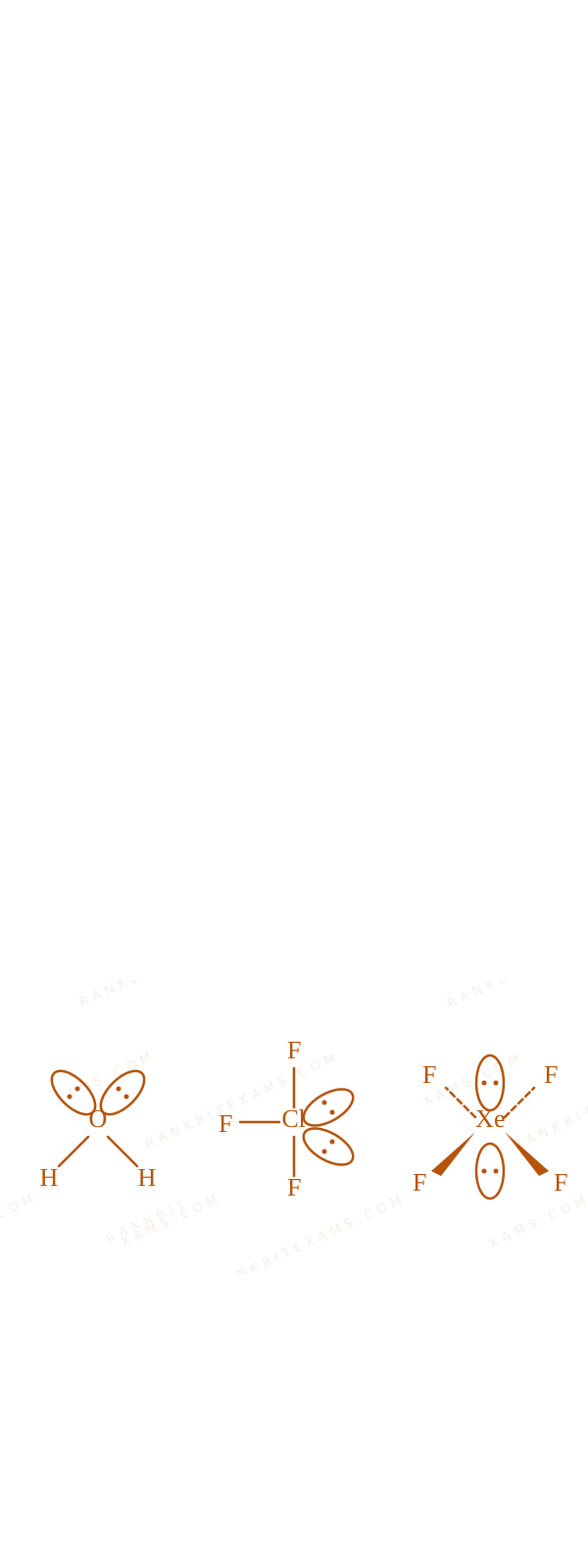
Statement (I) : for C F₃$\mathrm{C}\ell \mathrm{F}_{3}$ , all three possible structures may be drawn as follows.
The prompt displays three configurations of chlorine trifluoride with differing spatial positions for its two lone electron pairs.The prompt displays three configurations of chlorine trifluoride with differing spatial positions for its two lone electron pairs.The prompt displays three configurations of chlorine trifluoride with differing spatial positions for its two lone electron pairs.
Statement (II) : Structure III is most stable, as the orbitals having the lone pairs are axial, where the p-$\ell \mathfrak{p}-$ bp repulsion is minimum.
In the light of the above statements, choose the most appropriate answer from the options given below:
The prompt displays three configurations of chlorine trifluoride with differing spatial positions for its two lone electron pairs.
A.Statement I is incorrect but statement II is correct.
B.Statement I is correct but statement II is incorrect.
C.Both Statement I and statement II are correct.
D.Both Statement I and statement II are incorrect.
Solution & Explanation
Related Formula
Steric Number for ClF₃ = (7+3)/(2) = 5 sp³d hybridization (Trigonal Bipyramidal geometry)$$\text{Steric Number for } ClF_3 = \frac{7+3}{2} = 5 \implies sp^3d \text{ hybridization (Trigonal Bipyramidal geometry)}$$
Core Logic
Statement I is correct: The three structural arrangements represent the different ways to place three bond pairs and two lone pairs within a trigonal bipyramidal grid.
Statement II is incorrect: According to VSEPR theory and Bent's rule, in sp³d$sp^3d$ hybridization, lone pairs must occupy equatorial positions to minimize strong 90^°$90^\circ$ lone pair-bond pair (p-bp$\ell p-bp$) repulsions. Placing them axially maximizes repulsions, making that structure the least stable, not the most stable.
Pattern Recognition
For sp³d$sp^3d$ configurations (Trigonal Bipyramidal), lone pairs ALWAYS prefer equatorial sites where they experience 120^circ$120^circ$ interactions, minimizing severe 90^circ$90^circ$ structural strains. This results in the classic stable T-shaped configuration for ClF₃$ClF_3$.
Chapter Mix
Class 11 Chemistry: Chemical Bonding and Molecular Structure
For CHCl₃$CHCl_3$, the individual dipole vectors do not cancel due to differing electronegativities of H and Cl, leading to a permanent non-zero dipole moment (μ ≠ 0$\mu \neq 0$). Dipole vectors structural cancellation schema for Q69 - JEE Main 2024 Morning
Class 11 Chemistry: Chemical Bonding and Molecular Structure
Q89jee_main_2024_27_jan_morningMolecular Orbital Theory
Sum of bond order of CO$\text{CO}$ and NO^+$\text{NO}^+$ is $\text{\quad\quad}$.
Numerical Answer.Answer: 6 to 6
Solution
Step 1: Determine the bond order of CO$\text{CO}$
Carbon monoxide (CO$\text{CO}$) contains 6 + 8 = 14$6 + 8 = 14$ total electrons.
Its structural representation is C$\text{C}\equiv\text{O}$, matching a bond order value of 3.
Step 2: Determine the bond order of NO^+$\text{NO}^+$
The nitrosonium ion (NO^+$\text{NO}^+$) contains 7 + 8 - 1 = 14$7 + 8 - 1 = 14$ total electrons.
Since it is isoelectronic with N₂$\text{N}_2$ and CO$\text{CO}$ (14 electrons$14\text{ electrons}$), its corresponding bond order value is also 3.
Step 3: Sum the results
Sum = 3 + 3 = 6$$\text{Sum} = 3 + 3 = 6$$
Pattern Recognition
Isoelectronic species possessing 14 total electrons consistently demonstrate a bond order value of 3.
Chapter Mix
Class 11 Chemistry: Chemical Bonding and Molecular Structure
Q81jee_main_2024_29_jan_morningVSEPR Theory
Number of compounds with one lone pair of electrons on central atom amongst following is
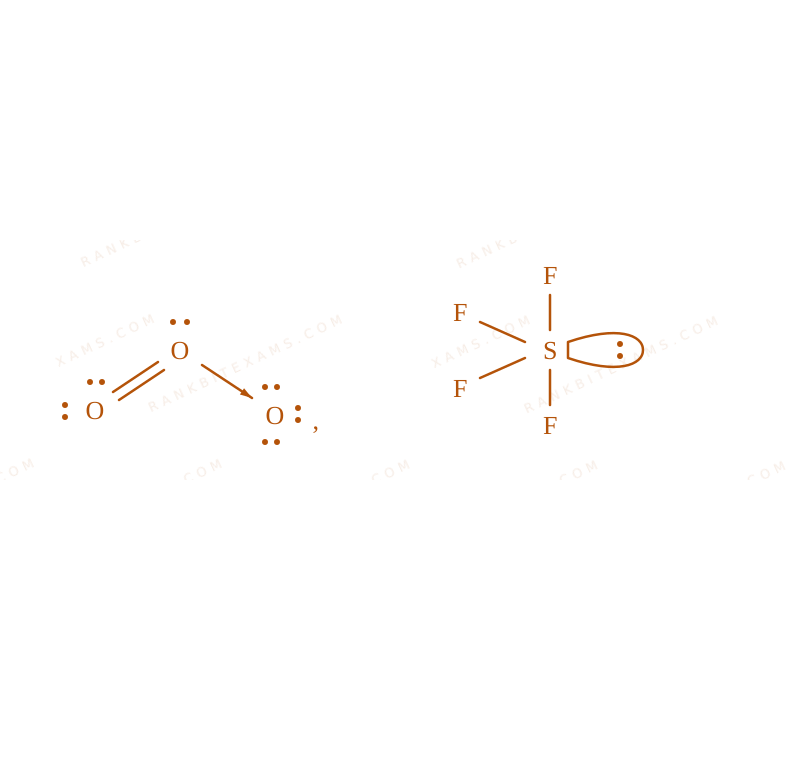
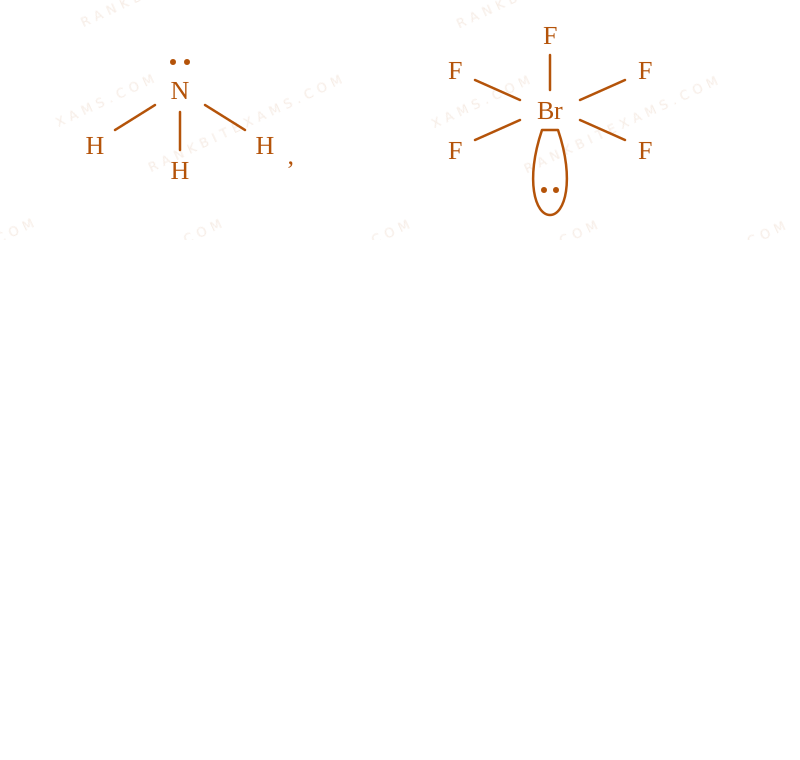
O₃$O_3$, H₂O$H_2O$, SF₄$SF_4$, ClF₃$ClF_3$, NH₃$NH_3$, BrF₅$BrF_5$, XeF₄$XeF_4$
Numerical Answer.Answer: 4 to 4
Solution
Core Logic
Let us determine the steric number (Z$Z$) and number of lone pairs (LP$LP$) for the central atom in each given molecule.
Formula: Z = (1)/(2) (V + M - C + A)$Z = \frac{1}{2} (V + M - C + A)$
Where V$V$ = valence electrons on central atom, M$M$ = number of monovalent atoms, C$C$ = cationic charge, A$A$ = anionic charge.
LP = Z - Bond Pairs (B.P.)$LP = Z - \text{Bond Pairs (B.P.)}$
O₃$O_3$: Central atom O (V=6$V=6$). It forms one double bond and one dative bond. It has 1 lone pair remaining.
H₂O$H_2O$: Central atom O (V=6$V=6$). Z = (1)/(2)(6 + 2) = 4$Z = \frac{1}{2}(6 + 2) = 4$. LP = 4 - 2 = 2$LP = 4 - 2 = 2$.
SF₄$SF_4$: Central atom S (V=6$V=6$). Z = (1)/(2)(6 + 4) = 5$Z = \frac{1}{2}(6 + 4) = 5$. LP = 5 - 4 = 1$LP = 5 - 4 = 1$ (See-saw shape).
VSEPR Theory diagram for Q81 - JEE Main 2024 MorningVSEPR Theory diagram for Q81 - JEE Main 2024 MorningVSEPR Theory diagram for Q81 - JEE Main 2024 Morning
The compounds containing exactly ONE lone pair on the central atom are O₃$O_3$, SF₄$SF_4$, NH₃$NH_3$, and BrF₅$BrF_5$.
Total count = 4.
Chapter Mix
Class 11 Chemistry: Chemical Bonding and Molecular Structure
Q88jee_main_2024_29_jan_morningMolecular Orbital Theory
The number of species from the following which are paramagnetic and with bond order equal to one is
H₂, He₂^+, O₂^+, N₂²⁻, O₂²⁻, F₂, Ne₂^+, B₂$$\mathrm {H}_2, \mathrm{He}_2^+, \mathrm{O}_2^+, \mathrm{N}_2^{2-}, \mathrm{O}_2^{2-}, \mathrm{F}_2, \mathrm{Ne}_2^+, \mathrm{B}_2$$
Numerical Answer.Answer: 1 to 1
Solution
Core Logic
Using Molecular Orbital (MO) Theory, we evaluate the bond order (BO = (Nb - Nₐ)/(2)$BO = \frac{N_b - N_a}{2}$) and magnetic nature (unpaired electrons = paramagnetic, all paired = diamagnetic) for each species:
Species
Magnetic behaviour
Bond order
H₂$H_2$
Diamagnetic
1
He₂^+$He_2^+$
Paramagnetic
0.5
O₂^+$O_2^+$
Paramagnetic
2.5
N₂²⁻$N_2^{2-}$
Paramagnetic
2
O₂²⁻$O_2^{2-}$
Diamagnetic
1
F₂$F_2$
Diamagnetic
1
Ne₂^+$Ne_2^+$
Paramagnetic
0.5
B₂$B_2$
Paramagnetic
1
Step 1: Final Selection
We need the species that satisfies BOTH conditions:
Paramagnetic
Bond Order = 1
Looking at the table, B₂$B_2$ is the only molecule that is paramagnetic (it has 2 unpaired electrons in degenerate π₂ₚ$\pi_{2p}$ orbitals) and has a bond order of 1.
Total number of such species = 1.
Pattern Recognition
B₂$B_2$ (10 electrons) and O₂$O_2$ (16 electrons) are the classic exceptions in MO theory that are paramagnetic despite having an even number of electrons. B₂$B_2$ has BO = 1, and O₂$O_2$ has BO = 2.
Chapter Mix
Class 11 Chemistry: Chemical Bonding and Molecular Structure
Qjee_main_2024_30_january_eveningVSEPR Theory and Molecular Shapes
PCl₅$PCl_5$: sp³d$sp^3d$ hybridization with 0 lone pairs arrow$\rightarrow$ Trigonal Bipyramidal.
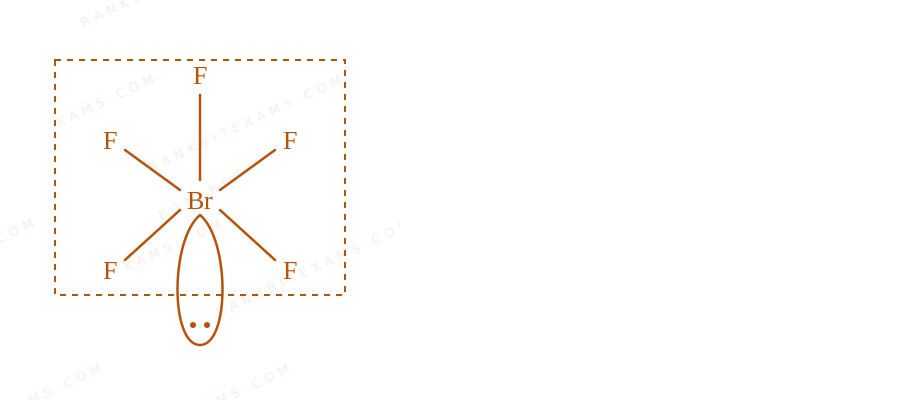
BrF₅$BrF_5$: Bromine has 7 valence electrons. It forms 5 single bonds with Fluorine, leaving 1 lone pair. sp³d²$sp^3d^2$ hybridization arrow$\rightarrow$ geometry is octahedral, but shape is Square Pyramidal.
PF₅$PF_5$: sp³d$sp^3d$ hybridization with 0 lone pairs arrow$\rightarrow$ Trigonal Bipyramidal.
Square Pyramidal structure of BrF5 diagram for Q69 - JEE Main 2024 Evening
Pattern Recognition
AX₅E₁$AX_5E_1$ configuration (5 bond pairs + 1 lone pair) typically yields a Square Pyramidal shape.
Chapter Mix
Class 11 Chemistry: Chemical Bonding and Molecular Structure
Class 12 Chemistry: Coordination Compounds
Practice past-year questions one chapter at a time. Pick an exam → subject → chapter and get every PYQ for that topic — pulled together from all past papers — with the chapter's key formulas alongside.


.svg "T-shaped geometry, lone pair equatorial placement, VSEPR repulsion")