Given below are two statements:
Statement (I) : for C F₃$\mathrm{C}\ell \mathrm{F}_{3}$ , all three possible structures may be drawn as follows.
The prompt displays three configurations of chlorine trifluoride with differing spatial positions for its two lone electron pairs.The prompt displays three configurations of chlorine trifluoride with differing spatial positions for its two lone electron pairs.The prompt displays three configurations of chlorine trifluoride with differing spatial positions for its two lone electron pairs.
Statement (II) : Structure III is most stable, as the orbitals having the lone pairs are axial, where the p-$\ell \mathfrak{p}-$ bp repulsion is minimum.
In the light of the above statements, choose the most appropriate answer from the options given below:
The prompt displays three configurations of chlorine trifluoride with differing spatial positions for its two lone electron pairs.
A.Statement I is incorrect but statement II is correct.
B.Statement I is correct but statement II is incorrect.
C.Both Statement I and statement II are correct.
D.Both Statement I and statement II are incorrect.
Solution & Explanation
Related Formula
Steric Number for ClF₃ = (7+3)/(2) = 5 sp³d hybridization (Trigonal Bipyramidal geometry)$$\text{Steric Number for } ClF_3 = \frac{7+3}{2} = 5 \implies sp^3d \text{ hybridization (Trigonal Bipyramidal geometry)}$$
Core Logic
Statement I is correct: The three structural arrangements represent the different ways to place three bond pairs and two lone pairs within a trigonal bipyramidal grid.
Statement II is incorrect: According to VSEPR theory and Bent's rule, in sp³d$sp^3d$ hybridization, lone pairs must occupy equatorial positions to minimize strong 90^°$90^\circ$ lone pair-bond pair (p-bp$\ell p-bp$) repulsions. Placing them axially maximizes repulsions, making that structure the least stable, not the most stable.
Pattern Recognition
For sp³d$sp^3d$ configurations (Trigonal Bipyramidal), lone pairs ALWAYS prefer equatorial sites where they experience 120^circ$120^circ$ interactions, minimizing severe 90^circ$90^circ$ structural strains. This results in the classic stable T-shaped configuration for ClF₃$ClF_3$.
Chapter Mix
Class 11 Chemistry: Chemical Bonding and Molecular Structure
More Chemical Bonding and Molecular Structure Previous-Year Questions — Page 6
Q43jee_main_2025_24_jan_morningHybridization and Molecular Geometry
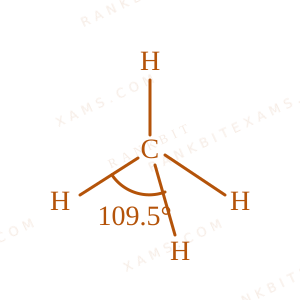
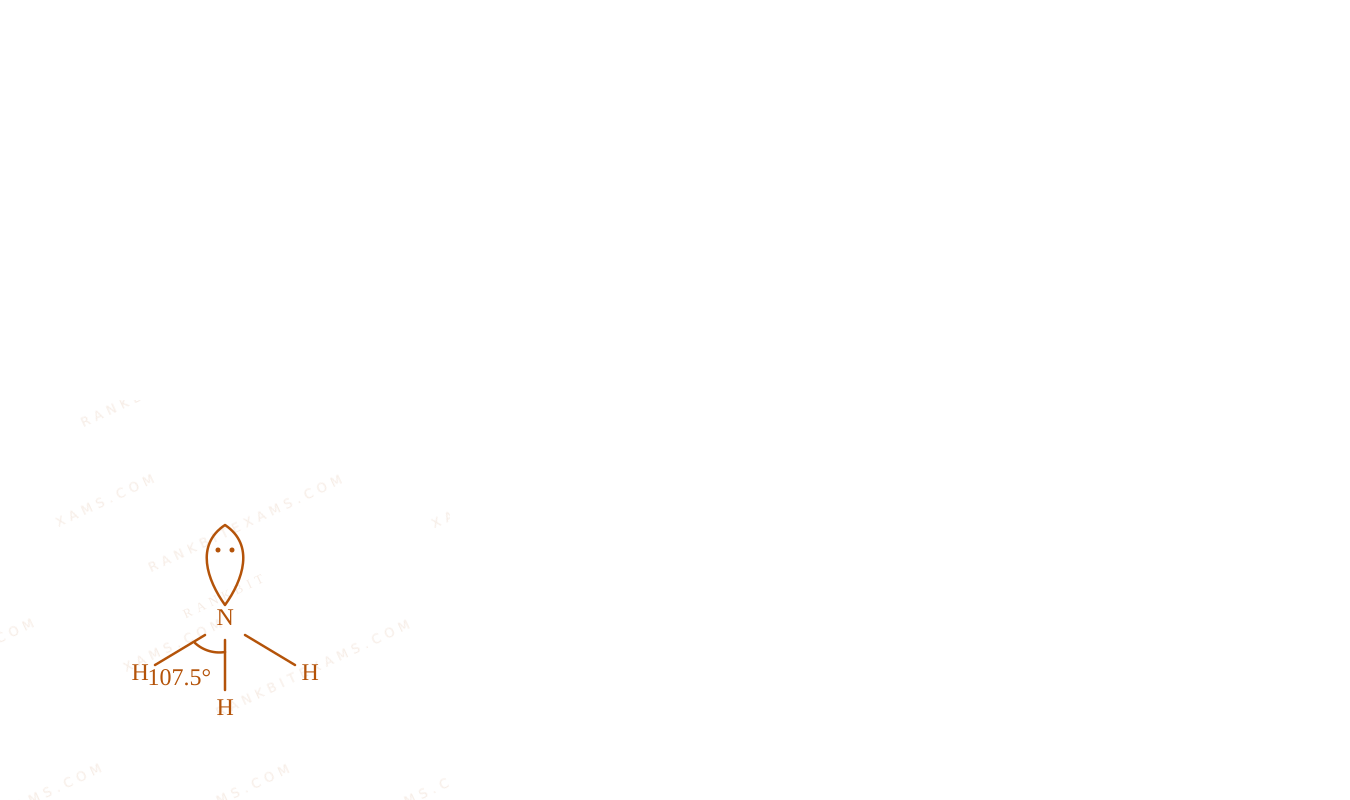
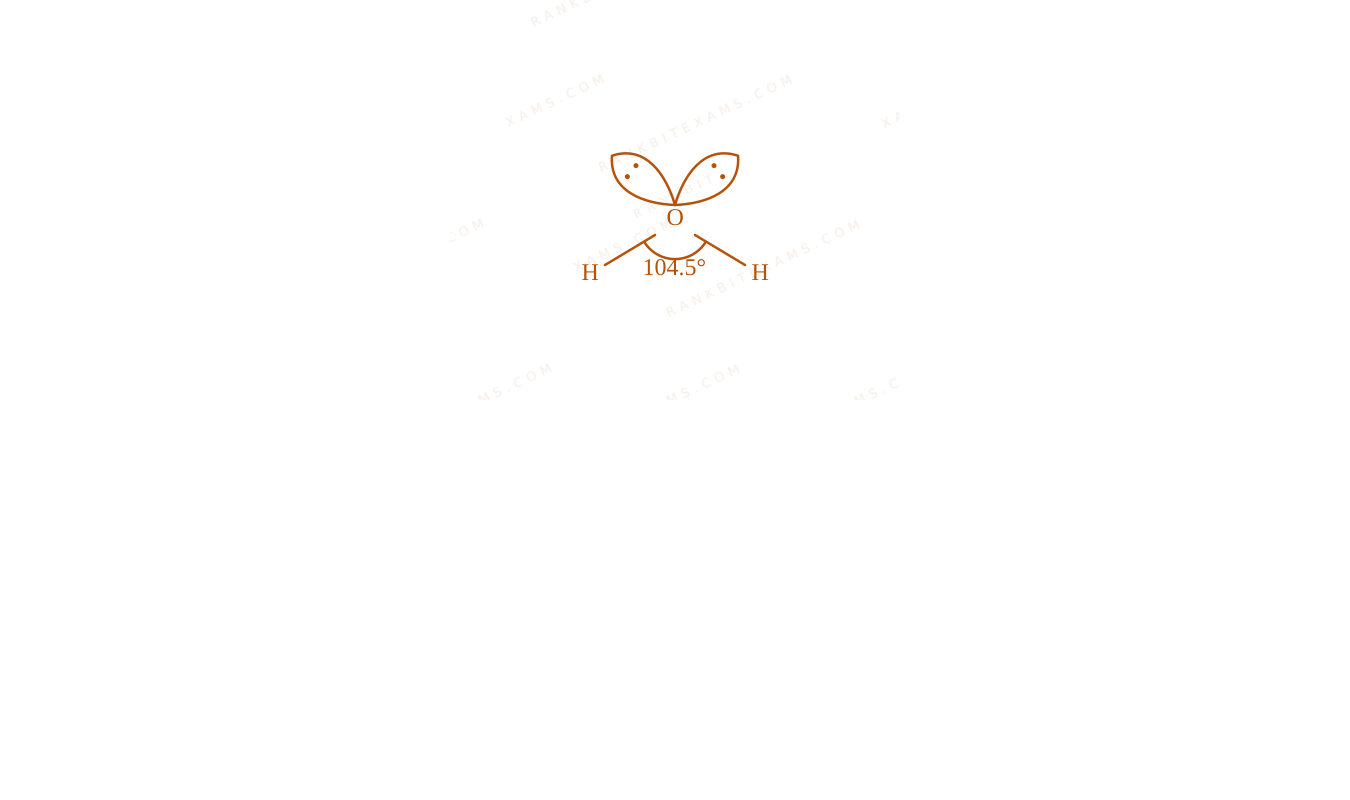
Which of the following statement is true with respect to H₂O, NH₃$\mathrm{H}_2\mathrm{O}, \mathrm{NH}_3$ and CH₄$\mathrm{CH}_4$ ?
A. The central atoms of all the molecules are sp³$\mathfrak{sp}^3$ hybridized.
B. The H-O-H, H-N-H and H-C-H angles in the above molecules are 104.5°$104.5^{\circ}$ , 107.5°$107.5^{\circ}$ and 109.5°$109.5^{\circ}$ respectively.
C. The increasing order of dipole moment is CH₄ < NH₃ < H₂O$\mathrm{CH}_4 < \mathrm{NH}_3 < \mathrm{H}_2\mathrm{O}$ .
D. Both H₂O$\mathrm{H}_2\mathrm{O}$ and NH₃$\mathrm{NH}_3$ are Lewis acids and CH₄$\mathrm{CH}_4$ is a Lewis base
E. A solution of NH₃$\mathrm{NH}_3$ in H₂O$\mathrm{H}_2\mathrm{O}$ is basic. In this solution NH₃$\mathrm{NH}_3$ and H₂O$\mathrm{H}_2\mathrm{O}$ act as Lowry-Bronsted acid and base respectively.
Choose the correct answer from the options given below:
A. A, B and C only
B. C, D and E only
C. A, D and E only
D. A, B, C and E only
Solution
Core Logic
Analyzing each statement individually:
Statement A is true: The central atoms (O, N, C$O, N, C$) all possess an electron steric number equal to 4, indicating sp³$\mathfrak{sp}^3$ hybridization state pathways.
Statement B is true: Due to valence shell electron pair repulsions, the bond angles decrease from the ideal tetrahedral angle (109.5°$109.5^{\circ}$ in CH₄$CH_4$, Water molecule structural bond configuration shape representation) as lone pairs are added (107.5°$107.5^{\circ}$ in NH₃$NH_3$ with 1 lone pair, Water molecule structural bond configuration shape representation; 104.5°$104.5^{\circ}$ in H₂O$H_2O$ with 2 lone pairs, Water molecule structural bond configuration shape representation).
Statement C is true: The dipole moment increases alongside central atom electronegativity and asymmetric lone pair configurations, following the sequence CH₄ (0 D) < NH₃ (1.47 D) < H₂O (1.85 D)$\mathrm{CH}_4 (0\text{ D}) < \mathrm{NH}_3 (1.47\text{ D}) < \mathrm{H}_2\mathrm{O} (1.85\text{ D})$.
Pattern Recognition
Lone pairs repel bonding electron pairs more strongly than bonding pairs repel each other, systematically compressing adjacent bond angles.
Chapter Mix
Class 11 Chemistry: Chemical Bonding and Molecular Structure
Q74jee_main_2024_01_february_morningIonic Character
Arrange the bonds in order of increasing ionic character in the molecules. LiF$LiF$, K₂O$K_2O$, N₂$N_2$, SO₂$SO_2$ and ClF₃$ClF_3$.
The ionic character of a bond is directly proportional to the electronegativity difference (Δ EN$\Delta EN$) between the two bonded atoms.
Larger Δ EN$\Delta EN \implies$ higher ionic character.
Step 1: Assess Electronegativity Differences
N₂$N_2$: Both atoms are Nitrogen. Δ EN = 0$\Delta EN = 0$. Purely covalent. (Lowest ionic character)
SO₂$SO_2$: Bond between S and O. Moderate Δ EN$\Delta EN$. Covalent with some polarity.
ClF₃$ClF_3$: Bond between Cl and F. Δ EN$\Delta EN$ is higher than S-O as F is the most electronegative element.
K₂O$K_2O$: Bond between K (alkali metal, very low EN) and O. Very high Δ EN$\Delta EN$. Ionic.
LiF$LiF$: Bond between Li (alkali metal) and F (highest EN). Maximum Δ EN$\Delta EN$ possible among these options. Most ionic.
Step 2: Order Derivation
Increasing order of ionic character (or Δ EN$\Delta EN$):
N₂ < SO₂ < ClF₃ < K₂O < LiF$N_2 < SO_2 < ClF_3 < K_2O < LiF$
Pattern Recognition
Homodiatomic (N₂$N_2$) is always 0% ionic. Alkali metal + Halogen (LiF$LiF$) represents the extreme of the ionic spectrum. Sorting non-metals by group distance yields the middle ranks.
Chapter Mix
Class 11 Chemistry: Chemical Bonding and Molecular Structure
Q85jee_main_2024_01_february_morningVSEPR Theory
The number of molecules/ion/s having trigonal bipyramidal shape is ....
PF₅$PF_5$, BrF₅$BrF_5$, PCl₅$PCl_5$, [PtCl₄]²⁻$[PtCl_4]^{2-}$, BF₃$BF_3$, Fe(CO)₅$Fe(CO)_5$
Numerical Answer.Answer: 3 to 3
Solution
Core Logic
Using VSEPR theory to find the hybridization and shape:
PF₅$PF_5$: P has 5 valence electrons, forms 5 single bonds with F. Steric number = 5 (sp3d). 0 lone pairs. Shape = Trigonal bipyramidal.
BrF₅$BrF_5$: Br has 7 valence electrons, forms 5 single bonds, 1 lone pair. Steric number = 6 (sp3d2). Shape = Square pyramidal.
PCl₅$PCl_5$: P has 5 valence electrons, 5 bonds, 0 lone pairs. Steric number = 5 (sp3d). Shape = Trigonal bipyramidal.
[PtCl₄]²⁻$[PtCl_4]^{2-}$: Pt²⁺$Pt^{2+}$ is a d⁸$d^8$ system. With Cl^-$Cl^-$ (but 4d/5d transition metals always form low spin square planar complexes), it's dsp²$dsp^2$ hybridized. Shape = Square planar.
BF₃$BF_3$: B has 3 valence electrons, 3 bonds, 0 lone pairs. Steric number = 3 (sp2). Shape = Trigonal planar.
Fe(CO)₅$Fe(CO)_5$: Fe (d6s2 -> d8 under strong field CO$CO$). Carbonyls strongly prefer 5-coordinate trigonal bipyramidal geometry for d⁸$d^8$ (dsp³$dsp^3$ hybridization). Shape = Trigonal bipyramidal.
Step 1: Count Trigonal Bipyramidal Molecules
Molecules with trigonal bipyramidal shape:
PF₅$PF_5$
PCl₅$PCl_5$
Fe(CO)₅$Fe(CO)_5$
Total count = 3.
Pattern Recognition
Steric Number = 5 with 0 lone pairs ALWAYS yields Trigonal Bipyramidal geometry. Watch out for BrF₅$BrF_5$ which has 5 bonds but 1 lone pair (SN = 6, Square Pyramidal).
Chapter Mix
Class 11 Chemistry: Chemical Bonding and Molecular Structure
Class 12 Chemistry: Coordination Compounds
Qjee_main_2024_29_january_eveningMolecular Orbital Theory
The total number of anti bonding molecular orbitals, formed from 2s and 2p atomic orbitals in a diatomic molecule is ________.
Numerical Answer.Answer: 4 to 4
Solution
Related Formula
Total Atomic Orbitals Combinations = Bonding MOs + Antibonding MOs$$\text{Total Atomic Orbitals Combinations} = \text{Bonding MOs} + \text{Antibonding MOs}$$
Core Logic
When atomic orbitals combine, they form an equal number of molecular orbitals:
Two 2s$2s$ atomic orbitals combine to form 1 bonding orbital (σ₂ₛ$\sigma_{2s}$) and 1 antibonding orbital (σ^*₂ₛ$\sigma^*_{2s}$).
Six 2p$2p$ atomic orbitals combine to form 3 bonding orbitals (σ2pz, π2pₓ, π2py$\sigma_{2p_z}, \pi_{2p_x}, \pi_{2p_y}$) and 3 antibonding orbitals (σ^2pz, π^2pₓ, π^*2py$\sigma^_{2p_z}, \pi^_{2p_x}, \pi^*_{2p_y}$).
Step 1: Total Summation
Summing the antibonding orbitals from both subshells:
The linear combination of N$N$ atomic orbitals always yields exactly (N)/(2)$\frac{N}{2}$ antibonding molecular orbitals.
Chapter Mix
Class 11 Chemistry: Chemical Bonding and Molecular Structure
Qjee_main_2024_29_january_eveningDipole Moment
The total number of molecules with zero dipole moment among CH₄$\mathrm{CH}_4$, BF₃$\mathrm{BF}_3$, H₂O$\mathrm{H}_2\mathrm{O}$, HF$\mathrm{HF}$, NH₃$\mathrm{NH}_3$, CO₂$\mathrm{CO}_2$, and SO₂$\mathrm{SO}_2$ is ________.
NH₃$\text{NH}_3$: Trigonal pyramidal shape due to a lone pair μ ≠ 0$\implies \mu \neq 0$.
CO₂$\text{CO}_2$: Symmetrical linear structure (O=C=O$\mathrm{O}=\mathrm{C}=\mathrm{O}$) where dipoles cancel out μ = 0$\implies \mu = 0$.
SO₂$\text{SO}_2$: Bent angular geometry due to a lone pair μ ≠ 0$\implies \mu \neq 0$.
Step 1: Final Counting
The molecules with a net zero dipole moment are CH₄$\text{CH}_4$, BF₃$\text{BF}_3$, and CO₂$\text{CO}_2$. This gives a total count of 3.
Pattern Recognition
Molecules with a symmetrical arrangement of identical bonds and no lone pairs on the central atom (e.g., tetrahedral CH₄$\text{CH}_4$, trigonal planar BF₃$\text{BF}_3$, linear CO₂$\text{CO}_2$) always have a net dipole moment of zero.
Chapter Mix
Class 11 Chemistry: Chemical Bonding and Molecular Structure
Practice past-year questions one chapter at a time. Pick an exam → subject → chapter and get every PYQ for that topic — pulled together from all past papers — with the chapter's key formulas alongside.


.svg "T-shaped geometry, lone pair equatorial placement, VSEPR repulsion")