JEE Main · Chemistry → Steady

Aldehydes, Ketones and Carboxylic Acids appeared 46 times across 3 years — 5.4% of Chemistry. This question is from Iodoform Test.

Year 2026 2025 2024 Total
Questions 14 21 11 46

Which among the following compounds give yellow solid when reacted with NaOI/NaOH? (A) CH₃ - CH(OH) - C₂H₅ (B) CH₃ - CH₂ - CH₂ - OH (C) CH₃ - CO - C₂H₅ (D) CH₃-CO- OH (E) CH₃ - CH₂ - CHO Choose the correct answer from the options given below:

Solution & Explanation

Related Formula
Compounds with CH₃-CH(OH)- or CH₃-CO- groups undergo the iodoform reaction to form CHI₃ (Yellow Solid)
Core Logic

Let's check the structural groups of each given option:

  • (A) CH₃ - CH(OH) - C₂H₅: Contains the methylcarbinol group (CH₃-CH(OH)-). Gives a positive iodoform test.
  • (B) CH₃ - CH₂ - CH₂ - OH: Linear primary alcohol, does not contain the required group.
  • (C) CH₃ - CO - C₂H₅: Contains the methyl ketone group (CH₃-CO-). Gives a positive iodoform test.
  • (D) CH₃ - OH: Methanol does not give the test.
  • (E) CH₃ - CH₂ - H: Ethane does not give the test.
  • Thus, only (A) and (C) yield the yellow precipitate of iodoform (CHI₃).

Step 1: Chemical Equations

The balanced haloform pathways occur as follows:

CH₃-CH(OH)-CH₂-CH₃ NaOI/NaOH CHI₃ + CH₃-CH₂-COO^-Na^+ CH₃-CO-CH₂-CH₃ NaOI/NaOH CHI₃ + CH₃-CH₂-COO^-Na^+
Pattern Recognition

The iodoform test specifically isolates methyl ketones or secondary methyl alcohols. Scan dynamically for a terminal -CH₃ affixed directly to a carbonyl oxygen index (C=O) or a hydroxyl carbon (CH-OH).

Chapter Mix

Class 12 Chemistry: Aldehydes, Ketones and Carboxylic Acids Class 12 Chemistry: Alcohols, Phenols and Ethers

More Aldehydes, Ketones and Carboxylic Acids Previous-Year Questions — Page 7

Q45 jee_main_2025_24_jan_morning Chemical Reactions of Ketones
The product (A) formed in the following reaction sequence is : C H _ 3 - C ≡ C H [ (i i) H _ 2 / N i ](i) H g ^ 2 +, H _ 2 S O _ 4 (A)
  • A. CH₃-C(NH₂)(CH₃)-CH₂-OH
  • B. CH₃-C(OH)(CH₃)-CH₂-NH₂
  • C. CH₃-CH₂-CH(OH)-CH₂-OH
  • D. CH₃-CH(OH)-CH(CH₃)-NH₂

Solution

Core Logic

Breaking down the multi-step reaction path sequence:

  • Hydration of propyne using Kucherov's trigger condition (Hg²⁺, H₂SO₄) adds water across the triple bond via Markovnikov's rule. The intermediate enol undergoes tautomerization to yield acetone (CH₃-CO-CH₃).
  • Reacting acetone with HCN drives nucleophilic addition at the carbonyl carbon, forming a cyanohydrin intermediate: CH₃-C(OH)(CH₃)-CN.
  • Introducing a reducing agent (H₂/Ni) selectively converts the nitrile group (-CN) into a primary amine side chain (-CH₂-NH₂).
  • The final synthesized structure is: CH₃-C(OH)(CH₃)-CH₂-NH₂.
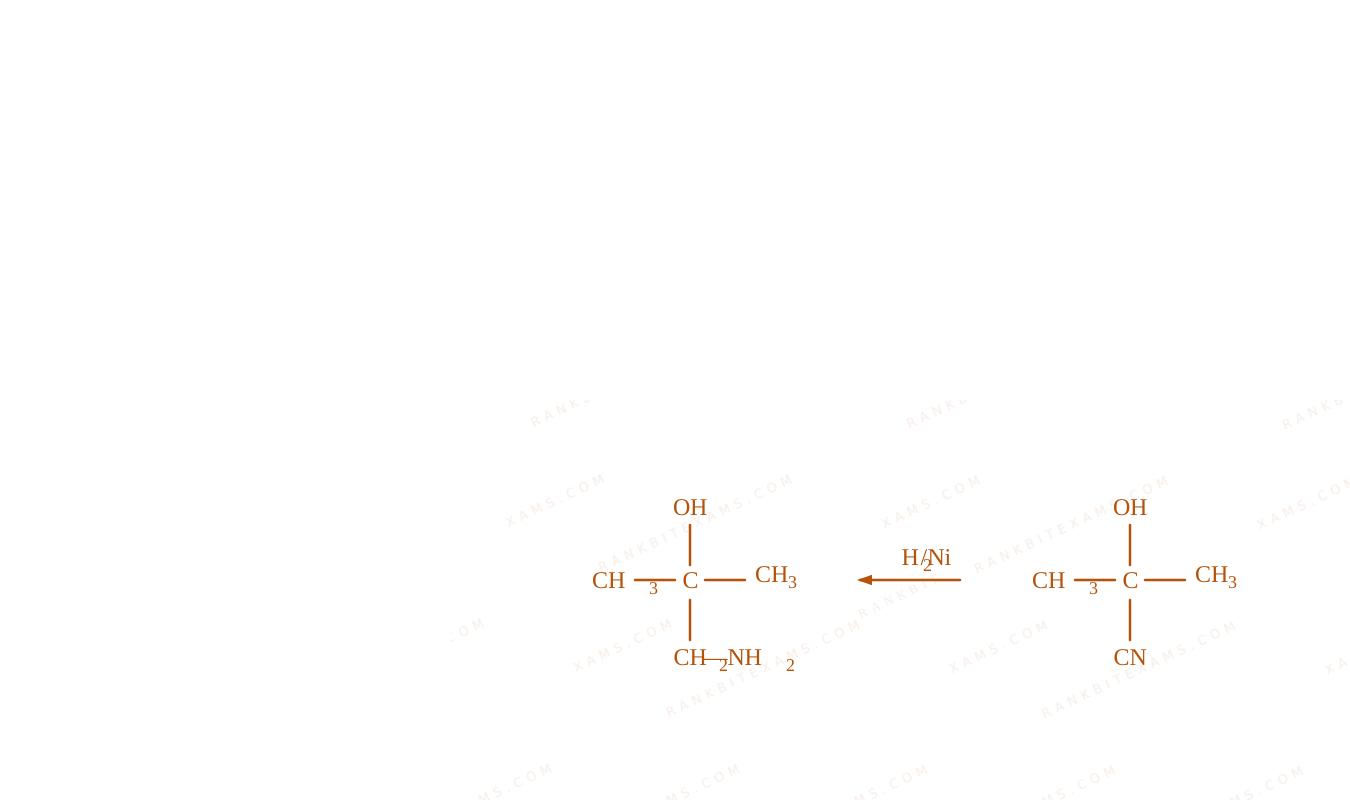
    Chemical Reactions of Ketones step sequence product chart for Q45
    Chemical Reactions of Ketones step sequence product chart for Q45

Pattern Recognition

Alkyne hydration produces a ketone carbonyl system. Cyanohydrin synthesis introduces a carbon coordinate, which subsequently reduces to a primary aliphatic amine functional group.

Chapter Mix

Class 12 Chemistry: Aldehydes, Ketones and Carboxylic Acids
Q48 jee_main_2025_24_jan_morning Reactions of Carboxylic Acids
Xg of benzoic acid on reaction with aq. NaHCO₃ release CO₂ that occupied 11.2 L volume at STP. X is ______ g.
Numerical Answer. Answer: 61 to 61

Solution

Related Formula
Moles of gas at STP = V in Liters22.4 L/mol
Core Logic

The balanced acid-base reaction equation is:

C₆H₅COOH + NaHCO₃ arrow C₆H₅COO⁻Na⁺ + H₂O + CO₂

This stoichiometry shows a 1:1 molar ratio between benzoic acid and the released carbon dioxide gas.

Calculate the total moles of evolved CO₂ gas at standard conditions:

moles of CO₂ = 11.2 L22.4 L mol⁻¹ = 0.5 moles

Thus, the reaction consumed exactly 0.5 moles of benzoic acid (C₆H₅COOH, molecular weight = 122 g/mol):

mass consumed (X) = 0.5 × 122 = 61 grams
Pattern Recognition

Carboxylic acids react with sodium bicarbonate in a straightforward 1:1 molar ratio, releasing exactly 1 mole of carbon dioxide gas per mole of acid group.

Chapter Mix

Class 12 Chemistry: Aldehydes, Ketones and Carboxylic Acids
Q37 jee_main_2025_28_jan_evening Oxidation of Alkylbenzenes
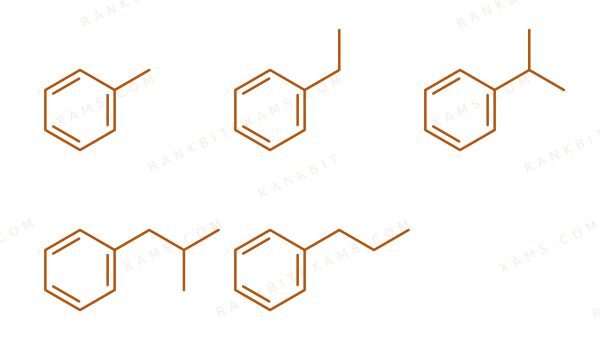
The total number of compounds from below when treated with hot KMnO₄ giving benzoic acid is:
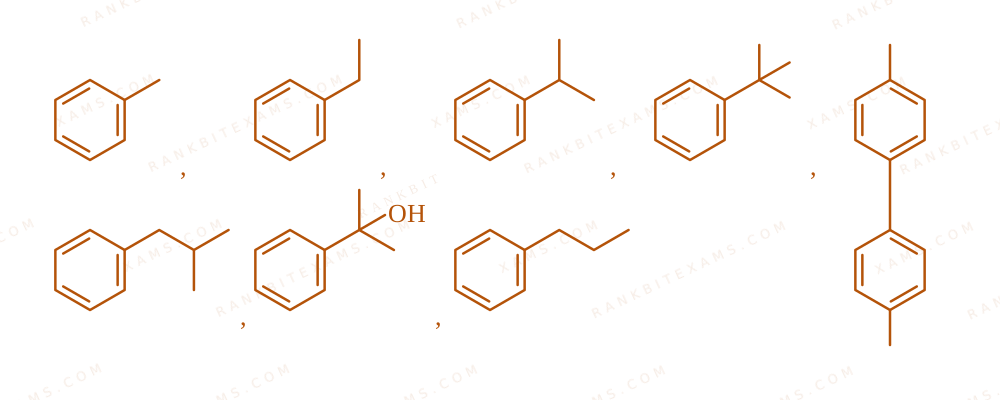
Alkylbenzene structures for Q37 - JEE Main 2025
The image lists seven distinct aromatic side-chain hydrocarbon structures to assess for side-chain oxidation.
  • A. 3
  • B. 4
  • C. 6
  • D. 5

Solution

Related Formula

Side-chain oxidation criteria:

Ar-CH(R)₂ hot KMnO₄ Ar-COOH

Requires the presence of at least one benzylic hydrogen atom on the aromatic side chain structure.

Core Logic

Alkyl side chains on a benzene ring are oxidized entirely down to a carboxylic acid group (benzoic acid) by strong oxidizing agents like hot alkaline KMnO₄, provided the benzylic carbon contains at least one hydrogen atom.

Evaluating the structures from the diagram:

  • Toluene (contains 3 benzylic H) arrow Yields benzoic acid
  • Ethylbenzene (contains 2 benzylic H) arrow Yields benzoic acid
  • Isopropylbenzene / Cumene (contains 1 benzylic H) arrow Yields benzoic acid
  • tert-Butylbenzene (contains 0 benzylic H) arrow Resists oxidation
  • Isobutylbenzene (contains 2 benzylic H) arrow Yields benzoic acid
  • 2-Phenylpropan-2-ol (contains 0 benzylic H, tertiary alcohol center) arrow Resists oxidation
  • n-Propylbenzene (contains 2 benzylic H) arrow Yields benzoic acid
  • The last biphenyl derivative undergoes complex disruption or ring cleavages and does not cleanly yield simple benzoic acid under standard monocyclic oxidation definitions.
Step 1: Counting Valid Targets

The compounds that undergo oxidation to form benzoic acid are toluene, ethylbenzene, isopropylbenzene, isobutylbenzene, and n-propylbenzene.

Total count = 5 compounds.

Structural evaluation summary for side-chain oxidation targets
The image lists seven distinct aromatic side-chain hydrocarbon structures to assess for side-chain oxidation.

Pattern Recognition

Look immediately at the benzylic carbon (the carbon bonded directly to the ring). If it is a quaternary center (like in tert-butylbenzene) or lacks a hydrogen atom entirely, mark it as unreactive to hot KMnO₄ side-chain oxidation.

Chapter Mix

Class 12 Chemistry: Aldehydes, Ketones and Carboxylic Acids

Q jee_main_2025_29_jan_morning Clemmensen Reduction
The product (P) formed in the following reaction is:
Clemmensen Reduction diagram for Q41 - JEE Main 2025 Morning
The structural flowchart indicates a multi-functional molecule treated with Zn-Hg/HCl.
  • A.
  • B.
  • C.
  • D.

Solution

Related Formula
R-CO-R' [HCl]Zn-Hg R-CH₂-R'
Core Logic

The provided reaction relies on classic Clemmensen Reduction reagent configurations (Zn-Hg / HCl). This reagent explicitly selective targets ketone/aldehyde carbonyl centers (>C=O) and converts them cleanly into methylene units (-CH₂-). Any free aliphatic alcohol functionalities (-OH) located on the ring are preserved under these reductive conditions. Thus, the ketone group on the ring is cleanly converted to -CH₂-, yielding option (3):

Clemmensen Reduction solution diagram for Q41 - JEE Main 2025 Morning
The structural flowchart indicates a multi-functional molecule treated with Zn-Hg/HCl.

Pattern Recognition

Clemmensen routes deoxygenate carbonyl clusters selectively without compromising adjacent standalone cyclic alcohol structural components.

Chapter Mix

Class 12 Chemistry: Aldehydes, Ketones and Carboxylic Acids

Q jee_main_2025_29_jan_morning Chemical Reactions of Carbonyl Compounds
Based on the reaction sequence:
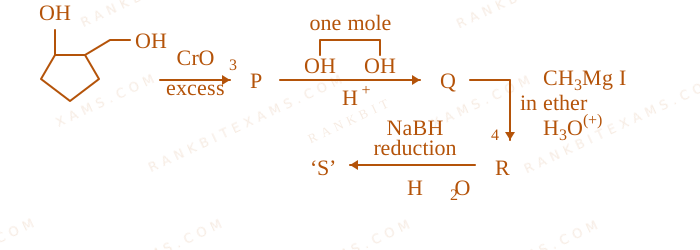
Organic synthesis reaction sequence diagram for Q50 - JEE Main 2025 Morning
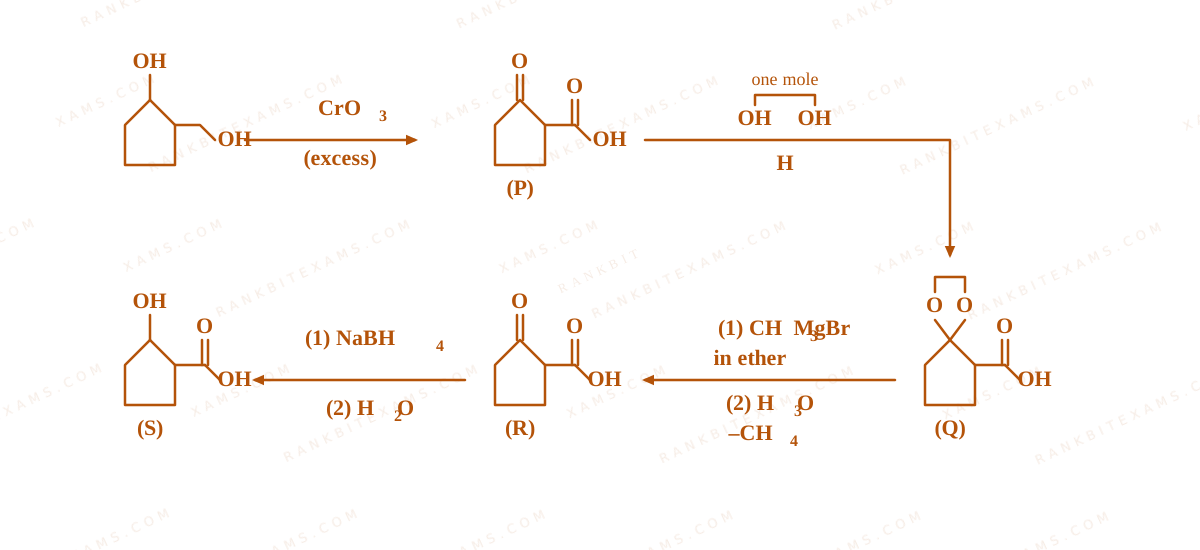
A structural flow charts the transformation of a cyclic dialcohol into final product S.
0.1 mole of compound 'S' will weigh ________ g. (Given molar mass in g mol⁻¹ C:12, H:1, O:16)
Numerical Answer. Answer: 13 to 13

Solution

Related Formula
Mass = Moles · Molar Mass
Core Logic

Let us trace the reaction scheme row-by-row:

Organic synthesis intermediate layout mapping
A structural flow charts the transformation of a cyclic dialcohol into final product S.

  • Reactant: 2-(hydroxymethyl)cyclopentan-1-ol.
  • Step 1: Excess CrO₃ (Jones oxidation) oxidizes the secondary alcohol to a ketone and the primary alcohol to a carboxylic acid arrow Product P.
  • Step 2: Reaction with 1 mole of glycol protects the ketone selectively as a cyclic ketal arrow Product Q.
  • Step 3: Treatment with CH₃MgI targets the free carboxylic acid (or ester equivalent) to form a methyl ketone after workup arrow Product R.
  • Step 4: NaBH₄ reduces the methyl ketone to a secondary alcohol, and acid workup deprotects the ketal back to the original ketone arrow Compound S.
  • Chemical structural formula of S: 2-(1-hydroxyethyl)cyclopentan-1-one (C₇H₁₂O₂).

    Molar mass of S (C₇H₁₂O₂):

M = (7 · 12) + (12 · 1) + (2 · 16) = 84 + 12 + 32 = 130 ~g/mol Mass of 0.1 mole = 0.1 · 130 = 13 ~g
Pattern Recognition

Ketal groups serve as stable protective masks that shield ketones, allowing selective organometallic reactions to take place elsewhere on the molecule.

Chapter Mix

Class 12 Chemistry: Aldehydes, Ketones and Carboxylic Acids

Rankbit System
JEE Physics: Waves (+15.5%) | Electrostatics: Concentric Shells (-29.7%) | Modern Physics: Photoelectric Clones (+34.2%) | Mathematics: Definite Integrals (+18.1%) | Chemistry: Coordination Splitting (-11.4%) | JEE Physics: Waves (+15.5%) | Electrostatics: Concentric Shells (-29.7%) | Modern Physics: Photoelectric Clones (+34.2%) | Mathematics: Definite Integrals (+18.1%) | Chemistry: Coordination Splitting (-11.4%)