JEE Main · Chemistry → Steady

Aldehydes, Ketones and Carboxylic Acids appeared 46 times across 3 years — 5.4% of Chemistry. This question is from Iodoform Test.

Year 2026 2025 2024 Total
Questions 14 21 11 46

Which among the following compounds give yellow solid when reacted with NaOI/NaOH? (A) CH₃ - CH(OH) - C₂H₅ (B) CH₃ - CH₂ - CH₂ - OH (C) CH₃ - CO - C₂H₅ (D) CH₃-CO- OH (E) CH₃ - CH₂ - CHO Choose the correct answer from the options given below:

Solution & Explanation

Related Formula
Compounds with CH₃-CH(OH)- or CH₃-CO- groups undergo the iodoform reaction to form CHI₃ (Yellow Solid)
Core Logic

Let's check the structural groups of each given option:

  • (A) CH₃ - CH(OH) - C₂H₅: Contains the methylcarbinol group (CH₃-CH(OH)-). Gives a positive iodoform test.
  • (B) CH₃ - CH₂ - CH₂ - OH: Linear primary alcohol, does not contain the required group.
  • (C) CH₃ - CO - C₂H₅: Contains the methyl ketone group (CH₃-CO-). Gives a positive iodoform test.
  • (D) CH₃ - OH: Methanol does not give the test.
  • (E) CH₃ - CH₂ - H: Ethane does not give the test.
  • Thus, only (A) and (C) yield the yellow precipitate of iodoform (CHI₃).

Step 1: Chemical Equations

The balanced haloform pathways occur as follows:

CH₃-CH(OH)-CH₂-CH₃ NaOI/NaOH CHI₃ + CH₃-CH₂-COO^-Na^+ CH₃-CO-CH₂-CH₃ NaOI/NaOH CHI₃ + CH₃-CH₂-COO^-Na^+
Pattern Recognition

The iodoform test specifically isolates methyl ketones or secondary methyl alcohols. Scan dynamically for a terminal -CH₃ affixed directly to a carbonyl oxygen index (C=O) or a hydroxyl carbon (CH-OH).

Chapter Mix

Class 12 Chemistry: Aldehydes, Ketones and Carboxylic Acids Class 12 Chemistry: Alcohols, Phenols and Ethers
More Aldehydes, Ketones and Carboxylic Acids Previous-Year Questions — Page 6

Q41 jee_main_2025_04_april_morning Chemical Properties of Ketones
An organic compound (X) with molecular formula C₃H₆O is not readily oxidised. On reduction it gives C₃H₈O (Y) which reacts with HBr to give a bromide (Z) which is converted to Grignard reagent. This Grignard reagent on reaction with (X) followed by hydrolysis gives 2, 3-dimethylbutan-2-ol. Compounds (X), (Y) and (Z) respectively are:
  • A. CH₃COCH₃, CH₃CH₂CH₂OH, CH₃CH(Br)CH₃
  • B. CH₃COCH₃, CH₃CH(OH)CH₃, CH₃CH(Br)CH₃
  • C. CH₃CH₂CHO, CH₃CH₂CH₂OH, CH₃CH₂CH₂Br
  • D. CH₃CH₂CHO, CH₃CH=CH₂, CH₃CH(Br)CH₃

Solution

Core Logic

Let's deduce the identities stepwise:

  • Compound (X) has the formula C₃H₆O and is resistant to mild oxidation, which identifies it as a ketone: Acetone (CH₃COCH₃).
  • Reduction of Acetone yields a secondary alcohol, Propan-2-ol (CH₃CH(OH)CH₃, Compound Y).
  • Treatment of Propan-2-ol with HBr substitutes the hydroxyl group to form 2-Bromopropane (CH₃CH(Br)CH₃, Compound Z).
  • Reacting 2-Bromopropane with Magnesium in ether creates the branched Grignard reagent, Isopropylmagnesium bromide ((CH₃)₂CHMgBr).
  • Finally, nucleophilic addition of this Grignard reagent to Acetone followed by aqueous workup yields the highly branched tertiary alcohol: 2,3-dimethylbutan-2-ol.
Pattern Recognition

Resistance to mild oxidation immediately distinguishes ketones from isomeric aldehydes. Nucleophilic addition of an isopropyl Grignard to acetone cleanly yields the 2,3-dimethylbutan-2-ol framework.

Chapter Mix

Class 12 Chemistry: Aldehydes, Ketones and Carboxylic Acids Class 12 Chemistry: Alcohols, Phenols and Ethers

Q30 jee_main_2025_07_april_evening Identification of Carbonyl Compounds
"P" is an optically active compound with molecular formula C₆H₁₂O. When "P" is treated with 2,4-dinitrophenylhydrazine, it gives a positive test. However, in presence of Tollens reagent, "P" gives a negative test. Predict the structure of "P".
  • A. CH₃-C(=O)-CH₂-CH₂-CH₂-CH₃
  • B. CH₃-C(=O)-CH(CH₂-CH₃)-CH₃
  • C. H-C(=O)-CH₂-CH(CH₂-CH₃)-CH₃
  • D. CH₃-C(=O)-CH₂-CH(CH₃)₂

Solution

Related Formula
Carbonyl compound + 2,4-DNP arrow Hydrazone derivative (Positive test) Aldehyde + Tollens' Reagent arrow Silver Mirror (Positive test) Ketone + Tollens' Reagent arrow No reaction (Negative test)
Core Logic

Analyzing individual functional constraints:

  • Positive 2,4-DNP test shows compound contains a carbonyl group (aldehyde or ketone).
  • Negative Tollens' test clarifies it is not an aldehyde; hence it must be a ketone.
  • The compound is optically active, meaning it must possess a chiral center (carbon with 4 distinct groups).
  • Let's evaluate the options via structural configurations:

    Identification of Carbonyl Compounds diagram for Q30 - JEE Main 2025 Evening
    Identification of Carbonyl Compounds diagram for Q30 - JEE Main 2025 Evening

    Identification of Carbonyl Compounds diagram for Q30 - JEE Main 2025 Evening
    Identification of Carbonyl Compounds diagram for Q30 - JEE Main 2025 Evening

Step 1: Structural Verification

Option (2) represents 3-methylpentan-2-one:

CH3-C(=O)- CH(CH3)(CH2CH3)

The third carbon (C3) is linked to: -H, -CH₃, -CH₂CH₃, and -COCH₃. It has 4 distinct structural fields, making it chiral and optically active.

Pattern Recognition

Tollens' negative + DNP positive = Ketone. Once categorized as a ketone, look directly for the structure holding a carbon with four unique groups to secure the optical activity constraint.

Chapter Mix

Class 12 Chemistry: Aldehydes, Ketones and Carboxylic Acids Class 11 Chemistry: Organic Chemistry - Some Basic Principles and Techniques

Q42 jee_main_2025_24_jan_evening Preparation of Aldehydes
Match List-I with List-II
List-IList-II (Name of Reaction)
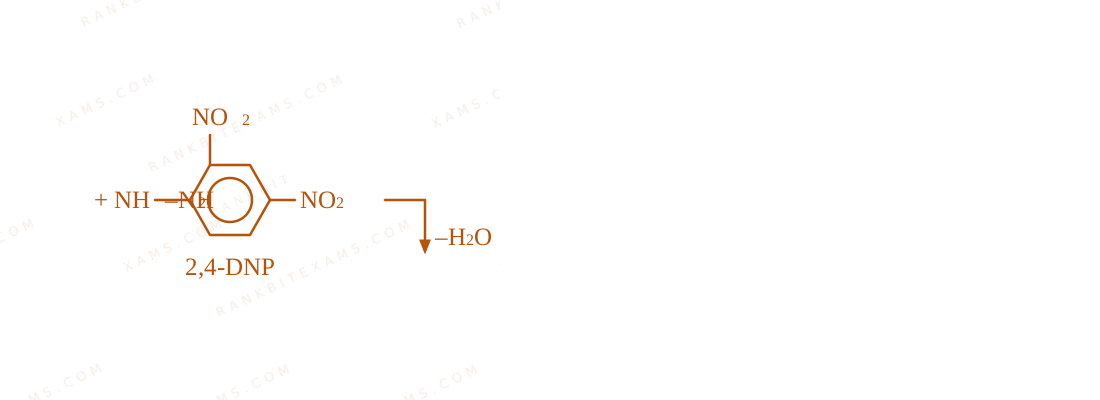
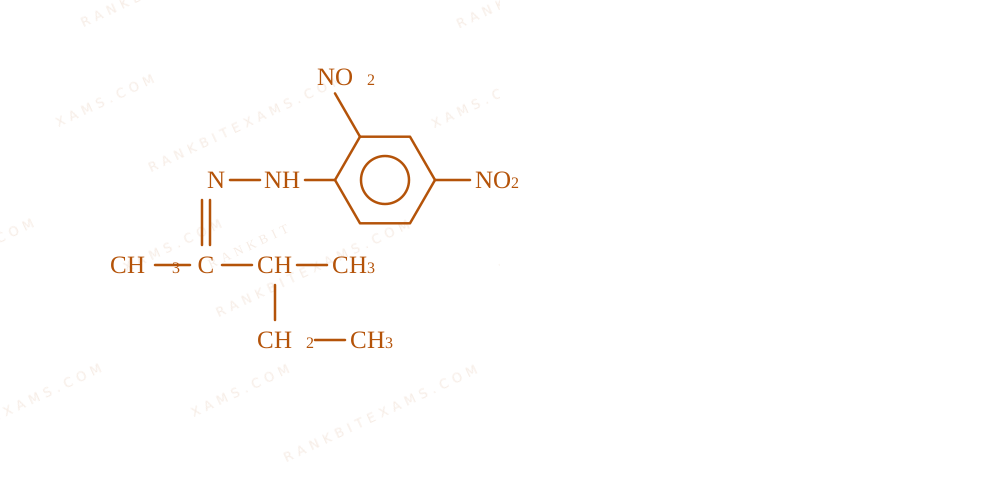
(A) RCN [(ii)H₃O⁺](i)SnCl₂, HCl RCHO(I) Etard reaction
(B)
Preparation of Aldehydes diagram for Q42 - JEE Main 2025 Evening
The Match List displays chemical transformations side-by-side with their respective named organic chemical reactions.
(II) Gatterman-Koch reaction
(C)
Preparation of Aldehydes diagram for Q42 - JEE Main 2025 Evening
The Match List displays chemical transformations side-by-side with their respective named organic chemical reactions.
(III) Rosenmund reduction
(D)
Preparation of Aldehydes diagram for Q42 - JEE Main 2025 Evening
The Match List displays chemical transformations side-by-side with their respective named organic chemical reactions.
(IV) Stephen reaction
Choose the correct answer from the options given below:
  • A. \text{(A)-(IV), (B)-(III), (C)-(I), (D)-(II)}
  • B. \text{(A)-(III), (B)-(IV), (C)-(II), (D)-(I)}
  • C. \text{(A)-(I), (B)-(III), (C)-(II), (D)-(IV)}
  • D. \text{(A)-(III), (B)-(IV), (C)-(I), (D)-(II)}

Solution

Core Logic

Let's match each aldehyde preparation method with its official named organic reaction:

  • (A) RCN arrow RCHO using SnCl₂/HCl followed by hydrolysis: This is the classic Stephen reaction arrow (IV).
  • (B) Reducing an acyl chloride (RCOCl) to an aldehyde using H₂ over Pd-BaSO₄: This partial reduction is known as the Rosenmund reduction arrow (III).
  • (C) Oxidizing toluene to benzaldehyde using chromyl chloride (CrO₂Cl₂) in CS₂: This selective oxidation method is the Etard reaction arrow (I).
  • (D) Converting benzene to benzaldehyde using CO and HCl in the presence of anhydrous AlCl₃/CuCl: This formylation process is the Gatterman-Koch reaction arrow (II).
  • Combining these assignments yields the final sequence: (A)-(IV), (B)-(III), (C)-(I), (D)-(II).

Step-by-Step Layout

The visual reaction components correspond directly to the official structural transformations:

Preparation of Aldehydes solution diagram for Q42 - JEE Main 2025 Evening
The Match List displays chemical transformations side-by-side with their respective named organic chemical reactions.
Preparation of Aldehydes solution diagram for Q42 - JEE Main 2025 Evening
The Match List displays chemical transformations side-by-side with their respective named organic chemical reactions.
Preparation of Aldehydes solution diagram for Q42 - JEE Main 2025 Evening
The Match List displays chemical transformations side-by-side with their respective named organic chemical reactions.

Pattern Recognition

Quick identification keys:

  • Nitrile arrow Aldehyde = Stephen
  • Acid Chloride arrow Aldehyde = Rosenmund
  • Toluene arrow Chromyl Complex = Etard
  • Benzene arrow Carbon Monoxide = Gatterman-Koch
Chapter Mix

Class 12 Chemistry: Aldehydes, Ketones and Carboxylic Acids

Q jee_main_2025_24_jan_morning Aldol Condensation and Ozonolysis
Aman has been asked to synthesise the molecule ring with C—CH3 (x). He thought of preparing the molecule using an aldol condensation reaction. He found a few cyclic alkenes in his laboratory. He thought of performing ozonolysis reaction on alkene to produce a dicarbonyl compound followed by aldol reaction to prepare “x”. Predict the suitable alkene that can lead to the formation of “x”.
  • A.
  • B.
  • C.
  • D.

Solution

Core Logic

Analyzing the retro-synthesis path step-by-step:

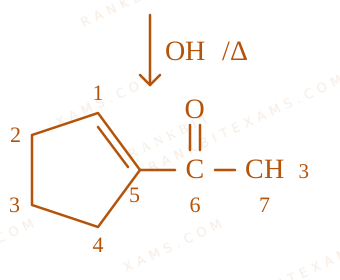
  • The objective compound is 1-acetylcyclopentene.
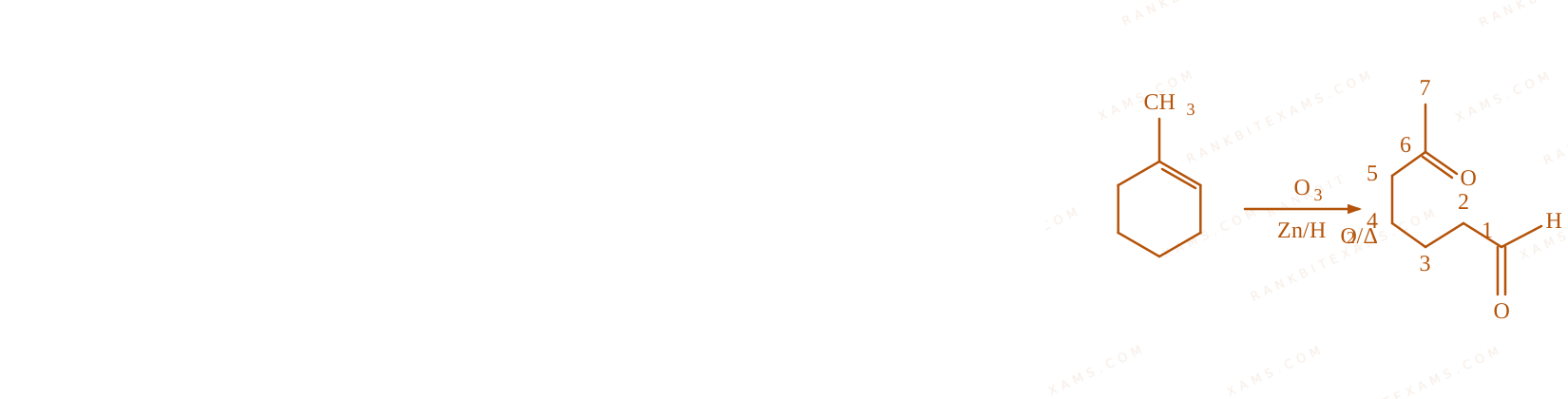
  • Performing reductive ozonolysis (O₃, Zn/H₂O) on 1-methylcyclohexene (Option A) symmetrically breaks the internal endocyclic double bond to form heptane-2,6-dione, a dicarbonyl system.
    Aldol Condensation and Ozonolysis reaction part 1 for Q41
    Aldol Condensation and Ozonolysis reaction part 1 for Q41
  • Adding a base intermediate trigger (OH⁻, Δ) drives an intramolecular aldol condensation: the methyl group carbanion at position 1 attacks the carbon 6 ketone site. This ring-closing event effectively drops water to synthesize the 5-membered cyclopentene core molecule attached to the acetyl unit.
    Aldol Condensation and Ozonolysis reaction part 1 for Q41
    Aldol Condensation and Ozonolysis reaction part 1 for Q41
Pattern Recognition

Counting carbon coordinates is essential. Reductive cleavage transforms a 6-membered ring into an open heptane system, which easily self-condenses into a stable 5-membered ring attached to a methyl ketone side chain.

Chapter Mix

Class 12 Chemistry: Aldehydes, Ketones and Carboxylic Acids

Q40 jee_main_2025_24_jan_morning Reactivity towards Nucleophilic Addition
Which of the following arrangements with respect to their reactivity in nucleophilic addition reaction is correct?
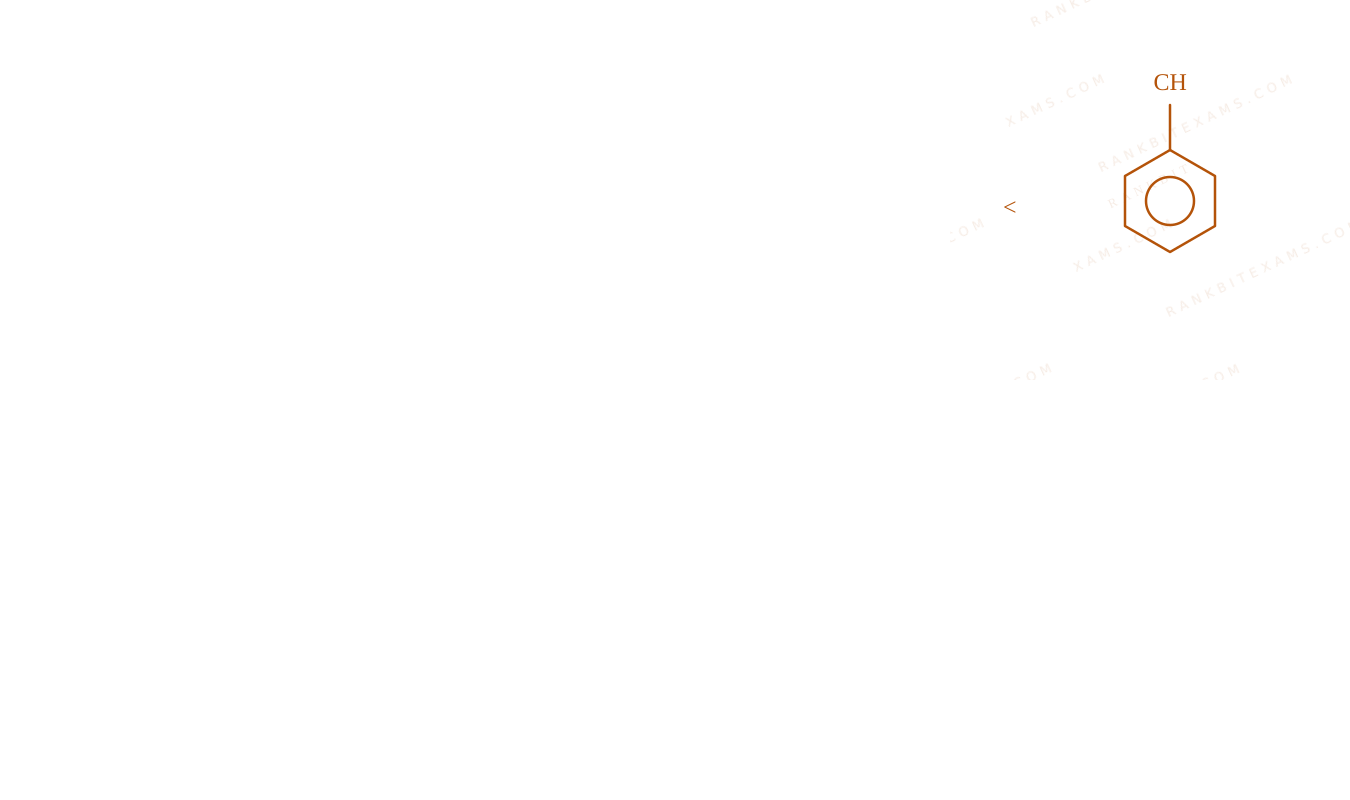
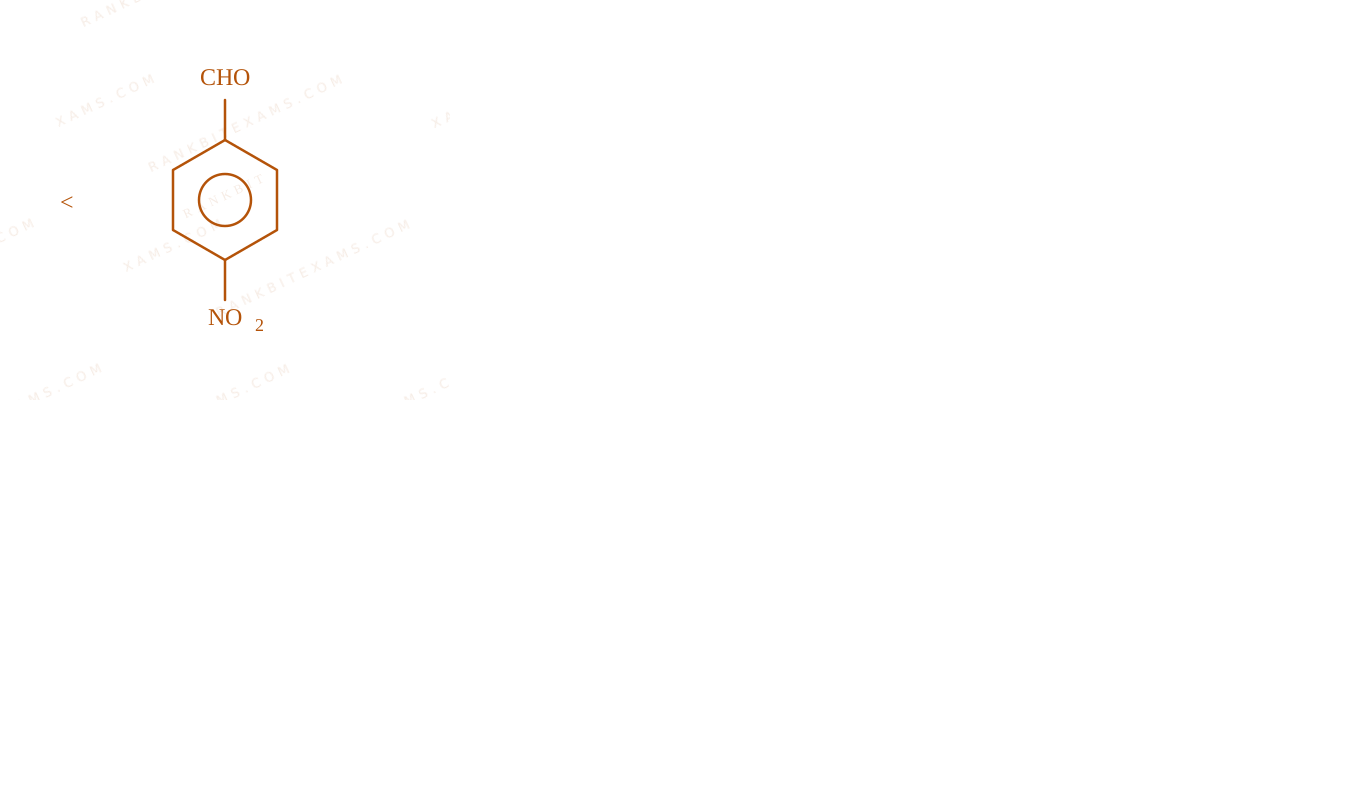
  • A. benzaldehyde < acetophenone < p-nitrobenzaldehyde < p-tolualdehyde
  • B. acetophenone < benzaldehyde < p-tolualdehyde < p-nitrobenzaldehyde
  • C. acetophenone < p-tolualdehyde < benzaldehyde < p-nitrobenzaldehyde
  • D. p-nitrobenzaldehyde < benzaldehyde < p-tolualdehyde < acetophenone

Solution

Core Logic

Reactivity in nucleophilic addition reactions is governed by a combination of steric hindrance and electronic effects around the electrophilic carbonyl carbon:

  • Ketones are significantly less reactive than aldehydes due to the bulkiness and electron-donating inductive effect (+I) of their two alkyl/aryl groups. Thus, acetophenone has the lowest reactivity.
  • For substituted benzaldehydes, electron-withdrawing groups heighten the partial positive charge on the carbonyl carbon, accelerating nucleophilic attack. Conversely, electron-donating groups suppress reactivity.
  • Symmetry breakdown structures are shown below:

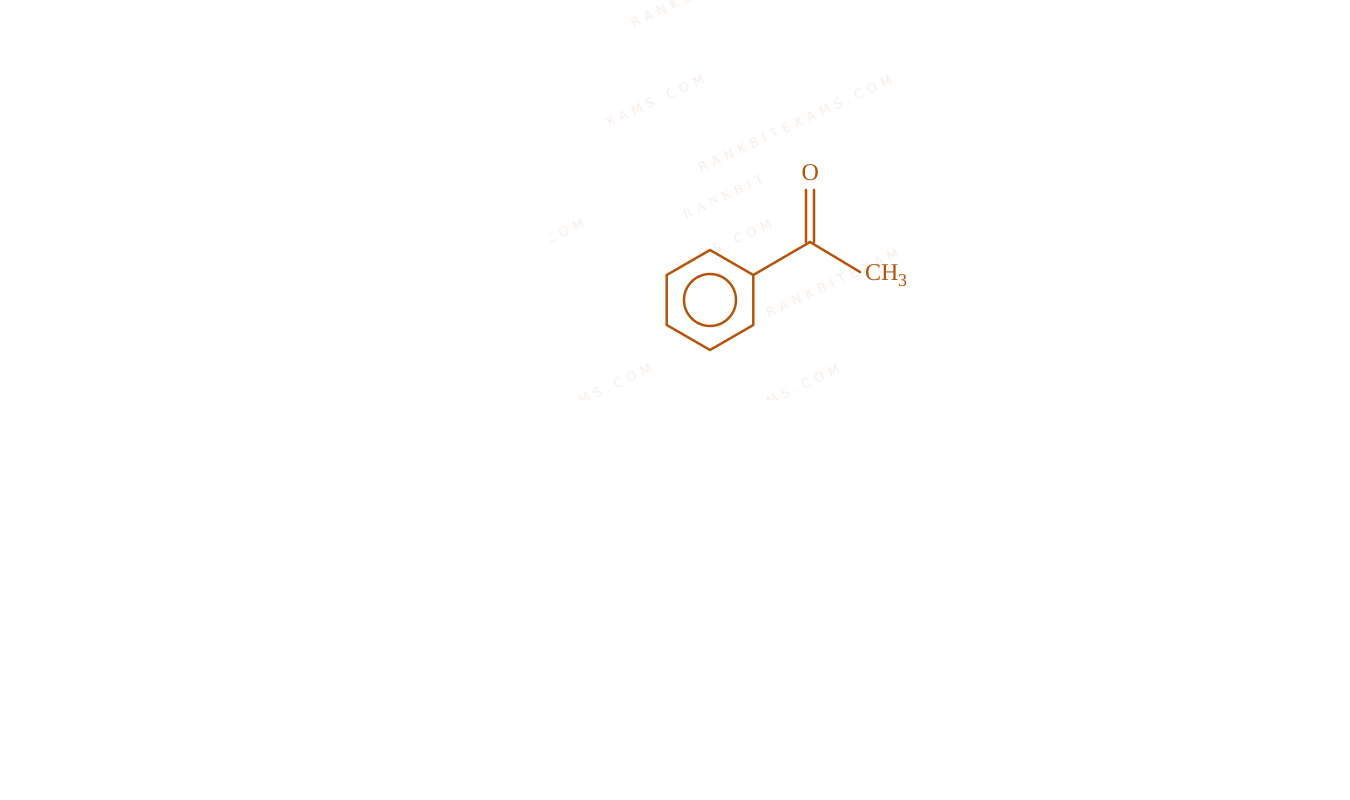
  • Acetophenone:
    Acetophenone structure for reactivity comparison
    Acetophenone structure for reactivity comparison
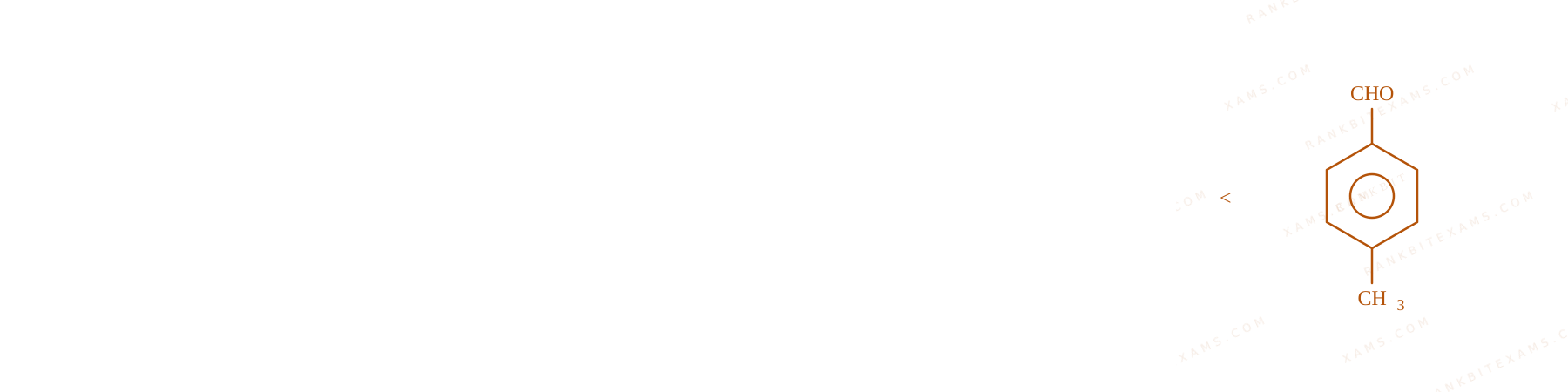
  • p-tolualdehyde:
    Acetophenone structure for reactivity comparison
    Acetophenone structure for reactivity comparison
  • Benzaldehyde:
    Acetophenone structure for reactivity comparison
    Acetophenone structure for reactivity comparison
  • p-nitrobenzaldehyde:
    Acetophenone structure for reactivity comparison
    Acetophenone structure for reactivity comparison
  • Methoxy/methyl donors decrease reactivity: p-tolualdehyde < benzaldehyde
  • Nitro group (-NO₂) acts as a strong electron-withdrawing agent via both -M and -I pathways, maximizing the electrophilic nature of the carbonyl site. Therefore, p-nitrobenzaldehyde is the most reactive.
  • Thus, the correct order of reactivity is:

acetophenone < p-tolualdehyde < benzaldehyde < p-nitrobenzaldehyde
Pattern Recognition

Aldehydes naturally exhibit higher reactivity than ketones. Electron-withdrawing groups (-NO₂) accelerate addition pathways, whereas electron-donating groups (-CH₃) impede them.

Chapter Mix

Class 12 Chemistry: Aldehydes, Ketones and Carboxylic Acids

Rankbit System
JEE Physics: Waves (+15.5%) | Electrostatics: Concentric Shells (-29.7%) | Modern Physics: Photoelectric Clones (+34.2%) | Mathematics: Definite Integrals (+18.1%) | Chemistry: Coordination Splitting (-11.4%) | JEE Physics: Waves (+15.5%) | Electrostatics: Concentric Shells (-29.7%) | Modern Physics: Photoelectric Clones (+34.2%) | Mathematics: Definite Integrals (+18.1%) | Chemistry: Coordination Splitting (-11.4%)