A person measures mass of 3 different particles as 435.42~g$435.42\mathrm{~g}$, 226.3~g$226.3\mathrm{~g}$ and 0.125~g$0.125\mathrm{~g}$. According to the rules for arithmetic operations with significant figures, the additions of the masses of 3 particles will be.
A.661.845~g$661.845\mathrm{~g}$
B.662~g$662\mathrm{~g}$
C.661.8~g$661.8\mathrm{~g}$
D.661.84~g$661.84\mathrm{~g}$
Solution & Explanation
Related Formula
Significant Figures Rule for Addition/Subtraction:
The final result must be rounded off to keep only as many decimal places as there are in the measurement with the least number of decimal places.
Core Logic
Let's look at the decimal places of each measurement:
435.42~g$435.42\mathrm{~g}$ has 2 decimal places.
226.3~g$226.3\mathrm{~g}$ has 1 decimal place.
0.125~g$0.125\mathrm{~g}$ has 3 decimal places.
The minimum number of decimal places is 1 decimal place (from 226.3~g$226.3\mathrm{~g}$).
Step 1: Addition and Rounding
First, perform the standard mathematical addition:
The digit after tenths place is 4 (4 < 5$4 < 5$), so we round down.
Net rounded sum = 661.8~g$661.8\mathrm{~g}$.
Pattern Recognition
Bust the common myth: Addition depends on the least number of decimal places, whereas multiplication/division depends on the least number of significant figures. Always distinguish between these two rules during exams!
Chapter Mix
Class 11 Physics: Units and Measurements: Error Analysis and Significant Figures
Young's Modulus: Y = (F/A)/(Δ / )$$\text{Young's Modulus: } Y = \frac{F/A}{\Delta \ell / \ell}$$Torque: τ = F · r$$\text{Torque: } \tau = F \cdot r$$Viscosity Force: F = η A (dv)/(dx)$$\text{Viscosity Force: } F = \eta A \frac{dv}{dx}$$Gravitational Force: F = (G m₁ m₂)/(r²)$$\text{Gravitational Force: } F = \frac{G m_1 m_2}{r^2}$$
Torque and energy share the identical dimensional formula ML²T⁻²$\mathrm{ML^2T^{-2}}$. Modulus and pressure share ML⁻¹T⁻²$\mathrm{ML^{-1}T^{-2}}$. Spotting these matching associations cuts solving time significantly.
Chapter Mix
Class 11 Physics: Units and Measurements
Q23jee_main_2025_29_jan_eveningCombination of Errors
A physical quantity Q$Q$ is related to four observables a, b, c, d$a, b, c, d$ as follows: Q = (ab⁴)/(cd)$Q = \frac{ab^4}{cd}$ where, a = (60 ± 3)~Pa$a = (60 \pm 3)\mathrm{~Pa}$ ; b = (20 ± 0.1)~m$b = (20 \pm 0.1)\mathrm{~m}$ ; c = (40 ± 0.2)~Nsm⁻²$c = (40 \pm 0.2)\mathrm{~Nsm}^{-2}$ and d = (50 ± 0.1)~m$d = (50 \pm 0.1)\mathrm{~m}$ , then the percentage error in Q$Q$ is (x)/(1000)$\frac{x}{1000}$ , where x =$x = $ ______.
Given that percentage error equals (x)/(1000)$\frac{x}{1000}$:
(x)/(1000) = 7.7 x = 7700$$\frac{x}{1000} = 7.7 \implies x = 7700$$
Pattern Recognition
Powers scale up error contributions via direct multiplication multipliers. The term b⁴$b^4$ contributes exactly 4 times its basic fraction error component to the compilation step.
Chapter Mix
Class 11 Physics: Units and Measurements

Q21jee_main_2025_28_jan_morningErrors in Measurement
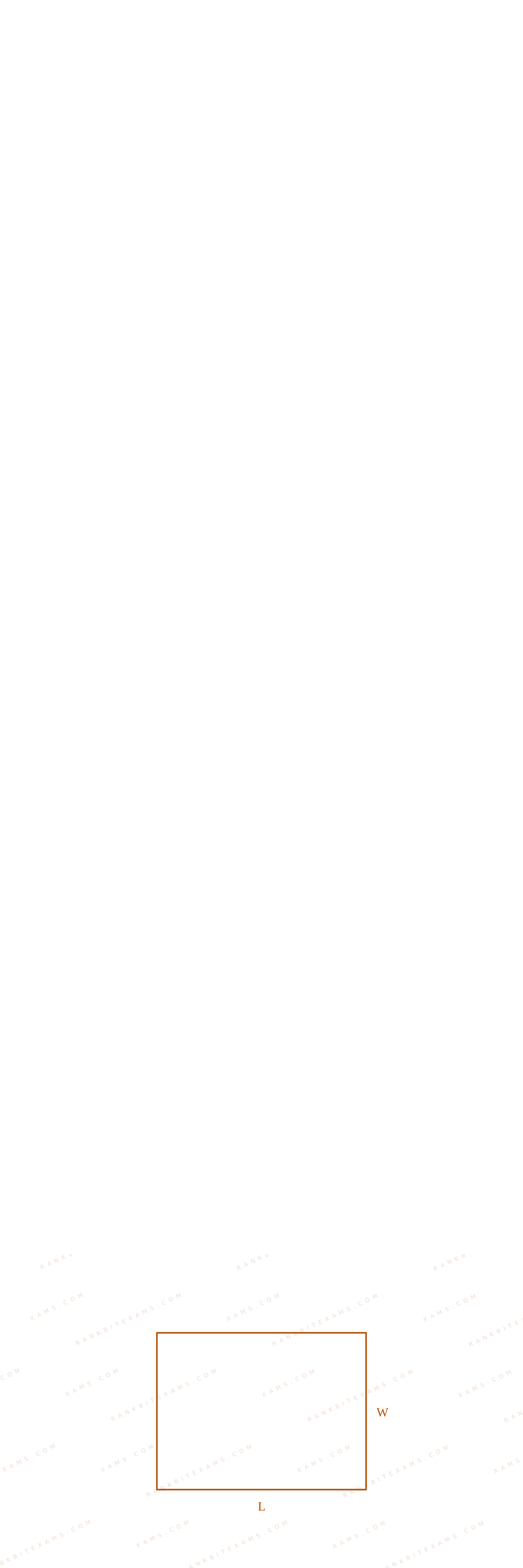
A tiny metallic rectangular sheet has length and breadth of 5 ~mm$5 \mathrm{~mm}$ and 2.5 ~mm$2.5 \mathrm{~mm}$ , respectively. Using a specially designed screw gauge which has pitch of 0.75 ~mm$0.75 \mathrm{~mm}$ and 15 divisions in the circular scale, you are asked to find the area of the sheet. In this measurement, the maximum fractional error will be x100$\frac{\mathrm{x}}{100}$ where x$\mathrm{x}$ is ________.
Numerical Answer.Answer: 3 to 3
Solution
Core Logic
First, find the least count of the measurement tool:
Least Count = PitchNumber of circular scale divisions = 0.75 ~mm15 = 0.05 ~mm$$\text{Least Count} = \frac{\text{Pitch}}{\text{Number of circular scale divisions}} = \frac{0.75 \mathrm{~mm}}{15} = 0.05 \mathrm{~mm}$$
Least count calculation tracking diagram for Q21
The area of the rectangular metallic sheet is calculated as:
A = L · W$$\mathrm{A} = \mathrm{L} \cdot \mathrm{W}$$
Expressing the absolute error via fractional configuration parts:
Comparing this to the target format x100$\frac{\mathrm{x}}{100}$ gives:
x = 3$\mathrm{x} = 3$
Pattern Recognition
The absolute measurement uncertainty matches the instrument's least count value directly. Sum up individual fractional errors to compute the total area uncertainty parameter.
In a measurement, it is asked to find modulus of elasticity per unit torque applied on the system. The measured quantity has dimension of [MaLbTc]$\left[\mathrm{M}^{\mathrm{a}}\mathrm{L}^{\mathrm{b}}\mathrm{T}^{\mathrm{c}}\right]$ . If b = 3$b = 3$ , the value of c$c$ is
Numerical Answer.Answer: 0 to 0
Solution
Core Logic
Let's find the dimensional formula for the ratio of Modulus of Elasticity to Torque:
Comparing this output to the target layout formula [Ma Lb Tc]$[\mathrm{M}^{\mathrm{a}} \mathrm{L}^{\mathrm{b}} \mathrm{T}^{\mathrm{c}}]$:
c = 0$\mathrm{c} = 0$
Pattern Recognition
Both dimensions share identical time dependence factors (T⁻²$\mathrm{T}^{-2}$), meaning they cancel out completely. This leaves the time exponent value as exactly zero.
To save precious exam time on match-the-column questions, start with the easiest dimensional terms first. You know Acceleration due to gravity is g arrow [LT⁻²]$g \rightarrow [LT^{-2}]$ (D-I) and energy is [ML²T⁻²]$[ML^2T^{-2}]$ (B-III). Looking at the options, only Option 1 matches this sequence immediately!
Chapter Mix
Class 11 Physics: Units and Measurements
Class 11 Physics: Gravitation
More Units and Measurements Questions — jee_main_2025_03_april_morning
Practice past-year questions one chapter at a time. Pick an exam → subject → chapter and get every PYQ for that topic — pulled together from all past papers — with the chapter's key formulas alongside.