Related Formula
First Law of Thermodynamics:
Δ Q = Δ U + Wby gas$$\Delta Q = \Delta U + W_{\text{by gas}}$$
Work done by an ideal gas during isothermal expansion:
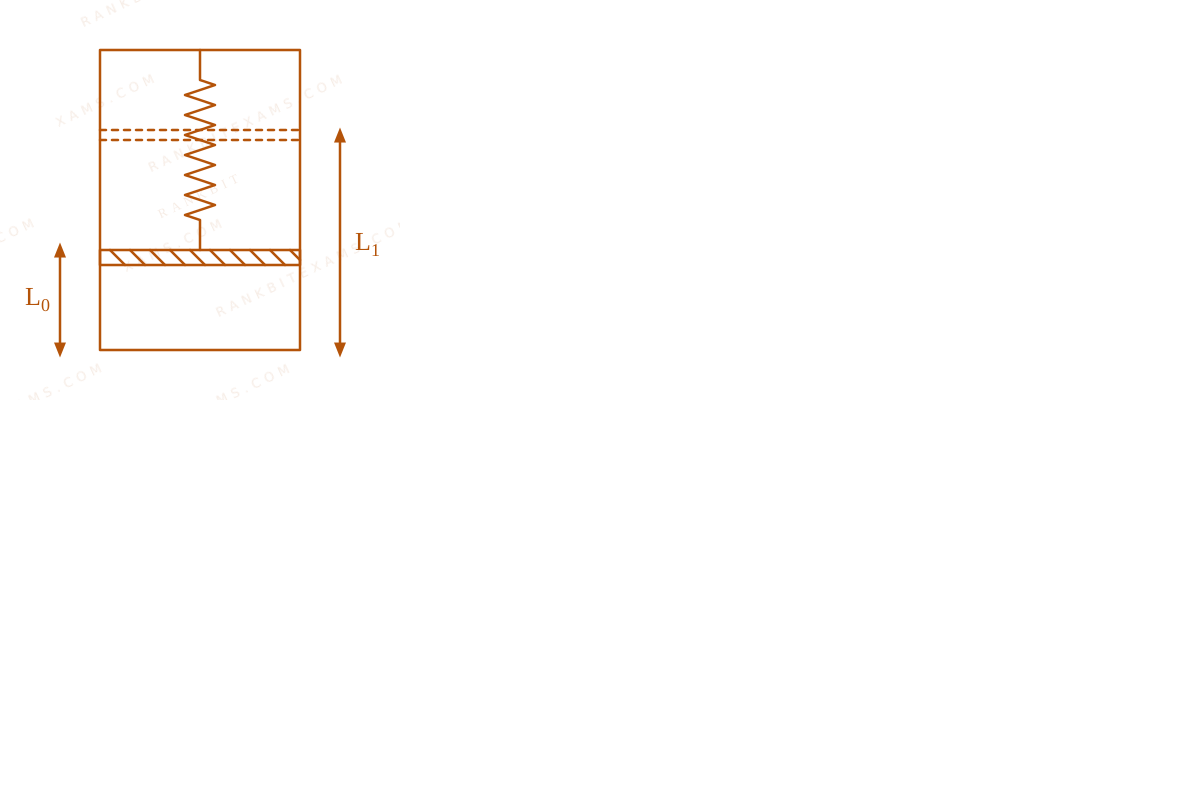
Wgas = nRTln((V₁)/(V₀)) = nRTln((L₁)/(L₀))$$W_{\text{gas}} = nRT\ln\left(\frac{V_1}{V_0}\right) = nRT\ln\left(\frac{L_1}{L_0}\right)$$
Conservation of Energy (Work-Energy Theorem):
Total energy delivered by the heating filament (Wfilament$W_{\text{filament}}$) must equal the total work needed to lift the piston against gravity and compress the non-linear spring.
Core Logic
Since the process is isothermal, the change in internal energy of the ideal gas is zero (Δ U = 0$\Delta U = 0$). Hence:
Q = Wgas$$Q = W_{\text{gas}}$$
By the Work-Energy Theorem for the piston:
Wgas + Wfilament = Δ Ugravity + Δ Uspring$$W_{\text{gas}} + W_{\text{filament}} = \Delta U_{\text{gravity}} + \Delta U_{\text{spring}}$$
Let's evaluate each term:
- Increase in gravitational potential energy:
Δ Ugravity = Mg(L₁ - L₀)$$\Delta U_{\text{gravity}} = Mg(L_1 - L_0)$$
- Increase in spring potential energy:
Uspring = -∫L₀L₁ Frestoring dx = ∫L₀L₁ kx³ dx = (k)/(4)(L₁⁴ - L₀⁴)$$U_{\text{spring}} = -\int_{L_0}^{L_1} F_{\text{restoring}}\,dx = \int_{L_0}^{L_1} kx^3\,dx = \frac{k}{4}(L_1^4 - L_0^4)$$
Step 1: Finding Total Energy Delivered
Isolating Wfilament$W_{\text{filament}}$ (the net external energy delivered to the gas system):
Wfilament = Wgas + Mg(L₁ - L₀) + (k)/(4)(L₁⁴ - L₀⁴)$$W_{\text{filament}} = W_{\text{gas}} + Mg(L_1 - L_0) + \frac{k}{4}(L_1^4 - L_0^4)$$
Since Wgas = nRTln((L₁)/(L₀))$W_{\text{gas}} = nRT\ln\left(\frac{L_1}{L_0}\right)$:
Wfilament = nRTln((L₁)/(L₀)) + Mg(L₁ - L₀) + (k)/(4)(L₁⁴ - L₀⁴)$$W_{\text{filament}} = nRT\ln\left(\frac{L_1}{L_0}\right) + Mg(L_1 - L_0) + \frac{k}{4}(L_1^4 - L_0^4)$$
Pattern Recognition
Notice how energy conservation instantly frames this complex thermodynamics question. The heating filament's energy simply goes into three distinct stores: the isothermal work of gas expansion, raising the mass against gravity (Mgh$Mgh$), and the potential energy of the spring (integrated from kx³$kx^3$). Keeping this total energy ledger in mind prevents tedious mathematical tangents.
Chapter Mix
Class 11 Physics: Thermodynamics: First Law
Class 11 Physics: Work, Energy and Power: Variable Force Integration