Rankbit System
JEE Physics: Waves (+15.5%) | Electrostatics: Concentric Shells (-29.7%) | Modern Physics: Photoelectric Clones (+34.2%) | Mathematics: Definite Integrals (+18.1%) | Chemistry: Coordination Splitting (-11.4%) | JEE Physics: Waves (+15.5%) | Electrostatics: Concentric Shells (-29.7%) | Modern Physics: Photoelectric Clones (+34.2%) | Mathematics: Definite Integrals (+18.1%) | Chemistry: Coordination Splitting (-11.4%)

During the melting of a slab of ice at 273mathrm~K at atmospheric pressure:

Solution & Explanation

### Related Formula Delta U = Delta Q + Delta W_texton system where, Delta U = change in internal energy, Delta Q = heat exchange, Delta W_texton system = work done on the system. ### Core Logic During the melting of ice at 273mathrm~K, the density of water is higher than the density of ice. This means the volume of the ice-water system decreases during melting: V_f < V_i implies Delta V < 0 Since the system contracts, the atmosphere performs positive work on it: W_texton system = -P Delta V > 0 Additionally, heat is absorbed by the system to melt the ice, so Delta Q > 0. By the first law of thermodynamics, since both Delta Q and Delta W_texton system are positive, the internal energy of the system increases: Delta U = Delta Q + W_texton system > 0 ### Step 1: Evaluation of Options Let's check the given options: 1. Internal energy remains unchanged rightarrow False (it increases). 2. Positive work is done by the system rightarrow False (work done by the system is negative since it contracts). 3. Internal energy decreases rightarrow False. 4. Positive work is done on the ice-water system by the atmosphere rightarrow True (since volume decreases under atmospheric pressure). ### Pattern Recognition Remember: Ice contracts upon melting (unlike most solids). Shrinking volume (V downarrow) under positive pressure (P > 0) means the surroundings (atmosphere) compress it, performing positive work on the system. ### Evaluation Rubric / Model Answer null ### Chapter Mix Class 11 Physics: Thermal Properties of Matter Class 11 Physics: Thermodynamics

Reference Study Guides

More Thermodynamics Previous-Year Questions — Page 2

Q48 2025 Bomb Calorimetry and Heat of Combustion
A sample of n-octane (1.14mathrm~g) was completely burnt in excess of oxygen in a bomb calorimeter, whose heat capacity is 5mathrm~kJ~K^-1. As a result of combustion reaction, the temperature of the calorimeter is increased by 5 K. The magnitude of the heat of combustion of octane at constant volume is ________ mathrmkJ~mol^-1. (nearest integer)
Numerical Answer. Answer: 2500 to 2500

Solution

### Related Formula Heat released at constant volume (q_v) in a bomb calorimeter is: q_v = C_textcal cdot Delta T Molar heat of combustion at constant volume (Delta U_textcomb): Delta U_textcomb = fracq_vn_textfuel ### Core Logic Given parameters: - Mass of n-octane m = 1.14mathrm~g - Heat capacity of calorimeter C_textcal = 5mathrm~kJ/K - Temperature rise Delta T = 5mathrm~K - Formula of octane: mathrmC_8H_18 Rightarrow Molar mass = 8(12) + 18(1) = 114mathrm~g/mol ### Step 1: Calculate heat absorbed by the calorimeter (q_v) q_v = 5mathrm~kJ/K times 5mathrm~K = 25mathrm~kJ ### Step 2: Calculate moles of octane n = frac1.14mathrm~g114mathrm~g/mol = 0.01mathrm~mol ### Step 3: Calculate molar heat of combustion Delta U_textcomb = frac25mathrm~kJ0.01mathrm~mol = 2500mathrm~kJ/mol The magnitude of the heat of combustion is 2500\mathrm{~kJ~mol^{-1}}. ### Pattern Recognition A bomb calorimeter operates at rigid constant volume, meaning boundary work w = 0. Thus, by the first law of thermodynamics, the measured heat flow represents the internal energy change (\Delta U), not the enthalpy change (\Delta H$, which occurs at constant pressure). ### Evaluation Rubric / Model Answer null ### Chapter Mix Class 11 Chemistry: Thermodynamics
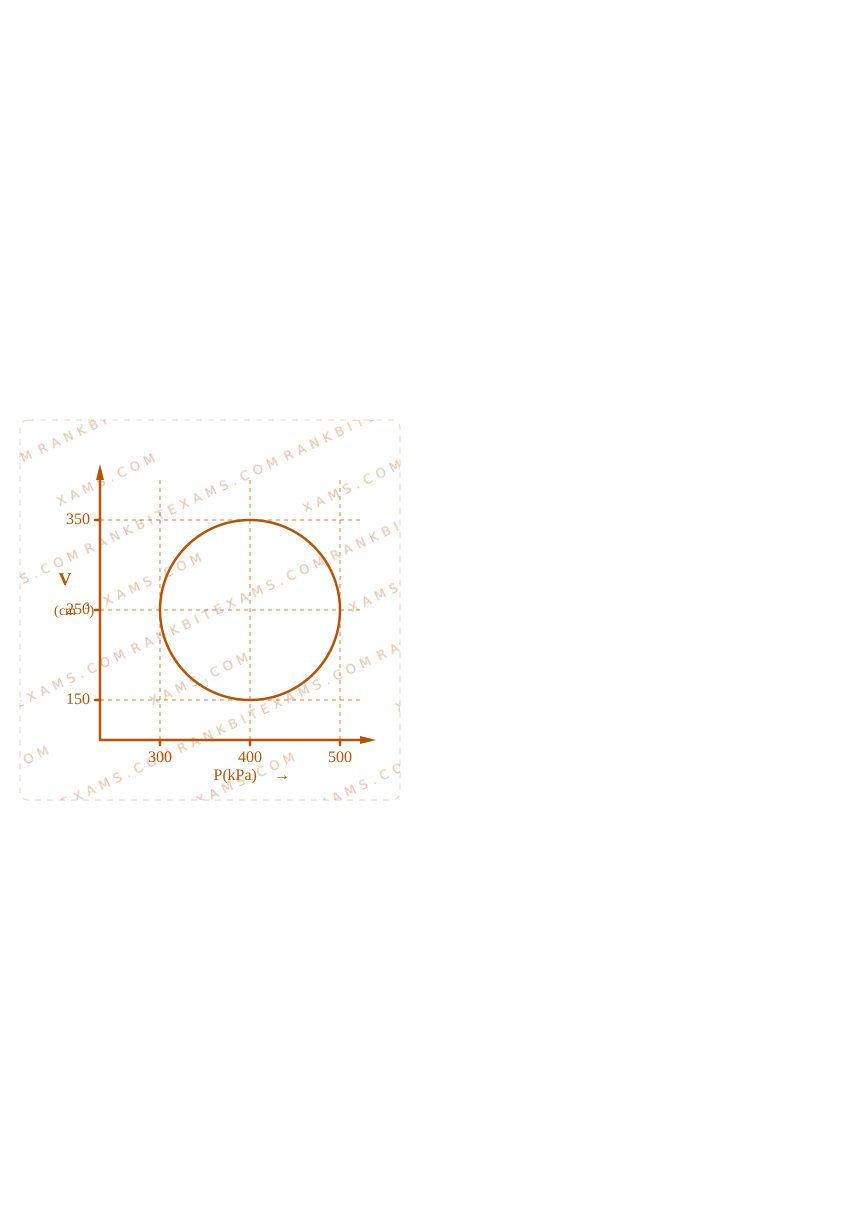
Q25 2025 Work Done in Thermodynamic Processes
An ideal gas has undergone through the cyclic process as shown in the figure. Work done by the gas in the entire cycle is times 10^-1 J. (Take pi = 3.14 )
Elliptical thermodynamic cycle on PV plane for Q25 - JEE Main 2025 Morning
A cycle plot in which the volume lies in cm^3 (150 to 350) and pressure is in kPa (300 to 500), forming an ellipse.
Numerical Answer. Answer: 314 to 314

Solution

### Related Formula The work done W in a cyclic thermodynamic process is equal to the area enclosed by the loop on a Pressure-Volume (P-V) diagram: W = textArea of Closed Loop For an ellipse with semi-major axis a and semi-minor axis b: textArea = pi a b ### Core Logic Determine the semi-axes of the elliptical cycle on the P-V plane: - On the Pressure axis (x-axis): a = fracP_textmax - P_textmin2 = frac500 - 3002 mathrm~kPa = 100 mathrm~kPa = 10^5 mathrm~Pa - On the Volume axis (y-axis): b = fracV_textmax - V_textmin2 = frac350 - 1502 mathrm~cm^3 = 100 mathrm~cm^3 = 100 times 10^-6 mathrm~m^3 = 10^-4 mathrm~m^3 ### Step 1: Calculate Area Substitute a and b in standard SI units into the area equation: W = pi a b = 3.14 times (10^5 mathrm~Pa) times (10^-4 mathrm~m^3) W = 3.14 times 10 = 31.4 mathrm~J Express in terms of times 10^-1 mathrm~J: W = 314 times 10^-1 mathrm~J Thus, the multiplier is 314. ### Pattern Recognition Sees: Circular/elliptical thermodynamic cycle. Shortcut: Work done is always pi Delta P Delta V / 4. Simply compute the semi-axes difference 100 mathrm~kPa and 100 mathrm~cm^3 and multiply by pi directly, keeping tracking of metric prefixes (10^3 times 10^-6 = 10^-3). ### Evaluation Rubric / Model Answer null ### Chapter Mix Class 11 Physics: Thermodynamics
Q5 2025 Specific Heat Capacity
Water falls from a height of 200mathrm~m into a pool. Calculate the rise in temperature of the water assuming no heat dissipation from the water in the pool. (Take g = 10mathrm~m/s^2, specific heat of water = 4200mathrm~J/(kgcdot K))
  • A. 0.23mathrm~K
  • B. 0.36mathrm~K
  • C. 0.14mathrm~K
  • D. 0.48mathrm~K

Solution

### Related Formula Delta U = mgh quad textand quad Q = msDelta T By conservation of energy (assuming all potential energy goes into heating the water): mgh = msDelta T implies Delta T = fracghs where, g = acceleration due to gravity h = height of the fall s = specific heat of water Delta T = rise in temperature ### Core Logic Given parameters: - h = 200mathrm~m - g = 10mathrm~m/s^2 - s = 4200mathrm~J/(kgcdot K) Substitute the values to find Delta T: Delta T = frac10 times 2004200 = frac20004200 Delta T = frac1021 approx 0.476mathrm~K approx 0.48mathrm~K ### Pattern Recognition Sees: "Water falling from height h raises temperature" → Mass cancels out. Delta T = fracghs. Shortcut: Always use SI units (s_textwater = 4200mathrm~J/kgcdot K is given; if given in mathrmcal/gcdot^circ C, convert using 1mathrm~cal = 4.184mathrm~J). ✓ ### Evaluation Rubric / Model Answer null ### Chapter Mix Class 11 Physics: Thermodynamics Class 11 Physics: Work, Energy and Power
Q11 2025 Thermodynamic Processes
A monoatomic gas having gamma = frac53 is stored in a thermally insulated container and the gas is suddenly compressed to left(frac18right)^mathrmth of its initial volume. The ratio of final pressure and initial pressure is: (gamma is the ratio of specific heats of the gas at constant pressure and at constant volume)
  • A. 16
  • B. 40
  • C. 32
  • D. 28

Solution

### Related Formula P_i V_i^gamma = P_f V_f^gamma where, P_i, P_f = initial and final pressures V_i, V_f = initial and final volumes gamma = adiabatic exponent ### Core Logic Since the gas is stored in a "thermally insulated container" and is compressed "suddenly", the process is **adiabatic**. From the adiabatic relation: fracP_fP_i = left(fracV_iV_fright)^gamma Given: - V_f = frac18 V_i implies fracV_iV_f = 8 - gamma = frac53 ### Step 1: Computation Substitute the values to find the pressure ratio: fracP_fP_i = (8)^5/3 = left(2^3right)^5/3 fracP_fP_i = 2^5 = 32 ### Pattern Recognition Sees: "suddenly compressed" or "thermally insulated container" → Adiabatic process. Shortcut: P V^gamma = textconstant. Since the volume goes down by 8 times, the pressure increases by 8^gamma = 8^5/3 = 32 times. ✓ ### Evaluation Rubric / Model Answer null ### Chapter Mix Class 11 Physics: Thermodynamics
Q 2025 Isothermal and Adiabatic Processes
Given below are two statements. One is labelled as Assertion (A) and the other is labelled as Reason (R).

**Assertion** (A): With the increase in the pressure of an ideal gas, the volume falls off more rapidly in an isothermal process in comparison to the adiabatic process.

Reason (R): In isothermal process, PV = textconstant, while in adiabatic process PV^gamma = textconstant. Here gamma is the ratio of specific heats, P is the pressure and V is the volume of the ideal gas.

In the light of the above statements, choose the correct answer from the options given below:
  • A. textBoth (A) and (R) are true but (R) is NOT the correct explanation of (A)
  • B. text(A) is true but (R) is false
  • C. textBoth (A) and (R) are true and (R) is the correct explanation of (A)
  • D. text(A) is false but (R) is true

Solution

### Related Formula left(fracdPdVright)_textisothermal = -fracPV left(fracdPdVright)_textadiabatic = -gamma fracPV ### Core Logic The slope of an adiabatic process on a P-V diagram is gamma times steeper than that of an isothermal process: left|left(fracdPdVright)_textadiabaticright| > left|left(fracdPdVright)_textisothermalright|
Isothermal and Adiabatic Processes diagram for Q2 - JEE Main 2025 Evening
When pressure increases (compression), the volume drops. Because the adiabatic curve is steeper, the pressure rises more rapidly for a given drop in volume, or conversely, for a specified increase in pressure, the volume falls off more rapidly in the isothermal process than the adiabatic process. Hence, Assertion (A) is true. Reason (R) states the governing equations PV = C and PV^gamma = C, which directly lead to these slope expressions via differentiation. Thus, Reason (R) is true and correctly explains Assertion (A). ### Pattern Recognition Adiabatic curves are steeper than isothermal curves on a P-V diagram because gamma > 1. For any expansion or compression process, remember that slope magnitude satisfies textSlope_textadi = gamma cdot textSlope_textiso. ### Evaluation Rubric / Model Answer null ### Chapter Mix Class 11 Physics: Thermodynamics

More Thermodynamics Questions — jee_main_2025_03_april_morning

Practice all Thermodynamics previous-year questions →

YOUR FIRST PREP STEP STARTS HERE

We Map Every Repeating Question in Competitive Exams.

Say goodbye to generic mock test fatigue. RankBit uses smart analysis to group past exam questions into their foundational Repeating Question Types. Find chapter weightage, track repeating questions, and score higher with targeted practice.

Select Your Target Exam

Choose an exam track below to find formulas per chapter and patterns.

Syncing Exam Intelligence

Mapping formulas and patterns across all tracks…

PATH A — FULL LENGTH PRACTICE

Full Mock Test Hub

Simulate real NTA exam conditions with fully tracked mocks. Time yourself against past papers.

Under Development
PATH B — TARGETED PRACTICE

Topic-wise Practice Hub

Practice past-year questions one chapter at a time. Pick an exam → subject → chapter and get every PYQ for that topic — pulled together from all past papers — with the chapter's key formulas alongside.

Loading Questions... Browse Topics
Latest from the Blog
View all →

Loading articles...