JEE Main · Physics → Steady

Thermodynamics appeared 36 times across 3 years — 4.2% of Physics. This question is from Adiabatic Compression.

Year 2026 2025 2024 Total
Questions 11 19 6 36

A gas is kept in a container having walls which are thermally non-conducting. Initially the gas has a volume of 800~cm³ and temperature 27°C . The change in temperature when the gas is adiabatically compressed to 200~cm³ is: (Take γ = 1.5)

Solution & Explanation

Related Formula

For an adiabatic process:

T Vγ - 1 = constant

where, T = absolute temperature in Kelvin, V = volume of the gas, γ = adiabatic exponent.

Core Logic

Given values:

  • Initial volume, V₁ = 800~cm³
  • Final volume, V₂ = 200~cm³
  • Initial temperature, T₁ = 27°C = 27 + 273 = 300~K
  • Adiabatic exponent, γ = 1.5 γ - 1 = 0.5
Step 1: Calculating Final Temperature

Apply the adiabatic relation:

T₁ V₁γ - 1 = T₂ V₂γ - 1 T₂ = T₁ ((V₁)/(V₂))γ - 1

Substitute the values:

T₂ = 300 ((800)/(200))0.5 = 300 × (4)0.5 T₂ = 300 × 2 = 600~K
Step 2: Calculating Change in Temperature

Now compute the change in temperature (Δ T):

Δ T = T₂ - T₁ = 600~K - 300~K = 300~K
Pattern Recognition

Always read carefully to see if the question asks for the final temperature or the change in temperature. Many students lose marks by choosing 600~K (the final temperature) instead of the difference 300~K! Stay sharp.

Chapter Mix

Class 11 Physics: Thermodynamics

Reference Study Guides

More Thermodynamics Previous-Year Questions — Page 8

Q jee_main_2024_31_jan_morning Isobaric Process
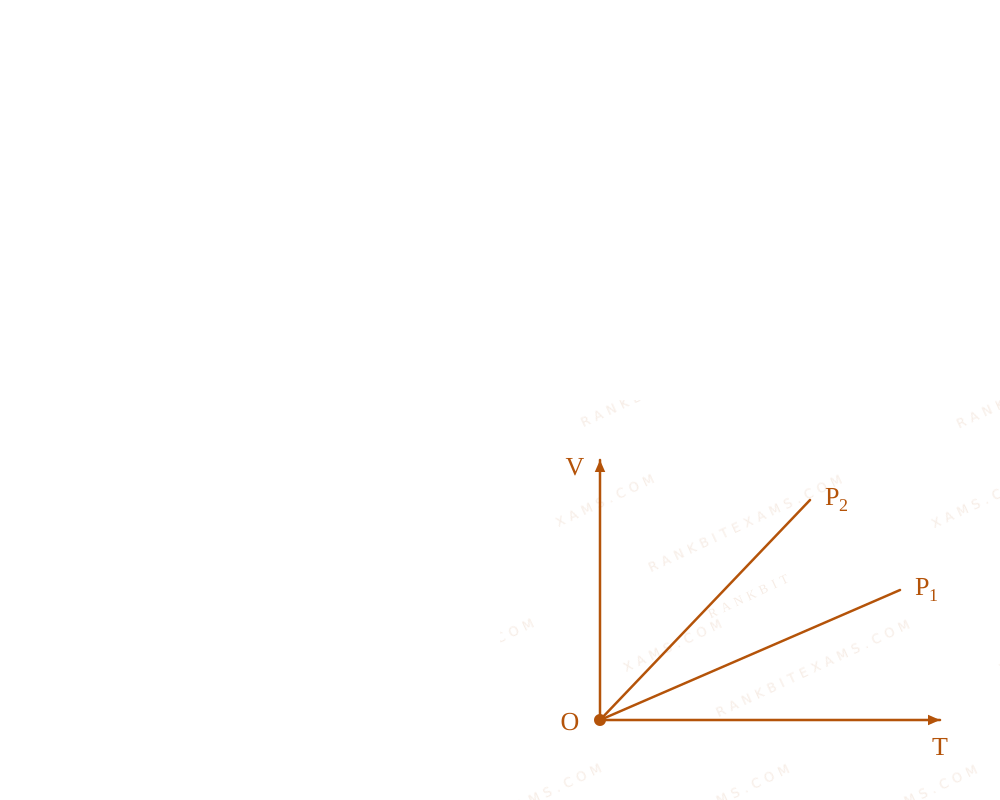
The given figure represents two isobaric processes for the same mass of an ideal gas, then
Isobaric Process diagram for Q38 - JEE Main 2024 Morning
A Volume vs Temperature (V-T) graph showing two straight lines starting from the origin representing distinct constant pressures P1 and P2.
  • A. P₂≥ P₁
  • B. P₂ > P₁
  • C. P₁ = P₂
  • D. P₁ > P₂

Solution

Related Formula

PV = nRT

Core Logic

From the Ideal Gas Law:

V = ((nR)/(P)) T

In a V-T graph, the equation of the line represents y = mx, where the slope m is:

Slope = (nR)/(P) Slope ∝ (1)/(P)

Thus, a higher slope corresponds to a lower pressure.

Step 2: Compare Slopes

From the given figure, the slope of line 2 is greater than the slope of line 1:

(Slope)₂ > (Slope)₁

Therefore, inversely: P₂ < P₁ or P₁ > P₂.

Pattern Recognition

In V-T graphs, steeper lines mean lower Pressure. In P-T graphs, steeper lines mean lower Volume. It's an inverse inverse slope relationship.

Chapter Mix

Class 11 Physics: Thermodynamics

More Thermodynamics Questions — jee_main_2025_03_april_morning

Practice all Thermodynamics previous-year questions →

Rankbit System
JEE Physics: Waves (+15.5%) | Electrostatics: Concentric Shells (-29.7%) | Modern Physics: Photoelectric Clones (+34.2%) | Mathematics: Definite Integrals (+18.1%) | Chemistry: Coordination Splitting (-11.4%) | JEE Physics: Waves (+15.5%) | Electrostatics: Concentric Shells (-29.7%) | Modern Physics: Photoelectric Clones (+34.2%) | Mathematics: Definite Integrals (+18.1%) | Chemistry: Coordination Splitting (-11.4%)