
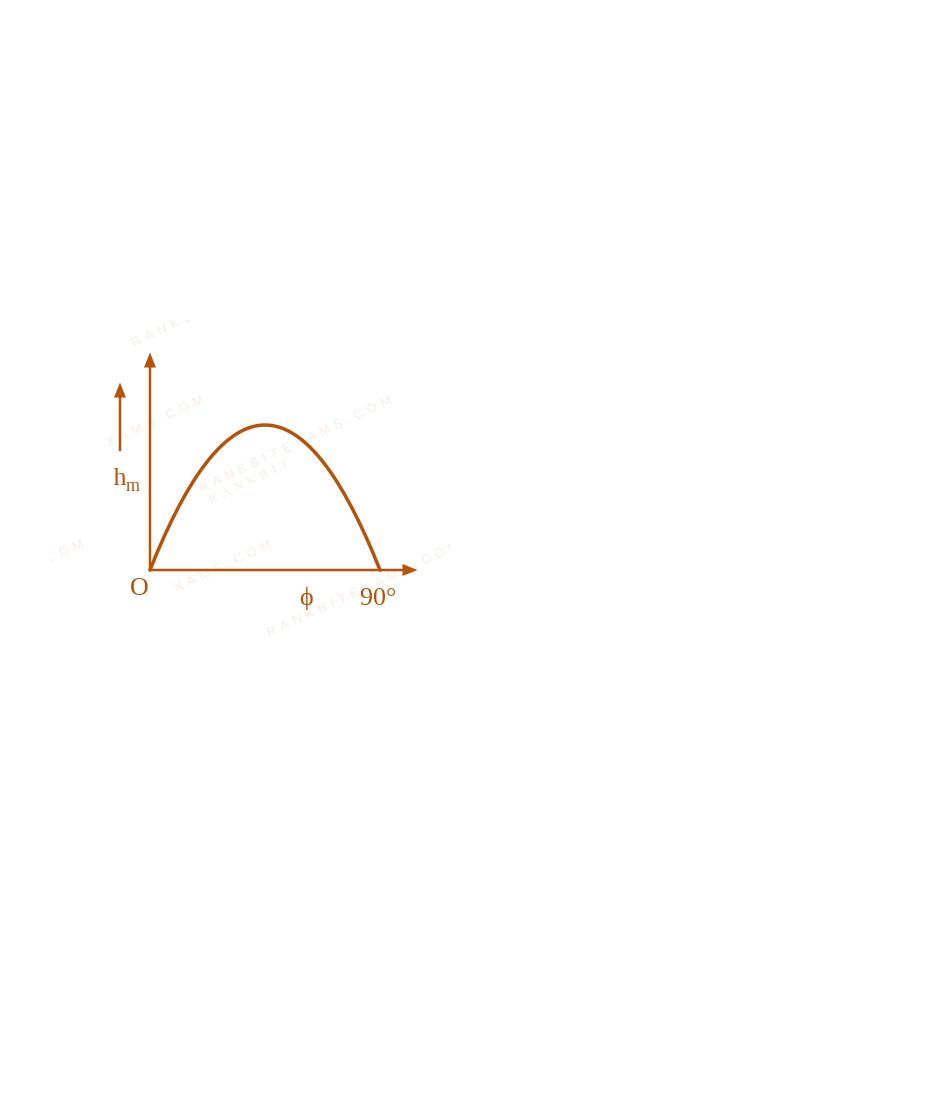
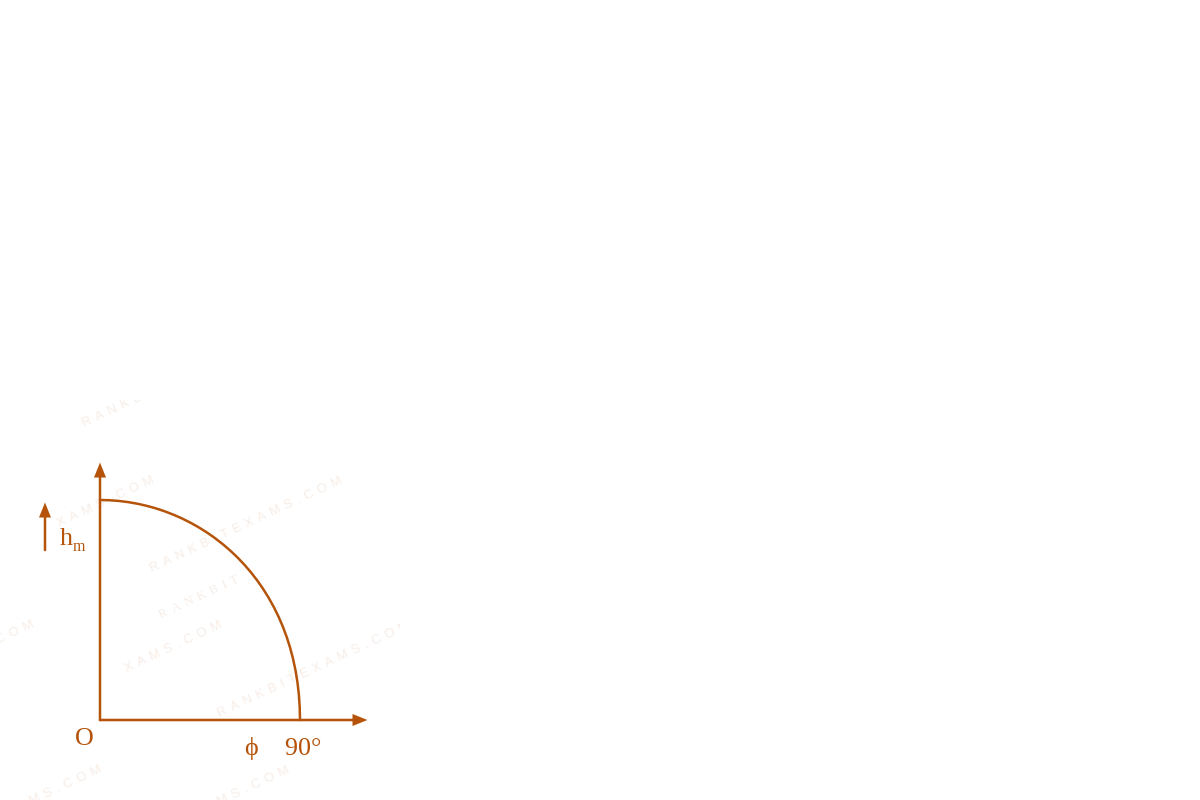
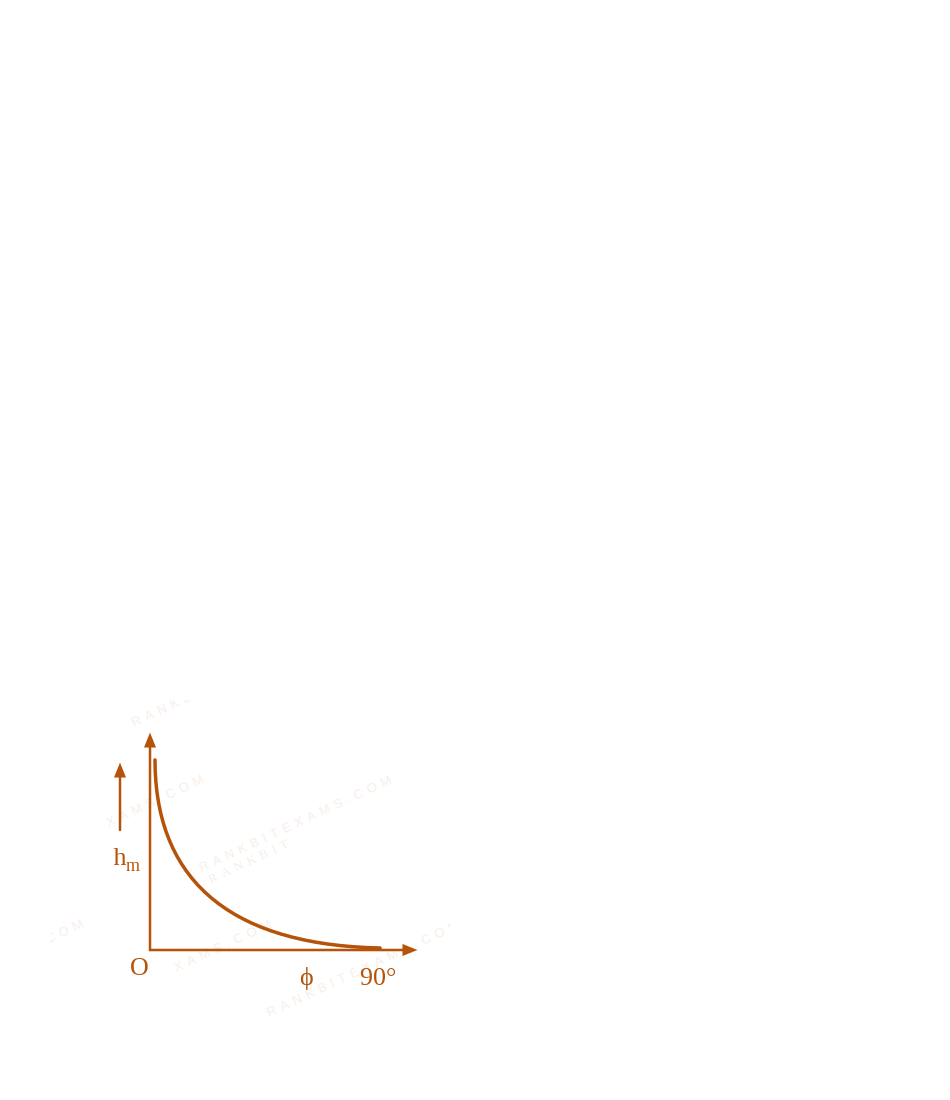
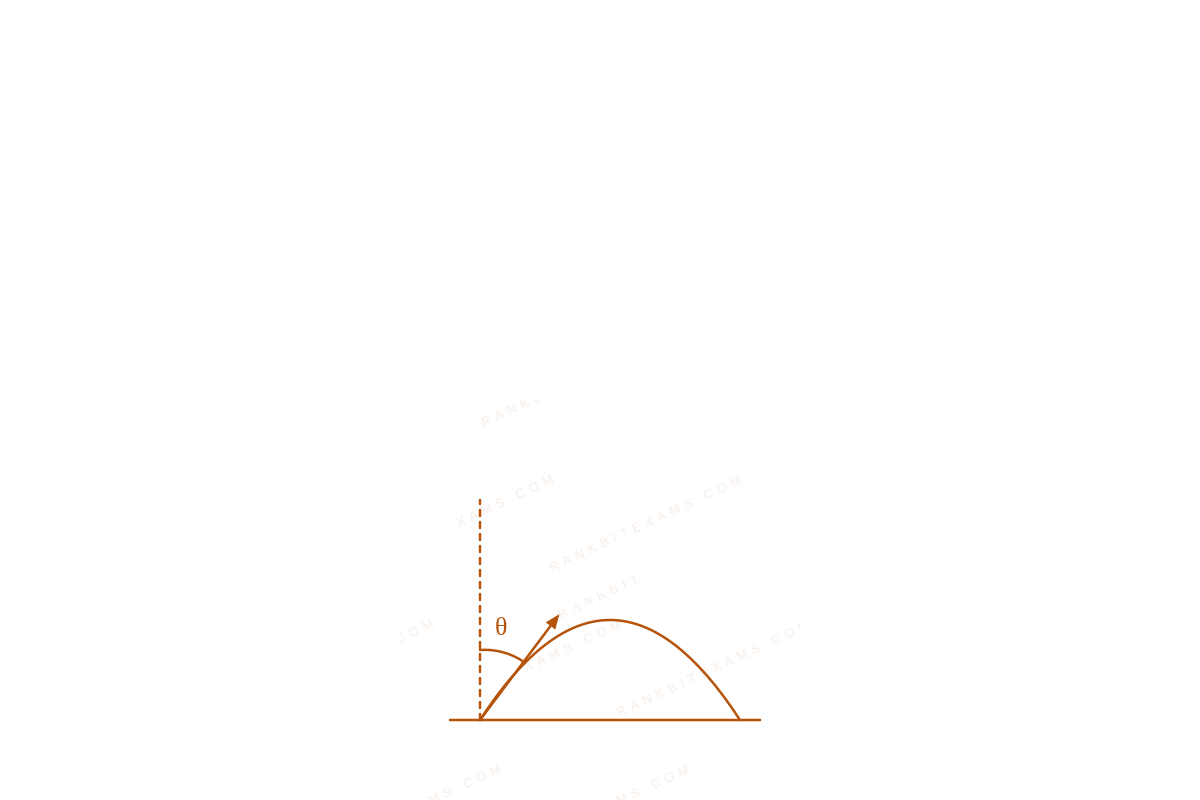
The angle of projection of a particle is measured from the vertical axis as φ$\phi$ and the maximum height reached by the particle is hm$h_m$. Here hm$h_m$ as function of φ$\phi$ can be presented as:
At φ = 90°$\phi = 90^{\circ}$ (fired horizontally along the ground):
hm(90°) = 0$$h_m(90^{\circ}) = 0$$
Let's evaluate the behavior of hm(φ)$h_m(\phi)$:
At small angles φ ≈ 0$\phi \approx 0$, the slope (d hm)/(dφ) = -(u²)/(2g) (2φ) ≈ 0$\frac{d h_m}{d\phi} = -\frac{u^2}{2g} \sin(2\phi) \approx 0$. This means the curve starts with a horizontal slope (flat top).
As φ$\phi$ increases towards 90°$90^{\circ}$, hm$h_m$ falls smoothly, reaching 0 at 90°$90^{\circ}$ with flat slope again.
This sinusoidal falloff perfectly matches Curve (3).
Curve plot of vertical height hm versus launch angle phi for Q19
Pattern Recognition
Always read the coordinate origin carefully! Measuring angle from the vertical instead of the horizontal turns ²θ$\sin^2\theta$ into ²φ$\cos^2\phi$. Checking extremes: vertical shot (0°$0^{\circ}$) yields maximum height, while flat shot (90°$90^{\circ}$) yields zero height.
Chapter Mix
Class 11 Physics: Motion in a Plane: Projectile Motion
Checking options, only | A + B| = 2R ((θ)/(2))$|\vec{A} + \vec{B}| = 2R \cos \left(\frac{\theta}{2}\right)$ is correctly paired in the choice list.
Pattern Recognition
Standard geometry shortcut: Addition of two equal vectors yields a cosine half-angle dependency. Subtraction yields a sine half-angle dependency. (+ → )$(+ \to \cos)$, (- → )$(- \to \sin)$.
Chapter Mix
Class 11 Physics: Motion in a Plane
Qjee_main_2024_31_jan_morningProjectile Motion
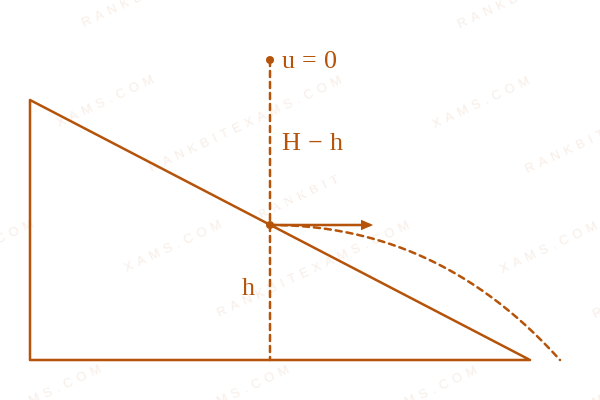
A body starts falling freely from height H$H$ hits an inclined plane in its path at height h$h$. As a result of this perfectly elastic impact, the direction of the velocity of the body becomes horizontal. The value of (H)/(h)$\frac{H}{h}$ for which the body will take the maximum time to reach the ground is
Numerical Answer.Answer: 2 to 2
Solution
Related Formula
t = √((2d)/(g))$$t = \sqrt{\frac{2d}{g}}$$
Core Logic
Projectile Motion diagram for Q55 - JEE Main 2024 Morning
The body falls freely from height H$H$ to height h$h$. The distance fallen is (H - h)$(H - h)$.
Time taken to fall this distance:
After elastic impact, the vertical velocity becomes zero (the entire velocity is directed horizontally). From height h$h$, it now acts as a horizontal projectile.
The time taken to reach the ground vertically from height h$h$ is:
Squaring both sides:
H - h = h$H - h = h$H = 2h$H = 2h$
(H)/(h) = 2$$\frac{H}{h} = 2$$
Chapter Mix
Class 11 Physics: Kinematics
Q33jee_main_2024_31_jan_morningDifferentiation In Kinematics
The relation between time 't$t$' and distance 'x$x$' is t = α x² + β x$t = \alpha x^2 + \beta x$, where α$\alpha$ and β$\beta$ are constants. The relation between acceleration (a$a$) and velocity (v$v$) is:
Standard kinematic shortcut: Whenever t = Ax² + Bx$t = Ax^2 + Bx$, v = (2Ax+B)⁻¹$v = (2Ax+B)^{-1}$ and a = -2A v³$a = -2A v^3$. Memorizing this directly saves derivation time during the exam.
Chapter Mix
Class 11 Physics: Kinematics
More Kinematics Questions — jee_main_2025_03_april_morning
Practice past-year questions one chapter at a time. Pick an exam → subject → chapter and get every PYQ for that topic — pulled together from all past papers — with the chapter's key formulas alongside.
