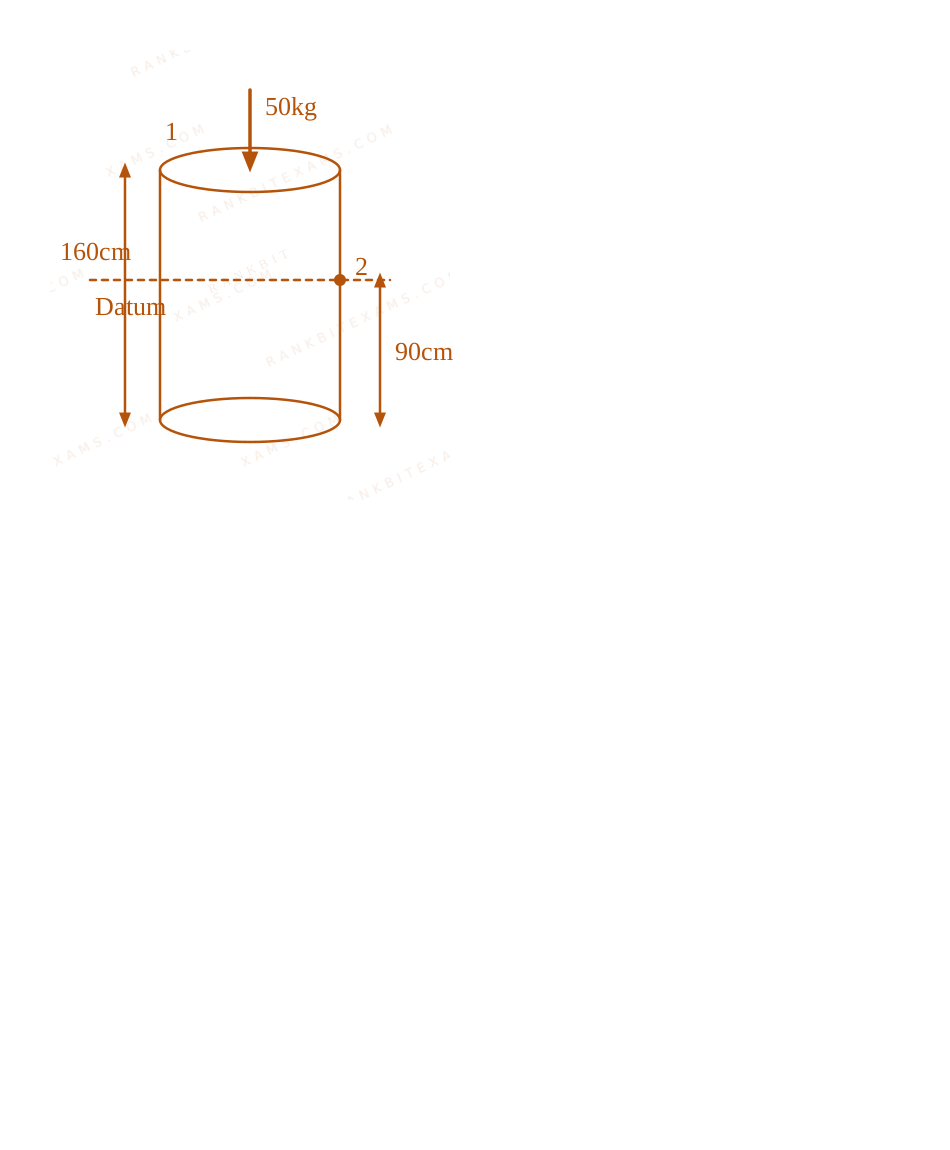
Consider a completely full cylindrical water tank of height 1.6~m and cross-sectional area 0.5~m² . It has a small hole in its side at a height 90~cm from the bottom. Assume, the cross-sectional area of the hole to be negligibly small as compared to that of the water tank. If a load 50~kg is applied at the top surface of the water in the tank then the velocity of the water coming out at the instant when the hole is opened is: (g = 10~m/s²)

Solution & Explanation

Related Formula

Bernoulli's Principle between the top surface (1) and the hole (2):

P₁ + (1)/(2)ρ v₁² + ρ g h₁ = P₂ + (1)/(2)ρ v₂² + ρ g h₂
Core Logic

Let the top surface be point 1, and the opening of the hole be point 2.

  • Height of tank, H = 1.6~m (thus height of point 1, h₁ = 1.6~m)
  • Height of hole, h₂ = 90~cm = 0.9~m from the bottom.
  • Depth of the hole below top surface, h = H - h₂ = 1.6 - 0.9 = 0.7~m.
  • Since area of hole is negligibly small compared to tank area, the velocity of fluid surface at the top is negligible (v₁ ≈ 0).
  • Pressure at point 1 (top surface):
P₁ = P₀ + (Mg)/(A)

where M = 50~kg, A = 0.5~m², P₀ is atmospheric pressure.

  • Pressure at point 2 (outside the hole):
  • P₂ = P₀

Step 1: Applying Bernoulli's Equation

Substitute these values into Bernoulli's equation with reference datum at the hole (h₂ = 0):

P₁ + ρ g h = P₂ + (1)/(2)ρ v₂² (P₀ + (Mg)/(A)) + ρ g h = P₀ + (1)/(2)ρ v₂² (Mg)/(A) + ρ g h = (1)/(2)ρ v₂²
Step 2: Substitution and Calculation

Substitute M = 50~kg, g = 10~m/s², A = 0.5~m², ρ = 10³~kg/m³, and h = 0.7~m:

(50 × 10)/(0.5) + 10³ × 10 × 0.7 = (1)/(2) × 10³ × v₂² 1000 + 7000 = 500 × v₂² 8000 = 500 × v₂² v₂² = 16 v₂ = 4~m/s

Cylindrical water tank pressure and velocity profile diagram for Q2

Pattern Recognition

Modified Torricelli's formula with top pressure overload:

v = √(2gh + (2Δ P)/(ρ))

Substitute Δ P = (Mg)/(A) = (500)/(0.5) = 1000~Pa. This quickly yields: v = √(2(10)(0.7) + (2(1000))/(1000)) = √(14 + 2) = 4~m/s. Keep this shortcut in mind for pressurized tanks!

Chapter Mix

Class 11 Physics: Mechanical Properties of Fluids

Reference Study Guides

More Fluid Mechanics Previous-Year Questions — Page 7

Q47 jee_main_2024_31_jan_evening Viscosity and Terminal Velocity
A small spherical ball of radius r, falling through a viscous medium of negligible density has terminal velocity 'v'. Another ball of the same mass but of radius 2r, falling through the same viscous medium will have terminal velocity:
  • A. (v)/(2)
  • B. (v)/(4)
  • C. 4v
  • D. 2v

Solution

Related Formula

At terminal velocity, downward force equals upward drag (assuming negligible buoyancy):

Mg = 6π η r v v = (Mg)/(6π η r)
Core Logic

Since the density of the medium is negligible, we ignore buoyant forces. The mass M of the ball is specified to remain the same in both cases, despite the change in radius (implying the material density of the second ball is lower).

Step 1: Setup Proportionality

Since M, g, and η are all constants:

v ∝ (1)/(r)
Step 2: Evaluating the Ratio

For the second ball, r' = 2r. Therefore, the new terminal velocity v' is:

v' = v × ((r)/(r')) = v × ((r)/(2r)) = (v)/(2)
Pattern Recognition

Read the constraints carefully. Usually, questions keep material density uniform (v ∝ r²). However, this specifically says "same mass". This shifts the formula dependency from v ∝ r² entirely to v ∝ 1/r because M acts as a constant numerator.

Chapter Mix

Class 11 Physics: Mechanical Properties of Fluids
Q jee_main_2024_31_jan_morning Viscosity And Terminal Velocity
A small steel ball is dropped into a long cylinder containing glycerine. Which one of the following is the correct representation of the velocity time graph for the transit of the ball?
  • A.
  • B.
  • C.
  • D.

Solution

Related Formula
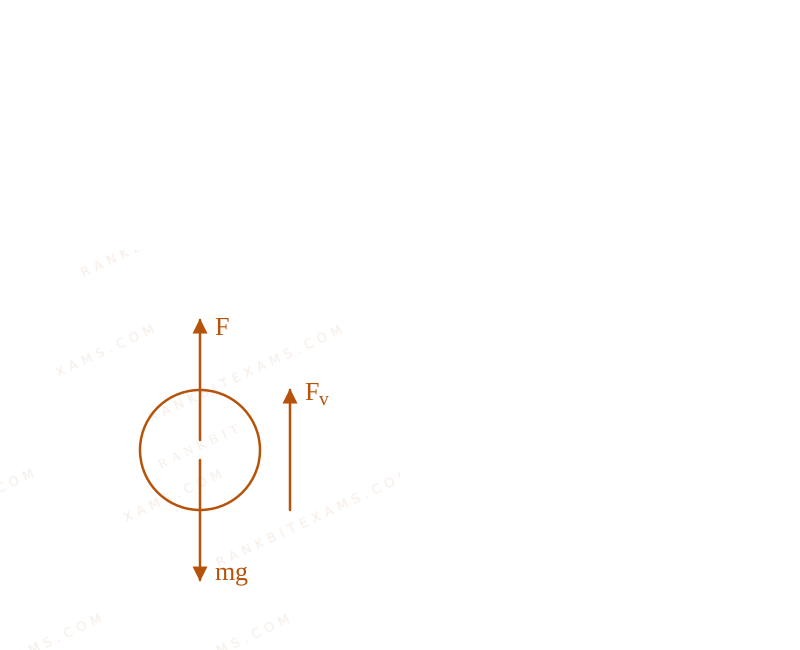
mg - FB - Fv = ma Fv = 6πη r v
Core Logic

Viscosity And Terminal Velocity diagram for Q46 - JEE Main 2024 Morning

When dropped, three forces act on the ball: Gravity downwards, Buoyant force upwards, and Viscous drag upwards.

mg - FB - Fv = m (dv)/(dt) (ρ (4)/(3)π r³)g - (ρL (4)/(3)π r³)g - 6πη rv = m (dv)/(dt)

Let (4π r³ g(ρ - ρL))/(3m) = K₁ and (6πη r)/(m) = K₂.

(dv)/(dt) = K₁ - K₂ v

Integrating from t=0, v=0:

∫₀^v (dv)/(K₁ - K₂ v) = ∫₀^t dt -(1)/(K₂) ln ((K₁ - K₂ v)/(K₁)) = t v = (K₁)/(K₂) ( 1 - e-K₂ t )

This is an exponential curve starting from the origin and asymptotically approaching the terminal velocity VT = K₁ / K₂.

Chapter Mix

Class 11 Physics: Mechanical Properties Of Fluids

Rankbit System
JEE Physics: Waves (+15.5%) | Electrostatics: Concentric Shells (-29.7%) | Modern Physics: Photoelectric Clones (+34.2%) | Mathematics: Definite Integrals (+18.1%) | Chemistry: Coordination Splitting (-11.4%) | JEE Physics: Waves (+15.5%) | Electrostatics: Concentric Shells (-29.7%) | Modern Physics: Photoelectric Clones (+34.2%) | Mathematics: Definite Integrals (+18.1%) | Chemistry: Coordination Splitting (-11.4%)
