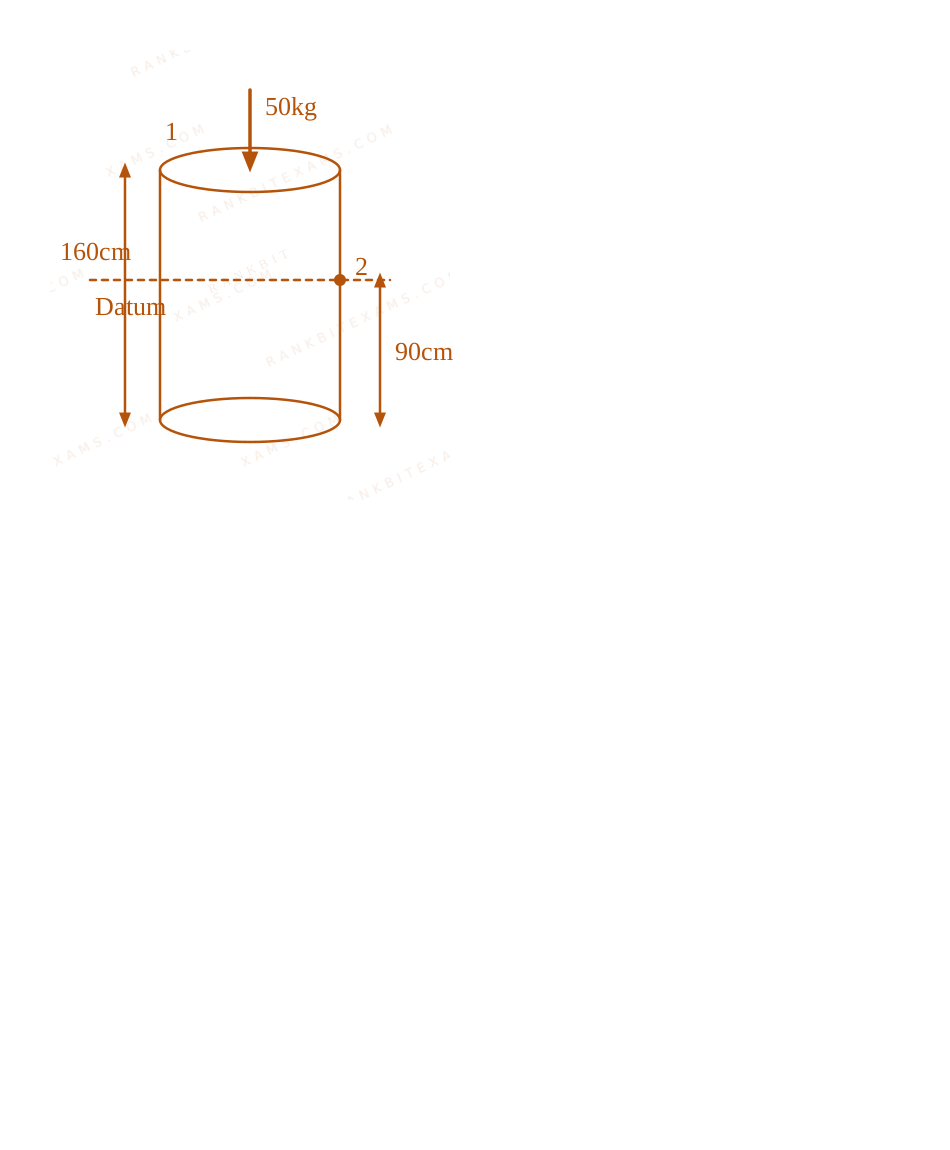
Consider a completely full cylindrical water tank of height 1.6~m$1.6\mathrm{~m}$ and cross-sectional area 0.5~m²$0.5\mathrm{~m}^2$ . It has a small hole in its side at a height 90~cm$90\mathrm{~cm}$ from the bottom. Assume, the cross-sectional area of the hole to be negligibly small as compared to that of the water tank. If a load 50~kg$50\mathrm{~kg}$ is applied at the top surface of the water in the tank then the velocity of the water coming out at the instant when the hole is opened is: (g = 10~m/s²)$(\mathrm{g} = 10\mathrm{~m/s}^2)$
A.3~m/s$3\mathrm{~m/s}$
B.5~m/s$5\mathrm{~m/s}$
C.2~m/s$2\mathrm{~m/s}$
D.4~m/s$4\mathrm{~m/s}$
Solution & Explanation
Related Formula
Bernoulli's Principle between the top surface (1) and the hole (2):
P₁ + (1)/(2)ρ v₁² + ρ g h₁ = P₂ + (1)/(2)ρ v₂² + ρ g h₂$$P_1 + \frac{1}{2}\rho v_1^2 + \rho g h_1 = P_2 + \frac{1}{2}\rho v_2^2 + \rho g h_2$$
Core Logic
Let the top surface be point 1, and the opening of the hole be point 2.
Height of tank, H = 1.6~m$H = 1.6\mathrm{~m}$ (thus height of point 1, h₁ = 1.6~m$h_1 = 1.6\mathrm{~m}$)
Height of hole, h₂ = 90~cm = 0.9~m$h_2 = 90\mathrm{~cm} = 0.9\mathrm{~m}$ from the bottom.
Depth of the hole below top surface, h = H - h₂ = 1.6 - 0.9 = 0.7~m$h = H - h_2 = 1.6 - 0.9 = 0.7\mathrm{~m}$.
Since area of hole is negligibly small compared to tank area, the velocity of fluid surface at the top is negligible (v₁ ≈ 0$v_1 \approx 0$).
Pressure at point 1 (top surface):
P₁ = P₀ + (Mg)/(A)$$P_1 = P_0 + \frac{Mg}{A}$$
where M = 50~kg$M = 50\mathrm{~kg}$, A = 0.5~m²$A = 0.5\mathrm{~m}^2$, P₀$P_0$ is atmospheric pressure.
Pressure at point 2 (outside the hole):
P₂ = P₀$P_2 = P_0$
Step 1: Applying Bernoulli's Equation
Substitute these values into Bernoulli's equation with reference datum at the hole (h₂ = 0$h_2 = 0$):
P₁ + ρ g h = P₂ + (1)/(2)ρ v₂²$$P_1 + \rho g h = P_2 + \frac{1}{2}\rho v_2^2$$(P₀ + (Mg)/(A)) + ρ g h = P₀ + (1)/(2)ρ v₂²$$\left(P_0 + \frac{Mg}{A}\right) + \rho g h = P_0 + \frac{1}{2}\rho v_2^2$$(Mg)/(A) + ρ g h = (1)/(2)ρ v₂²$$\frac{Mg}{A} + \rho g h = \frac{1}{2}\rho v_2^2$$
Step 2: Substitution and Calculation
Substitute M = 50~kg$M = 50\mathrm{~kg}$, g = 10~m/s²$g = 10\mathrm{~m/s}^2$, A = 0.5~m²$A = 0.5\mathrm{~m}^2$, ρ = 10³~kg/m³$\rho = 10^3\mathrm{~kg/m}^3$, and h = 0.7~m$h = 0.7\mathrm{~m}$:
Keywords:#efflux velocity cylindrical tank#Bernoulli's equation JEE Main#Fluid Mechanics JEE Main 2025#Torricelli's law with load
More Fluid Mechanics Previous-Year Questions — Page 6
Qjee_main_2024_29_january_eveningSurface Tension
A small liquid drop of radius R$R$ is divided into 27$27$ identical liquid drops. If the surface tension is T$T$, then the work done in the process will be:
A.8π R² T$8\pi R^2 T$
B.3π R² T$3\pi R^2 T$
C.(1)/(8)π R² T$\frac{1}{8}\pi R^2 T$
D.4π R² T$4\pi R^2 T$
Solution
Related Formula
The work done in changing the surface area of a liquid is given by:
W = T · Δ A$$W = T \cdot \Delta A$$
where:
T$T$ is the surface tension of the liquid.
Δ A = Af - Aᵢ$\Delta A = A_f - A_i$ is the change in the total surface area.
Core Logic
Since the total volume remains constant during splitting:
Δ A = Af - Aᵢ = 12π R² - 4π R² = 8π R²$$\Delta A = A_f - A_i = 12\pi R^2 - 4\pi R^2 = 8\pi R^2$$
Step 2: Calculate Work Done
Substituting the change in area into the work done formula:
W = T · Δ A = 8π R² T$$W = T \cdot \Delta A = 8\pi R^2 T$$
Pattern Recognition
For splitting a large drop of radius R$R$ into n$n$ identical small drops, the change in surface area is given by Δ A = 4π R² (n1/3 - 1)$\Delta A = 4\pi R^2 (n^{1/3} - 1)$. Substituting n = 27$n = 27$ gives Δ A = 4π R² (3 - 1) = 8π R²$\Delta A = 4\pi R^2 (3 - 1) = 8\pi R^2$, leading immediately to 8π R² T$8\pi R^2 T$.
Chapter Mix
Class 11 Physics: Mechanical Properties of Fluids
Q32jee_main_2024_27_jan_morningViscosity and Surface Tension
Given below are two statements:
Statement (I): Viscosity of gases is greater than that of liquids.
Statement (II): Surface tension of a liquid decreases due to the presence of insoluble impurities.
In the light of the above statements, choose the most appropriate answer from the options given below:
A.Statement I is correct but Statement II is incorrect$\text{Statement I is correct but Statement II is incorrect}$
B.Statement I is incorrect but Statement II is correct$\text{Statement I is incorrect but Statement II is correct}$
C.Both Statement I and Statement II are incorrect$\text{Both Statement I and Statement II are incorrect}$
D.Both Statement I and Statement II are correct$\text{Both Statement I and Statement II are correct}$
Solution
Core Logic
Statement (I): Liquids have much stronger intermolecular forces compared to gases, leading to significantly higher viscosity in liquids than in gases. Thus, Statement I is incorrect.
Statement (II): The presence of insoluble impurities (like soap or detergents) disrupts the cohesive forces between liquid molecules at the surface, which decreases the surface tension. Thus, Statement II is correct.
Pattern Recognition
Viscosity in liquids decreases with temperature, whereas in gases it increases with temperature due to molecular collisions. Insoluble impurities act as surface-active agents that lower surface tension cohesive stability.
Chapter Mix
Class 11 Physics: Mechanical Properties of Fluids
Q33jee_main_2024_29_jan_morningSurface Tension and Capillarity
Given below are two statements:
Statement I: If a capillary tube is immersed first in cold water and then in hot water, the height of capillary rise will be smaller in hot water.
Statement II: If a capillary tube is immersed first in cold water and then in hot water, the height of capillary rise will be smaller in cold water.
In the light of the above statements, choose the most appropriate from the options given below:
Remember the key physical dependence: Temperature Up $\implies$ Surface Tension Down $\implies$ Capillary Rise Down. This basic trend of cohesive/adhesive properties versus thermal energy frequently appears in competitive conceptual physical chemistry/fluid physics questions.
In a test experiment on a model aeroplane in wind tunnel, the flow speeds on the upper and lower surfaces of the wings are 70~ms⁻¹$70~\mathrm{ms}^{-1}$ and 65~ms⁻¹$65~\mathrm{ms}^{-1}$ respectively. If the wing area is 2~m²$2~\mathrm{m}^2$ the lift of the wing is ________ N. (Given density of air = 1.2~kg m⁻³$= 1.2~\mathrm{kg}\,\mathrm{m}^{-3}$)
Numerical Answer.Answer: 810 to 810
Solution
Related Formula
From Bernoulli's Principle (ignoring small height differences across the wing thickness):
Therefore, the net lift force on the wing is 810 ~N$810 \mathrm{~N}$.
Pattern Recognition
Use the algebraic difference of squares shortcut a² - b² = (a-b)(a+b)$a^2 - b^2 = (a-b)(a+b)$ to solve velocity square differences quickly: 70² - 65² = (70-65)(70+65) = 5 × 135 = 675$70^2 - 65^2 = (70-65)(70+65) = 5 \times 135 = 675$, bypassing squaring heavy multi-digit calculations.
Chapter Mix
Class 11 Physics: Mechanical Properties of Fluids
Q52jee_main_2024_30_january_eveningSurface Energy of Drops
A big drop is formed by coalescing 1000$1000$ small identical drops of water. If E₁$\mathrm{E}_1$ be the total surface energy of 1000$1000$ small drops of water and E₂$\mathrm{E}_2$ be the surface energy of single big drop of water, the E₁:E₂$\mathrm{E}_1:\mathrm{E}_2$ is x:1$x:1$ where x =$x =$
Thus, the ratio is 10:1$10:1$, which means x = 10$x = 10$.
Pattern Recognition
When N$N$ droplets merge to form one big drop, the radius scales as R = N1/3 r$R = N^{1/3} r$. The ratio of total initial surface energy to final surface energy is N1/3$N^{1/3}$.
Practice past-year questions one chapter at a time. Pick an exam → subject → chapter and get every PYQ for that topic — pulled together from all past papers — with the chapter's key formulas alongside.