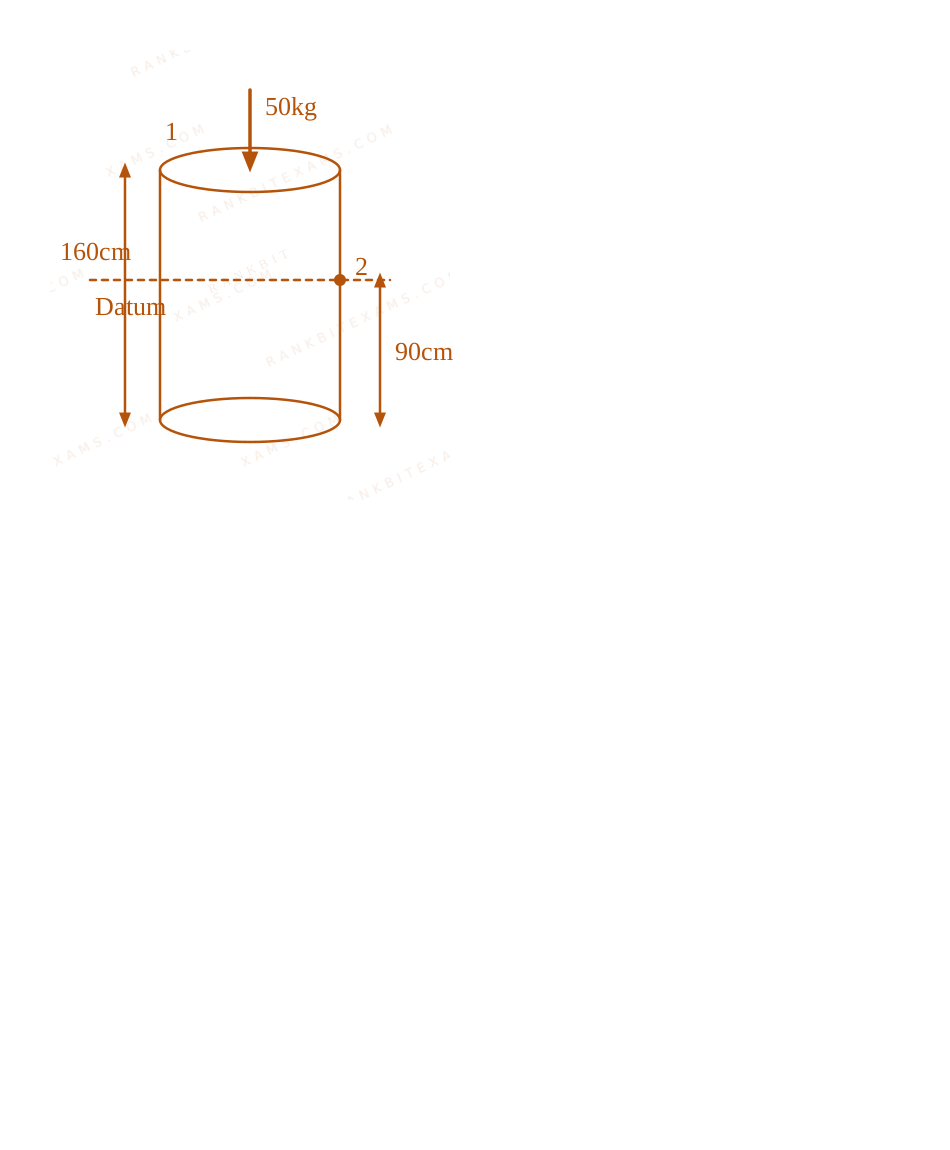
Consider a completely full cylindrical water tank of height 1.6~m$1.6\mathrm{~m}$ and cross-sectional area 0.5~m²$0.5\mathrm{~m}^2$ . It has a small hole in its side at a height 90~cm$90\mathrm{~cm}$ from the bottom. Assume, the cross-sectional area of the hole to be negligibly small as compared to that of the water tank. If a load 50~kg$50\mathrm{~kg}$ is applied at the top surface of the water in the tank then the velocity of the water coming out at the instant when the hole is opened is: (g = 10~m/s²)$(\mathrm{g} = 10\mathrm{~m/s}^2)$
A.3~m/s$3\mathrm{~m/s}$
B.5~m/s$5\mathrm{~m/s}$
C.2~m/s$2\mathrm{~m/s}$
D.4~m/s$4\mathrm{~m/s}$
Solution & Explanation
Related Formula
Bernoulli's Principle between the top surface (1) and the hole (2):
P₁ + (1)/(2)ρ v₁² + ρ g h₁ = P₂ + (1)/(2)ρ v₂² + ρ g h₂$$P_1 + \frac{1}{2}\rho v_1^2 + \rho g h_1 = P_2 + \frac{1}{2}\rho v_2^2 + \rho g h_2$$
Core Logic
Let the top surface be point 1, and the opening of the hole be point 2.
Height of tank, H = 1.6~m$H = 1.6\mathrm{~m}$ (thus height of point 1, h₁ = 1.6~m$h_1 = 1.6\mathrm{~m}$)
Height of hole, h₂ = 90~cm = 0.9~m$h_2 = 90\mathrm{~cm} = 0.9\mathrm{~m}$ from the bottom.
Depth of the hole below top surface, h = H - h₂ = 1.6 - 0.9 = 0.7~m$h = H - h_2 = 1.6 - 0.9 = 0.7\mathrm{~m}$.
Since area of hole is negligibly small compared to tank area, the velocity of fluid surface at the top is negligible (v₁ ≈ 0$v_1 \approx 0$).
Pressure at point 1 (top surface):
P₁ = P₀ + (Mg)/(A)$$P_1 = P_0 + \frac{Mg}{A}$$
where M = 50~kg$M = 50\mathrm{~kg}$, A = 0.5~m²$A = 0.5\mathrm{~m}^2$, P₀$P_0$ is atmospheric pressure.
Pressure at point 2 (outside the hole):
P₂ = P₀$P_2 = P_0$
Step 1: Applying Bernoulli's Equation
Substitute these values into Bernoulli's equation with reference datum at the hole (h₂ = 0$h_2 = 0$):
P₁ + ρ g h = P₂ + (1)/(2)ρ v₂²$$P_1 + \rho g h = P_2 + \frac{1}{2}\rho v_2^2$$(P₀ + (Mg)/(A)) + ρ g h = P₀ + (1)/(2)ρ v₂²$$\left(P_0 + \frac{Mg}{A}\right) + \rho g h = P_0 + \frac{1}{2}\rho v_2^2$$(Mg)/(A) + ρ g h = (1)/(2)ρ v₂²$$\frac{Mg}{A} + \rho g h = \frac{1}{2}\rho v_2^2$$
Step 2: Substitution and Calculation
Substitute M = 50~kg$M = 50\mathrm{~kg}$, g = 10~m/s²$g = 10\mathrm{~m/s}^2$, A = 0.5~m²$A = 0.5\mathrm{~m}^2$, ρ = 10³~kg/m³$\rho = 10^3\mathrm{~kg/m}^3$, and h = 0.7~m$h = 0.7\mathrm{~m}$:
A vessel with square cross-section and height of 6~m$6\mathrm{~m}$ is vertically partitioned. A small window of 100~cm²$100\mathrm{~cm}^2$ with hinged door is fitted at a depth of 3~m$3\mathrm{~m}$ in the partition wall. One part of the vessel is filled completely with water and the other side is filled with the liquid having density 1.5× 10³~kg/m³$1.5\times 10^{3}\mathrm{~kg/m}^{3}$. What force one needs to apply on the hinged door so that it does not get opened? (Acceleration due to gravity = 10~m/s²$= 10\mathrm{~m/s}^2$)
Numerical Answer.Answer: 150 to 150
Solution
Related Formula
P = P₀ + ρ g h$$P = P_0 + \rho g h$$F = Δ P · A$$F = \Delta P \cdot A$$
Core Logic
Let's analyze the pressure acting on the window at depth h = 3~m$h = 3\mathrm{~m}$ from both sides:
Water side (density ρw = 1.0 × 10³~kg/m³$\rho_w = 1.0 \times 10^3\mathrm{~kg/m}^3$):
The window has area A = 100~cm² = 100 × 10⁻⁴~m² = 10⁻²~m²$A = 100\mathrm{~cm}^2 = 100 \times 10^{-4}\mathrm{~m}^2 = 10^{-2}\mathrm{~m}^2$.
To keep the door from opening, we must apply a force balancing the pressure difference:
F = Δ P · A = 15000 × 10⁻² = 150~N$$F = \Delta P \cdot A = 15000 \times 10^{-2} = 150\mathrm{~N}$$
Step 1: Final Conclusion
The required force is
$
Step 1: Final Conclusion
The required force is $
150\mathrm{~N}.
Pattern Recognition
For a vertical interface between two fluids, the net pressure difference is simply given by
$.
Pattern Recognition
For a vertical interface between two fluids, the net pressure difference is simply given by $
\Delta P = \Delta \rho \cdot g h. The ambient atmospheric pressure$. The ambient atmospheric pressure $P_0$ cancels out since it acts on both sides of the window.
Chapter Mix
Class 11 Physics: Mechanical Properties of Fluids
Qjee_main_2025_03_april_eveningWork Done by Gravity in Connecting Vessels
Two cylindrical vessels of equal cross sectional area of 2~m²$2\mathrm{~m}^{2}$ contain water upto height 10~m$10\mathrm{~m}$ and 6~m$6\mathrm{~m}$, respectively. If the vessels are connected at their bottom then the work done by the force of gravity is :
(Density of water is 10³~kg/m³$10^{3}\mathrm{~kg/m}^{3}$ and g=10~m/s²$g=10\mathrm{~m/s}^{2}$)
A.1 × 10⁵~J$1 \times 10^{5}\mathrm{~J}$
B.4 × 10⁴~J$4 \times 10^{4}\mathrm{~J}$
C.6 × 10⁴~J$6 \times 10^{4}\mathrm{~J}$
D.8 × 10⁴~J$8 \times 10^{4}\mathrm{~J}$
Solution
Related Formula
The gravitational potential energy U$U$ of a liquid column of mass m$m$ and height h$h$ is evaluated relative to its bottom by placing its total mass at its center of mass (h/2$h/2$):
U = m g ((h)/(2)) = (ρ A h) g ((h)/(2)) = (1)/(2) ρ A g h²$$U = m g \left(\frac{h}{2}\right) = (\rho A h) g \left(\frac{h}{2}\right) = \frac{1}{2} \rho A g h^2$$
Work done by the force of gravity (W$W$) equals the negative change in potential energy:
W = -Δ U = Uᵢ - Uf$$W = -\Delta U = U_i - U_f$$
Core Logic
Since the vessels are identical and connected at the bottom, water flows from the higher column to the lower one until their final heights equalize at:
Step 1: Calculate Initial Potential Energy (Uᵢ$U_i$)
Let the reference level U=0$U=0$ be at the bottom:
Uᵢ = U₁ + U₂ = (1)/(2) ρ A g h₁² + (1)/(2) ρ A g h₂²$$U_i = U_1 + U_2 = \frac{1}{2} \rho A g h_1^2 + \frac{1}{2} \rho A g h_2^2$$Uᵢ = (1)/(2) ρ A g (10² + 6²) = (1)/(2) ρ A g (100 + 36) = 68 ρ A g$$U_i = \frac{1}{2} \rho A g \left(10^2 + 6^2\right) = \frac{1}{2} \rho A g (100 + 36) = 68 \rho A g$$
Work Done by Gravity in Connecting Vessels
Step 2: Calculate Final Potential Energy (Uf$U_f$)
Both vessels equalize to hf = 8~m$h_f = 8\mathrm{~m}$:
Uf = 2 × [ (1)/(2) ρ A g hf² ] = ρ A g (8²) = 64 ρ A g$$U_f = 2 \times \left[ \frac{1}{2} \rho A g h_f^2 \right] = \rho A g (8^2) = 64 \rho A g$$
Step 3: Work Done by Gravity (W$W$)
W = Uᵢ - Uf = 68 ρ A g - 64 ρ A g = 4 ρ A g$$W = U_i - U_f = 68 \rho A g - 64 \rho A g = 4 \rho A g$$
Substitute the given values (ho = 10³~kg/m³$
ho = 10^3\mathrm{~kg/m}^3$, A = 2~m²$A = 2\mathrm{~m}^2$, g = 10~m/s²$g = 10\mathrm{~m/s}^2$):
For leveling liquids between two identical connected columns, the shift in center of mass always simplifies. The loss in potential energy is given by
$
Pattern Recognition
For leveling liquids between two identical connected columns, the shift in center of mass always simplifies. The loss in potential energy is given by $
\Delta U = \frac{1}{4} \rho A g (h_1 - h_2)^2. Applying this directly:$. Applying this directly:
$Δ U = (1)/(4) × 10³ × 2 × 10 × (10 - 6)² = 5000 × 16 = 8 × 10⁴~J$\Delta U = \frac{1}{4} \times 10^3 \times 2 \times 10 \times (10 - 6)^2 = 5000 \times 16 = 8 \times 10^4\mathrm{~J}$$
Chapter Mix
Class 11 Physics: Mechanical Properties of Fluids
Q12jee_main_2025_03_april_eveningViscosity and Terminal Velocity
A solid steel ball of diameter 3.6~mm$3.6\mathrm{~mm}$ acquired terminal velocity 2.45×10⁻²~m/s$2.45\times10^{-2}\mathrm{~m/s}$ while falling under gravity through an oil of density 925~kg~m⁻³$925\mathrm{~kg~m}^{-3}$. Take density of steel as 7825~kg~m⁻³$7825\mathrm{~kg~m}^{-3}$ and g as 9.8~m/s²$9.8\mathrm{~m/s}^{2}$. The viscosity of the oil in SI unit is :
A. 2.18
B. 2.38
C. 1.68
D. 1.99
Solution
Related Formula
Terminal velocity vₜ$v_t$ of a spherical body falling through a viscous fluid is given by Stokes' Law:
vₜ = (2)/(9) r² g (ρbody - ρfluid)η$$v_t = \frac{2}{9} \frac{r^2 g (\rho_{\text{body}} - \rho_{\text{fluid}})}{\eta}$$
Hence, the viscosity coefficient η$\eta$ is:
η = (2)/(9) r² g (ρbody - ρfluid)vₜ$$\eta = \frac{2}{9} \frac{r^2 g (\rho_{\text{body}} - \rho_{\text{fluid}})}{v_t}$$
r = d/2$). Always ensure all numerical parameters are converted cleanly to SI base units (meters, kilograms, seconds) before applying Stokes' formula.
Chapter Mix
Class 11 Physics: Mechanical Properties of Fluids
Q22jee_main_2025_03_april_eveningExcess Pressure in Soap Bubbles
The excess pressure inside a soap bubble A in air is half the excess pressure inside another soap bubble B in air. If the volume of the bubble A is n$n$ times the volume of the bubble B, then the value of n$n$ is ________.
Numerical Answer.Answer: 8 to 8
Solution
Related Formula
Excess pressure inside a soap bubble in air (which has two liquid-gas interfaces) is given by:
Δ P = (4T)/(R) ⇒ R ∝ (1)/(Δ P)$$\Delta P = \frac{4T}{R} \Rightarrow R \propto \frac{1}{\Delta P}$$
The volume V$V$ of a spherical bubble of radius R$R$ is:
V = (4)/(3)π R³ ⇒ V ∝ R³ ∝ ((1)/(Δ P))³$$V = \frac{4}{3}\pi R^3 \Rightarrow V \propto R^3 \propto \left(\frac{1}{\Delta P}\right)^3$$
VA = n VB ⇒ n = (VA)/(VB) = ((RA)/(RB))³ = (2)³ = 8$$V_A = n V_B \Rightarrow n = \frac{V_A}{V_B} = \left(\frac{R_A}{R_B}\right)^3 = (2)^3 = 8$$
Pattern Recognition
Volume scale factors depend on the cube of linear scale factors (V ∝ R³$V \propto R^3$). Since radius is inversely proportional to excess pressure, a halving of excess pressure leads to doubling of radius, scaling volume by 2³ = 8$2^3 = 8$.
Chapter Mix
Class 11 Physics: Mechanical Properties of Fluids
Q22jee_main_2025_08_april_eveningBulk Modulus
A sample of a liquid is kept at 1~atm$1\mathrm{~atm}$. It is compressed to 5~atm$5\mathrm{~atm}$ which leads to change of volume of 0.8~cm³$0.8\mathrm{~cm}^{3}$. If the bulk modulus of the liquid is 2~GPa$2\mathrm{~GPa}$, the initial volume of the liquid was ________ litre. (Take 1~atm = 10⁵~Pa$1\mathrm{~atm} = 10^{5}\mathrm{~Pa}$)
Numerical Answer.Answer: 4 to 4
Solution
Related Formula
B = -(Δ P)/(Δ V / V) V = B (-Δ V)/(Δ P)$$B = -\frac{\Delta P}{\Delta V / V} \implies V = B \frac{-\Delta V}{\Delta P}$$
where,
B$B$ = Bulk modulus of liquid
Δ P$\Delta P$ = change in pressure
Δ V$\Delta V$ = change in volume
V$V$ = initial volume
Thus, the initial volume was 4~litres$4\mathrm{~litres}$.
Pattern Recognition
Sees: Bulk modulus definition calculation.
Trap: Watch out for unit conversions: 1~GPa = 10⁹~Pa$1\mathrm{~GPa} = 10^9\mathrm{~Pa}$, and 1~cm³ = 10⁻⁶~m³$1\mathrm{~cm}^3 = 10^{-6}\mathrm{~m}^3$. Finally, express the answer in Litres, where 1~L = 10⁻³~m³$1\mathrm{~L} = 10^{-3}\mathrm{~m}^3$. ✓
Practice past-year questions one chapter at a time. Pick an exam → subject → chapter and get every PYQ for that topic — pulled together from all past papers — with the chapter's key formulas alongside.
