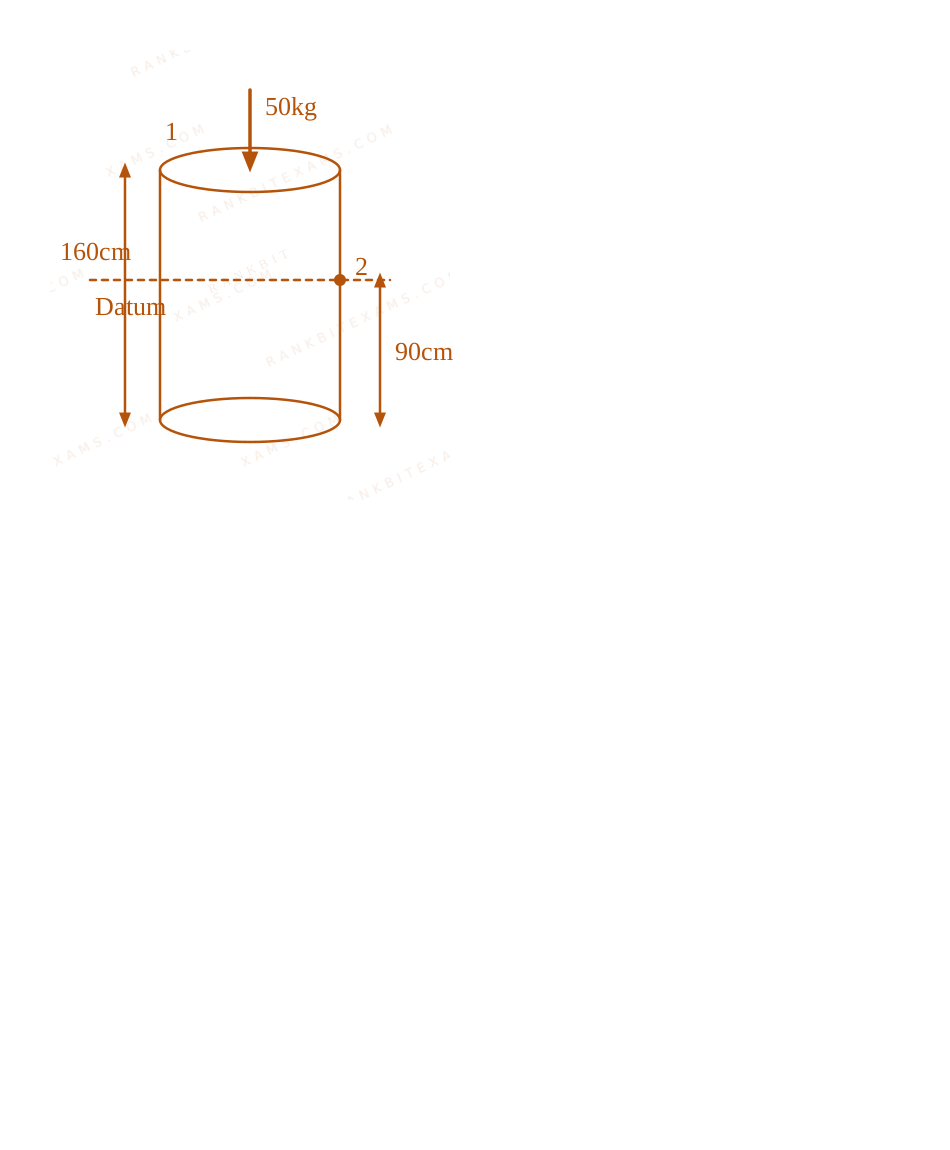
Consider a completely full cylindrical water tank of height 1.6~m$1.6\mathrm{~m}$ and cross-sectional area 0.5~m²$0.5\mathrm{~m}^2$ . It has a small hole in its side at a height 90~cm$90\mathrm{~cm}$ from the bottom. Assume, the cross-sectional area of the hole to be negligibly small as compared to that of the water tank. If a load 50~kg$50\mathrm{~kg}$ is applied at the top surface of the water in the tank then the velocity of the water coming out at the instant when the hole is opened is: (g = 10~m/s²)$(\mathrm{g} = 10\mathrm{~m/s}^2)$
A.3~m/s$3\mathrm{~m/s}$
B.5~m/s$5\mathrm{~m/s}$
C.2~m/s$2\mathrm{~m/s}$
D.4~m/s$4\mathrm{~m/s}$
Solution & Explanation
Related Formula
Bernoulli's Principle between the top surface (1) and the hole (2):
P₁ + (1)/(2)ρ v₁² + ρ g h₁ = P₂ + (1)/(2)ρ v₂² + ρ g h₂$$P_1 + \frac{1}{2}\rho v_1^2 + \rho g h_1 = P_2 + \frac{1}{2}\rho v_2^2 + \rho g h_2$$
Core Logic
Let the top surface be point 1, and the opening of the hole be point 2.
Height of tank, H = 1.6~m$H = 1.6\mathrm{~m}$ (thus height of point 1, h₁ = 1.6~m$h_1 = 1.6\mathrm{~m}$)
Height of hole, h₂ = 90~cm = 0.9~m$h_2 = 90\mathrm{~cm} = 0.9\mathrm{~m}$ from the bottom.
Depth of the hole below top surface, h = H - h₂ = 1.6 - 0.9 = 0.7~m$h = H - h_2 = 1.6 - 0.9 = 0.7\mathrm{~m}$.
Since area of hole is negligibly small compared to tank area, the velocity of fluid surface at the top is negligible (v₁ ≈ 0$v_1 \approx 0$).
Pressure at point 1 (top surface):
P₁ = P₀ + (Mg)/(A)$$P_1 = P_0 + \frac{Mg}{A}$$
where M = 50~kg$M = 50\mathrm{~kg}$, A = 0.5~m²$A = 0.5\mathrm{~m}^2$, P₀$P_0$ is atmospheric pressure.
Pressure at point 2 (outside the hole):
P₂ = P₀$P_2 = P_0$
Step 1: Applying Bernoulli's Equation
Substitute these values into Bernoulli's equation with reference datum at the hole (h₂ = 0$h_2 = 0$):
P₁ + ρ g h = P₂ + (1)/(2)ρ v₂²$$P_1 + \rho g h = P_2 + \frac{1}{2}\rho v_2^2$$(P₀ + (Mg)/(A)) + ρ g h = P₀ + (1)/(2)ρ v₂²$$\left(P_0 + \frac{Mg}{A}\right) + \rho g h = P_0 + \frac{1}{2}\rho v_2^2$$(Mg)/(A) + ρ g h = (1)/(2)ρ v₂²$$\frac{Mg}{A} + \rho g h = \frac{1}{2}\rho v_2^2$$
Step 2: Substitution and Calculation
Substitute M = 50~kg$M = 50\mathrm{~kg}$, g = 10~m/s²$g = 10\mathrm{~m/s}^2$, A = 0.5~m²$A = 0.5\mathrm{~m}^2$, ρ = 10³~kg/m³$\rho = 10^3\mathrm{~kg/m}^3$, and h = 0.7~m$h = 0.7\mathrm{~m}$:
Keywords:#efflux velocity cylindrical tank#Bernoulli's equation JEE Main#Fluid Mechanics JEE Main 2025#Torricelli's law with load
More Fluid Mechanics Previous-Year Questions — Page 2
Q45jee_main_2026_23_january_eveningViscosity and Terminal Velocity
A small metallic sphere of diameter 2 mm and density 10.5 g/cm³$10.5 \, \mathrm{g/cm}^{3}$ is dropped in glycerine having viscosity 10 Poise and density 1.5 g/cm³$1.5 \, \mathrm{g/cm}^{3}$ respectively. The terminal velocity attained by the sphere is ____ cm/s.
(π = (22)/(7) and g = 10 m/s²$\pi = \frac{22}{7} \text{ and } g = 10 \, \mathrm{m/s^2}$)
Watch the units closely. Poise is the CGS unit for viscosity, so converting all values to CGS (cm, g, s) makes the calculation direct and prevents factor-of-10 errors common when mixing SI and CGS.
Sixty four rain drops of radius 1 mm each falling down with a terminal velocity of 10 cm/s coalesce to form a bigger drop. The terminal velocity of bigger drop is ____ cm/s.
When N$N$ identical drops coalesce, the new radius is N1/3$N^{1/3}$ times the old radius. Consequently, the new terminal velocity scales precisely as N2/3$N^{2/3}$. For N=64$N=64$, 642/3 = 16$64^{2/3} = 16$. Just multiply initial v$v$ by 16.
Chapter Mix
Class 11 Physics: Mechanical Properties of Fluids
Q37jee_main_2026_24_january_eveningBuoyancy and Archimedes Principle
A cubical block of density ρb = 600 kg/m³$\rho_{\mathrm{b}} = 600 \, \mathrm{kg/m^{3}}$ floats in a liquid of density ρₑ = 900 kg/m³$\rho_{\mathrm{e}} = 900 \, \mathrm{kg/m^{3}}$ . If the height of block is H = 8.0 cm$H = 8.0 \, \mathrm{cm}$ then height of the submerged part is ____ cm.
A.7.3$7.3$
B.4.3$4.3$
C.6.3$6.3$
D.5.3$5.3$
Solution
Related Formula
Fbuoyancy = Mg$$F_{\text{buoyancy}} = Mg$$ρliquid Vsubmerged g = ρblock Vtotal g$$\rho_{\text{liquid}} V_{\text{submerged}} g = \rho_{\text{block}} V_{\text{total}} g$$
Core Logic
For a floating block, the weight of the block equals the buoyant force exerted by the liquid.
M g = Fb$M g = F_b$
ρb × A × H × g = ρₑ × A × h × g$$\rho_b \times A \times H \times g = \rho_e \times A \times h \times g$$
Submerged fraction is exactly the ratio of densities: (h)/(H) = ρobjectρfluid$\frac{h}{H} = \frac{\rho_{\text{object}}}{\rho_{\text{fluid}}}$.
Chapter Mix
Class 11 Physics: Mechanical Properties of Fluids
Q50jee_main_2026_24_january_eveningSurface Tension and Work Done
A soap bubble of surface tension 0.04 N/m is blown to a diameter of 7 cm. If (15000 - x) μJ of work is done in blowing it further to make its diameter 14 cm, then the value of x is ____.
(π = 2 2 / 7)$(\pi = 2 2 / 7)$
Numerical Answer.Answer: 11304 to 11304
Solution
Related Formula
W = Δ U = S · Δ A$$W = \Delta U = S \cdot \Delta A$$
For a soap bubble with two surfaces:
Δ A = 2 × 4π (r₂² - r₁²)$$\Delta A = 2 \times 4\pi (r_2^2 - r_1^2)$$
A soap bubble has two free surfaces; always multiply area changes by 2 (W = 8π S Δ r²$W = 8\pi S \Delta r^2$). Failing to account for both surfaces yields exactly half the answer, acting as a common trap.
Chapter Mix
Class 11 Physics: Mechanical Properties of Fluids
Q4jee_main_2025_02_april_eveningSurface Tension and Surface Energy
Two water drops each of radius r$r$ coalesce to form a bigger drop. If T$T$ is the surface tension, the surface energy released in this process is:
A.4π r² T [2 - 2(2)/(3)]$4\pi r^2 T \left[2 - 2^{\frac{2}{3}}\right]$
B.4π r² T [2 - 2(1)/(3)]$4\pi r^2 T \left[2 - 2^{\frac{1}{3}}\right]$
C.4π r² T [1 + √(2)]$4\pi r^2 T \left[1 + \sqrt{2}\right]$
D.4π r² T [√(2) - 1]$4\pi r^2 T \left[\sqrt{2} - 1\right]$
Solution
Related Formula
Surface Energy:
U = T · A = T · (4π R²)$$U = T \cdot A = T \cdot (4\pi R^2)$$
Conservation of Volume during coalescence of drops:
Δ E = Uᵢ - Uf = T(Aᵢ - Af)$$\Delta E = U_i - U_f = T(A_i - A_f)$$Δ E = T ( 8π r² - 4π r² 22/3 ) = 4π r² T [ 2 - 22/3 ]$$\Delta E = T \left( 8\pi r^2 - 4\pi r^2 2^{2/3} \right) = 4\pi r^2 T \left[ 2 - 2^{2/3} \right]$$
Pattern Recognition
Sees: Coalescence of N$N$ identical drops.
Trap: Forgetting to conserve volume first, or confusing initial and final surface areas.
Shortcut: Energy released when N$N$ drops coalesce into one big drop is:
Δ E = 4π r² T [ N - N2/3 ]$$\Delta E = 4\pi r^2 T \left[ N - N^{2/3} \right]$$
Here, substituting N = 2$N = 2$ directly gives 4π r² T [ 2 - 22/3 ]$4\pi r^2 T \left[ 2 - 2^{2/3} \right]$.
Practice past-year questions one chapter at a time. Pick an exam → subject → chapter and get every PYQ for that topic — pulled together from all past papers — with the chapter's key formulas alongside.