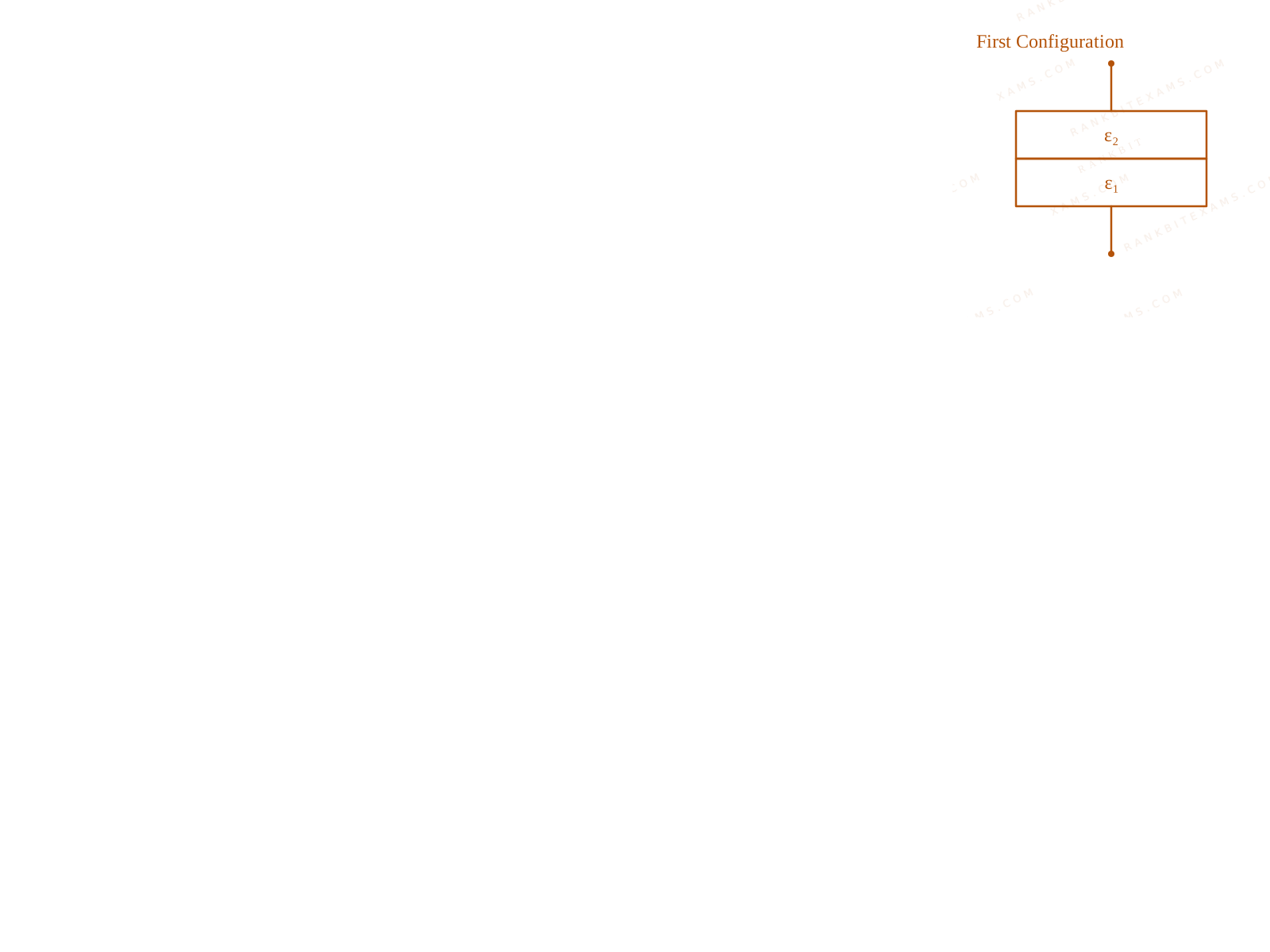
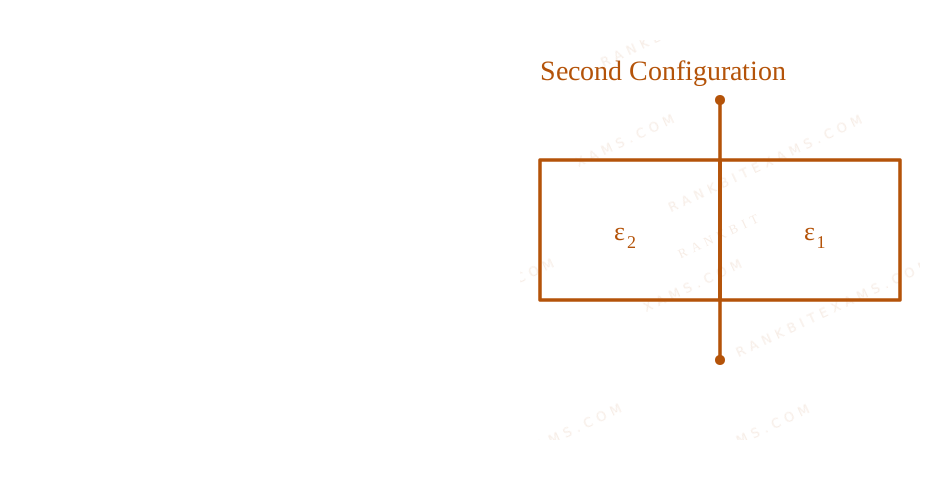
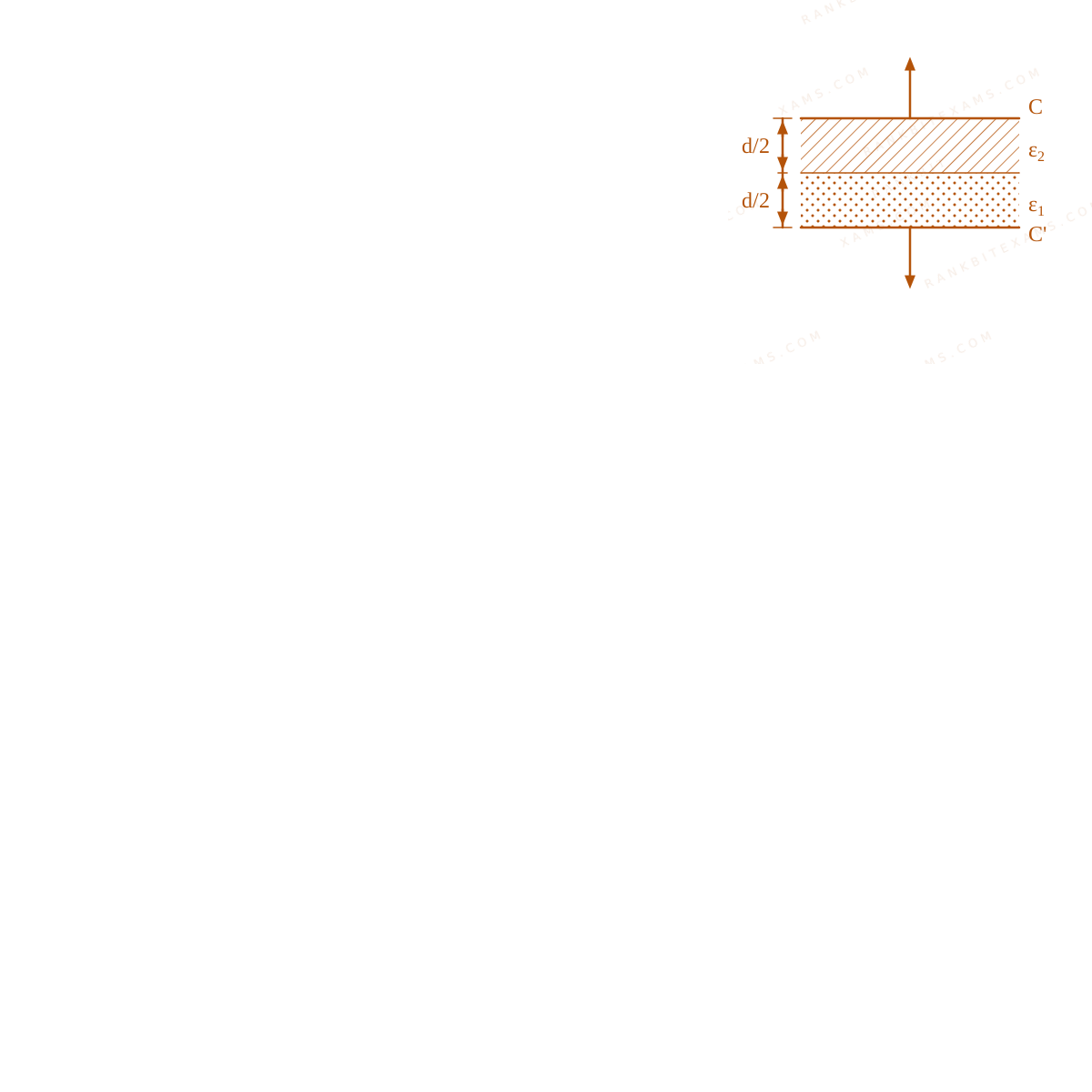
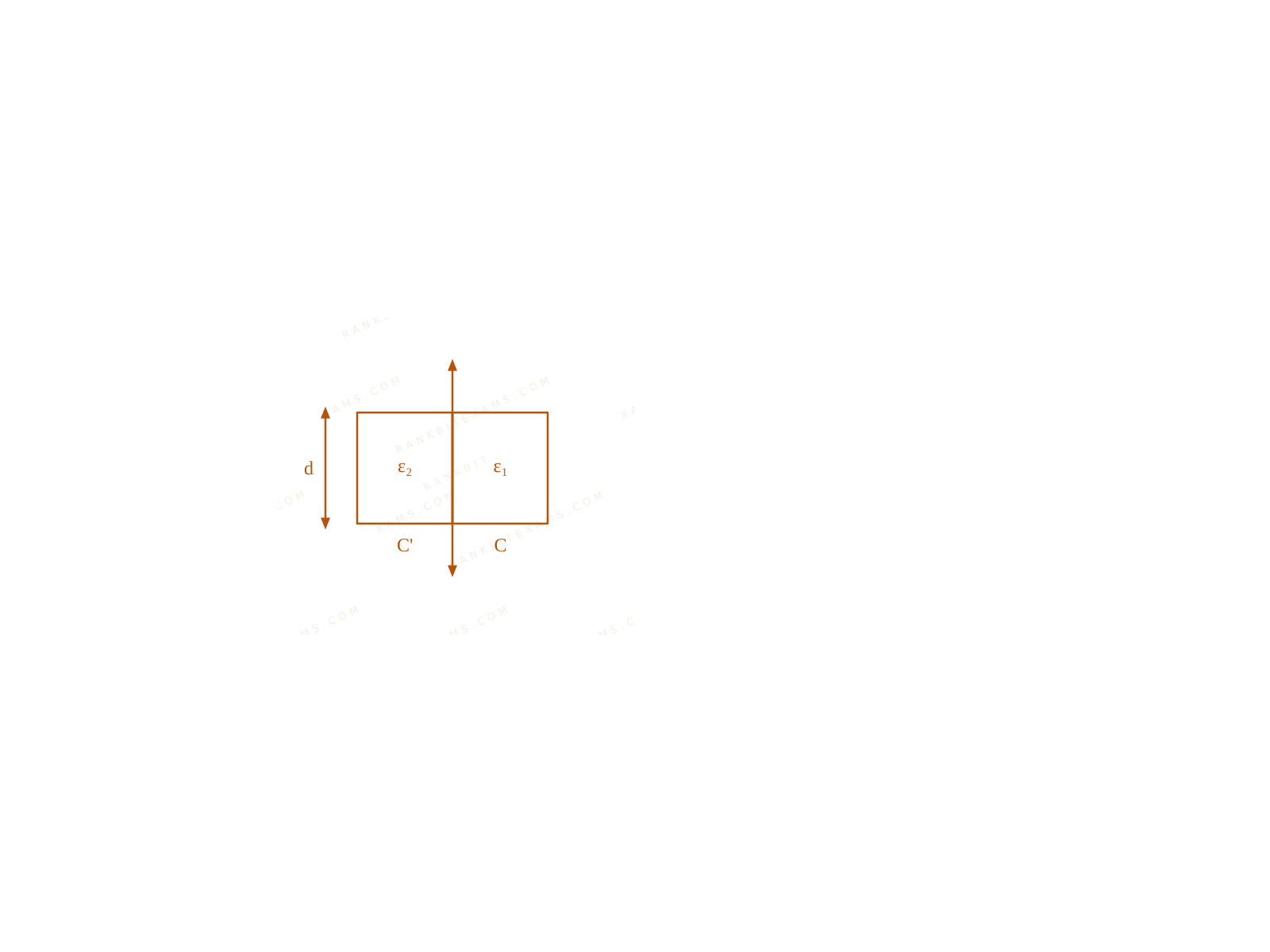
A parallel plate capacitor is filled equally (half) with two dielectrics of dielectric constant varepsilon_1$\varepsilon_1$ and varepsilon_2$\varepsilon_2$, as shown in figures. The distance between the plates is d$d$ and area of each plate is A$A$. If capacitance in first configuration and second configuration are C_1$C_1$ and C_2$C_2$ respectively, then fracC_1C_2$\frac{C_1}{C_2}$ is:
Illustrates two parallel plate configurations: stacked horizontally (series) and stacked vertically (parallel).Illustrates two parallel plate configurations: stacked horizontally (series) and stacked vertically (parallel).
Keywords:#dielectric parallel plate capacitor#capacitance series and parallel#JEE Main 2025 Morning Q8#harmonic arithmetic mean capacitance#dielectric capacitor#series parallel capacitor#dielectric constant ratio
More Electrostatics Previous-Year Questions — Page 9
Q42jee_main_2024_31_jan_morningElectric Field Zero Point
Two charges q$q$ and 3q$3q$ are separated by a distance 'r$r$' in air. At a distance x$x$ from charge q$q$, the resultant electric field is zero. The value of x$x$ is :
A.frac(1 + sqrt3)r$\frac{(1 + \sqrt{3})}{r}$
B.fracr3(1 + sqrt3)$\frac{r}{3(1 + \sqrt{3})}$
C.fracr(1 + sqrt3)$\frac{r}{(1 + \sqrt{3})}$
D.r(1 + sqrt3)$r(1 + \sqrt{3})$
Solution
### Related Formula
E = frackqx^2$$E = \frac{kq}{x^2}$$
### Core Logic
Electric Field Zero Point diagram for Q42 - JEE Main 2024 Morning
For the net electric field to be zero at point P situated at distance x$x$ from charge q$q$, the electric fields produced by both charges must be equal in magnitude and opposite in direction.
Let the charges be placed at ends of a line. Point P is between them since both charges are of the same sign.
(vecE_textnet)_P = 0$$(\vec{E}_{\text{net}})_P = 0$$frackqx^2 = frack(3q)(r-x)^2$$\frac{kq}{x^2} = \frac{k(3q)}{(r-x)^2}$$
### Step 2: Solving for x
Taking square roots on both sides:
frac1x = fracsqrt3r-x$$\frac{1}{x} = \frac{\sqrt{3}}{r-x}$$r - x = sqrt3x$$r - x = \sqrt{3}x$$r = x(sqrt3 + 1)$$r = x(\sqrt{3} + 1)$$x = fracrsqrt3 + 1$$x = \frac{r}{\sqrt{3} + 1}$$
### Evaluation Rubric / Model Answer
null
### Chapter Mix
Class 12 Physics: Electrostatics
Q52jee_main_2024_31_jan_morningCapacitance With Dielectric
A parallel plate capacitor with plate separation5 mathrm~mm$5 \mathrm{~mm}$ is charged up by a battery. It is found that on introducing a dielectric sheet of thickness 2 mathrm~mm$2 \mathrm{~mm}$, while keeping the battery connections intact, the capacitor draws 25 \%$25 \%$ more charge from the battery than before. The dielectric constant of the sheet is _____.
Numerical Answer.Answer: 2 to 2
Solution
### Related Formula
C = fracvarepsilon_0 Ad$$C = \frac{\varepsilon_0 A}{d}$$C' = fracvarepsilon_0 Ad - t + fractK$$C' = \frac{\varepsilon_0 A}{d - t + \frac{t}{K}}$$Q = CV$Q = CV$
### Core Logic
Initially, the charge stored without the dielectric is:
Q_i = fracA varepsilon_0d V$$Q_i = \frac{A \varepsilon_0}{d} V$$
After introducing a dielectric of thickness t$t$, the new capacitance C'$C'$ leads to a new charge Q_f$Q_f$:
Q_f = fracA varepsilon_0 Vd - t + fractK$$Q_f = \frac{A \varepsilon_0 V}{d - t + \frac{t}{K}}$$
### Step 2: Charge Relationship
Given that the capacitor draws 25\%$25\%$ more charge:
Q_f = 1.25 Q_i = frac54 Q_i$$Q_f = 1.25 Q_i = \frac{5}{4} Q_i$$
Equating the expressions:
fracA varepsilon_0 Vd - t + fractK = 1.25 left( fracA varepsilon_0 Vd right)$$\frac{A \varepsilon_0 V}{d - t + \frac{t}{K}} = 1.25 \left( \frac{A \varepsilon_0 V}{d} \right)$$frac15 - 2 + frac2K = frac1.255$$\frac{1}{5 - 2 + \frac{2}{K}} = \frac{1.25}{5}$$frac13 + frac2K = frac1.255 = frac14$$\frac{1}{3 + \frac{2}{K}} = \frac{1.25}{5} = \frac{1}{4}$$3 + frac2K = 4$$3 + \frac{2}{K} = 4$$frac2K = 1 Rightarrow K = 2$$\frac{2}{K} = 1 \Rightarrow K = 2$$
### Evaluation Rubric / Model Answer
null
### Chapter Mix
Class 12 Physics: Electrostatics
More Electrostatics Questions — jee_main_2025_03_april_morning
We Map Every Repeating Question in Competitive Exams.
Say goodbye to generic mock test fatigue. RankBit uses smart analysis to group past exam questions into their foundational Repeating Question Types. Find chapter weightage, track repeating questions, and score higher with targeted practice.
Select Your Target Exam
Choose an exam track below to find formulas per chapter and patterns.
Syncing Exam Intelligence
Mapping formulas and patterns across all tracks…
PATH A — FULL LENGTH PRACTICE
Full Mock Test Hub
Simulate real NTA exam conditions with fully tracked mocks. Time yourself against past papers.
Practice past-year questions one chapter at a time. Pick an exam → subject → chapter and get every PYQ for that topic — pulled together from all past papers — with the chapter's key formulas alongside.