Let f(x) = ∫ x³√(3 - x²) dx[cite: 635, 637]. If 5f(√(2)) = -4 [cite: 638], then f(1) is equal to[cite: 642]:

Solution & Explanation

Related Formula

Method of algebraic parameter substitution: Set 3-x² = t² -2xdx = 2tdt xdx = -tdt

Core Logic

Perform the specified variable parameter replacement steps [cite: 1361, 1362]: 3 - x² = t² x dx = -t dt [cite: 1361, 1362] Rewrite the internal integral block components [cite: 1363]: f(x) = ∫ x² · √(3-x²) · (x dx) = ∫ (3-t²) · t · (-t dt) [cite: 1363] = ∫ (t⁴ - 3t²) dt = (t⁵)/(5) - t³ + C [cite: 1363, 1366]

Return to original reference variable x [cite: 1366]: f(x) = (3-x²)5/25 - (3-x²)3/2 + C [cite: 1366]

Step 1: Constant integration resolving

Evaluate function boundary conditions at x = √(2) [cite: 1366]: f(√(2)) = (3-2)5/25 - (3-2)3/2 + C = (1)/(5) - 1 + C = -(4)/(5) + C [cite: 1366] Given 5f(√(2)) = -4 f(√(2)) = -(4)/(5) [cite: 638, 1366]. -(4)/(5) + C = -(4)/(5) C = 0 [cite: 1366]

Step 2: Numeric tracking value

Evaluate final targeted definition state value at x=1 [cite: 1367]: f(1) = (3-1)5/25 - (3-1)3/2 = 25/25 - 23/2 [cite: 1367] = 23/2((2)/(5) - 1) = 2√(2)(-(3)/(5)) = - 6√(2)5 [cite: 1367, 1368]

Pattern Recognition

Splitting powers of x to create a direct match with internal derivative differential flags speeds up the integration transformation sequence.

Chapter Mix

Class 12 Mathematics: Integrals

Reference Study Guides

More Integrals Previous-Year Questions — Page 7

Q75 jee_main_2025_03_april_morning Area Under Bounded Curves
The area of the region bounded by the curve y = |x|, x|x - 2| [cite: 699], the x-axis and the lines x = -2 and x = 4 is equal to[cite: 699, 702]:
Numerical Answer. Answer: 12 to 12

Solution

Related Formula

Definite integration geometry area: Split boundary zones around intersections where functional dominant switches occur.
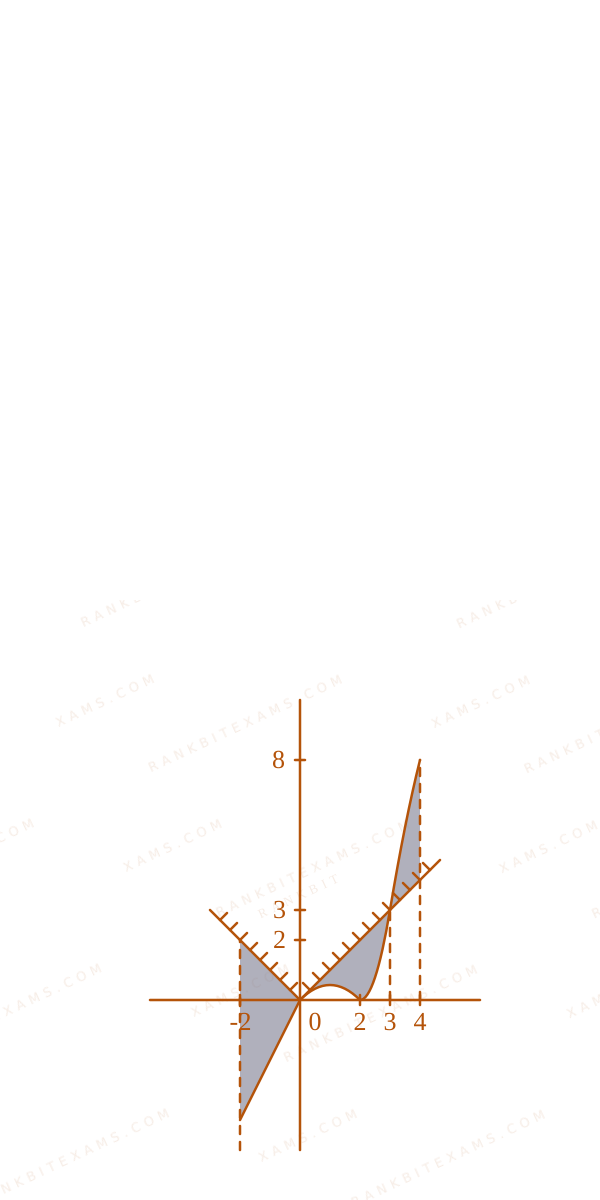
Area Under Bounded Curves diagram for Q75 - JEE Main 2025 Morning

Core Logic

Analyze intersection points between y₁ = |x| and y₂ = x|x-2| across required integration span regions:

  • For x in [-2, 0]: |x| = -x and x|x-2| = -x(2-x) = x² - 2x. Max curve tracks through distinct segments.
  • For positive sectors, compute intersections: x = x(2-x) x = 1 or x=0. Also check switch locations where graphs swap dominance.
Step 1: Setting up separate area integral blocks

Using geometric area partitions calculated across continuous regions [cite: 1495]: Area = (1)/(2) × 2 × 2 + (1)/(2) × 3 × 3 + (1)/(2) × 1 × 11 = 12 [cite: 1495] Alternatively, splitting the boundary metrics via continuous definite limits yields identical whole tracking blocks matching exactly to 12 total units[cite: 1495].

Pattern Recognition

Plotting multiple curves dynamically highlights dominance shifts quickly. Computing distinct straight triangular chunks saves valuable integration time.

Chapter Mix

Class 12 Mathematics: Integrals (Application of Integrals)
Q68 jee_main_2025_04_april_evening Properties of Definite Integrals
Let f(x) + 2f((1)/(x)) = x² + 5 and 2 g (x) - 3 g ((1)/(2)) = x, x > 0. If α = ∫_ 1 ^ 2 f (x) d x, and β = ∫_ 1 ^ 2 g (x) d x, then the value of 9α + β is:
  • A. 1
  • B. 0
  • C. 10
  • D. 11

Solution

Core Logic

We have two functional equations to solve before integrating.

Equation 1: f(x) + 2f((1)/(x)) = x² + 5 Replace x with (1)/(x):

f((1)/(x)) + 2f(x) = (1)/(x²) + 5

Multiplying this new equation by 2 and subtracting the original Equation 1 eliminates the f((1)/(x)) term:

4f(x) + 2f((1)/(x)) - (f(x) + 2f((1)/(x))) = 2((1)/(x²) + 5) - (x² + 5) 3f(x) = (2)/(x²) - x² + 5 f(x) = (2)/(3x²) - (x²)/(3) + (5)/(3)
Step 1: Finding alpha

Integrate f(x) from 1 to 2:

α = ∫₁² ( (2)/(3x²) - (x²)/(3) + (5)/(3) ) dx = [ -(2)/(3x) - (x³)/(9) + (5x)/(3) ]₁² α = ( -(1)/(3) - (8)/(9) + (10)/(3) ) - ( -(2)/(3) - (1)/(9) + (5)/(3) ) = (19)/(9) - (8)/(9) = (11)/(9)

Thus, 9α = 11.

Step 2: Solving for g(x) and finding beta

We are given 2g(x) - 3g((1)/(2)) = x. Substitute x = (1)/(2):

2g((1)/(2)) - 3g((1)/(2)) = (1)/(2) -g((1)/(2)) = (1)/(2) g((1)/(2)) = -(1)/(2)

Substitute this constant value back into the original equation:

2g(x) - 3(-(1)/(2)) = x 2g(x) + (3)/(2) = x g(x) = (x)/(2) - (3)/(4)

Now find β:

β = ∫₁² ( (x)/(2) - (3)/(4) ) dx = [ (x²)/(4) - (3x)/(4) ]₁² = ( 1 - (3)/(2) ) - ( (1)/(4) - (3)/(4) ) = -(1)/(2) - (-(1)/(2)) = 0
Step 3: Calculating 9alpha + beta

Combining our values:

9α + β = 11 + 0 = 11
Pattern Recognition

Functional equations involving x → (1)/(x) are easily solved by treating the swapped forms as a system of linear equations, allowing direct isolation of the underlying function.

Chapter Mix

Class 12 Mathematics: Definite Integrals Class 12 Mathematics: Functional Equations

Q72 jee_main_2025_04_april_evening Integration by Substitution
If ∫ (√(1 + x²) + x)¹⁰(√(1 + x²) - x)⁹dx = (1)/(m) (( 1 + x ^ 2 + x) ^ n (n 1 + x ^ 2 - x)) + C where C is the constant of integration and m,nin N, then m + n is equal to
Numerical Answer. Answer: 379 to 379

Solution

Core Logic

Let's simplify the integrand by rationalizing the denominator term block. Notice that:

(√(1+x²) - x)(√(1+x²) + x) = (1+x²) - x² = 1 1√(1+x²) - x = √(1+x²) + x

Substituting this back into the denominator expression column:

I = ∫ (√(1+x²) + x)¹⁰ · (√(1+x²) + x)⁹ dx = ∫ (√(1+x²) + x)¹⁹ dx
Step 1: Implementing the Substitution Path

Let t = √(1+x²) + x. Then:

dt = ( x√(1+x²) + 1 ) dx = ( x + √(1+x²)√(1+x²) ) dx = t√(1+x²) dx dx = √(1+x²)t dt

Since √(1+x²) + x = t and √(1+x²) - x = (1)/(t), adding both gives:

2√(1+x²) = t + (1)/(t) √(1+x²) = (1)/(2)(t + (1)/(t))

Thus, dx = (1)/(2t)(t + (1)/(t)) dt = (1)/(2)(1 + (1)/(t²)) dt.

Step 2: Integrating with respect to t

Substitute these back into the integral:

I = ∫ t¹⁹ · (1)/(2)(1 + (1)/(t²)) dt = (1)/(2) ∫ (t¹⁹ + t¹⁷) dt I = (1)/(2) ( t²⁰20 + t¹⁸18 ) + C = t¹⁸4 ( (t²)/(10) + (1)/(9) ) + C = t¹⁸360 (9t² + 10) + C
Step 3: Matching Form and Finding m + n

To match the template format, let's pull out a factor of t:

I = t¹⁹360 ( 9t + (10)/(t) ) + C = t¹⁹360 ( 9(√(1+x²)+x) + 10(√(1+x²)-x) ) + C I = (√(1+x²)+x)¹⁹360 ( 19√(1+x²) - x ) + C

Comparing this directly with the given answer format, we identify:

  • m = 360
  • n = 19
  • Computing m + n:

m + n = 360 + 19 = 379
Pattern Recognition

Expressions containing conjugate factors like √(1+x²) ± x frequently simplify under rationalization because their product equals 1. This dynamic quickly reduces fractional components into single power blocks.

Chapter Mix

Class 12 Mathematics: Indefinite Integrals

Q66 jee_main_2025_04_april_morning Properties of Definite Integrals
The value of ∫₋₁¹ (1 + √(|x| - x))e^x + (√(|x| - x))e-xe^x + e-x dx is equal to
  • A. 3 - 2√(2)3
  • B. 2 + 2√(2)3
  • C. 1 - 2√(2)3
  • D. 1 + 2√(2)3

Solution

Related Formula

King's property of definite integrals:

∫ₐb f(x)dx = ∫ₐb f(a+b-x)dx
Core Logic

Let the given integral be I. Apply King's property by substituting x → -x:

I = ∫₋₁¹ (1 + √(|x| + x))e-x + (√(|x| + x))exe-x + ex dx

Add both integral expressions 2I = I + I:

2I = ∫₋₁¹ (e^x + e-x) + (√(|x| - x) + √(|x| + x))(e^x + e-x)e^x + e-x dx 2I = ∫₋₁¹ (1 + √(|x| - x) + √(|x| + x)) dx
Step 1: Apply Symmetry Properties

The integrand is completely even. Hence, convert intervals:

2I = 2∫₀¹ (1 + √(|x| - x) + √(|x| + x)) dx

For x in [0,1], |x| = x √(|x| - x) = 0 and √(|x| + x) = √(2x):

I = ∫₀¹ (1 + √(2x)) dx
Step 2: Final Integration Execution
I = [ x + √(2) · x3/23/2 ]₀¹ = [ x + 2√(2)3x3/2 ]₀¹ I = 1 + 2√(2)3
Pattern Recognition

When functions involve combinations of exponential components (e^x, e-x) over symmetric boundaries, adding the variable reflection eliminates exponential fractions instantly.

Chapter Mix

Class 12 Mathematics: Definite Integration

Q57 jee_main_2025_07_april_evening Area Under Curves
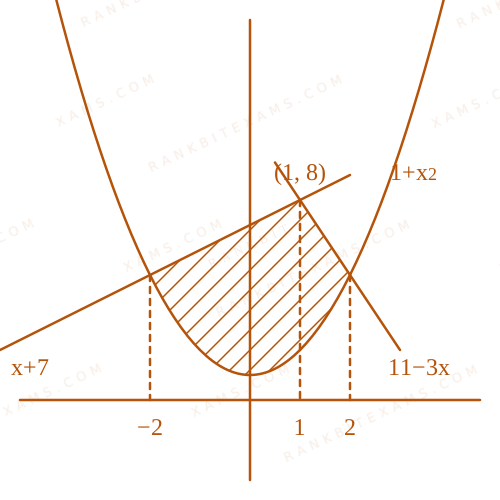
If the area of the region (x,y):1 + x²≤ y≤ x + 7,11 - 3x is A, then 3A is equal to
  • A. 50
  • B. 49
  • C. 46
  • D. 47

Solution

Related Formula

The area enclosed between upper bounding function yupper and lower function ylower is:

Area = ∫ₐb (yupper - ylower) dx
Core Logic

We need to find the intersection points of the curves to understand the x+7, 11-3x boundary transition:

  • x+7 = 11-3x 4x = 4 x = 1.
  • Hence, the line switches behavior at x=1.

  • Intersecting 1+x² with x+7:
x² - x - 6 = 0 (x-3)(x+2) = 0 x = -2 or x = 3
  • Intersecting 1+x² with 11-3x:
x² + 3x - 10 = 0 (x+5)(x-2) = 0 x = 2 or x = -5

Area Under Curves diagram for Q57 - JEE Main 2025 Evening

Step 1: Set up Integrals

The transition points show that from x = -2 to 1, the upper line is x+7, and from x = 1 to 2, the upper line is 11-3x.

A = ∫₋₂¹ ((x + 7) - (1 + x²)) dx + ∫₁² ((11 - 3x) - (1 + x²)) dx A = ∫₋₂¹ (x + 6 - x²) dx + ∫₁² (10 - 3x - x²) dx
Step 2: Integration Evaluation

Evaluating the first integral:

[ (x²)/(2) + 6x - (x³)/(3) ]₋₂¹ = ((1)/(2) + 6 - (1)/(3)) - (2 - 12 + (8)/(3)) = (37)/(6) - (-(22)/(3)) = (27)/(2)

Evaluating the second integral:

[ 10x - (3x²)/(2) - (x³)/(3) ]₁² = (20 - 6 - (8)/(3)) - (10 - (3)/(2) - (1)/(3)) = (34)/(3) - (49)/(6) = (19)/(6)

Total Area A:

A = (27)/(2) + (19)/(6) = (81 + 19)/(6) = (100)/(6) = (50)/(3)
Step 3: Calculate 3A

Multiplying the total area by 3:

3A = 3 · ((50)/(3)) = 50
Pattern Recognition

When a boundary contains a or component, always solve for their internal intersection first to identify the exact splitting point of your definite integrals.

Chapter Mix

Class 12 Mathematics: Integral Calculus

More Integrals Questions — jee_main_2025_03_april_morning

Practice all Integrals previous-year questions →

Rankbit System
JEE Physics: Waves (+15.5%) | Electrostatics: Concentric Shells (-29.7%) | Modern Physics: Photoelectric Clones (+34.2%) | Mathematics: Definite Integrals (+18.1%) | Chemistry: Coordination Splitting (-11.4%) | JEE Physics: Waves (+15.5%) | Electrostatics: Concentric Shells (-29.7%) | Modern Physics: Photoelectric Clones (+34.2%) | Mathematics: Definite Integrals (+18.1%) | Chemistry: Coordination Splitting (-11.4%)
