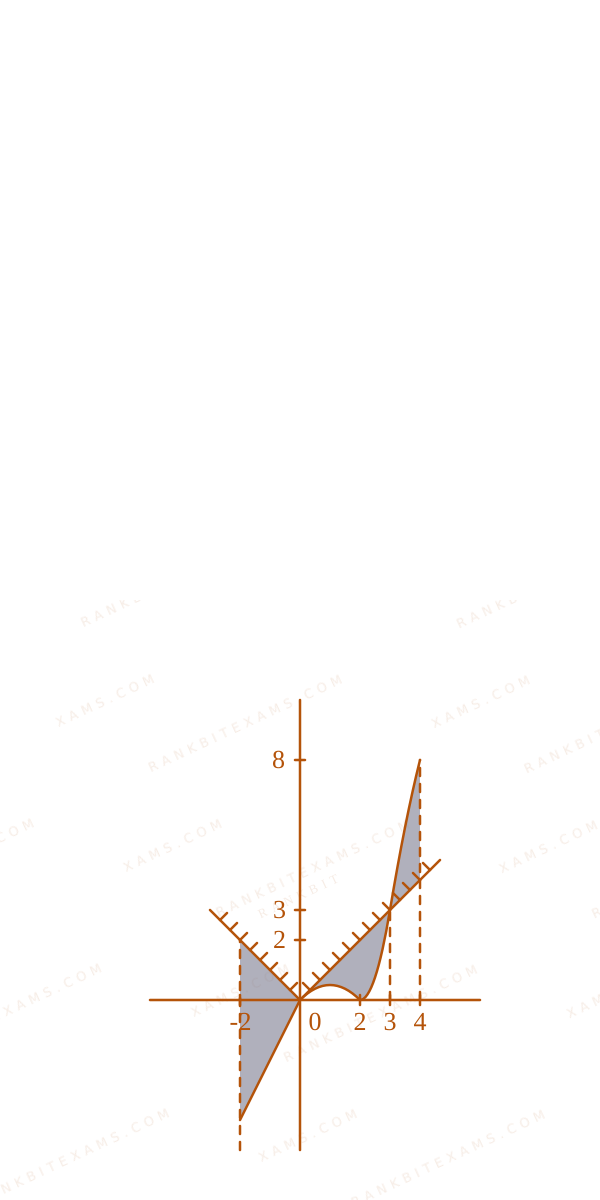
The area of the region bounded by the curve y = |x|, x|x - 2| [cite: 699], the x-axis and the lines x = -2 and x = 4 is equal to[cite: 699, 702]:

Numerical Answer Type:
Enter a numerical value Answer: 12 to 12 +4 marks

Solution & Explanation

Related Formula

Definite integration geometry area: Split boundary zones around intersections where functional dominant switches occur.

Area Under Bounded Curves diagram for Q75 - JEE Main 2025 Morning

Core Logic

Analyze intersection points between y₁ = |x| and y₂ = x|x-2| across required integration span regions:

  • For x in [-2, 0]: |x| = -x and x|x-2| = -x(2-x) = x² - 2x. Max curve tracks through distinct segments.
  • For positive sectors, compute intersections: x = x(2-x) x = 1 or x=0. Also check switch locations where graphs swap dominance.
Step 1: Setting up separate area integral blocks

Using geometric area partitions calculated across continuous regions [cite: 1495]: Area = (1)/(2) × 2 × 2 + (1)/(2) × 3 × 3 + (1)/(2) × 1 × 11 = 12 [cite: 1495] Alternatively, splitting the boundary metrics via continuous definite limits yields identical whole tracking blocks matching exactly to 12 total units[cite: 1495].

Pattern Recognition

Plotting multiple curves dynamically highlights dominance shifts quickly. Computing distinct straight triangular chunks saves valuable integration time.

Chapter Mix

Class 12 Mathematics: Integrals (Application of Integrals)

Reference Study Guides

More Integrals Previous-Year Questions — Page 8

Q72 jee_main_2025_07_april_evening Integration by Substitution
If ∫ ((1)/(x) +(1)/(x³))( [2]3x⁻²⁴ + x⁻²⁶)dx = - (α)/(3 (α + 1)) (3 x ^ β + x ^ γ) ^ (α + 1)/(α) + C, x > 0, (α, β, γ in Z), where C is the constant of integration, then α + β + γ is equal to
Numerical Answer. Answer: 19 to 19

Solution

Related Formula

Standard power integration formula rule is:

∫ uⁿ du = uⁿ⁺¹n+1 + C
Core Logic

Rewrite the integral by adjusting powers inside the radical container:

I = ∫ ((1)/(x²) + (1)/(x⁴)) ((3)/(x) + (1)/(x³))(1)/(23) dx

Let t = (3)/(x) + (1)/(x³) dt = -3((1)/(x²) + (1)/(x⁴)) dx.

Step 1: Integrate

Substituting t into the equation:

∫ t1/23 dt-3 = -(1)/(3) · t24/2324/23 = -(23)/(3(24)) t(24)/(23)

Comparing parameters directly yields:

α = 23, β = -1, γ = -3 α + β + γ = 23 - 1 - 3 = 19
Pattern Recognition

Pull out high powers from the root factor to seamlessly reveal a matching f'(x) substitution pair on the outside.

Chapter Mix

Class 12 Mathematics: Integral Calculus

Q75 jee_main_2025_24_jan_evening Indefinite Integration of Algebraic Functions
If ∫ 2x²+5x+9 x²+x+1dx=x x²+x+1+α x²+x+1+β ₑ|x+(1)/(2)+ x²+x+1|+C where C is the constant of integration, then α+2β is equal to \_\_\_\_.
Numerical Answer. Answer: 16

Solution

Related Formula

Standard integration templates for quadratic forms:

∫ √(t² + k²) dt = (t)/(2)√(t²+k²) + (k²)/(2)ln|t + √(t²+k²)| ∫ 1√(t² + k²) dt = ln|t + √(t²+k²)|
Core Logic

Decompose the numerator using polynomial differentiation components :

2x² + 5x + 9 = A(x² + x + 1) + B(2x + 1) + C

Equating coefficients dynamically yields :

  • For x²: A = 2 .
  • For x: A + 2B = 5 ⇒ 2 + 2B = 5 ⇒ B = (3)/(2) .
  • Constant: A + B + C = 9 ⇒ 2 + (3)/(2) + C = 9 ⇒ C = (11)/(2) .
  • Rewrite the integrand into three parts :

2∫ √(x²+x+1) dx + (3)/(2)∫ 2x+1√(x²+x+1) dx + (11)/(2)∫ 1√(x²+x+1) dx
Step 1: Complete Quadratics & Integrate

Format using completing the square technique: x² + x + 1 = (x + (1)/(2))² + ( √(3)2)².

  • First Integral evaluation:
2 [ ((x+(1)/(2)))/(2)√(x²+x+1) + (3)/(8)ln|x+(1)/(2)+√(x²+x+1)| ] = (x+(1)/(2))√(x²+x+1) + (3)/(4)ln|x+(1)/(2)+√(x²+x+1)|
  • Second Integral evaluation :
(3)/(2) · 2√(x²+x+1) = 3√(x²+x+1)
  • Third Integral evaluation :
(11)/(2)ln|x+(1)/(2)+√(x²+x+1)|
Step 2: Collect Like Terms

Gather and combine matching factor parameters:

Total = (x + (1)/(2) + 3)√(x²+x+1) + ((3)/(4) + (11)/(2))ln|x+(1)/(2)+√(x²+x+1)| Total = (x + (7)/(2))√(x²+x+1) + (25)/(4)ln|x+(1)/(2)+√(x²+x+1)| = x√(x²+x+1) + (7)/(2)√(x²+x+1) + (25)/(4)ln|x+(1)/(2)+√(x²+x+1)|
Step 3: Extract Coefficients

Compare directly against the given expression variables :

α = (7)/(2), β = (25)/(4) α + 2β = (7)/(2) + 2((25)/(4)) = (7)/(2) + (25)/(2) = (32)/(2) = 16
Pattern Recognition

When dividing large numerators containing x² elements over quadratic square roots, using matching coefficient expansion rules prevents lengthy substitution errors completely.

Chapter Mix

Class 12 Mathematics: Integrals

Q52 jee_main_2025_24_jan_morning Properties of Definite Integrals
If I(m,n) = ∫₀¹ xm-1 (1-x)ⁿ⁻¹ dx where m, n > 0, then I(9,14) + I(10,13) is :
  • A. I(9, 1)
  • B. I(19, 27)
  • C. I(1, 13)
  • D. I(9, 13)

Solution

Related Formula

The beta function integral format satisfies:

I(m,n) = ∫₀¹ xm-1 (1-x)ⁿ⁻¹ dx
Core Logic

Let's combine the terms of the requested sum directly by inserting their respective definitions:

I(9,14) = ∫₀¹ x⁹⁻¹ (1-x)¹⁴⁻¹ dx = ∫₀¹ x⁸ (1-x)¹³ dx I(10,13) = ∫₀¹ x¹⁰⁻¹ (1-x)¹³⁻¹ dx = ∫₀¹ x⁹ (1-x)¹² dx
Step 1: Factoring out common algebraic terms

Summing the two components:

I(9,14) + I(10,13) = ∫₀¹ [ x⁸ (1-x)¹³ + x⁹ (1-x)¹² ] dx

Factor out the common term x⁸ (1-x)¹² inside the integrand:

= ∫₀¹ x⁸ (1-x)¹² [ (1-x) + x ] dx = ∫₀¹ x⁸ (1-x)¹² (1) dx = ∫₀¹ x⁹⁻¹ (1-x)¹³⁻¹ dx = I(9,13)
Pattern Recognition

When dealing with linear combinations of beta functions with shifting parameter indices, directly writing down the definite integral expression often results in immediate algebraic cancellation or simplification via basic factoring.

Chapter Mix

Class 12 Mathematics: Definite Integrals

Q71 jee_main_2025_24_jan_morning Differentiating Under the Integral Sign
Let f be a differentiable function such that 2(x+2)²f(x) - 3(x+2)² = 10∫₀x(t+2)f(t)dt for x ≥ 0. Then f(2) is equal to ________.
Numerical Answer. Answer: 19

Solution

Related Formula

The Leibniz Integral Rule template allows direct differentiation of an integral with variable limits:

(d)/(dx)( ∫₀x g(t) dt ) = g(x)
Core Logic

Differentiate both sides of the given functional equation with respect to x using the product rule:

(d)/(dx)[ 2(x+2)² f(x) - 3(x+2)² ] = (d)/(dx)[ 10∫₀x(t+2)f(t)dt ] 4(x+2)f(x) + 2(x+2)² f'(x) - 6(x+2) = 10(x+2)f(x)

Since x ≥ 0, the factor (x+2) is strictly non-zero. Divide the entire equation by 2(x+2):

2f(x) + (x+2)f'(x) - 3 = 5f(x) (x+2)f'(x) - 3f(x) = 3
Step 1: Solve the First-Order Differential Equation

Rearrange the expression into standard linear differential equation form where y = f(x):

(dy)/(dx) - (3)/(x+2)y = (3)/(x+2)

Compute the Integrating Factor (I.F.):

I.F. = e∫ -(3)/(x+2) dx = e-3ln(x+2) = (x+2)⁻³

Multiply through by the I.F. and integrate:

y · (x+2)⁻³ = ∫ (3)/(x+2) · (x+2)⁻³ dx = ∫ 3(x+2)⁻⁴ dx (f(x))/((x+2)³) = 3 · (x+2)⁻³-3 + C = -(x+2)⁻³ + C f(x) = -1 + C(x+2)³
Step 2: Apply the Boundary Condition

Find the boundary condition by substituting x = 0 into the original integral equation equation:

2(0+2)² f(0) - 3(0+2)² = 10 ∫₀⁰ (t+2)f(t) dt 8f(0) - 12 = 0 f(0) = (12)/(8) = (3)/(2)

Substitute x = 0 into our general solution formula:

f(0) = -1 + C(0+2)³ (3)/(2) = -1 + 8C (5)/(2) = 8C C = (5)/(16)

Thus, the explicit function is:

f(x) = -1 + (5)/(16)(x+2)³
Step 3: Evaluate at target point x = 2

Substitute x = 2 into the final function equation:

f(2) = -1 + (5)/(16)(2+2)³ = -1 + (5)/(16)(64) f(2) = -1 + 5(4) = -1 + 20 = 19
Pattern Recognition

When an equation contains a variable integral limit ∫₀^x, differentiating both sides using the Leibniz rule converts it into a standard differential equation. The initial value is found by setting x = 0 directly in the original expression.

Chapter Mix

Class 12 Mathematics: Definite Integrals Class 12 Mathematics: Differential Equations
Q jee_main_2025_28_jan_evening Integration by Substitution
If f(x) = ∫ 1x1/4(1+x1/4) dx, f(0) = -6, then f(1) is equal to:
  • A. ₑ2+2
  • B. 4( ₑ2-2)
  • C. 2- ₑ2
  • D. 4( ₑ2+2)

Solution

Related Formula

Standard substitution method and logarithmic integral rule:

∫ (1)/(t+1) dt = ln|t+1| + C
Core Logic

Let x = t⁴ dx = 4t³ dt. When substituting into the integral:

f(x) = ∫ (4t³)/(t(1+t)) dt = 4 ∫ (t²)/(1+t) dt
Step 1: Simplify the Integral

Rewrite the numerator t² as (t² - 1) + 1:

4 ∫ ((t² - 1) + 1)/(1+t) dt = 4 ∫ ( ((t-1)(t+1))/(1+t) + (1)/(1+t) ) dt 4 ∫ (t - 1) dt + 4 ∫ (1)/(t+1) dt 4 [ ((t-1)²)/(2) ] + 4 ln|t+1| + C = 2(t-1)² + 4 ln|t+1| + C

Substitute back t = x1/4:

f(x) = 2(x1/4 - 1)² + 4 ln(1 + x1/4) + C
Step 2: Solve for Constant C and Find f(1)

Given f(0) = -6:

-6 = 2(0 - 1)² + 4 ln(1 + 0) + C -6 = 2 + 0 + C C = -8

Now find f(1):

f(1) = 2(11/4 - 1)² + 4 ln(1 + 11/4) - 8 f(1) = 2(0) + 4 ln(2) - 8 = 4 ln 2 - 8 = 4(ln 2 - 2)
Pattern Recognition

By adding and subtracting terms in the numerator (t²-1+1), we can quickly bypass long division for polynomials and directly integrate using standard forms.

Chapter Mix

Class 12 Mathematics: Indefinite Integration

More Integrals Questions — jee_main_2025_03_april_morning

Practice all Integrals previous-year questions →

Rankbit System
JEE Physics: Waves (+15.5%) | Electrostatics: Concentric Shells (-29.7%) | Modern Physics: Photoelectric Clones (+34.2%) | Mathematics: Definite Integrals (+18.1%) | Chemistry: Coordination Splitting (-11.4%) | JEE Physics: Waves (+15.5%) | Electrostatics: Concentric Shells (-29.7%) | Modern Physics: Photoelectric Clones (+34.2%) | Mathematics: Definite Integrals (+18.1%) | Chemistry: Coordination Splitting (-11.4%)
