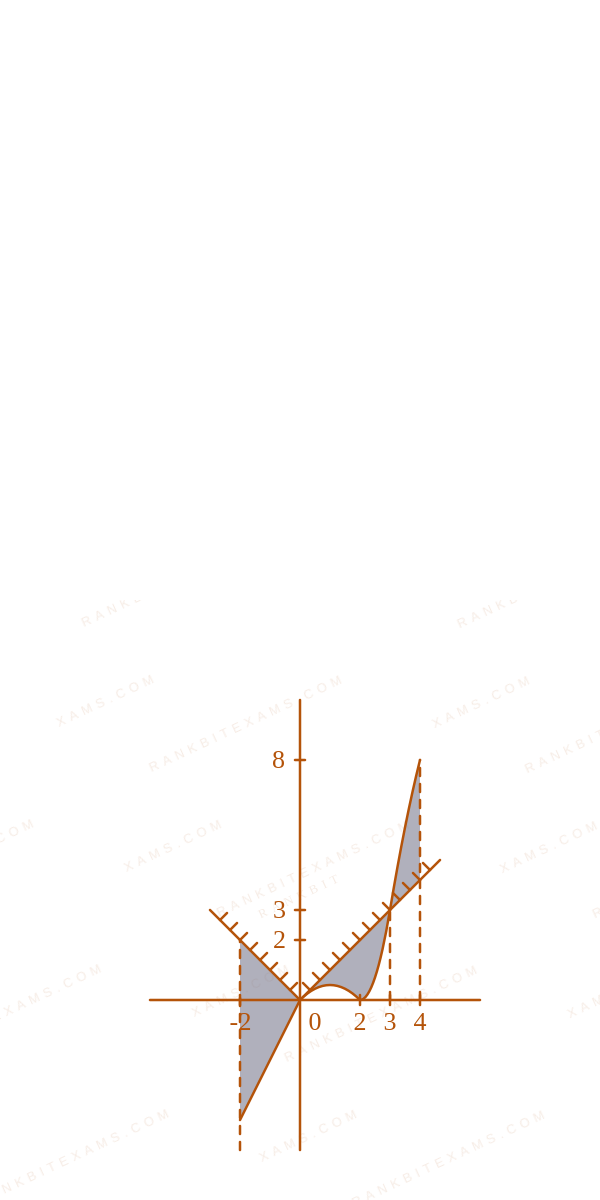
The area of the region bounded by the curve y = |x|, x|x - 2|, the x-axis and the lines x = -2 and x = 4 is equal to:

Numerical Answer Type:
Enter a numerical value Answer: 12 to 12 +4 marks

Solution & Explanation

Related Formula

Definite integration geometry area: Split boundary zones around intersections where functional dominant switches occur.

Area Under Bounded Curves diagram for Q75 - JEE Main 2025 Morning

Core Logic

Analyze intersection points between y₁ = |x| and y₂ = x|x-2| across required integration span regions:

  • For x in [-2, 0]: |x| = -x and x|x-2| = -x(2-x) = x² - 2x. Max curve tracks through distinct segments.
  • For positive sectors, compute intersections: x = x(2-x) x = 1 or x=0. Also check switch locations where graphs swap dominance.
Step 1: Setting up separate area integral blocks

Using geometric area partitions calculated across continuous regions:

Area = (1)/(2) × 2 × 2 + (1)/(2) × 3 × 3 + (1)/(2) × 1 × 11 = 12

Alternatively, splitting the boundary metrics via continuous definite limits yields identical whole tracking blocks matching exactly to 12 total units.

Pattern Recognition

Plotting multiple curves dynamically highlights dominance shifts quickly. Computing distinct straight triangular chunks saves valuable integration time.

Chapter Mix

Class 12 Mathematics: Integrals (Application of Integrals)

Reference Study Guides

More Integrals Previous-Year Questions — Page 4

Q24 jee_main_2026_28_january_morning Properties of Definite Integrals
The value of Σr=1²⁰(| π(∫₀rx| π x|dx)|) is ____.
Numerical Answer. Answer: 210 to 210

Solution

Core Logic

Let Iᵣ = ∫₀r x | π x| dx. Apply King's property of definite integrals: ∫₀a f(x) dx = ∫₀a f(a-x) dx.

Iᵣ = ∫₀r (r - x) | π(r - x)| dx

Since r is an integer, | π(r - x)| = | (π r - π x)| = |(-1)^r (π x)| = | π x|.

Iᵣ = ∫₀r (r - x) | π x| dx

Adding the original and the transformed integral:

2Iᵣ = ∫₀r r | π x| dx Iᵣ = (r)/(2) ∫₀r | π x| dx
Step 1: Integral of Modulus

The function | π x| is periodic with period 1. Using the property of periodic functions ∫₀nT f(x)dx = n ∫₀T f(x)dx:

∫₀r | π x| dx = r ∫₀¹ | π x| dx

For x in [0, 1], π x ≥ 0.

∫₀¹ π x dx = [ -( π x)/(π) ]₀¹ = -(-1 - 1)/(π) = (2)/(π)

So, Iᵣ = (r)/(2) ( r · (2)/(π) ) = (r²)/(π).

Step 2: Evaluate the Sum

The expression inside the summation is:

√(π Iᵣ) = √(π · (r²)/(π)) = √(r²) = r

So the total sum is:

S = Σr=1²⁰ r S = (20 × 21)/(2) = 210
Chapter Mix

Class 12 Mathematics: Integrals Class 11 Mathematics: Sequences and Series

Q13 jee_main_2026_28_january_evening Greatest Integer Function integrals
Let [·] denote the greatest integer function. Then ∫-(π)/(2)(π)/(2)((12(3+[x]))/(3+[ x]+[ x]))dx is equal to:
  • A. 15π + 4
  • B. 11π + 2
  • C. 13π + 1
  • D. 12π + 5

Solution

Core Logic

Split the integral I at integer points and trigonometric step thresholds between -π/2 ≈ -1.57 and π/2 ≈ 1.57: Intervals are: (-π/2, -1), (-1, 0), (0, 1), (1, π/2). For all x in (-π/2, π/2) excluding exactly 0, [ x] = 0. [ x] = -1 for x in (-π/2, 0) and [ x] = 0 for x in (0, π/2).

Execution

Evaluate in pieces:

  • x in (-π/2, -1):
  • [x] = -2, [ x] = -1, [ x] = 0. Integrand = (12(3 - 2))/(3 - 1 + 0) = (12(1))/(2) = 6.

  • x in (-1, 0):
  • [x] = -1, [ x] = -1, [ x] = 0. Integrand = (12(3 - 1))/(2) = (24)/(2) = 12.

  • x in (0, 1):
  • [x] = 0, [ x] = 0, [ x] = 0. Integrand = (12(3 + 0))/(3) = 12.

  • x in (1, π/2):
  • [x] = 1, [ x] = 0, [ x] = 0. Integrand = (12(3 + 1))/(3) = (48)/(3) = 16.

    Integrate piece by piece:

I = ∫-π/2⁻¹ 6 dx + ∫₋₁⁰ 12 dx + ∫₀¹ 12 dx + ∫₁π/2 16 dx I = 6(-1 + π/2) + 12(0 - (-1)) + 12(1 - 0) + 16(π/2 - 1) I = 3π - 6 + 12 + 12 + 8π - 16

I = 11π + 2

Pattern Recognition

For integrals combining integer functions and trigonometric boundaries, breaking the domain purely at integer values (-1, 0, 1) generally perfectly matches trigonometric boundaries since the ranges of and in (-π/2, π/2) hover near these integers.

Chapter Mix

Class 12 Maths: Definite Integration

Q19 jee_main_2026_28_january_evening Substitution of Fractional Powers
Let f(x) = ∫ dxx(2/3) + 2x(1/2) be such that f(0) = -26 + 24 ₑ(2). If f(1) = a + b ₑ(3) where a, b in Z, then a + b is equal to:
  • A. -18
  • B. -5
  • C. -11
  • D. -26

Solution

Core Logic
f(x) = ∫ dxx2/3 + 2x1/2

To eliminate fractional powers, use substitution. The LCM of denominators 3 and 2 is 6. Put x = t⁶ ⇒ dx = 6t⁵ dt.

Integration steps watermark

Execution
f(x) = ∫ (6t⁵ dt)/(t⁴ + 2t³) = 6 ∫ (t²)/(t + 2) dt

Rewrite the numerator using polynomial division or algebraic manipulation:

6 ∫ ((t² - 4) + 4)/(t + 2) dt = 6 [ ∫ (t - 2) dt + 4 ∫ (1)/(t + 2) dt ] = 6 [ (t²)/(2) - 2t + 4 ln|t + 2| ] + C = 3t² - 12t + 24 ln|t + 2| + C

Substitute t = x1/6:

f(x) = 3x1/3 - 12x1/6 + 24 ln|x1/6 + 2| + C

Evaluate constant C using f(0): f(0) = 24 ln 2 + C = -26 + 24 ln 2 ⇒ C = -26.

Find f(1):

f(1) = 3(1) - 12(1) + 24 ln(1 + 2) - 26 = -9 - 26 + 24 ln 3 = -35 + 24 ln 3

Given f(1) = a + b ln 3, we map a = -35 and b = 24. a + b = -35 + 24 = -11.

Pattern Recognition

For integrals with multiple roots x1/m and x1/n, substituting x = tLCM(m,n) strictly normalizes the algebraic fraction into simple polynomial synthetic division.

Chapter Mix

Class 12 Maths: Indefinite Integration

Q57 jee_main_2025_02_april_evening Properties of Definite Integrals
Let (a, b) be the point of intersection of the curve x² = 2y and the straight line y - 2x - 6 = 0 in the second quadrant. Then the integral I = ∫ₐb (9x²)/(1 + 5^x) dx is equal to:
  • A. 24
  • B. 27
  • C. 18
  • D. 21

Solution

Related Formula
King's Property: ∫ₐb f(x) dx = ∫ₐb f(a+b-x) dx
Core Logic

First, we find the coordinates of intersection in the second quadrant to determine the integration limits a and b.

Step 1: Find points of intersection

Substitute y = (x²)/(2) into the line equation y - 2x - 6 = 0:

(x²)/(2) - 2x - 6 = 0 x² - 4x - 12 = 0 (x - 6)(x + 2) = 0 x = 6 or x = -2

Since the point (a, b) lies in the second quadrant, x must be negative:

a = -2

b = 2(a) + 6 = 2(-2) + 6 = 2

Thus, the integration limits are a = -2 and b = 2.

Step 2: Solve the Integral using King's Property

The integral is:

I = ∫₋₂² (9x²)/(1 + 5^x) dx --- (1)

Apply King's property, substituting x → -x (since -2 + 2 - x = -x):

I = ∫₋₂² 9(-x)²1 + 5-x dx = ∫₋₂² (9x² · 5^x)/(1 + 5^x) dx --- (2)

Adding equations (1) and (2):

2I = ∫₋₂² 9x² ( (1 + 5^x)/(1 + 5^x) ) dx = ∫₋₂² 9x² dx

Since 9x² is an even function:

2I = 2 ∫₀² 9x² dx I = [ 3x³ ]₀² = 3(8) - 0 = 24
Pattern Recognition

Whenever you see an exponential denominator like 1 + c^x inside a symmetric interval definite integral [-a, a], applying King's property will almost always cancel the exponential factor cleanly when the remaining numerator is even.

Chapter Mix

Class 12 Mathematics: Integral Calculus

Q63 jee_main_2025_02_april_evening Integration by Rationalisation
4∫₀¹( 1√(3 + x²) + √(1 + x²))dx - 3 ₑ(√(3)) is equal to:
  • A. 2 + √(2) + ₑ(1 + √(2))
  • B. 2 - √(2) - ₑ(1 + √(2))
  • C. 2 + √(2) - ₑ(1 + √(2))
  • D. 2 - √(2) + ₑ(1 + √(2))

Solution

Related Formula
∫ √(a² + x²) dx = (x)/(2) √(a² + x²) + (a²)/(2) ln| x + √(a² + x²) |
Core Logic

We first rationalise the denominator to split the integral into two standard integration terms.

Step 1: Rationalise the integrand

Multiply the numerator and denominator by √(3+x²) - √(1+x²):

1√(3 + x²) + √(1 + x²) = √(3 + x²) - √(1 + x²)(3+x²) - (1+x²) = √(3 + x²) - √(1 + x²)2

Thus, the integral expression simplifies to:

I = 4 ∫₀¹ ( √(3 + x²) - √(1 + x²)2 ) dx - 3 ₑ(√(3)) I = 2 ∫₀¹ √(3 + x²) dx - 2 ∫₀¹ √(1 + x²) dx - (3)/(2) ₑ 3
Step 2: Evaluate the integrals

For the first integral:

2 ∫₀¹ √(3 + x²) dx = 2 [ (x)/(2) √(3 + x²) + (3)/(2) ln| x + √(3 + x²) | ]₀¹ = [ x √(3 + x²) + 3 ln| x + √(3 + x²) | ]₀¹ = ( √(4) + 3 ln(1 + √(4)) ) - ( 0 + 3 ln√(3) ) = 2 + 3 ln 3 - (3)/(2) ln 3 = 2 + (3)/(2) ln 3

For the second integral:

-2 ∫₀¹ √(1 + x²) dx = -2 [ (x)/(2) √(1 + x²) + (1)/(2) ln| x + √(1 + x²) | ]₀¹ = - [ x √(1 + x²) + ln| x + √(1 + x²) | ]₀¹ = - ( √(2) + ln(1 + √(2)) )
Step 3: Sum the terms

Now compile all terms:

I = ( 2 + (3)/(2) ln 3 ) - √(2) - ln(1 + √(2)) - (3)/(2) ln 3 I = 2 - √(2) - ln(1 + √(2))
Pattern Recognition

Integration of roots of quadratics: Always look for algebraic rationalisation when dealing with sum of root denominators. It directly reduces complex fractions into standard integrable functions.

Chapter Mix

Class 12 Mathematics: Integral Calculus

More Integrals Questions — jee_main_2025_03_april_morning

Practice all Integrals previous-year questions →

Rankbit System
JEE Physics: Waves (+15.5%) | Electrostatics: Concentric Shells (-29.7%) | Modern Physics: Photoelectric Clones (+34.2%) | Mathematics: Definite Integrals (+18.1%) | Chemistry: Coordination Splitting (-11.4%) | JEE Physics: Waves (+15.5%) | Electrostatics: Concentric Shells (-29.7%) | Modern Physics: Photoelectric Clones (+34.2%) | Mathematics: Definite Integrals (+18.1%) | Chemistry: Coordination Splitting (-11.4%)
