Solution
Related Formula
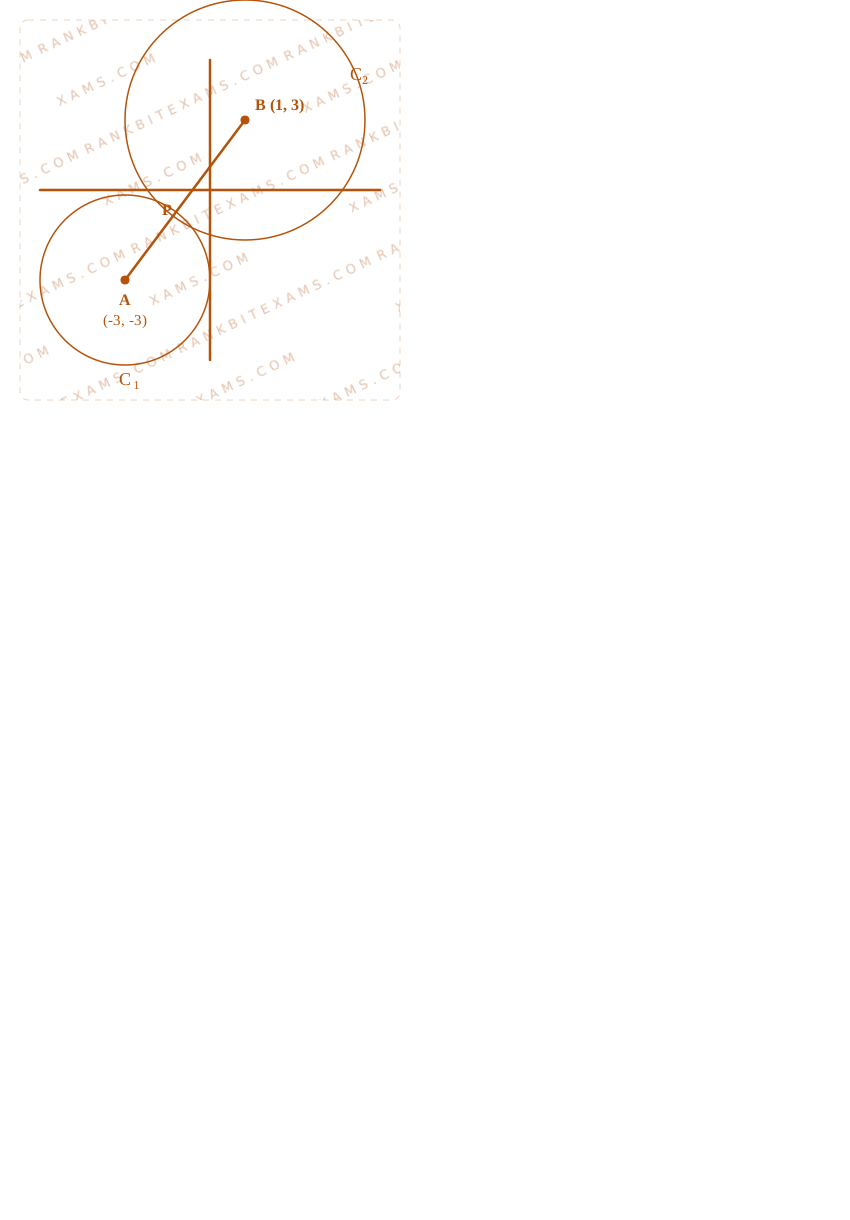
For a circle in the third quadrant touching both coordinate axes, the center layout is (-r, -r) and equation looks like:
(x + r)² + (y + r)² = r²For external contact between circles C₁ and C₂, the distance between centers equals the sum of their radii:
C₁C₂ = r₁ + r₂Core Logic
Circle C₁ has radius r₁ = 3 and touches both axes in the third quadrant, so its center is A(-3, -3). Circle C₂ has center B(1, 3).
The distance between centers A and B is:
AB = √((1 - (-3))² + (3 - (-3))²) = √(4² + 6²) = √(16 + 36) = √(52) = 2√(13)Step 1: Determine Radius of Circle 2
Step 2: Locate the Contact Point via Section Formula
The point of contact P(α, β) divides the line segment joining centers A(-3, -3) and B(1, 3) internally in the ratio r₁ : r₂ = 3 : (2√(13) - 3).
Using the internal section formula:
α = 3(1) + (2√(13) - 3)(-3)3 + (2√(13) - 3) = 3 - 6√(13) + 92√(13) = 12 - 6√(13) + 02√(13) = 6 - 3√(13)√(13) β = 3(3) + (2√(13) - 3)(-3)3 + (2√(13) - 3) = 9 - 6√(13) + 92√(13) = 18 - 6√(13)2√(13) = 9 - 3√(13)√(13)Step 3: Calculate the Difference Value
Find (β - α)²:
β - α = 9 - 3√(13)√(13) - 6 - 3√(13)√(13) = 3√(13) (β - α)² = ( 3√(13))² = (9)/(13)Comparing with (m)/(n) where (m, n) = 1 gives m = 9, n = 13.
m + n = 9 + 13 = 22Pattern Recognition
Notice that computing (β - α) directly cancels out the irrational √(13) term from the numerator before squaring, saving a significant amount of tedious arithmetic expansion.
Chapter Mix
Class 11 Mathematics: Coordinate Geometry Class 11 Mathematics: Circles