JEE Main · Mathematics → Steady

Conic Sections appeared 94 times across 3 years — 10.9% of Mathematics. This question is from Ellipse and Line Properties.

Year 2026 2025 2024 Total
Questions 29 44 21 94

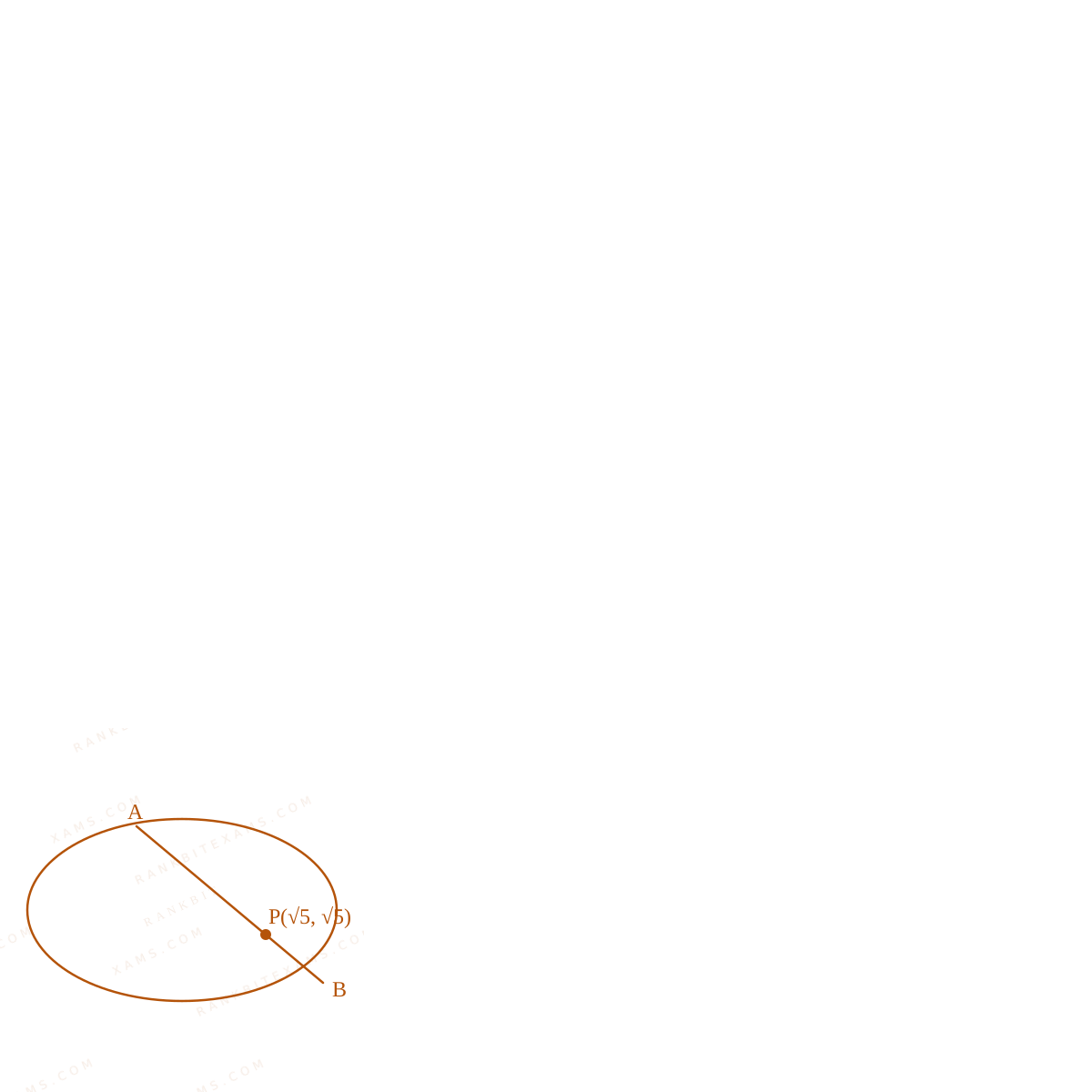
A line passing through the point P(√(5), √(5)) intersects the ellipse (x²)/(36) + (y²)/(25) = 1 at A and B [cite: 567] such that (PA) · (PB) is maximum. Then 5(PA² + PB²) is equal to

Solution & Explanation

Related Formula

Parametric line equation relative to an offset point P(x₀, y₀):

x = x₀ + r θ, y = y₀ + r θ

Ellipse and Line Properties diagram for Q56 - JEE Main 2025 Morning

Core Logic

Assume any line through P(√(5), √(5)) can be represented parametrically by:

Q(√(5) + r θ, √(5) + r θ)

Substitute coordinates into the standard ellipse equation 25x² + 36y² = 900:

25(√(5) + r θ)² + 36(√(5) + r θ)² = 900

Expanding and gathering powers of r yields:

r²(25 ²θ + 36 ²θ) + 2√(5)r(25 θ + 36 θ) - 595 = 0

The product of roots corresponds to the distance product:

PA · PB = |r₁ r₂| = (595)/(25 ²θ + 36 ²θ) = (595)/(25 + 11 ²θ)
Step 1: Maximization Condition

To maximize PA · PB, the denominator must be minimized:

²θ = 0 θ = 0

This implies the chord line AB must run parallel to the x-axis:

yA = yB = √(5)

Substitute y = √(5) back into the ellipse equation to calculate x-coordinates:

(x²)/(36) + (5)/(25) = 1 (x²)/(36) = (4)/(5) x² = (144)/(5)

Therefore, the coordinates are x = ± 12√(5).

Step 2: Distance Value Summation

Compute PA² + PB² using coordinates directly:

PA² + PB² = (√(5) - 12√(5))² + (√(5) + 12√(5))² = 2(5 + (144)/(5)) = (338)/(5)

Multiplying by 5 gives the required value:

5(PA² + PB²) = 338
Pattern Recognition

Shortcut: Represent lines through an arbitrary point parametrically in conic intersection problems. The product of distances |r₁ r₂| directly falls out of the constant term over the leading coefficient, making trigonometric optimization straightforward.

Evaluation Rubric / Model Answer

338

Chapter Mix

Class 11 Mathematics: Conic Sections (Ellipse)

More Conic Sections Previous-Year Questions — Page 10

Q64 jee_main_2025_29_jan_evening Equation of a Circle
Let a circle C pass through the points (4,2) and (0,2), and its centre lie on 3x + 2y + 2 = 0. Then the length of the chord, of the circle C, whose mid-point is (1,2), is:
  • A. √(3)
  • B. 2√(3)
  • C. 4√(2)
  • D. 2√(2)

Solution

Related Formula

Length of a chord with perpendicular distance d from the center of a circle of radius r is:

Length = 2√(r² - d²)
Core Logic

Points A(4,2) and B(0,2) have the same y-coordinate, meaning chord AB is horizontal. The perpendicular bisector of a horizontal chord is vertical.
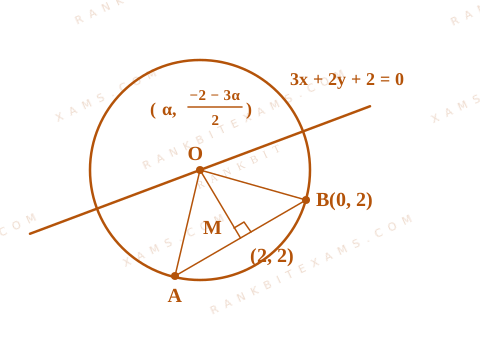
Equation of a Circle diagram for Q64 - JEE Main 2025 Evening

Midpoint of AB is M(2,2). Thus, the vertical line passing through the center is x = 2.

Step 1: Identify Center and Radius

Since the center lies on the line 3x + 2y + 2 = 0, substitute x = 2 to find the y-coordinate:

3(2) + 2y + 2 = 0 2y = -8 y = -4

So, Center O = (2, -4).

Calculate radius r using point B(0,2):

r = OB = √((2 - 0)² + (-4 - 2)²) = √(4 + 36) = √(40)
Step 2: Find Target Chord Length

The targeted chord has a given midpoint N(1,2). Distance from center O(2,-4) to N(1,2):

d = ON = √((2 - 1)² + (-4 - 2)²) = √(1 + 36) = √(37) Length of chord = 2√(r² - d²) = 2√(40 - 37) = 2√(3)
Pattern Recognition

Points sharing a coordinate define standard vertical or horizontal perpendicular configurations immediately. Always exploit geometrical configurations before jumping into standard circle equations.

Chapter Mix

Class 11 Mathematics: Circles
Q75 jee_main_2025_29_jan_evening Properties of Focal Chords
Let y² = 12x the parabola and S be its focus. Let PQ be a focal chord of the parabola such that (SP) (SQ) = (147)/(4). Let C be the circle described taking PQ as a diameter. If the equation of a circle C is 64x² + 64y² - α x - 64√(3)y = β, then \beta - \alpha is equal to
Numerical Answer. Answer: 1328 to 1328

Solution

Related Formula

Properties of focal chord parameter metrics in parabolas y² = 4ax:

t₁ · t₂ = -1

Distance to the directrix property:

SP = a(1 + t²), SQ = a(1 + (1)/(t²))
Core Logic

Given parabola y² = 12x a = 3. Focus S = (3, 0). Set up focal segments product equation:

SP · SQ = 3(1+t²) · 3(1+(1)/(t²)) = (147)/(4) 9 · ((1+t²)²)/(t²) = (147)/(4) ((1+t²)²)/(t²) = (49)/(12)

Solving for t²:

12t⁴ - 25t² + 12 = 0 t² = (3)/(4) or (4)/(3)
Step 1: Compute Endpoint Coordinate Bounds

Choosing t = - √(3)2 allows defining both chord coordinates symmetrically:

P(3t², 6t) P((9)/(4), -3√(3)) Q((3)/(t²), -(6)/(t)) Q(4, 4√(3))
Step 2: Derive Circle Equation

Write the diameter circle form equation:

(x - 4)(x - (9)/(4)) + (y - 4√(3))(y + 3√(3)) = 0 x² + y² - (25)/(4)x - √(3)y - 27 = 0

Multiply by 64 to clear the fractions and match the given equation template structure:

64x² + 64y² - 400x - 64√(3)y - 1728 = 0

Comparing directly with 64x² + 64y² - α x - 64√(3)y = β yields:

α = 400, β = 1728 β - α = 1728 - 400 = 1328
Pattern Recognition

The distance from focal chord endpoints to the focus equals their perpendicular distance to the directrix. This property connects parameter metrics to geometric lengths cleanly.

Chapter Mix

Class 11 Mathematics: Conic Sections Class 11 Mathematics: Circles

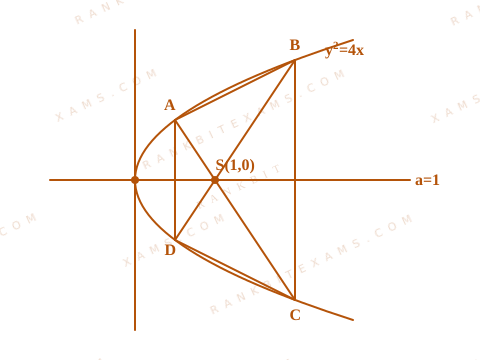
Q jee_main_2025_28_jan_morning Parabola and Trapezium Properties
Let ABCD be a trapezium whose vertices lie on the parabola y² = 4x. Let the sides AD and BC of the trapezium be parallel to y-axis. If the diagonal AC is of length (25)/(4) and it passes through the point (1,0), then the area of ABCD is:
  • A. (75)/(4)
  • B. (25)/(2)
  • C. (125)/(8)
  • D. (75)/(8)

Solution

Related Formula

Area of a trapezium is given by:

Area = (1)/(2) × (sum of parallel sides) × (distance between them)
Core Logic

Let the coordinates of the vertices be parameterized on the parabola y² = 4x. Since AD and BC are parallel to the y-axis, the coordinates take the form: A(at₁², 2at₁) and D(at₁², -2at₁) B(at₂², 2at₂) and C(at₂², -2at₂)

Given a=1, the points simplify accordingly.

Parabola and Trapezium Properties diagram for Q52 - JEE Main 2025 Morning

Step 1: Using Diagonal Properties

The length of diagonal AC passing through focal point (1,0) implies focal chord properties:

Length AC = a(t₁ + (1)/(t₁))² = (25)/(4) t₁ + (1)/(t₁) = ±(5)/(2) t₁ = 2 or (1)/(2)
Step 2: Finding Coordinates and Area

Substituting t₁ = 2, we get: A((1)/(2), 1), D((1)/(4), -1), B(4, 4), C(4, -4)

Evaluating the area formula:

Area = (1)/(2) × (8 + 2) × (4 - (1)/(4)) = (75)/(4)
Pattern Recognition

Focal chords of parabolas always satisfy t₁ t₂ = -1. Recognizing the passage through (1,0) unlocks quick parametric simplifications.

Chapter Mix

Class 11 Maths: Conic Sections

Q jee_main_2025_28_jan_morning Circles Touching Axes and Intercepts
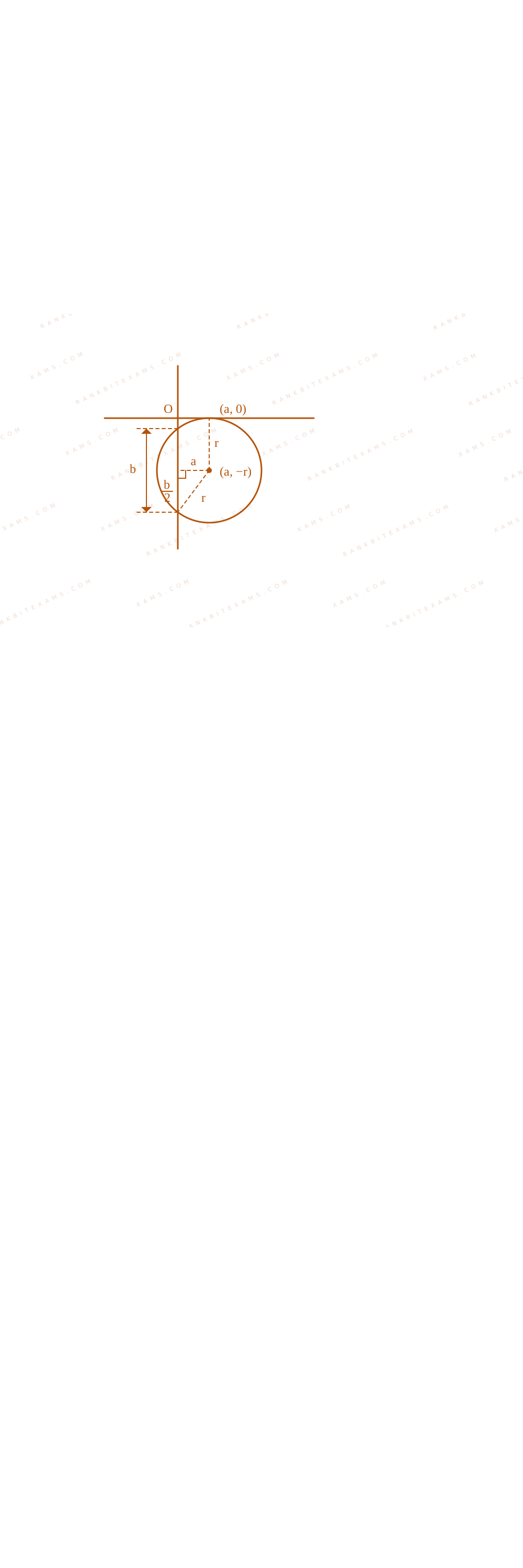
Let the equation of the circle, which touches x-axis at the point (a, 0), a > 0 and cuts off an intercept of length b on y-axis be x² + y² - α x + β y + γ = 0. If the circle lies below x-axis, then the ordered pair (2a, b²) is equal to:
  • A. (α, β² + 4γ)
  • B. (γ, β² - 4α)
  • C. (γ, β² + 4α)
  • D. (α, β² - 4γ)

Solution

Related Formula

Circle intercepts standard form templates:

y-intercept = 2√(f² - c)
Core Logic

Since the circle touches the x-axis at (a,0) and lies entirely below it, its center is located at (a, -p) where p matches its radius r.

By Pythagoras' theorem:

Circles Touching Axes and Intercepts diagram for Q58 - JEE Main 2025 Morning

r² = a² + (b²)/(4) = p²
Step 1: Translating to General Equation Form

The explicit standard equation is (x-a)² + (y+p)² = r². Expanding it out:

x² + y² - 2ax + 2py + a² = 0

Comparing this directly to x² + y² - α x + β y + γ = 0 yields: α = 2a, β = 2p, and γ = a².

Step 2: Evaluating the Target Mapped Ordered Pair

Isolating b² using the parametric radius dimensions:

b² = 4p² - 4a² = (2p)² - 4(a²) = β² - 4γ

Thus, the mapped ordered pair (2a, b²) evaluates directly to (α, β² - 4γ).

Pattern Recognition

Tangency conditions fix center parameters to match radius scale sizes instantly, reducing variable overhead in coordinate transformations.

Chapter Mix

Class 11 Maths: Circles

Q75 jee_main_2025_28_jan_morning Infinite Series of Ellipses
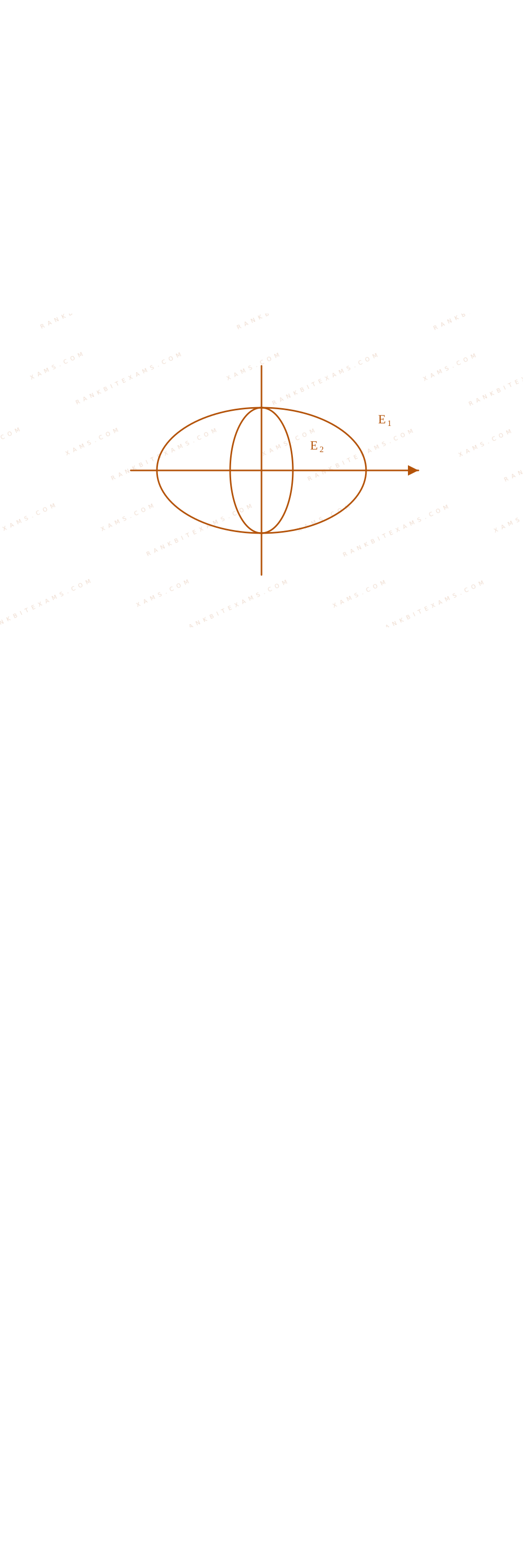
Let E₁: (x²)/(9) + (y²)/(4) = 1 be an ellipse. Ellipses Eᵢ 's are constructed such that their centres and eccentricities are same as that of E₁ , and the length of minor axis of Eᵢ is the length of major axis of Eᵢ₊₁ ( i ≥ 1 ). If Aᵢ is the area of the ellipse Eᵢ , then (5)/(pi) ( Σi=1∞ Aᵢ ) , is equal to ....
Numerical Answer. Answer: 54 to 54

Solution

Related Formula

Area of an ellipse with semi-axes a and b:

Area = π a b
Core Logic

Calculate the constant eccentricity e from the initial ellipse E₁:

Infinite Series of Ellipses diagram for Q75 - JEE Main 2025 Morning

e = √(1 - (4)/(9)) = √(5)3

For any subsequent ellipse E₂, its major axis equals the minor axis of E₁ (2b₁ = 4 a₂ = 2). Since eccentricity remains constant:

(5)/(9) = 1 - (b₂²)/(a₂²) = 1 - (b₂²)/(4) b₂² = (16)/(9) b₂ = (4)/(3)
Step 1: Finding the Area Sequence Terms

Evaluate the area values for the initial ellipses: A₁ = π · 3 · 2 = 6π A₂ = π · 2 · (4)/(3) = (8π)/(3)

The areas form an infinite geometric progression with a common ratio r = (4)/(9).

Step 2: Summing the Infinite Geometric Series
Σi=1∞ Aᵢ = (6π)/(1 - (4)/(9)) = (6π)/((5)/(9)) = (54π)/(5)

Evaluating the final scaling formula:

(5)/(π) ( (54π)/(5) ) = 54
Pattern Recognition

Iterative dimensional scaling creates geometric progressions where the ratio equals the square of the linear scaling factor.

Chapter Mix

Class 11 Maths: Conic Sections

Rankbit System
JEE Physics: Waves (+15.5%) | Electrostatics: Concentric Shells (-29.7%) | Modern Physics: Photoelectric Clones (+34.2%) | Mathematics: Definite Integrals (+18.1%) | Chemistry: Coordination Splitting (-11.4%) | JEE Physics: Waves (+15.5%) | Electrostatics: Concentric Shells (-29.7%) | Modern Physics: Photoelectric Clones (+34.2%) | Mathematics: Definite Integrals (+18.1%) | Chemistry: Coordination Splitting (-11.4%)