Which of the following postulate of Bohr's model of hydrogen atom in not in agreement with quantum mechanical model of an atom?
A.An atom in a stationary state does not emit electromagnetic radiation as long as it stays in the same state
B.An atom can take only certain distinct energies E_1$E_{1}$, E_2$E_{2}$, E_3$E_{3}$, etc. These allowed states of constant energy are called the stationary states of atom
C.When an electron makes a transition from a higher energy stationary state to a lower energy stationary state, then it emits a photon of light
D.The electron in a H atom's stationary state moves in a circle around the nucleus
Solution & Explanation
### Related Formula
According to the quantum mechanical model, the position and momentum of an electron cannot be determined simultaneously with absolute certainty as per Heisenberg's Uncertainty Principle:
Delta x cdot Delta p ge frach4pi
$$\Delta x \cdot \Delta p \ge \frac{h}{4\pi}
$$
### Core Logic
Bohr's model defines fixed circular orbits for electrons around the nucleus, implying precise knowledge of both trajectory and position. However, the quantum mechanical model replaces these deterministic circular paths with three-dimensional probability distributions known as orbitals, where the path is spherical for the ground state of hydrogen.
### Step 1: Evaluation of Options
Postulates (1), (2), and (3) regarding discrete energy levels, stationary states, and photon emissions are preserved in the quantum mechanical framework. Postulate (4) incorrectly confines the electron to a defined circular two-dimensional path, which directly contradicts quantum mechanical principles.
### Pattern Recognition
Sees: "Bohr's model not in agreement with Quantum Mechanics"
ightarrow$
ightarrow$ Look for deterministic trajectories like "moves in a circle" or "fixed path". Quantum mechanics is probabilistic, not deterministic.
### Evaluation Rubric / Model Answer
null
### Chapter Mix
Class 11 Chemistry: Structure of Atom
Keywords:#Bohr's model of hydrogen atom#JEE Main 2025 Morning Q26#Structure of Atom JEE Main 2025#Quantum mechanical model of an atom
More Structure of Atom Previous-Year Questions — Page 2
Q40jee_main_2025_08_april_eveningQuantum Numbers and Electronic Configuration
Identify the correct statements for an element possessing atomic number 9:
A. There can be 5 electrons for which m_s = +frac12$m_s = +\frac{1}{2}$ and 4 electrons for which m_s = -frac12$m_s = -\frac{1}{2}$.
B. There is only one electron in the p_z$p_z$ orbital.
C. The last electron goes into an orbital described by quantum parameters n = 2$n = 2$ and l = 1$l = 1$.
D. The sum of angular nodes of all populated atomic orbitals is 1.
Choose the correct answer from the options given below:
A.textC and D Only$\text{C and D Only}$
B.textA and C Only$\text{A and C Only}$
C.textA, C and D Only$\text{A, C and D Only}$
D.textA and B Only$\text{A and B Only}$
Solution
### Core Logic
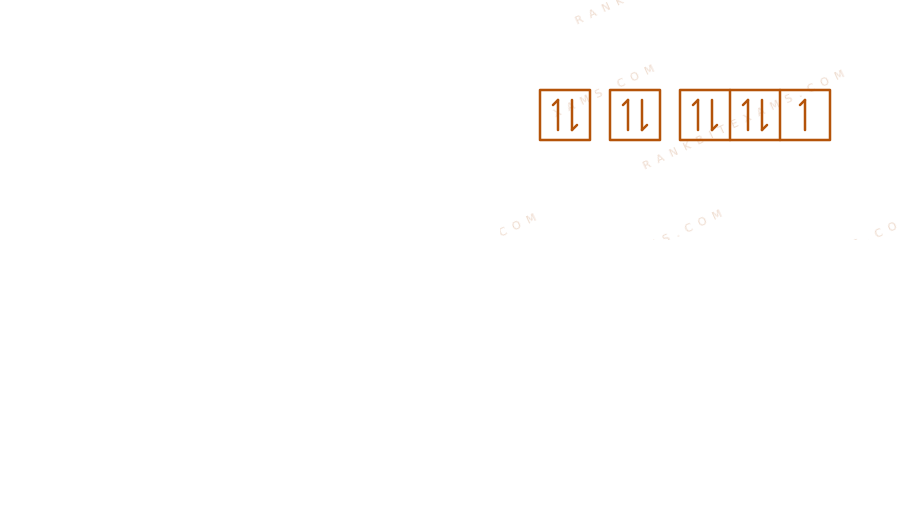
The element with atomic number 9 is **Fluorine (F)**. Let's write out its ground state electronic configuration:
F (Z=9) = 1s^2 \, 2s^2 \, 2p^5$$F (Z=9) = 1s^2 \, 2s^2 \, 2p^5$$
Let's systematically audit each statement:
* **Statement A**: Within the total population of 9 electrons, the pairing distribution across shells shows: 1s^2$1s^2$ (one up, one down), 2s^2$2s^2$ (one up, one down), 2p^5$2p^5$ (three up, two down). Summing up-spins (m_s = +frac12$m_s = +\frac{1}{2}$) yields 1 + 1 + 3 = 5$1 + 1 + 3 = 5$ electrons. Down-spins (m_s = -frac12$m_s = -\frac{1}{2}$) yield 1 + 1 + 2 = 4$1 + 1 + 2 = 4$ electrons. **Statement A is fully correct.** Orbital spin configuration box diagram for Fluorine atom
* **Statement B**: By Hund's Rule, the 5 electrons in the 2p subshell occupy the degenerate p_x, p_y, p_z$p_x, p_y, p_z$ states. This produces two fully-filled sub-orbitals and one half-filled sub-orbital. The unpaired slot can reside arbitrarily in *any* of the three orbitals (p_x, p_y$p_x, p_y$, or p_z$p_z$) due to spatial symmetry. It is not constrained to p_z$p_z$. **Statement B is incorrect.**
* **Statement C**: The highest energy valence electron enters the 2p subshell, which is defined by principal number n = 2$n = 2$ and azimuthal index l = 1$l = 1$. **Statement C is fully correct.**
* **Statement D**: Angular nodes are given directly by the quantum number l$l$. For s-orbitals (1s, 2s$1s, 2s$), angular nodes = 0$= 0$. For each of the three populated p-orbitals (2p$2p$), angular nodes = 1$= 1$. The sum total of angular nodes across all orbitals is 0 + 0 + 3 = 3$0 + 0 + 3 = 3$. **Statement D is incorrect.**
### Pattern Recognition
Total angular nodes equals the total number of p-electrons' spatial orientation count, not simply the subshell boundary value. Recognizing that degenerate p-orbitals share uniform probability status exposes the restriction in Statement B instantly.
### Evaluation Rubric / Model Answer
null
### Chapter Mix
Class 11 Chemistry: Structure of Atom
Q47jee_main_2025_08_april_eveningBohr's Model
The energy of an electron in the first Bohr orbit of the Hydrogen atom is -13.6 text eV$-13.6 \text{ eV}$. The magnitude of the energy value of an electron in the first excited state of the textBe^3+$\text{Be}^{3+}$ ion is _________ eV (as the nearest integer value).
Numerical Answer.Answer: 54 to 54
Solution
### Related Formula
Bohr energy level formula for hydrogenic species:
E_n = -13.6 times fracZ^2n^2 quad texteV$$E_n = -13.6 \times \frac{Z^2}{n^2} \quad \text{eV}$$
where:
Z$Z$ = atomic number of the species
n$n$ = principal quantum number of the orbit
### Execution
Step 1: Identify the parameters for the first excited state of textBe^3+$\text{Be}^{3+}$:
* For Beryllium (textBe$\text{Be}$), the atomic number is Z = 4$Z = 4$.
* The term 'first excited state' refers to the second energy level, so n = 2$n = 2$.
Step 2: Substitute these values into the Bohr energy equation:
E_textBe^3+ = -13.6 times frac4^22^2 = -13.6 times frac164$$E_{\text{Be}^{3+}} = -13.6 \times \frac{4^2}{2^2} = -13.6 \times \frac{16}{4}$$E_textBe^3+ = -13.6 times 4 = -54.4 text eV$$E_{\text{Be}^{3+}} = -13.6 \times 4 = -54.4 \text{ eV}$$
Step 3: Extract the magnitude and round to the nearest integer value:
|E_textBe^3+| = 54.4 approx 54$$|E_{\text{Be}^{3+}}| = 54.4 \approx 54$$
### Pattern Recognition
For the first excited state of Beryllium (Z=4, n=2$Z=4, n=2$), the term fracZ^2n^2 = frac4^22^2 = frac164 = 4$\frac{Z^2}{n^2} = \frac{4^2}{2^2} = \frac{16}{4} = 4$. Thus, the energy value is exactly 4 times that of the ground-state hydrogen atom (13.6 times 4 = 54.4$13.6 \times 4 = 54.4$).
### Evaluation Rubric / Model Answer
null
### Chapter Mix
Class 11 Chemistry: Structure of Atom
Q27jee_main_2025_29_jan_eveningBohr Model for Hydrogen-like Species
For hydrogen like species, which of the following graphs provides the most appropriate representation of E vs Z plot for a constant n?
[E: Energy of the stationary state, Z: atomic number, n: principal quantum number]
A. Graph (1)
B. Graph (2)
C. Graph (3)
D. Graph (4)
Solution
### Related Formula
E_n = -13.6 fracZ^2n^2text eV$$E_n = -13.6 \frac{Z^2}{n^2}\text{ eV}$$
### Core Logic
For a constant principal quantum number n$n$, the energy E$E$ is directly proportional to -Z^2$-Z^2$.
This represents a quadratic relation where the curve is a downward-opening parabola starting from the origin in the negative energy region.
### Pattern Recognition
Since energy values are inherently negative for bound states, as Z$Z$ increases, E$E$ becomes rapidly more negative following a parabolic curve.
### Evaluation Rubric / Model Answer
null
### Chapter Mix
Class 11 Chemistry: Structure of Atom
Given below are two statements:
Statement (I): It is impossible to specify simultaneously with arbitrary precision, both the linear momentum and the position of a particle.
Statement (II) If the uncertainty in the measurement of position and uncertainty in measurement of momentum are equal for an electron, then the uncertainty in the measurement of velocity is gesqrtfrachpitimesfrac12m$gesqrt{\frac{h}{pi}}\times\frac{1}{2m}$
In the light of the above statements, choose the correct answer from the options given below:
A. Statement I is true but Statement II is false.
B. Both Statement I and Statement II are true.
C. Statement I is false but Statement II is true.
D. Both Statement I and Statement II are false.
Solution
### Related Formula
Delta x cdot Delta p ge frach4pi$$Delta x cdot Delta p ge \frac{h}{4pi}$$
### Core Logic
Statement I is a verbatim definition of Heisenberg's Uncertainty Principle, hence it is completely true.
For Statement II, we are given that Delta x = Delta p$Delta x = Delta p$:
Delta p cdot Delta p ge frach4pi implies (Delta p)^2 ge frach4pi $$Delta p cdot Delta p ge \frac{h}{4pi} implies (Delta p)^2 ge \frac{h}{4pi} $$Delta p ge sqrtfrach4pi = frac12sqrtfrachpi$$Delta p ge sqrt{\frac{h}{4pi}} = \frac{1}{2}sqrt{\frac{h}{pi}}$$
Since Delta p = m cdot Delta v$Delta p = m cdot Delta v$:
m cdot Delta v ge frac12sqrtfrachpi implies Delta v ge frac12msqrtfrachpi$$m cdot Delta v ge \frac{1}{2}sqrt{\frac{h}{pi}} implies Delta v ge \frac{1}{2m}sqrt{\frac{h}{pi}}$$
This perfectly matches Statement II, so it is also true.
### Pattern Recognition
When solving inequality bounds for identical uncertainties, always substitute directly to obtain a clean quadratic form before taking the square root.
### Evaluation Rubric / Model Answer
null
### Chapter Mix
Class 11 Chemistry: Structure of Atom
Q38jee_main_2025_28_jan_morningQuantum Numbers and Orbital Energies
In a multielectron atom, which of the following orbitals described by three quantum numbers with have same energy in absence of electric and magnetic fields?
A. n = 1, l = 0, m_l = 0$n = 1, l = 0, m_{l} = 0$
B. n = 2, l = 0, m_l = 0$n = 2, l = 0, m_{l} = 0$
C. n = 2, l = 1, m_l = 1$n = 2, l = 1, m_{l} = 1$
D. n = 3, l = 2, m_l = 1$n = 3, l = 2, m_{l} = 1$
E. n = 3, l = 2, m_l = 0$n = 3, l = 2, m_{l} = 0$
Choose the correct answer from the options given below:
A.textA and B only$\text{A and B only}$
B.textB and C only$\text{B and C only}$
C.textC and D only$\text{C and D only}$
D.textD and E only$\text{D and E only}$
Solution
### Core Logic
In multi-electron systems, the energy profile depends on both the primary shell (n$n$) and azimuthal subshell (l$l$) quantum values via the (n+l)$(n+l)$ rule. Orbitals sharing the exact same n$n$ and l$l$ values are energy-degenerate as long as external field metrics are zero.
Let us map each set:
- **A:** 1s$1s$
- **B:** 2s$2s$
- **C:** 2p$2p$
- **D:** 3d$3d$ (m_l = 1$m_l = 1$)
- **E:** 3d$3d$ (m_l = 0$m_l = 0$)
Since both D and E describe subcomponents of the same 3d$3d$ subshell (n=3, l=2$n=3, l=2$), they share identical energies, establishing perfect degeneracy.
### Pattern Recognition
Sees: Orbitals matching energy level in multi-electron space.
Trap: Confusing single-electron hydrogen atoms (where energy depends solely on n$n$) with multielectron atoms.
### Evaluation Rubric / Model Answer
null
### Chapter Mix
Class 11 Chemistry: Structure of Atom
More Structure of Atom Questions — jee_main_2025_03_april_morning
We Map Every Repeating Question in Competitive Exams.
Say goodbye to generic mock test fatigue. RankBit uses smart analysis to group past exam questions into their foundational Repeating Question Types. Find chapter weightage, track repeating questions, and score higher with targeted practice.
Select Your Target Exam
Choose an exam track below to find formulas per chapter and patterns.
Syncing Exam Intelligence
Mapping formulas and patterns across all tracks…
PATH A — FULL LENGTH PRACTICE
Full Mock Test Hub
Simulate real NTA exam conditions with fully tracked mocks. Time yourself against past papers.
Practice past-year questions one chapter at a time. Pick an exam → subject → chapter and get every PYQ for that topic — pulled together from all past papers — with the chapter's key formulas alongside.