Rankbit System
JEE Physics: Waves (+15.5%) | Electrostatics: Concentric Shells (-29.7%) | Modern Physics: Photoelectric Clones (+34.2%) | Mathematics: Definite Integrals (+18.1%) | Chemistry: Coordination Splitting (-11.4%) | JEE Physics: Waves (+15.5%) | Electrostatics: Concentric Shells (-29.7%) | Modern Physics: Photoelectric Clones (+34.2%) | Mathematics: Definite Integrals (+18.1%) | Chemistry: Coordination Splitting (-11.4%)

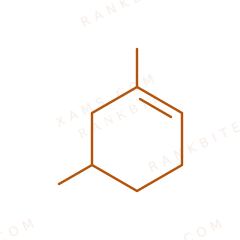
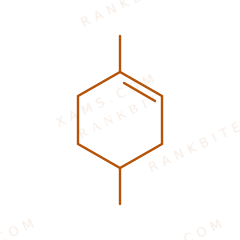
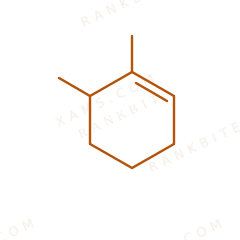
Which compound would give 3-methyl-6-oxoheptanal upon ozonolysis ?

Solution & Explanation

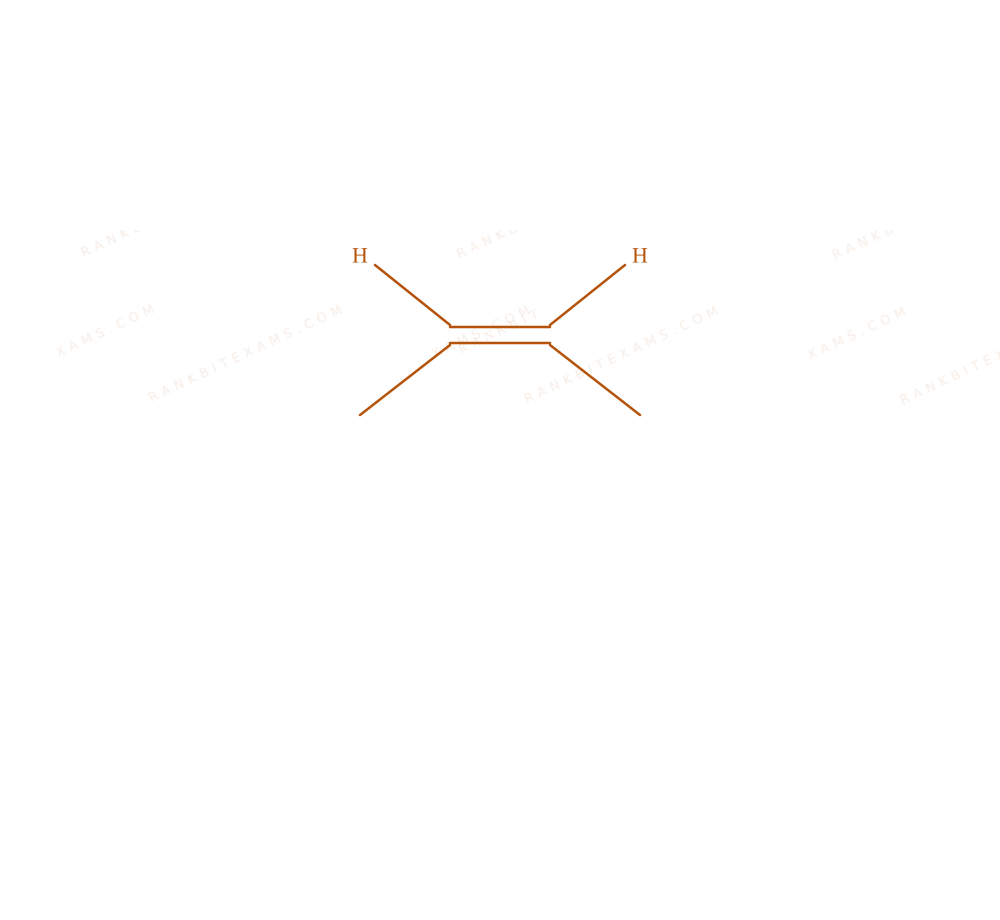
### Core Logic Let us reconstruct the original alkene from the given ozonolysis product fragments. Write down the line-structure formula for 3-methyl-6-oxoheptanal: textO=textCH-textCH2-textCH(CH*3)-textCH*2-textCH*2-textC(O)-textCH*3 Remove both carbonyl oxygen atoms and link carbon-1 directly to carbon-6 with a double bond. This cyclizes into a 6-membered ring structure: 1,4-dimethylcyclohexene.
Alkene cyclization path for Q42 - JEE Main 2025 Morning
### Step 1: Ozonolysis Verification Performing reductive ozonolysis (O_3 / Zn, H_2O) cleaves the internal endocyclic double bond of 1,4-dimethylcyclohexene, perfectly regenerating the acyclic keto-aldehyde compound. ### Pattern Recognition Shortcut: Count the carbons in the main chain product (7text carbons total). Ozonolysis of option (2) creates an open chain containing a terminal aldehyde group on one end and a methyl ketone group on the other. ### Evaluation Rubric / Model Answer null ### Chapter Mix Class 11 Chemistry: Hydrocarbons

Reference Study Guides

More Hydrocarbons Previous-Year Questions — Page 2

Q38 2025 Properties of Benzene
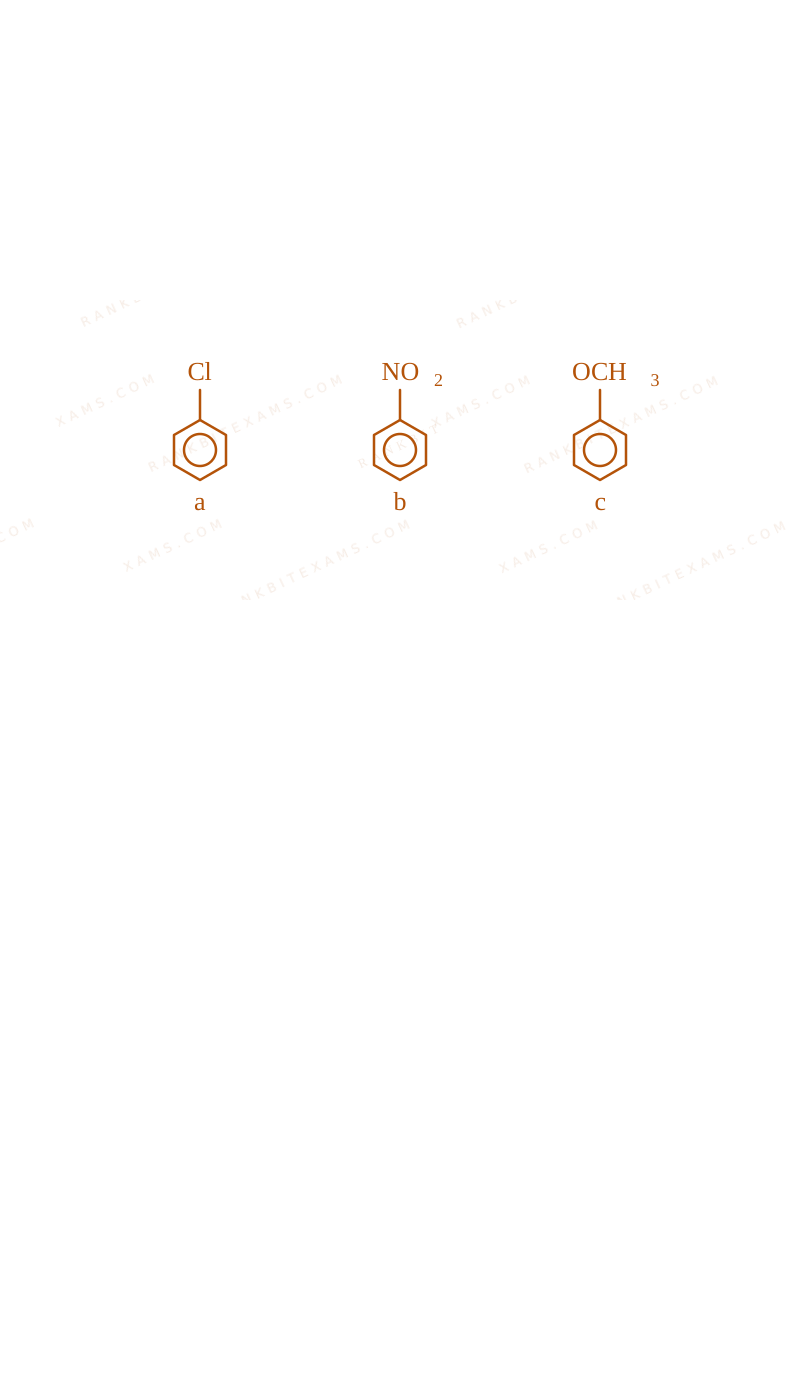
Benzene is treated with oleum to produce compound (X) which when further heated with molten sodium hydroxide followed by acidification produces compound (Y). The compound Y is treated with zinc metal to produce compound (Z). Identify the structure of compound (Z) from the following options:
  • A. textStructure 1
  • B. textStructure 2
  • C. textStructure 3
  • D. textStructure 4

Solution

### Core Logic Let's map out this complete aromatic synthesis pathway: 1. **Benzene + Oleum:** Sulfonation steps take place to form Benzene Sulfonic Acid (C_6H_5SO_3H, Compound X). 2. **Fusion with molten NaOH followed by H^+ activation:** The sulfonic group is displaced, passing through a sodium phenoxide intermediate to yield Phenol (C_6H_5OH, Compound Y). 3. **Phenol + Zinc dust distillation:** Phenol undergoes clean deoxygenation reduction when heated with Zinc metal, stripping the hydroxyl group away to reform **Benzene** (Compound Z). ### Pattern Recognition Zinc dust distillation is a highly reliable reduction tool designed explicitly to strip phenolic hydroxyl groups away, leaving a clean unsubstituted aromatic ring behind. ### Evaluation Rubric / Model Answer null ### Chapter Mix Class 11 Chemistry: Hydrocarbons Class 12 Chemistry: Alcohols, Phenols and Ethers
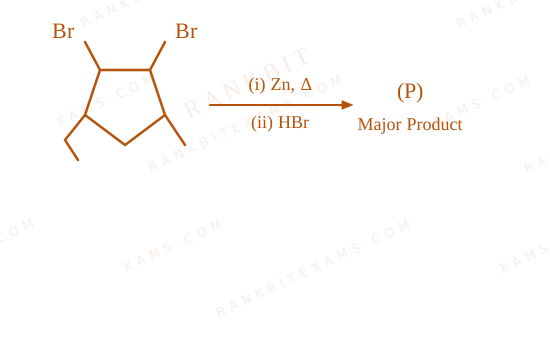
Q42 2025 Free Radical Bromination
Predict the major product of the following reaction sequence:
Alkyl radical halogenation flowchart matrix for Q42 - JEE Main 2025 Morning
The sequence pathways specify Br2/hv free radical substitution, alcoholic KOH elimination, and HBr/peroxide addition.
  • A. textProduct 1
  • B. textProduct 2
  • C. textProduct 3
  • D. textProduct 4

Solution

### Core Logic Let's analyze the steps of the reaction sequence: 1. **Step 1 (Br_2 / hnu):** Light-induced free radical substitution targeted at the most stable tertiary position, producing 1-bromo-1-methylcyclohexane. 2. **Step 2 (Alcoholic KOH, Delta):** Dehydrohalogenation occurs via an E2 mechanism. Following Saytzeff's rule, elimination favors the formation of the more highly substituted, stable alkene: 1-methylcyclohexene. 3. **Step 3 (HBr / R-O-O-R, hnu):** Radical hydrobromination across the unsymmetrical alkene. The presence of peroxide shifts addition toward the **Anti-Markovnikov** path, placing the bromine atom cleanly at the less-substituted secondary carbon to yield **1-bromo-2-methylcyclohexane**. ### Pattern Recognition Combining Saytzeff elimination with a peroxide-promoted HBr addition allows you to reposition functional groups from highly substituted tertiary carbons to adjacent secondary positions. ### Evaluation Rubric / Model Answer null ### Chapter Mix Class 11 Chemistry: Hydrocarbons Class 12 Chemistry: Haloalkanes and Haloarenes
Q41 2025 Ozonolysis and Stereochemistry
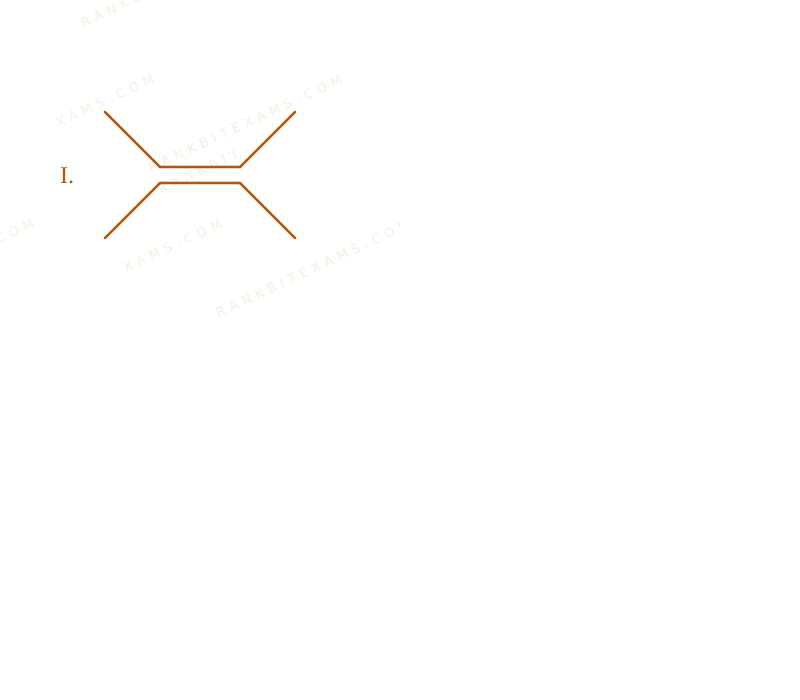
The number of optically active products obtained from the complete ozonolysis of the given compound is: [cite: 364, 365]
Ozonolysis and Stereochemistry compound diagram for Q41 - JEE Main 2025 Evening
The image details a symmetrically structured long-chain polyene containing multiple internal alkene bonds and chiral carbon sites.
  • A. 2
  • B. 0
  • C. 1
  • D. 4

Solution

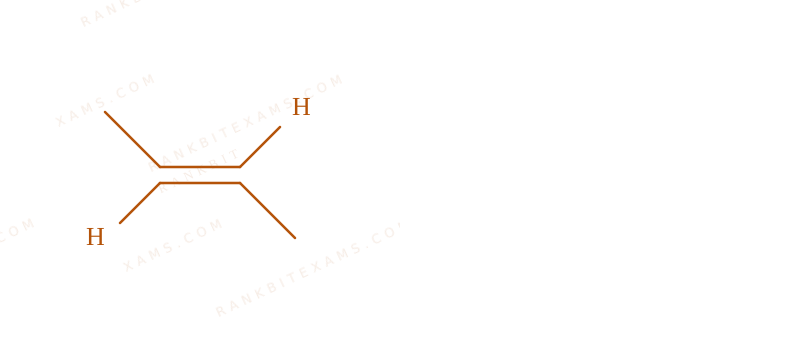
### Related Formula textR_1text-CH=textCH-R_2 xrightarrow[textZn / H_2textO]textO_3 textR_1text-CHO + textR_2text-CHO ### Core Logic Complete oxidative cleavage of all double bonds via reductive ozonolysis breaks the molecule into smaller fragments: textCH_3text-CH=textCH-CH(textCH_3)text-CH=textCH-CH(textCH_3)text-CH=textCH-CH_3 Let's trace the fragmentation logic mapping visually:
Ozonolysis and Stereochemistry products diagram for Q41 - JEE Main 2025 Evening
The image details a symmetrically structured long-chain polyene containing multiple internal alkene bonds and chiral carbon sites.
### Step 1: Tracking Fragment Structures The chemical reaction outputs two major molecular product types: 1. textCH3text-CHO (Acetaldehyde): Optically inactive as it lacks a chiral carbon. 2. textOHC-CH(textCH_3)text-CHO (2-methylpropanedial): Let's inspect the substituted central carbon. It is bonded to: a hydrogen atom (-textH), a methyl group (-textCH_3), and two identical formyl groups (-textCHO). Because two of the groups are identical (-textCHO), this molecule does not have a chiral center and is entirely optically inactive. ### Step 2: Total Summation Since every single product formed is achiral, the number of optically active products is zero. ### Pattern Recognition Symmetry check shortcut: When a symmetrical dialkene is cleaved, it yields symmetric fragments. The central carbon is attached to identical flanking aldehyde units post-cleavage, destroying any prior asymmetry and leaving 0 optically active compounds. ### Evaluation Rubric / Model Answer null ### Chapter Mix Class 11 Chemistry: Hydrocarbons Class 11 Chemistry: Organic Chemistry - Some Basic Principles and Techniques
Q50 2025 Reaction Mechanisms and Hybridization
Identify the structure of the final product (D) in the following sequence of the reactions:
Reaction Mechanisms scheme diagram for Q50 - JEE Main 2025 Evening
The image maps out a sequential multi-step chemical reaction scheme moving from acetophenone via gem-dichloride to an alkyne, hydroboration, and product D.
Total number of sp^2 hybridised carbon atoms in product D is dots.
Numerical Answer. Answer: 6.5 to 7.5

Solution

### Related Formula textTerminal Alkyne (textR-CequivtextCH) xrightarrow[2.\,textH_2textO_2 / textOH^-]1.\,textB_2textH_6 textR-CH_2text-CHO quad text(Anti-Markovnikov Hydroboration-Oxidation) ### Core Logic Let's track the molecular changes at every intermediate junction: - Step 1: Acetophenone (textPh-CO-CH_3) reacts with textPCl_5 to generate a gem-dichloride intermediate [A]: textPh-CCl_2text-CH_3. - Step 2: Reaction with 3 equivalents of the incredibly strong base textNaNH_2 triggers dual elimination to form a terminal sodium acetylide salt [B]: textPh-CequivtextC^-textNa^+. - Step 3: Acidification yields phenylacetylene [C]: textPh-CequivtextCH. - Step 4: Hydroboration-oxidation of phenylacetylene leads to anti-Markovnikov water addition forming an enol structure, which immediately tautomerizes to [D] phenylacetaldehyde: textPh-CH_2text-CHO. ### Step 1: Counting Hybridized Carbons The step transformations match the sequential tracking map:
Structural analysis product diagram for Q50 - JEE Main 2025 Evening
The image maps out a sequential multi-step chemical reaction scheme moving from acetophenone via gem-dichloride to an alkyne, hydroboration, and product D.
Let's locate all sp^2 hybridised carbon environments in product D (textPh-CH_2text-CHO): 1. The aromatic benzene ring contains 6 sp^2 carbon atoms. 2. The aldehyde carbonyl carbon (-textCHO) is double-bonded to oxygen, adding 1 sp^2 carbon atom. 3. The aliphatic link carbon (-textCH_2-) is entirely sp^3 hybridized. Total sp^2 carbon count = 6 + 1 = 7. ### Pattern Recognition Alkyne oxidation mapping: Hydroboration-oxidation transforms a terminal alkyne into an aldehyde carbonyl group, while oxymercuration-demercuration yields a ketone carbonyl. Both introduce precisely one extra carbonyl sp^2 site on top of the original aromatic framework. ### Evaluation Rubric / Model Answer null ### Chapter Mix Class 12 Chemistry: Aldehydes, Ketones and Carboxylic Acids Class 11 Chemistry: Hydrocarbons

More Hydrocarbons Questions — jee_main_2025_03_april_morning

Practice all Hydrocarbons previous-year questions →

YOUR FIRST PREP STEP STARTS HERE

We Map Every Repeating Question in Competitive Exams.

Say goodbye to generic mock test fatigue. RankBit uses smart analysis to group past exam questions into their foundational Repeating Question Types. Find chapter weightage, track repeating questions, and score higher with targeted practice.

Select Your Target Exam

Choose an exam track below to find formulas per chapter and patterns.

Syncing Exam Intelligence

Mapping formulas and patterns across all tracks…

PATH A — FULL LENGTH PRACTICE

Full Mock Test Hub

Simulate real NTA exam conditions with fully tracked mocks. Time yourself against past papers.

Under Development
PATH B — TARGETED PRACTICE

Topic-wise Practice Hub

Practice past-year questions one chapter at a time. Pick an exam → subject → chapter and get every PYQ for that topic — pulled together from all past papers — with the chapter's key formulas alongside.

Loading Questions... Browse Topics
Latest from the Blog
View all →

Loading articles...