JEE Main · Chemistry ↓ Falling

Coordination Compounds appeared 68 times across 3 years — 7.9% of Chemistry. This question is from Isomerism in Coordination Compounds.

Year 2026 2025 2024 Total
Questions 19 34 15 68

The number of optical isomers exhibited by the iron complex (A) obtained from the following reaction is FeCl₃ + KOH + H₂C₂O₄ arrow A

Numerical Answer Type:
Enter a numerical value Answer: 2 to 2 +4 marks

Solution & Explanation

Related Formula

Complex type [M(AA)₃] lacks a plane of symmetry and forms d- and l-enantiomers.

Core Logic

Reaction of ferric chloride with potassium hydroxide and oxalic acid forms potassium trioxalatoferrate(III):

FeCl₃ + 3 KOH + 3 H₂C₂O₄ arrow K₃[Fe(C₂O₄)₃] + 3 HCl + 3 H₂O

Complex (A) is [Fe(C₂O₄)₃]³⁻, which is a homoleptic tris-bidentate complex of type [M(AA)₃].

Step 1: Calculation

Complexes of type [M(AA)₃] are chiral and exist as two non-superimposable mirror images (d-dextrorotatory and l-levorotatory optical isomers).

Therefore, total optical isomers = 2.

Pattern Recognition

[M(AA)₃] octahedral complex arrow 0 geometrical isomers, exactly 2 optical isomers (d- and l- pair).

Chapter Mix

Class 12 Chemistry: Coordination Compounds

Reference Study Guides

More Coordination Compounds Previous-Year Questions — Page 7

Q26 jee_main_2025_29_jan_evening Magnetic Properties of Coordination Compounds
The calculated spin-only magnetic moments of K₃[Fe(OH)₆] and K₄[Fe(OH)₆] respectively are: (1) 4.90 and 4.90 B.M. (2) 5.92 and 4.90 B.M. (3) 3.87 and 4.90 B.M. (4) 4.90 and 5.92 B.M.
  • A. 4.90 and 4.90 B.M.
  • B. 5.92 and 4.90 B.M.
  • C. 3.87 and 4.90 B.M.
  • D. 4.90 and 5.92 B.M.

Solution

Related Formula
mu = sqrtn(n+2) B.M.
Core Logic

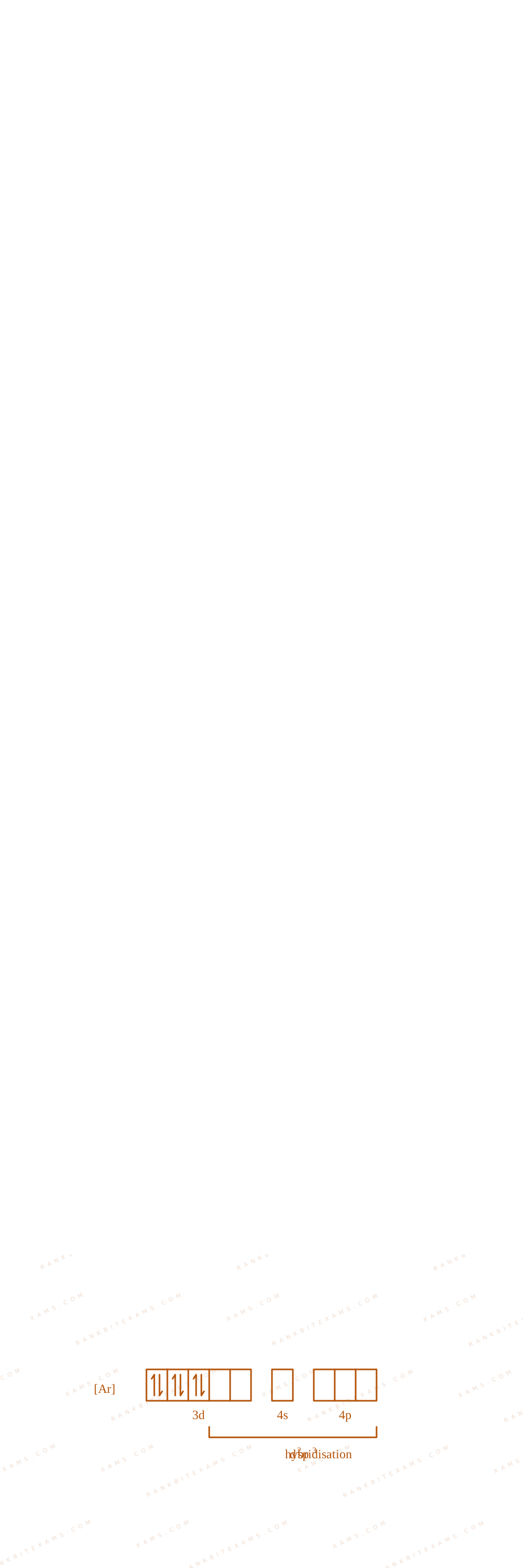
In K₃[Fe(OH)₆], iron is in the +3 oxidation state (Fe³⁺ = 3d⁵). Since OH⁻ is a weak field ligand, no pairing of electrons takes place. The number of unpaired electrons (n) is 5.

mu = sqrt5(5+2) = sqrt35 approx 5.92 B.M.

In K₄[Fe(OH)₆], iron is in the +2 oxidation state (Fe²⁺ = 3d⁶). Since OH⁻ is a weak field ligand, no pairing occurs. The number of unpaired electrons (n) is 4.

mu = sqrt4(4+2) = sqrt24 approx 4.90 B.M.
Pattern Recognition

Identify the ligand field strength first. OH⁻ is a weak field ligand in the spectrochemical series, so it does not cause pairing in either Fe²⁺ or Fe³⁺ configurations.

Chapter Mix

Class 12 Chemistry: Coordination Compounds
Q37 jee_main_2025_29_jan_evening Homoleptic Complexes and Electronic Configurations
Identify the homoleptic complexes with odd number of d electrons in the central metal. (A) [FeO₄]²⁻ (B) [Fe(CN)₆]³⁻ (C) [Fe(CN)₅NO]²⁻ (D) [CoCl₄]²⁻ (E) [Co(H₂O)₃F₃] Choose the correct answer from the options given below:
  • A. (B) and (D) only
  • B. (C) and (E) only
  • C. (A), (B) and (D) only
  • D. (A), (C) and (E) only

Solution

Core Logic

A complex is homoleptic if the metal is bound to only one kind of donor ligand group.

  • (A) [FeO₄]²⁻ is homoleptic, but Fe⁺⁶ corresponds to a 3d² (even) electronic configuration.
  • (B) [Fe(CN)₆]³⁻ is homoleptic. Fe⁺³ corresponds to a 3d⁵ (odd) configuration.
  • (C) [Fe(CN)₅NO]²⁻ is heteroleptic (contains two types of ligands).
  • (D) [CoCl₄]²⁻ is homoleptic. Co⁺² corresponds to a 3d⁷ (odd) configuration.
  • (E) [Co(H₂O)₃F₃] is heteroleptic.
Pattern Recognition

Filter by 'homoleptic' first to instantly eliminate multi-ligand mixed structures like options (C) and (E).

Chapter Mix

Class 12 Chemistry: Coordination Compounds

Q46 jee_main_2025_29_jan_evening Crystal Field Theory and Colors of Complexes
Consider the following low-spin complexes K₃[Co(NO₂)₆], K₄[Fe(CN)₆], K₃[Fe(CN)₆], Cu₂[Fe(CN)₆] and Zn₂[Fe(CN)₆]. The sum of the spin-only magnetic moment values of complexes having yellow colour is ________ B.M. (answer is nearest integer)
Numerical Answer. Answer: 0 to 0

Solution

Core Logic

From the given list, the complexes exhibiting a distinct yellow color are K₃[Co(NO₂)₆] and K₄[Fe(CN)₆].

Let's calculate the spin-only magnetic moments for these low-spin configurations:

  • For K₃[Co(NO₂)₆], cobalt is in +3 oxidation state (Co³⁺ = 3d⁶).
  • In the presence of the strong ligand field (NO₂^-), all six electrons pair up completely in the t2g orbitals:

t2g⁶ eg⁰ implies n = 0 unpaired electrons implies mu = 0 BM

Crystal Field Theory and Colors of Complexes diagram for Q46 - JEE Main 2025 Evening

  • For K₄[Fe(CN)₆], iron is in +2 oxidation state (Fe²⁺ = 3d⁶).
  • In the strong field of cyanide ligands (CN^-), pairing is complete:

t2g⁶ eg⁰ implies n = 0 unpaired electrons implies mu = 0 BM

Therefore, the sum of their spin-only magnetic moments is 0 + 0 = 0.

Pattern Recognition

Low-spin d⁶ octahedral complexes always yield a fully closed-shell t2g⁶ arrangement with zero unpaired electrons, leading deterministically to a magnetic moment of 0 BM.

Chapter Mix

Class 12 Chemistry: Coordination Compounds

Q36 jee_main_2025_28_jan_morning Borax Bead Test and Crystal Field Split
The metal ion whose electronic configuration is not affected by the nature of the ligand and which gives a violet colour in non-luminous flame under hot condition in borax bead test is
  • A. Ti³⁺
  • B. Ni²⁺
  • C. Mn²⁺
  • D. Cr³⁺

Solution

Core Logic

Nickel (Ni²⁺) exhibits a d⁸ electronic profile. In regular octahedral complex splits: t2g⁶ eg² Because the lower t2g subshell is fully paired and the higher eg contains exactly 2 electrons matching Hund's rules, this orbital distribution remains configurationally identical under both strong-field and weak-field environments. Additionally, Ni²⁺ compounds produce a characteristic violet bead during hot cycles in a non-luminous flame within the qualitative borax matrix.

Pattern Recognition

Sees: Configuration invariant to ligand strength + qualitative test combination. Shortcut: A d⁸ structure in octahedral splitting always stays high-spin/low-spin identical, pointing strictly to Ni²⁺.

Chapter Mix

Class 12 Chemistry: Coordination Compounds Class 12 Chemistry: The d-and f-Block Elements

Q39 jee_main_2025_03_april_morning Crystal Field Theory and Spectrochemical Series
The correct order of the complexes [Co(NH₃)₅(H₂O)]³⁺ (A), [Co(NH₃)₆]³⁺ (B), [Co(CN)₆]³⁻ (C) and [CoCl(NH₃)₅]²⁺ (D) in terms of wavelength of light absorbed is:
  • A. D > A > B > C
  • B. C > B > D > A
  • C. D > C > B > A
  • D. C > B > A > D

Solution

Related Formula
E = Δₒ = (hc)/(λ) λ ∝ (1)/(Δₒ)
Core Logic

All complexes contain Co³⁺ ion (3d⁶). The crystal field splitting energy (CFSE, Δₒ) depends on the field strength of the ligands in the spectrochemical series:

CN^- > NH₃ > H₂O > Cl^-
Step 1: Wavelength Determination

Order of CFSE (Δₒ):

C > B > A > D

Since absorbed wavelength λ is inversely proportional to Δₒ, the wavelength order is reversed:

D > A > B > C
Pattern Recognition

Stronger ligand field arrow Larger Δₒ arrow Shorter absorbed wavelength λ.

Chapter Mix

Class 12 Chemistry: Coordination Compounds

More Coordination Compounds Questions — jee_main_2025_03_april_morning

Practice all Coordination Compounds previous-year questions →

Rankbit System
JEE Physics: Waves (+15.5%) | Electrostatics: Concentric Shells (-29.7%) | Modern Physics: Photoelectric Clones (+34.2%) | Mathematics: Definite Integrals (+18.1%) | Chemistry: Coordination Splitting (-11.4%) | JEE Physics: Waves (+15.5%) | Electrostatics: Concentric Shells (-29.7%) | Modern Physics: Photoelectric Clones (+34.2%) | Mathematics: Definite Integrals (+18.1%) | Chemistry: Coordination Splitting (-11.4%)