A block of mass 1 kg, moving along x with speed v_i=10mathrm~m/s enters a rough region ranging from x=0.1mathrm~m to x=1.9mathrm~m. The retarding force acting on the block in this range is F_r=-kxmathrm~N with k=10mathrm~N/m. Then the final speed of the block as it crosses rough region is :

Solution & Explanation

### Related Formula By the Work-Energy Theorem, the work done by the retarding force equals the change in kinetic energy: W = Delta K = K_f - K_i W = int_x_i^x_f F_r(x) dx = frac12 m v_f^2 - frac12 m v_i^2 ### Core Logic Given parameters: - Mass m = 1mathrm~kg - Initial velocity v_i = 10mathrm~m/s - Region bounds: x_i = 0.1mathrm~m, x_f = 1.9mathrm~m - Retarding force F_r = -kx = -10xmathrm~N ### Step 1: Calculate Work Done by the Retarding Force (W) W = int_0.1^1.9 (-10x) dx = -10 left[ fracx^22 right]_0.1^1.9 = -5 left[ (1.9)^2 - (0.1)^2 right] Using the algebraic identity a^2 - b^2 = (a-b)(a+b): (1.9)^2 - (0.1)^2 = (1.9 - 0.1)(1.9 + 0.1) = (1.8)(2.0) = 3.6 W = -5 times 3.6 = -18mathrm~J ### Step 2: Solve for final velocity (v_f) Apply the Work-Energy Theorem: -18 = frac12 (1) v_f^2 - frac12 (1) (10^2) -18 = 0.5 v_f^2 - 50 0.5 v_f^2 = 50 - 18 = 32 v_f^2 = 64 Rightarrow v_f = 8mathrm~m/s ### Pattern Recognition Notice that integrating a linear force F = -kx yields a potential-energy-like term \frac{1}{2}k(x_f^2 - x_i^2). Combining this with the Work-Energy theorem gives \frac{1}{2} m v_f^2 + \frac{1}{2} k x_f^2 = \frac{1}{2} m v_i^2 + \frac{1}{2} k x_i^2$, which is identical to conservation of mechanical energy. ### Evaluation Rubric / Model Answer null ### Chapter Mix Class 11 Physics: Work, Energy and Power
Reference Study Guides

More Work, Energy and Power Previous-Year Questions — Page 5

Q37 jee_main_2024_29_jan_morning Potential Energy and Force Relationship
The potential energy function (in J) of a particle in a region of space is given as U = (2x^2 + 3y^3 + 2z). Here x, y and z are in meter. The magnitude of x - component of force (in N) acting on the particle at point P (1, 2, 3) m is:
  • A. 2
  • B. 6
  • C. 4
  • D. 8

Solution

### Related Formula The force vector vecF is related to the potential energy U by the negative gradient of potential energy: vecF = -vecnabla U = -left( fracpartial Upartial xhati + fracpartial Upartial yhatj + fracpartial Upartial zhatk right) Hence, the x-component of force is: F_x = -fracpartial Upartial x ### Core Logic Given the potential energy function: U = 2x^2 + 3y^3 + 2z Taking the partial derivative with respect to x (treating y and z as constants): fracpartial Upartial x = fracpartialpartial x(2x^2) = 4x ### Step 1: Substitute Coordinates The x-component of the force is: F_x = -4x At point P(1, 2, 3) mathrm~m, we substitute x = 1: F_x = -4(1) = -4 mathrm~N Magnitude of the x-component of force is: |F_x| = 4 mathrm~N ### Pattern Recognition When asked for a specific component (like x-component), only differentiate partially with respect to that specific variable. The remaining coordinates (y, z) act purely as constants and vanish. ### Evaluation Rubric / Model Answer null ### Chapter Mix Class 11 Physics: Work, Energy and Power

Q37 jee_main_2024_30_jan_morning Conservation of Mechanical Energy
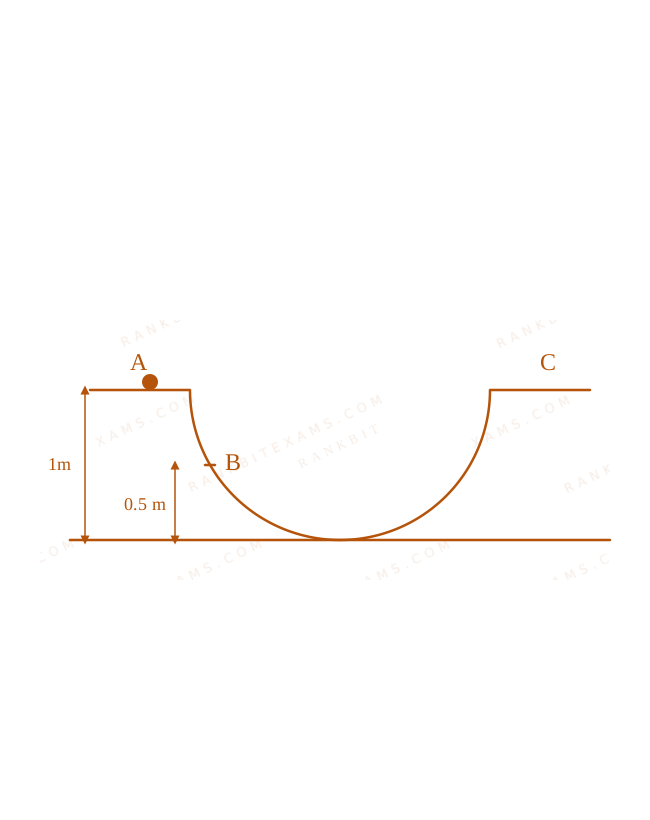
A particle is placed at the point A of a frictionless track ABC as shown in figure. It is gently pushed toward right. The speed of the particle when it reaches the point B is: (Take g = 10 mathrm~m/s^2).
Conservation of Mechanical Energy diagram for Q37 - JEE Main 2024 Morning
A particle on a frictionless track moving from height 1m at point A to 0.5m at point B.
  • A. 20 mathrm~m / s
  • B. sqrt10 mathrm~m / s
  • C. 2 sqrt10 mathrm~m / s
  • D. 10 mathrm~m / s

Solution

### Related Formula K_i + U_i = K_f + U_f frac12 m u^2 + mgh_i = frac12 m v^2 + mgh_f ### Core Logic Since the track is frictionless, mechanical energy is conserved. We can apply the Principle of Conservation of Mechanical Energy (COME) between point A and point B. ### Step 1: Apply Conservation of Energy At point A (initially pushed gently, u approx 0): textKE_A + U_A = textKE_B + U_B 0 + mg(h_A) = frac12 mv^2 + mg(h_B) Substitute the given values (h_A = 1 mathrm~m, h_B = 0.5 mathrm~m): mg(1) = frac12 mv^2 + mg(0.5) mg(0.5) = frac12 mv^2 v^2 = 2g(0.5) = g ### Step 2: Calculate Velocity Given g = 10 mathrm~m/s^2: v = sqrtg = sqrt10 mathrm~m/s ### Pattern Recognition For a mass sliding down a frictionless slope, its speed relies only on the vertical height dropped: v = sqrt2gDelta h. ### Evaluation Rubric / Model Answer null ### Chapter Mix Class 11 Physics: Work, Energy and Power
Q48 jee_main_2024_31_jan_evening Power by a Variable Force
A body of mass 2 text kg begins to move under the action of a time dependent force given by vecF = (6thati + 6t^2hatj)textN. The power developed by the force at the time t is given by:
  • A. (6t^4 + 9t^5)textW
  • B. (3t^3 + 6t^5)textW
  • C. (9t^5 + 6t^3)textW
  • D. (9t^3 + 6t^5)textW

Solution

### Related Formula vecF = mveca veca = fracdvecvdt implies vecv = int veca dt P = vecF cdot vecv ### Core Logic First find acceleration from force and mass. Then integrate acceleration to find the velocity vector at time t (starting from rest). Finally, compute the dot product of Force and Velocity to get instantaneous power. ### Step 1: Calculate Acceleration Given vecF = (6thati + 6t^2hatj) text N and m = 2 text kg. veca = fracvecFm = frac6thati + 6t^2hatj2 veca = (3thati + 3t^2hatj) text m/s^2 ### Step 2: Calculate Velocity Assuming the body begins to move from rest (at t=0, v=0): vecv = int_0^t veca \, dt = int_0^t (3thati + 3t^2hatj) \, dt vecv = left( frac3t^22 right)hati + left( frac3t^33 right)hatj vecv = left( frac3t^22 right)hati + t^3hatj ### Step 3: Calculate Power P = vecF cdot vecv P = (6thati + 6t^2hatj) cdot left(frac3t^22hati + t^3hatjright) P = (6t) times left(frac3t^22right) + (6t^2) times (t^3) P = 9t^3 + 6t^5 text W ### Pattern Recognition When force varies as a polynomial in time t^n, acceleration does too. Velocity jumps to t^n+1. Power (F cdot v) will result in terms behaving as t^2n+1. Here t to t^3 and t^2 to t^5. ### Evaluation Rubric / Model Answer null ### Chapter Mix Class 11 Physics: Work, Energy and Power Class 11 Physics: Motion in a Plane
Q49 jee_main_2024_31_jan_morning Conservation Of Momentum
An artillery piece of mass M_1 fires a shell of mass M_2 horizontally. Instantaneously after the firing, the ratio of kinetic energy of the artillery and that of the shell is :
  • A. M_1 / (M_1 + M_2)
  • B. fracM_2M_1
  • C. M_2 / (M_1 + M_2)
  • D. fracM_1M_2

Solution

### Related Formula textKE = fracp^22m ### Core Logic By conservation of linear momentum (since no external horizontal force acts on the system): 0 = M_1 v_1 + M_2 v_2 |vecp_1| = |vecp_2| = p Both the artillery and the shell acquire the exact same magnitude of momentum during firing. ### Step 2: Kinetic Energy Ratio The kinetic energy is related to momentum by textKE = fracp^22m. Since p is identical for both bodies: textKE propto frac1m Therefore, the ratio of kinetic energy of the artillery (M_1) to the shell (M_2) is: fractextKE_1textKE_2 = fracfracp^22M_1fracp^22M_2 = fracM_2M_1 ### Evaluation Rubric / Model Answer null ### Chapter Mix Class 11 Physics: Work, Energy And Power

More Work, Energy and Power Questions — jee_main_2025_03_april_evening

Practice all Work, Energy and Power previous-year questions →

Rankbit System
JEE Physics: Waves (+15.5%) | Electrostatics: Concentric Shells (-29.7%) | Modern Physics: Photoelectric Clones (+34.2%) | Mathematics: Definite Integrals (+18.1%) | Chemistry: Coordination Splitting (-11.4%) | JEE Physics: Waves (+15.5%) | Electrostatics: Concentric Shells (-29.7%) | Modern Physics: Photoelectric Clones (+34.2%) | Mathematics: Definite Integrals (+18.1%) | Chemistry: Coordination Splitting (-11.4%)