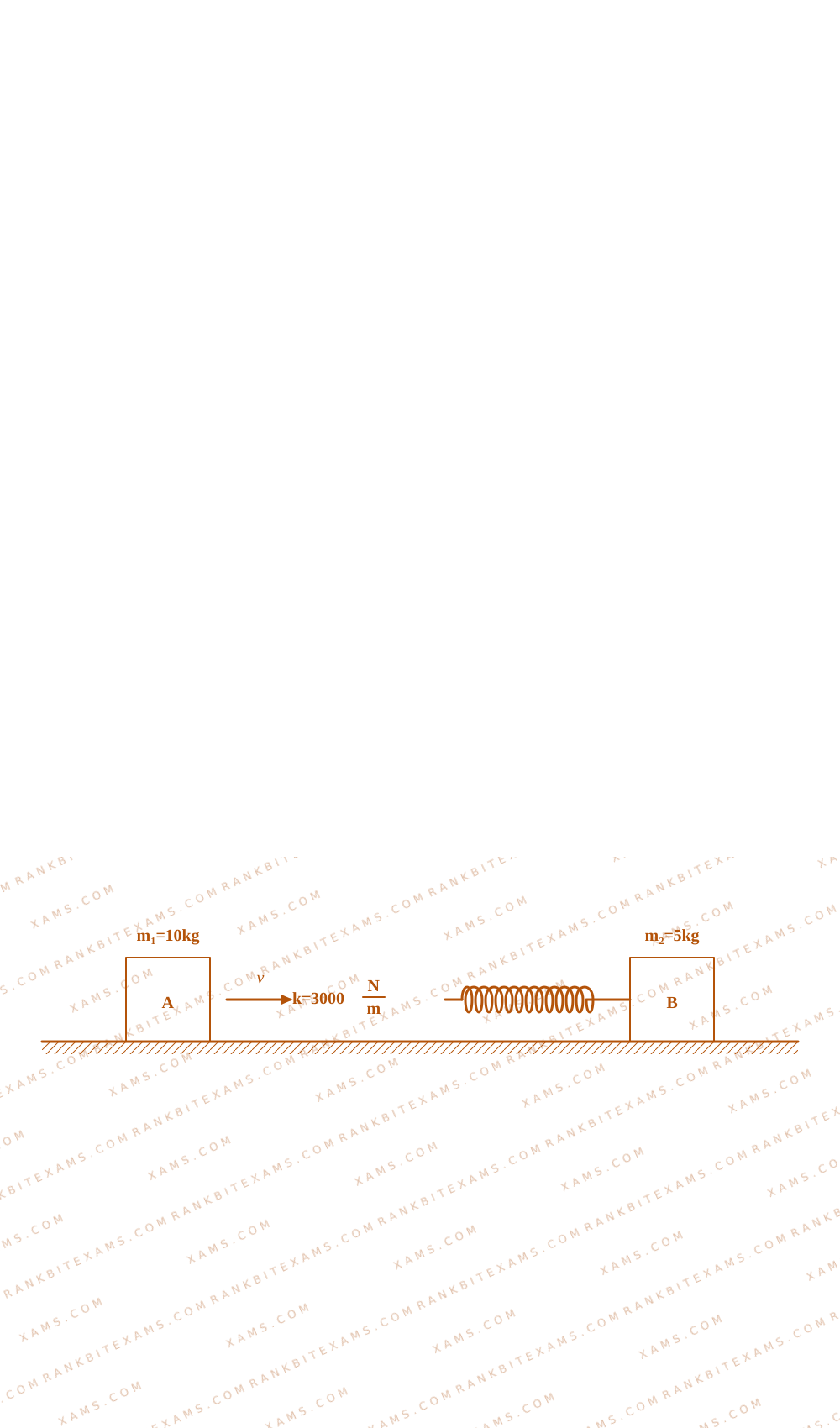
Consider two blocks A and B of masses m_1=10mathrm~kg and m_2=5mathrm~kg that are placed on a frictionless table. The block A moves with a constant speed v=3mathrm~m/s towards the block B kept at rest. A spring with spring constant k=3000mathrm~N/m is attached with the block B as shown in the figure.
Spring block collision diagram for Q10 - JEE Main 2025 Evening
Diagram showing Block A of mass m1 moving with velocity v towards Block B of mass m2 with a spring attached on a frictionless table.
After the collision, suppose that the blocks A and B, along with the spring in constant compression state, move together, then the compression in the spring is, (Neglect the mass of the spring)

Solution & Explanation

### Related Formula By conservation of linear momentum, the common velocity v_textcm of the combined mass system is: m_1 v_1 + m_2 v_2 = (m_1 + m_2) v_textcm By conservation of energy, the loss in Kinetic Energy during maximum compression converted to the potential energy of the spring: Delta K = frac12 k x^2 Rightarrow frac12 m_1 v^2 - frac12 (m_1 + m_2) v_textcm^2 = frac12 k x^2 ### Core Logic Given parameters: - m_1 = 10mathrm~kg, m_2 = 5mathrm~kg - Initial velocity of A: v = 3mathrm~m/s - Initial velocity of B: v_2 = 0 - Spring constant k = 3000mathrm~N/m ### Step 1: Calculate the common center of mass velocity (v_textcm) v_textcm = frac10 times 3 + 5 times 010 + 5 = frac3015 = 2mathrm~m/s ### Step 2: Apply Energy Conservation to find spring compression (x) frac12 k x^2 = K_i - K_f frac12 (3000) x^2 = left[ frac12 (10) (3^2) right] - left[ frac12 (10 + 5) (2^2) right] 1500 x^2 = frac12(90) - frac12(15)(4) 1500 x^2 = 45 - 30 = 15 x^2 = frac151500 = frac1100 x = frac110mathrm~m = 0.1mathrm~m ### Pattern Recognition For maximum compression in block-spring-block collisions, the relative kinetic energy gets fully transformed into spring potential energy. frac12 mu v_textrel^2 = frac12 k x^2 where \mu = \frac{m_1 m_2}{m_1 + m_2} is the reduced mass. Here: mu = frac10 times 515 = frac103mathrm~kg frac12 left(frac103right) (3)^2 = frac12 (3000) x^2 Rightarrow 15 = 1500 x^2 Rightarrow x = 0.1mathrm~m$ Using reduced mass simplifies center-of-mass collision problems instantly. ### Evaluation Rubric / Model Answer null ### Chapter Mix Class 11 Physics: Work, Energy and Power

Reference Study Guides

More Work, Energy and Power Previous-Year Questions — Page 4

Q jee_main_2025_29_jan_morning Vertical Circular Motion
A body of mass 'm' connected to a massless and unstretchable string goes in a vertical circle of radius 'R' under gravity g. The other end of the string is fixed at the center of a circle. If velocity at top of circular path is n sqrtgR , where, n geq 1 , then ratio of kinetic energy of the body at bottom to that at top of the circle is
  • A. fracmathrmnmathrmn + 4
  • B. fracmathrmn + 4mathrmn
  • C. fracmathrmn^2mathrmn^2 + 4
  • D. fracmathrmn^2 + 4mathrmn^2

Solution

### Related Formula V_textBottom = sqrtV_textTop^2 + 4gR ### Core Logic Given velocity at the top position : V_textTop = sqrtn^2 gR By work-energy theorem, mechanical energy conservation between the top and bottom positions gives : V_textBottom = sqrtn^2 gR + 4gR Since KE = frac12m v^2, the ratio of kinetic energy at the bottom to that at the top is textRatio = fracV_textBottom^2V_textTop^2 = fracn^2 gR + 4gRn^2 gR = fracn^2 + 4n^2 ### Pattern Recognition Kinetic energy change in vertical circles always gains a fixed additive value of 2mg(2R) = 4mgR due to gravity work. ### Chapter Mix Class 11 Physics: Work, Energy and Power

Q46 jee_main_2024_01_february_morning Collisions
A simple pendulum of length 1mathrm~m has a wooden bob of mass 1mathrm~kg. It is struck by a bullet of mass 10^-2mathrm~kg moving with a speed of 2 times 10^2mathrm~ms^-1. The bullet gets embedded into the bob. The height to which the bob rises before swinging back is (use g = 10mathrm~m/s^2):
  • A. 0.30 m
  • B. 0.20 m
  • C. 0.35 m
  • D. 0.40 m

Solution

### Related Formula Conservation of Linear Momentum during embedded collision: mu = (M + m)V Conservation of Mechanical Energy during vertical rise: frac12(M+m)V^2 = (M+m)gh implies h = fracV^22g ### Core Logic Given data: m = 10^-2mathrm~kg, u = 2 times 10^2mathrm~ms^-1, M = 1mathrm~kg, g = 10mathrm~m/s^2. Apply momentum balance: 10^-2 times (2 times 10^2) = (1 + 0.01)V 2 = 1.01V implies V approx 2mathrm~ms^-1\ text(since 1.01 approx 1text) ### Step 1: Compute Maximum Rise Height Using the work-energy relation for the subsequent upward swing: h = fracV^22g = frac2^22 times 10 = frac420 = 0.20mathrm~m ### Pattern Recognition Perfectly inelastic collision approximation: because m ll M, we can simplify M+m approx M during velocity matching to complete the calculation rapidly. ### Evaluation Rubric / Model Answer null ### Chapter Mix Class 11 Physics: Work, Energy and Power Class 11 Physics: Laws of Motion
Q37 jee_main_2024_29_january_evening Conservation of Mechanical Energy
The bob of a pendulum was released from a horizontal position. The length of the pendulum is 10text m. If it dissipates 10\% of its initial energy against air resistance, the speed with which the bob arrives at the lowest point is: [Use g = 10text m s^-2]
  • A. 6sqrt5text m s^-1
  • B. 5sqrt6text m s^-1
  • C. 5sqrt5text m s^-1
  • D. 2sqrt5text m s^-1

Solution

### Related Formula Potential energy at the horizontal release point relative to the lowest point: U_i = mgell If 10\% of energy is dissipated, the remaining 90\% is converted entirely to kinetic energy at the lowest point: E_f = 0.90 times U_i = frac12mv^2 ### Core Logic Let the horizontal position be our reference for potential energy relative to the lowest point. * Initial potential energy: U_i = mgell * Energy remaining after 10\% loss: 0.90(mgell) Equating this to kinetic energy at the bottom: frac910 mgell = frac12 mv^2 ### Step 1: Calculate the Velocity We can cancel m from both sides: frac910 gell = frac12 v^2 Substitute ell = 10text m and g = 10text m s^-2: frac910 (10)(10) = frac12 v^2 90 = frac12 v^2 implies v^2 = 180 v = sqrt180 = sqrt36 times 5 = 6sqrt5text m s^-1
Pendulum trajectory diagram for Q37
### Pattern Recognition Whenever there is a fractional energy loss x, use the formula: v = sqrt2(1-x)gell. Substituting x = 0.1 gives v = sqrt1.8gell directly. ### Evaluation Rubric / Model Answer null ### Chapter Mix Class 11 Physics: Work, Energy and Power

Q42 jee_main_2024_29_january_evening Vertical Circular Motion
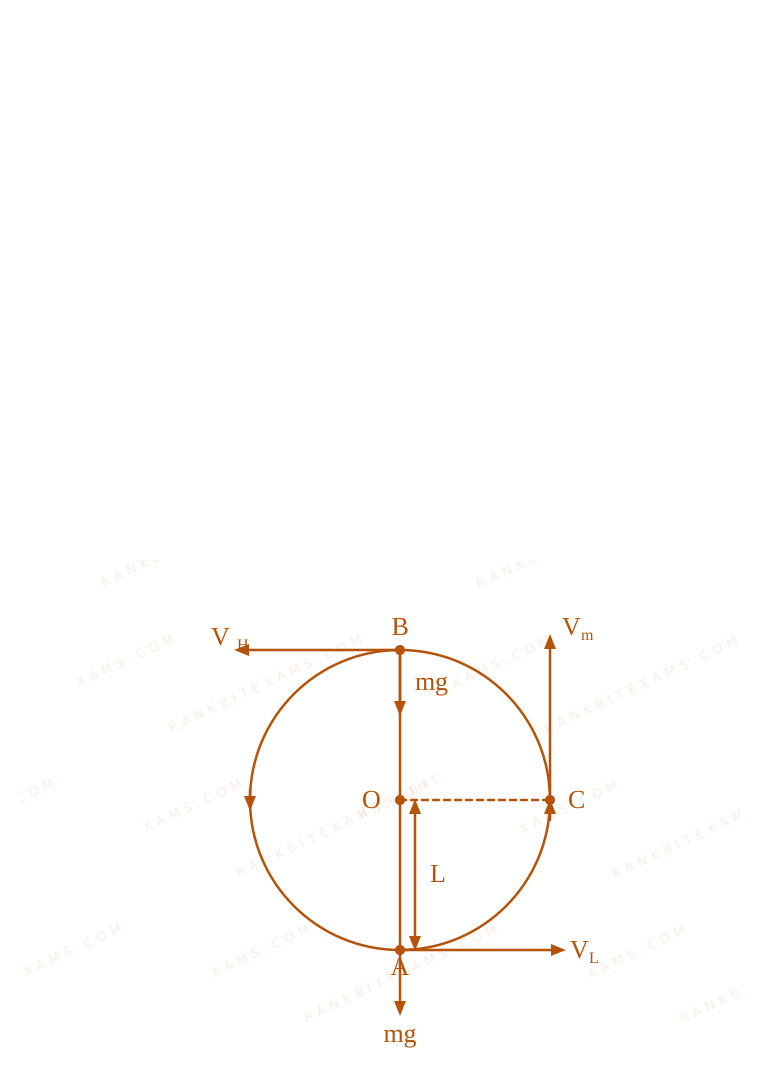
A bob of mass 'm' is suspended by a light string of length 'L'. It is imparted a minimum horizontal velocity at the lowest point A such that it just completes half circle reaching the top most position B. The ratio of kinetic energies frac(mathrmK.E.)_mathrmA(mathrmK.E.)_mathrmB is:
Vertical circular motion path of a pendulum bob for Q42 - JEE Main 2024 29 January Shift 2
The diagram displays a bob of mass m in vertical circular motion with velocity indicators at points A, B, and C.
  • A. 3:2
  • B. 5:1
  • C. 2:5
  • D. 1:5

Solution

### Related Formula For a body to just complete a vertical loop of radius L: * Speed at the lowest point A: v_A = sqrt5gL * Speed at the highest point B: v_B = sqrtgL ### Core Logic The kinetic energy at any point is given by: textK.E. = frac12mv^2 Thus: (textK.E.)_A = frac12m v_A^2 = frac12m(5gL) (textK.E.)_B = frac12m v_B^2 = frac12m(gL) ### Step 1: Calculate the Ratio Taking the ratio of the kinetic energies at A and B: frac(textK.E.)_A(textK.E.)_B = fracfrac12m(5gL)frac12m(gL) = frac51 = 5:1 ### Pattern Recognition Since textK.E. propto v^2, the ratio of kinetic energies is simply the ratio of the squares of the critical velocities at the bottom and top of the vertical loop: (sqrt5gL)^2 : (sqrtgL)^2 = 5:1. ### Evaluation Rubric / Model Answer null ### Chapter Mix Class 11 Physics: Work, Energy and Power
Q39 jee_main_2024_27_jan_morning Kinetic Energy and Momentum
Two bodies of mass 4text g and 25text g are moving with equal kinetic energies. The ratio of the magnitude of their linear momentum is:
  • A. 3:5
  • B. 5:4
  • C. 2:5
  • D. 4:5

Solution

### Related Formula K = fracP^22m implies P = sqrt2mK Where P is linear momentum, m is mass, and K is kinetic energy. ### Core Logic Given K_1 = K_2, the momentum ratio simplifies directly to the square root of their masses: fracP_1P_2 = sqrtfracm_1m_2 ### Step 1: Calculate the value Substitute m_1 = 4text g and m_2 = 25text g: fracP_1P_2 = sqrtfrac425 = frac25 ### Pattern Recognition For constant kinetic energy tracking profiles, momentum maps proportionally to sqrtm. ### Evaluation Rubric / Model Answer null ### Chapter Mix Class 11 Physics: Work, Energy and Power

More Work, Energy and Power Questions — jee_main_2025_03_april_evening

Practice all Work, Energy and Power previous-year questions →

Rankbit System
JEE Physics: Waves (+15.5%) | Electrostatics: Concentric Shells (-29.7%) | Modern Physics: Photoelectric Clones (+34.2%) | Mathematics: Definite Integrals (+18.1%) | Chemistry: Coordination Splitting (-11.4%) | JEE Physics: Waves (+15.5%) | Electrostatics: Concentric Shells (-29.7%) | Modern Physics: Photoelectric Clones (+34.2%) | Mathematics: Definite Integrals (+18.1%) | Chemistry: Coordination Splitting (-11.4%)