An ideal gas exists in a state with pressure P₀$P_{0}$, volume V₀$V_{0}$. It is isothermally expanded to 4 times of its initial volume (V₀)$(V_{0})$, then isobarically compressed to its original volume. Finally the system is heated isochorically to bring it to its initial state. The amount of heat exchanged in this process is :
A.P₀V₀(2ln 2-0.75)$P_{0}V_{0}(2\ln 2-0.75)$
B.P₀V₀(ln 2-0.75)$P_{0}V_{0}(\ln 2-0.75)$
C.P₀V₀(ln 2-0.25)$P_{0}V_{0}(\ln 2-0.25)$
D.P₀V₀(2ln 2-0.25)$P_{0}V_{0}(2\ln 2-0.25)$
Solution & Explanation
Related Formula
For a cyclic thermodynamic process, the net change in internal energy is zero:
Δ Ucyclic = 0$$\Delta U_{\text{cyclic}} = 0$$
By the First Law of Thermodynamics, the total heat exchanged QT$Q_T$ equals the net work done Wₙₑₜ$W_{\text{net}}$:
In any cyclic system returning to its initial state, finding total heat is mathematically equivalent to calculating the enclosed area on a P-V diagram. Here, the isobaric step occurs at the lowest expanded pressure, resulting in a simple negative rectangular area correction subtracted from the logarithmic isothermal expansion curve.
Chapter Mix
Class 11 Physics: Thermodynamics
More Thermodynamics Previous-Year Questions — Page 8
Qjee_main_2024_31_jan_morningIsobaric Process
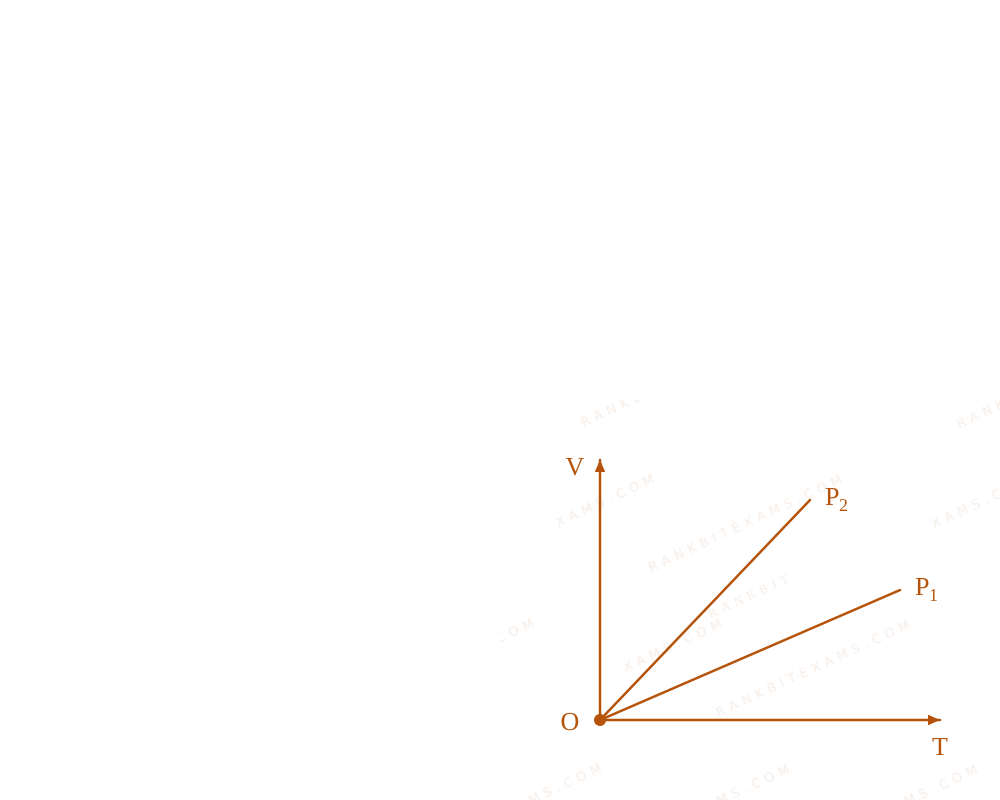
The given figure represents two isobaric processes for the same mass of an ideal gas, then
A Volume vs Temperature (V-T) graph showing two straight lines starting from the origin representing distinct constant pressures P1 and P2.
A.P₂≥ P₁$\mathrm{P}_2\geq \mathrm{P}_1$
B.P₂ > P₁$\mathrm{P}_2 > \mathrm{P}_1$
C.P₁ = P₂$\mathrm{P_1 = P_2}$
D.P₁ > P₂$\mathrm{P}_1 > \mathrm{P}_2$
Solution
Related Formula
PV = nRT$PV = nRT$
Core Logic
From the Ideal Gas Law:
V = ((nR)/(P)) T$$V = \left(\frac{nR}{P}\right) T$$
In a V-T$V-T$ graph, the equation of the line represents y = mx$y = mx$, where the slope m$m$ is:
Practice past-year questions one chapter at a time. Pick an exam → subject → chapter and get every PYQ for that topic — pulled together from all past papers — with the chapter's key formulas alongside.