JEE Main · Mathematics ↓ Falling

Binomial Theorem appeared 37 times across 3 years — 4.3% of Mathematics. This question is from Trinomial Expansion.

Year 2026 2025 2024 Total
Questions 9 17 11 37

Let (1 + x + x²)¹⁰ = a₀ + a₁x + a₂x² + + a₂₀x²⁰. If (a₁ + a₃ + a₅ + + a₁₉) - 11a₂ = 121k, then k is equal to

Numerical Answer Type:
Enter a numerical value Answer: 239 to 239 +4 marks

Solution & Explanation

Related Formula

For trinomial expansion:

(1+x+x²)ⁿ = Σr=0²ⁿ aᵣ x^r

Symmetric coefficients can be extracted by substituting x=1 and x=-1.

Core Logic

Let's perform the substitution:

  • For x = 1:
3¹⁰ = a₀ + a₁ + a₂ + + a₂₀ --- (1)
  • For x = -1:
1¹⁰ = a₀ - a₁ + a₂ - a₃ + + a₂₀ --- (2)
Step 1: Extracting odd term sum

Subtracting (2) from (1):

3¹⁰ - 1 = 2(a₁ + a₃ + a₅ + + a₁₉) a₁ + a₃ + a₅ + + a₁₉ = 3¹⁰ - 12

Since 3⁵ = 243 3¹⁰ = 59049:

a₁ + a₃ + a₅ + + a₁₉ = (59049 - 1)/(2) = 29524
Step 2: Finding a₂ and k

Using expansion formula to find a₂ (coefficient of x²):

(1 + x + x²)¹⁰ = Σ (10!)/(p! q! r!) xq + 2r (p+q+r = 10)

For q + 2r = 2:

  • Case 1: r=1, q=0 p=9. Coefficient = (10!)/(9! 0! 1!) = 10
  • Case 2: r=0, q=2 p=8. Coefficient = (10!)/(8! 2! 0!) = 45
a₂ = 10 + 45 = 55

Now substitute into the target relation:

29524 - 11(55) = 29524 - 605 = 28919 121k = 28919 k = 239
Pattern Recognition

Substituting standard complex roots or positive units is the fastest way to resolve sum of subset coefficients in polynomial expansions. Always use partition calculations for the early index terms (a₁, a₂) rather than standard multinomial permutations to avoid calculation mistakes.

Chapter Mix

Class 11 Mathematics: Binomial Theorem

Reference Study Guides

More Binomial Theorem Previous-Year Questions — Page 2

Q14 jee_main_2026_23_january_morning Coefficients in Expansion
The sum of all possible values of n in N, so that the coefficients of x, x² and x³ in the expansion of (1 + x²)² (1 + x)ⁿ, are in arithmetic progression is:
  • A. 3
  • B. 7
  • C. 12
  • D. 9

Solution

Core Logic

Expand the expression:

(1 + x²)² (1 + x)ⁿ = (1 + 2x² + x⁴) · Σr=0ⁿ ⁿCᵣ x^r

We need the coefficients of x, x², and x³. For x¹: Multiplier is 1 · ⁿC₁x = ⁿC₁. For x²: Multiplier is 1 · ⁿC₂x² + 2x² · ⁿC₀ = ⁿC₂ + 2. For x³: Multiplier is 1 · ⁿC₃x³ + 2x² · ⁿC₁x = ⁿC₃ + 2ⁿC₁.

These three coefficients are in Arithmetic Progression (A.P.).

Step 1: Set up the A.P. Condition

If A, B, C are in A.P., then 2B = A + C.

2(ⁿC₂ + 2) = ⁿC₁ + (ⁿC₃ + 2ⁿC₁) 2((n(n-1))/(2) + 2) = 3n + (n(n-1)(n-2))/(6) (assuming n ≥ 3)
Step 2: Solve the Polynomial Equation
n(n-1) + 4 = 3n + (n(n-1)(n-2))/(6)

Multiply by 6:

6n² - 6n + 24 = 18n + n(n² - 3n + 2) 6n² - 6n + 24 = 18n + n³ - 3n² + 2n n³ - 9n² + 26n - 24 = 0

Testing integer roots, for n = 2: 8 - 36 + 52 - 24 = 0 ⇒ n=2 is a root (wait, A.P. works for n=2 also, let's check later). For n = 3: 27 - 81 + 78 - 24 = 0 ⇒ n=3 is a root. For n = 4: 64 - 144 + 104 - 24 = 0 ⇒ n=4 is a root.

Step 3: Verification of Roots

Check for n = 2 (since our formula assumed n ≥ 3, ²C₃=0): Coeff of x = 2, Coeff of x² = 1+2 = 3, Coeff of x³ = 0 + 2(2) = 4. Sequence is 2, 3, 4 which is an A.P. So n=2 is valid. The values of n are 2, 3, 4. Required sum of values = 2 + 3 + 4 = 9.

Pattern Recognition

Whenever binomial limits logically constrain formulas (like ⁿC₃ demanding n≥ 3), explicitly check the lower bounds manually (n=2) to avoid dropping edge-case roots from the algebraic polynomial factorization.

Chapter Mix

Class 11 Maths: Binomial Theorem
Q14 jee_main_2026_24_january_morning Properties of Binomial Coefficients
Let S = (1)/(25!) + (1)/(3!23!) + (1)/(5!21!) + up to 13 terms. If 13S = (2^k)/(n!), k in N, then n + k is equal to
  • A. 51
  • B. 52
  • C. 49
  • D. 50

Solution

Related Formula
ⁿCᵣ = (n!)/(r!(n-r)!) ⁿC₁ + ⁿC₃ + ⁿC₅ + = 2ⁿ⁻¹
Core Logic

Multiply and divide the series by 26! to create combinatorial terms.

S = (1)/(26!) ( (26!)/(25!1!) + (26!)/(3!23!) + (26!)/(5!21!) + (13 terms) )
Step 1: Binomial Transformation
S = (1)/(26!) ( ²⁶C₁ + ²⁶C₃ + ²⁶C₅ + + ²⁶C₂₅ )

Notice there are exactly 13 terms, capturing all odd coefficients for n=26.

Step 2: Evaluating the Sum

The sum of odd binomial coefficients is 2ⁿ⁻¹.

²⁶C₁ + ²⁶C₃ + + ²⁶C₂₅ = 2²⁵ S = (1)/(26!) × 2²⁵
Step 3: Matching the Result

We need 13S:

13S = 13 × 2²⁵26! = 13 × 2²⁵26 × 25! = 2²⁵2 × 25! = 2²⁴25!

Comparing with (2^k)/(n!), we get k = 24, n = 25.

n + k = 25 + 24 = 49
Pattern Recognition

Series with denominators having factorials that sum to a constant (e.g., 1+25=26, 3+23=26) should immediately be normalized into Binomial Coefficients by multiplying by the sum-factorial (26!).

Chapter Mix

Class 11 Maths: Binomial Theorem

Q1 jee_main_2026_28_january_evening Divisibility and Integral Parts
Given below two statements: Statement I: 25¹³ + 20¹³ + 8¹³ + 3¹³ is divisible by 7. Statement II: The integral part of (7 + 4√(3))²⁵ is an odd number. In the light of the above statements, choose the correct answer from the options given below:
  • A. Both Statement I and Statement II are false.
  • B. Both Statement I and Statement II are true.
  • C. Statement I is false but Statement II is true.
  • D. Statement I is true but Statement II is false.

Solution

Related Formula
xⁿ + aⁿ is divisible by (x+a) when n is odd.
Core Logic

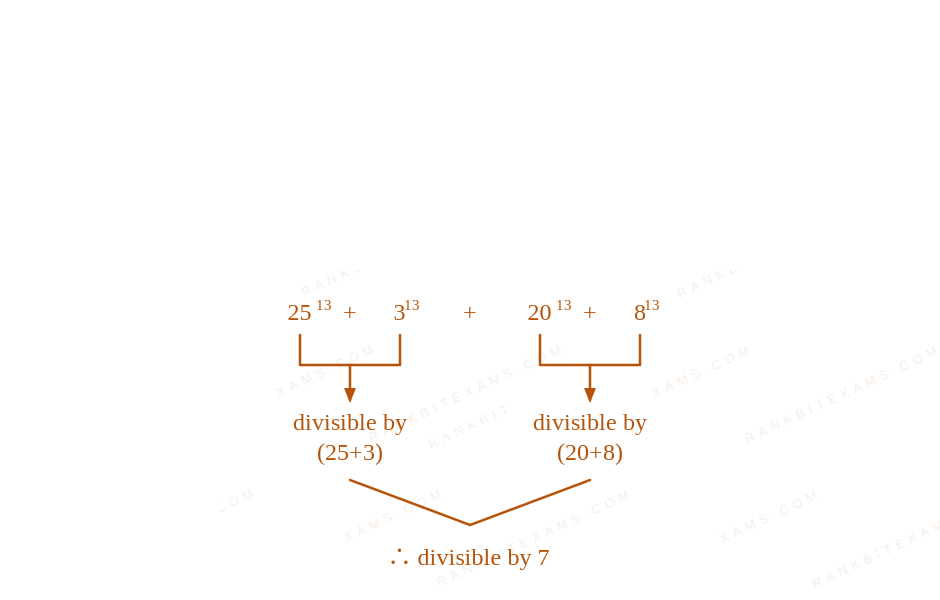
For Statement I: Group the terms to apply the divisibility rule:

25¹³ + 3¹³ + 20¹³ + 8¹³

(25¹³ + 3¹³) is divisible by (25+3) = 28, which is a multiple of 7. (20¹³ + 8¹³) is divisible by (20+8) = 28, which is a multiple of 7. Thus, the entire expression is divisible by 7.

Divisibility logic for Q1

Execution

For Statement II: Let R = (7 + 4√(3))²⁵ = I + f where I is the integral part and 0 ≤ f < 1. Let R' = (7 - 4√(3))²⁵ = f' where 0 < f' < 1. Adding R and R':

R + R' = 2[²⁵C₀7²⁵ + ²⁵C₂7²³(4√(3))² + …] I + f + f' = even integer

Since 0 < f + f' < 2 and f + f' must be an integer, f + f' = 1. Therefore, I + 1 = even integer ⇒ I = odd integer. Both statements are correct.

Pattern Recognition

For expressions of the form (a + √(b))ⁿ, finding the conjugate (a - √(b))ⁿ and adding/subtracting isolates the integer terms.

Chapter Mix

Class 11 Maths: Binomial Theorem

Q2 jee_main_2026_28_january_evening Sum of Coefficients in Expansion
The sum of the coefficients of x⁴⁹⁹ and x⁵⁰⁰ in (1 + x)¹⁰⁰⁰ + x(1 + x)⁹⁹⁹ + x²(1 + x)⁹⁹⁸ + … + x¹⁰⁰⁰ is
  • A. ¹⁰⁰¹C₅₀₁
  • B. ¹⁰⁰²C₅₀₀
  • C. ¹⁰⁰²C₅₀₁
  • D. ¹⁰⁰⁰C₅₀₁

Solution

Related Formula
Sₙ = a(1 - rⁿ)/(1 - r) ⁿCᵣ + ⁿCᵣ₋₁ = ⁿ⁺¹Cᵣ
Core Logic

The given series is a geometric progression:

S = (1 + x)¹⁰⁰⁰ + x(1 + x)⁹⁹⁹ + … + x¹⁰⁰⁰

First term a = (1+x)¹⁰⁰⁰, Common ratio r = (x)/(1+x), Number of terms n = 1001.

Sum of GP:

S = (1 + x)¹⁰⁰⁰ (1 - ((x)/(1 + x))¹⁰⁰¹)1 - (x)/(1 + x) = (1 + x)¹⁰⁰¹ - x¹⁰⁰¹
Execution

We need the sum of coefficients of x⁴⁹⁹ and x⁵⁰⁰ in the resulting expression (1 + x)¹⁰⁰¹ - x¹⁰⁰¹. For x⁴⁹⁹, the coefficient is ¹⁰⁰¹C₄₉₉. For x⁵⁰⁰, the coefficient is ¹⁰⁰¹C₅₀₀.

Required sum:

¹⁰⁰¹C₄₉₉ + ¹⁰⁰¹C₅₀₀ = ¹⁰⁰²C₅₀₀

Series sum resolution

Pattern Recognition

Transform the complex polynomial series using the Geometric Progression sum formula, which simplifies it into a single binomial expansion.

Chapter Mix

Class 11 Maths: Sequence and Series Class 11 Maths: Binomial Theorem

Q65 jee_main_2025_02_april_evening Properties of Binomial Coefficients
If Σr = 0¹⁰( 10r + 1 - 110r) · 11r + 1 = α¹¹ - 11¹¹10¹⁰, then α is equal to:
  • A. 15
  • B. 11
  • C. 24
  • D. 20

Solution

Related Formula
Sum of binomial coefficients: Σk=0ⁿ nk x^k = (1 + x)ⁿ Shifted binomial sum: Σk=1ⁿ nk x^k = (1+x)ⁿ - 1
Core Logic

We split the summation into two parts, express each as a binomial series expansion, and equate the resulting algebraic fraction to solve for α.

Step 1: Split the summation

The general term inside the summation can be written as:

( 10r+1 - 110^r ) = 10 - (1)/(10^r) = 10 - 10 ( (1)/(10) )r+1

Substitute this back into the sum:

S = Σr=0¹⁰ [ 10 - 10 ( (1)/(10) )r+1 ] 11r+1 S = 10 Σr=0¹⁰ 11r+1 - 10 Σr=0¹⁰ 11r+1 ( (1)/(10) )r+1
Step 2: Evaluate both parts of the sum

For the first part, let s = r+1:

Σr=0¹⁰ 11r+1 = Σs=1¹¹ 11s = 2¹¹ - 1

For the second part, using s = r+1:

Σr=0¹⁰ 11r+1 ( (1)/(10) )r+1 = Σs=1¹¹ 11s ( (1)/(10) )^s = ( 1 + (1)/(10) )¹¹ - 1 = ( (11)/(10) )¹¹ - 1
Step 3: Combine and find alpha

Multiply both parts by 10:

S = 10 ( 2¹¹ - 1 ) - 10 [ ( (11)/(10) )¹¹ - 1 ] S = 10 · 2¹¹ - 10 - 10 · 11¹¹10¹¹ + 10 = 10 · 2¹¹ - 11¹¹10¹⁰

Express the first term with a denominator of 10¹⁰:

10 · 2¹¹ = 10¹¹ · 2¹¹10¹⁰ = 20¹¹10¹⁰

Thus, the total sum is:

S = 20¹¹ - 11¹¹10¹⁰

Comparing this with α¹¹ - 11¹¹10¹⁰, we find:

α = 20

Pattern Recognition

Binomial base scaling: Whenever you see a sum of the form Σ a^r nr, it is simply the expanded form of a shifted binomial expansion of (1 + a)ⁿ. Factoring out scaling constants yields standard analytical forms.

Chapter Mix

Class 11 Mathematics: Binomial Theorem

More Binomial Theorem Questions — jee_main_2025_03_april_evening

Practice all Binomial Theorem previous-year questions →

Rankbit System
JEE Physics: Waves (+15.5%) | Electrostatics: Concentric Shells (-29.7%) | Modern Physics: Photoelectric Clones (+34.2%) | Mathematics: Definite Integrals (+18.1%) | Chemistry: Coordination Splitting (-11.4%) | JEE Physics: Waves (+15.5%) | Electrostatics: Concentric Shells (-29.7%) | Modern Physics: Photoelectric Clones (+34.2%) | Mathematics: Definite Integrals (+18.1%) | Chemistry: Coordination Splitting (-11.4%)