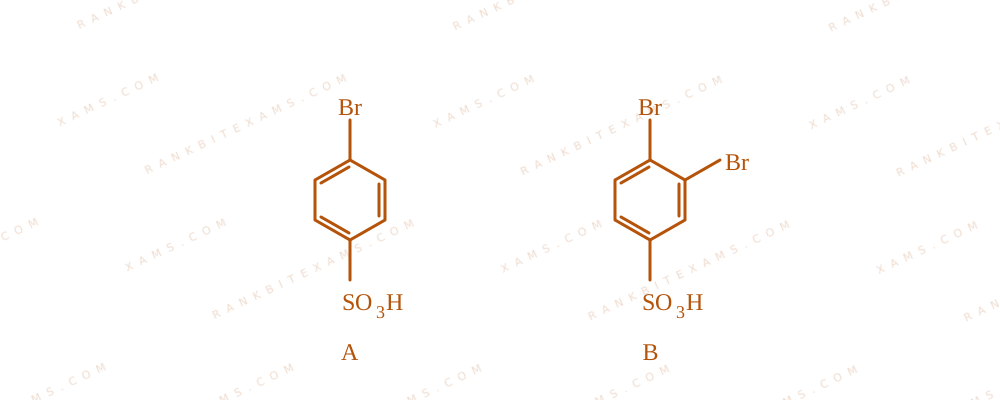
In the following series of reactions identify the major products A & B respectively:
Electrophilic Aromatic Substitution
A.
Electrophilic Aromatic Substitution
B.
Electrophilic Aromatic Substitution
C.
Electrophilic Aromatic Substitution
D.
Electrophilic Aromatic Substitution
Solution & Explanation
### Related Formula
Orienting effects in electrophilic aromatic substitution:
- Bromine (-Br$-Br$) is ortho/para-directing (para-dominated due to steric hindrance).
- Sulfonic acid group (-SO_3H$-SO_3H$) is a strong deactivating, meta-directing group.
Electrophilic Aromatic Substitution
### Core Logic
Analyzing the first step:
- Sulfonation of bromobenzene with mathrmSO_3/mathrmH_2mathrmSO_4$\mathrm{SO}_3/\mathrm{H}_2\mathrm{SO}_4$ yields 4-bromobenzenesulfonic acid as the major product (A) due to steric hindrance at the ortho-position.
### Step 1: Determine orientation for the second step
In 4-bromobenzenesulfonic acid, we have two substituents:
- -Br$-Br$ (ortho/para director)
- -SO_3H$-SO_3H$ (meta director)
The positions meta to the deactivating -SO_3H$-SO_3H$ group correspond to the positions ortho to the -Br$-Br$ group. Both directing effects align on the same position (carbon-3/carbon-5). Since -Br$-Br$ is activating relative to -SO_3H$-SO_3H$, it controls the orientation.
### Step 2: Identify Product B
Halogenation with mathrmBr_2/mathrmFe$\mathrm{Br}_2/\mathrm{Fe}$ introduces a bromine atom ortho to the existing bromine atom (meta to -SO_3H$-SO_3H$):
textProduct B = text3,4-dibromobenzenesulfonic acid$$\text{Product B} = \text{3,4-dibromobenzenesulfonic acid}$$
This matches Option (2).
### Pattern Recognition
When an activating group (-Br$-Br$) and a deactivating group (-SO_3H$-SO_3H$) compete on a benzene ring, the orienting influence of the activating group wins. Position ortho to the bromine atom is favored over meta positions of the sulfonic acid group.
### Evaluation Rubric / Model Answer
null
### Chapter Mix
Class 11 Chemistry: Hydrocarbons
Class 12 Chemistry: Haloalkanes and Haloarenes
More Hydrocarbons Previous-Year Questions — Page 5
Q84jee_main_2024_31_jan_eveningHalogenation of Alkanes (Isomers)
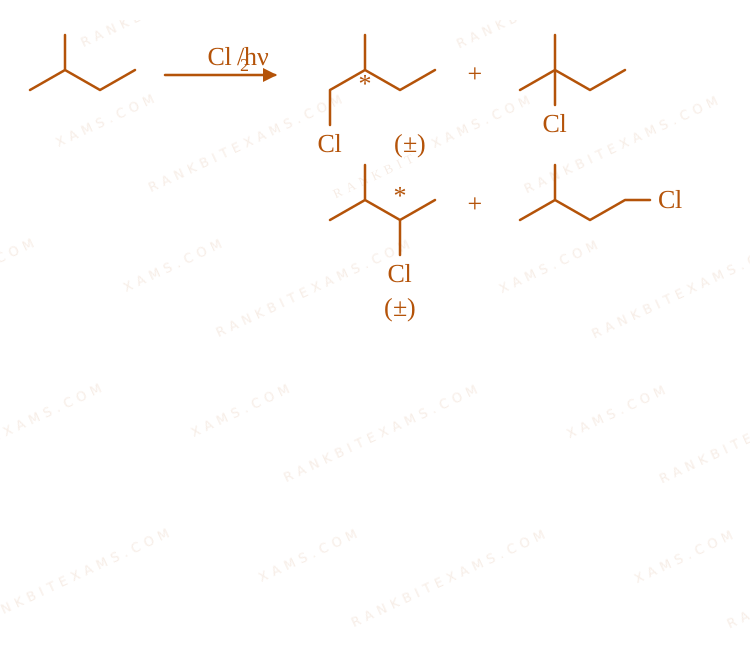
Number of isomeric products formed by mono-chlorination of 2-methylbutane in presence of sunlight is ________
Numerical Answer.Answer: 6 to 6
Solution
### Core Logic
The structure of 2-methylbutane is CH_3-CH(CH_3)-CH_2-CH_3$CH_3-CH(CH_3)-CH_2-CH_3$. It has four different types of hydrogen atoms, which can be substituted to form structural isomers:
1) 1-chloro-2-methylbutane: Chlorination at terminal CH_3$CH_3$ near branch. Yields a chiral center at C2 (2 enantiomers).
2) 2-chloro-2-methylbutane: Chlorination at the tertiary carbon (1 achiral product).
3) 2-chloro-3-methylbutane: Chlorination at the CH_2$CH_2$ group. Yields a chiral center at C2 (2 enantiomers).
4) 1-chloro-3-methylbutane: Chlorination at the far terminal CH_3$CH_3$. No chiral center (1 achiral product).
Halogenation of Alkanes (Isomers) diagram for Q84 - JEE Main 2024 Evening
### Step 1: Counting Stereoisomers
Total isomeric products = 2 (from 1st) + 1 (from 2nd) + 2 (from 3rd) + 1 (from 4th) = 6$2 (from 1st) + 1 (from 2nd) + 2 (from 3rd) + 1 (from 4th) = 6$.
### Pattern Recognition
When asked for "isomeric products" in halogenation without specifying "structural isomers", you must count stereoisomers (enantiomers) as well.
### Evaluation Rubric / Model Answer
null
### Chapter Mix
Class 11 Chemistry: Hydrocarbons
Class 12 Chemistry: Haloalkanes and Haloarenes
Number of alkanes obtained on electrolysis of a mixture of CH_3COONa$CH_3COONa$ and C_2H_5COONa$C_2H_5COONa$ is
Numerical Answer.Answer: 3 to 3
Solution
### Core Logic
Kolbe's electrolytic method generates free radicals at the anode, which then combine to form alkanes.
The given mixture yields two types of carboxylate radicals which decarboxylate to form alkyl radicals:
CH_3COONa rightarrow dotCH_3$CH_3COONa \rightarrow \dot{C}H_3$C_2H_5COONa rightarrow dotC_2H_5$C_2H_5COONa \rightarrow \dot{C}_2H_5$
These radicals can couple in three different ways:
1. Cross coupling: dotCH_3 + dotC_2H_5 rightarrow CH_3-CH_2-CH_3$\dot{C}H_3 + \dot{C}_2H_5 \rightarrow CH_3-CH_2-CH_3$ (Propane)
2. Self-coupling 1: dotCH_3 + dotCH_3 rightarrow CH_3-CH_3$\dot{C}H_3 + \dot{C}H_3 \rightarrow CH_3-CH_3$ (Ethane)
3. Self-coupling 2: dotC_2H_5 + dotC_2H_5 rightarrow CH_3-CH_2-CH_2-CH_3$\dot{C}_2H_5 + \dot{C}_2H_5 \rightarrow CH_3-CH_2-CH_2-CH_3$ (Butane)
Thus, a total of 3 different alkanes are formed.
### Evaluation Rubric / Model Answer
null
### Chapter Mix
Class 11 Chemistry: Hydrocarbons
We Map Every Repeating Question in Competitive Exams.
Say goodbye to generic mock test fatigue. RankBit uses smart analysis to group past exam questions into their foundational Repeating Question Types. Find chapter weightage, track repeating questions, and score higher with targeted practice.
Select Your Target Exam
Choose an exam track below to find formulas per chapter and patterns.
Syncing Exam Intelligence
Mapping formulas and patterns across all tracks…
PATH A — FULL LENGTH PRACTICE
Full Mock Test Hub
Simulate real NTA exam conditions with fully tracked mocks. Time yourself against past papers.
Practice past-year questions one chapter at a time. Pick an exam → subject → chapter and get every PYQ for that topic — pulled together from all past papers — with the chapter's key formulas alongside.
.svg)
.svg)
.svg)
.svg)
.svg)