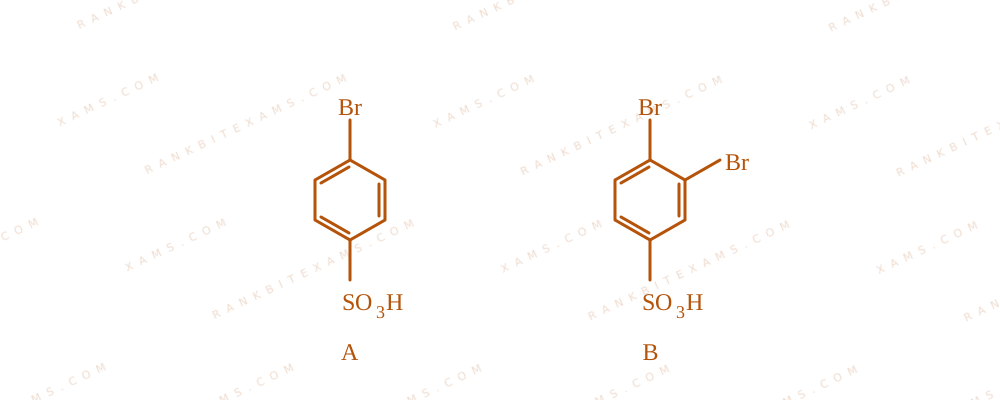
In the following series of reactions identify the major products A & B respectively:
Electrophilic Aromatic Substitution

Solution & Explanation

### Related Formula Orienting effects in electrophilic aromatic substitution: - Bromine (-Br) is ortho/para-directing (para-dominated due to steric hindrance). - Sulfonic acid group (-SO_3H) is a strong deactivating, meta-directing group.
Electrophilic Aromatic Substitution
### Core Logic Analyzing the first step: - Sulfonation of bromobenzene with mathrmSO_3/mathrmH_2mathrmSO_4 yields 4-bromobenzenesulfonic acid as the major product (A) due to steric hindrance at the ortho-position. ### Step 1: Determine orientation for the second step In 4-bromobenzenesulfonic acid, we have two substituents: - -Br (ortho/para director) - -SO_3H (meta director) The positions meta to the deactivating -SO_3H group correspond to the positions ortho to the -Br group. Both directing effects align on the same position (carbon-3/carbon-5). Since -Br is activating relative to -SO_3H, it controls the orientation. ### Step 2: Identify Product B Halogenation with mathrmBr_2/mathrmFe introduces a bromine atom ortho to the existing bromine atom (meta to -SO_3H): textProduct B = text3,4-dibromobenzenesulfonic acid This matches Option (2). ### Pattern Recognition When an activating group (-Br) and a deactivating group (-SO_3H) compete on a benzene ring, the orienting influence of the activating group wins. Position ortho to the bromine atom is favored over meta positions of the sulfonic acid group. ### Evaluation Rubric / Model Answer null ### Chapter Mix Class 11 Chemistry: Hydrocarbons Class 12 Chemistry: Haloalkanes and Haloarenes

More Hydrocarbons Previous-Year Questions — Page 4

Q90 jee_main_2024_29_jan_morning Reactions of Alkenes Ozonolysis
Consider the given reaction. CH_3-CH=C(CH_3)_2 xrightarrow[(ii) Zn/H_2O, (i) O_3 (P) The total number of oxygen atoms present per molecule of the product (P) is
Numerical Answer. Answer: 1 to 1

Solution

### Core Logic The reaction given is the reductive ozonolysis of an alkene, 2-methylbut-2-ene (CH_3-CH=C(CH_3)_2). In reductive ozonolysis (O_3 followed by Zn/H_2O), the carbon-carbon double bond is completely cleaved. An oxygen atom is placed on each carbon atom of the broken double bond to form carbonyl compounds (aldehydes or ketones). ### Step 1: Identifying the Products CH_3-CH=C(CH_3)_2 xrightarrowO_3 / Zn, H_2O CH_3-CHO + O=C(CH_3)_2 The reaction yields two distinct product molecules: 1. Acetaldehyde (CH_3CHO) - contains 1 oxygen atom. 2. Acetone (CH_3COCH_3) - contains 1 oxygen atom. The question asks for the number of oxygen atoms present **per molecule** of the product (P). Since any resulting product molecule (either acetaldehyde or acetone) contains exactly 1 oxygen atom, the answer is 1. ### Pattern Recognition Reductive ozonolysis of a simple alkene without other oxygenated functional groups always creates simple aldehydes or ketones. Each resulting discrete molecule formed from the cleaved double bond will have exactly 1 carbonyl group (1 oxygen atom) unless it's a cyclic alkene opening up (which would have 2). ### Evaluation Rubric / Model Answer null ### Chapter Mix Class 11 Chemistry: Hydrocarbons Class 12 Chemistry: Aldehydes Ketones and Carboxylic Acids
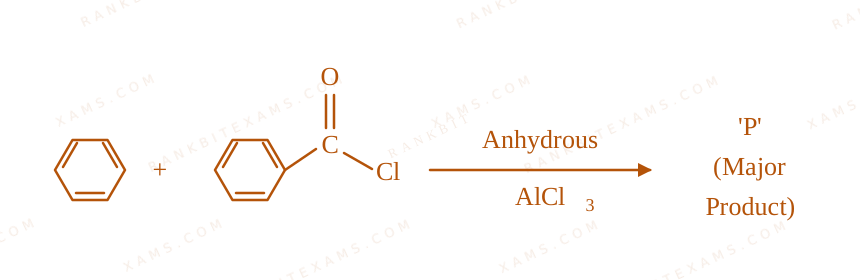
Q77 jee_main_2024_30_jan_morning Alkynes
Compound A formed in the following reaction reacts with B gives the product C. Find out A and B. CH_3-Cequiv CH + Na rightarrow A xrightarrowB CH_3-Cequiv C-CH_2-CH_2-CH_3 + NaBr
  • A. A=CH_3-Cequiv C^-Na^+, B=CH_3-CH_2-CH_2-Br
  • B. A=CH_3-CH=CH_2, B=CH_3-CH_2-CH_2-Br
  • C. A=CH_3-CH_2-CH_3, B=CH_3-Cequiv CH
  • D. A=CH_3-Cequiv C^-Na^+, B=CH_3-CH_2-CH_3

Solution

### Core Logic Terminal alkynes possess acidic hydrogen. When treated with a strong base or active metal like Sodium (Na), they form sodium acetylide salts. CH_3-Cequiv C-H + Na rightarrow CH_3-Cequiv C^-Na^+ + frac12H_2 So, A is Sodium propynide (CH_3-Cequiv C^-Na^+). ### Step 1: Analyzing the second step The product is CH_3-Cequiv C-CH_2-CH_2-CH_3. This indicates an S_N2 substitution reaction between the acetylide ion (nucleophile) and an alkyl halide (electrophile). Since NaBr is a byproduct, B must be a propyl bromide. CH_3-Cequiv C^-Na^+ + CH_3-CH_2-CH_2-Br rightarrow CH_3-Cequiv C-CH_2-CH_2-CH_3 + NaBr ### Step 2: Conclusion A is CH_3-Cequiv C^-Na^+ and B is CH_3-CH_2-CH_2-Br (1-Bromopropane). ### Evaluation Rubric / Model Answer null ### Chapter Mix Class 11 Chemistry: Hydrocarbons Class 12 Chemistry: Haloalkanes and Haloarenes
Q65 jee_main_2024_31_jan_evening Electrophilic Aromatic Substitution
Identify major product 'P' formed in the following reaction.
Electrophilic Aromatic Substitution diagram for Q65 - JEE Main 2024 Evening
The image shows an aromatic ring undergoing a reaction with an alkyl halide in the presence of anhydrous AlCl3.
  • A. text(1) Product A
  • B. text(2) Product B
  • C. text(3) Product C
  • D. text(4) Product D

Solution

### Core Logic The given reaction is an intramolecular Friedel-Crafts alkylation. 1) The alkyl chloride reacts with anhydrous AlCl_3 to form a carbocation intermediate. 2) The carbocation generated will act as an electrophile and attack the adjacent phenyl ring. 3) The intermediate carbocation will undergo electrophilic aromatic substitution to form a new six-membered ring, as a 6-membered ring is highly stable and preferred over other ring sizes.
Electrophilic Aromatic Substitution diagram for Q65 - JEE Main 2024 Evening
The image shows an aromatic ring undergoing a reaction with an alkyl halide in the presence of anhydrous AlCl3.
### Pattern Recognition Intramolecular Friedel-Crafts usually prefers forming 5 or 6 membered rings due to lesser angle strain. Here, the tether length is perfect for closing into a 6-membered tetralin-like system. ### Evaluation Rubric / Model Answer null ### Chapter Mix Class 11 Chemistry: Hydrocarbons
Q66 jee_main_2024_31_jan_evening Electrophilic Addition to Alkenes
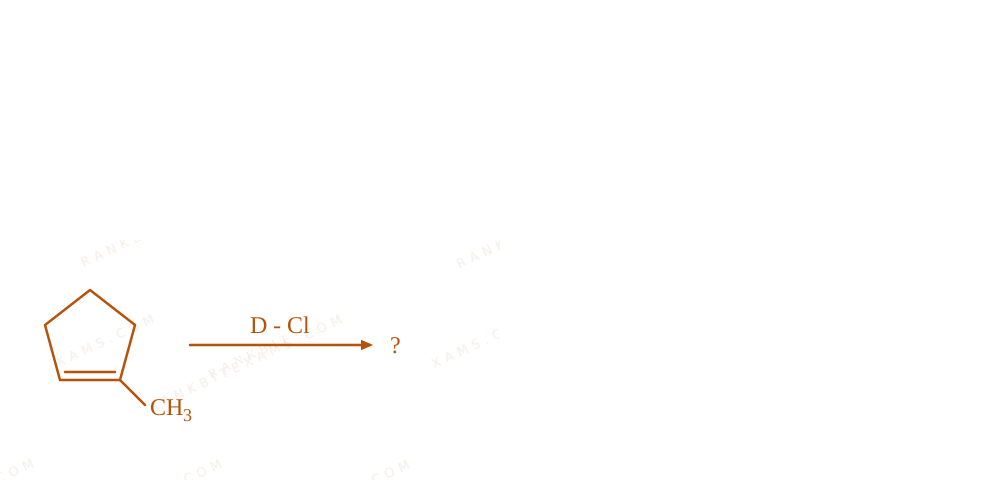
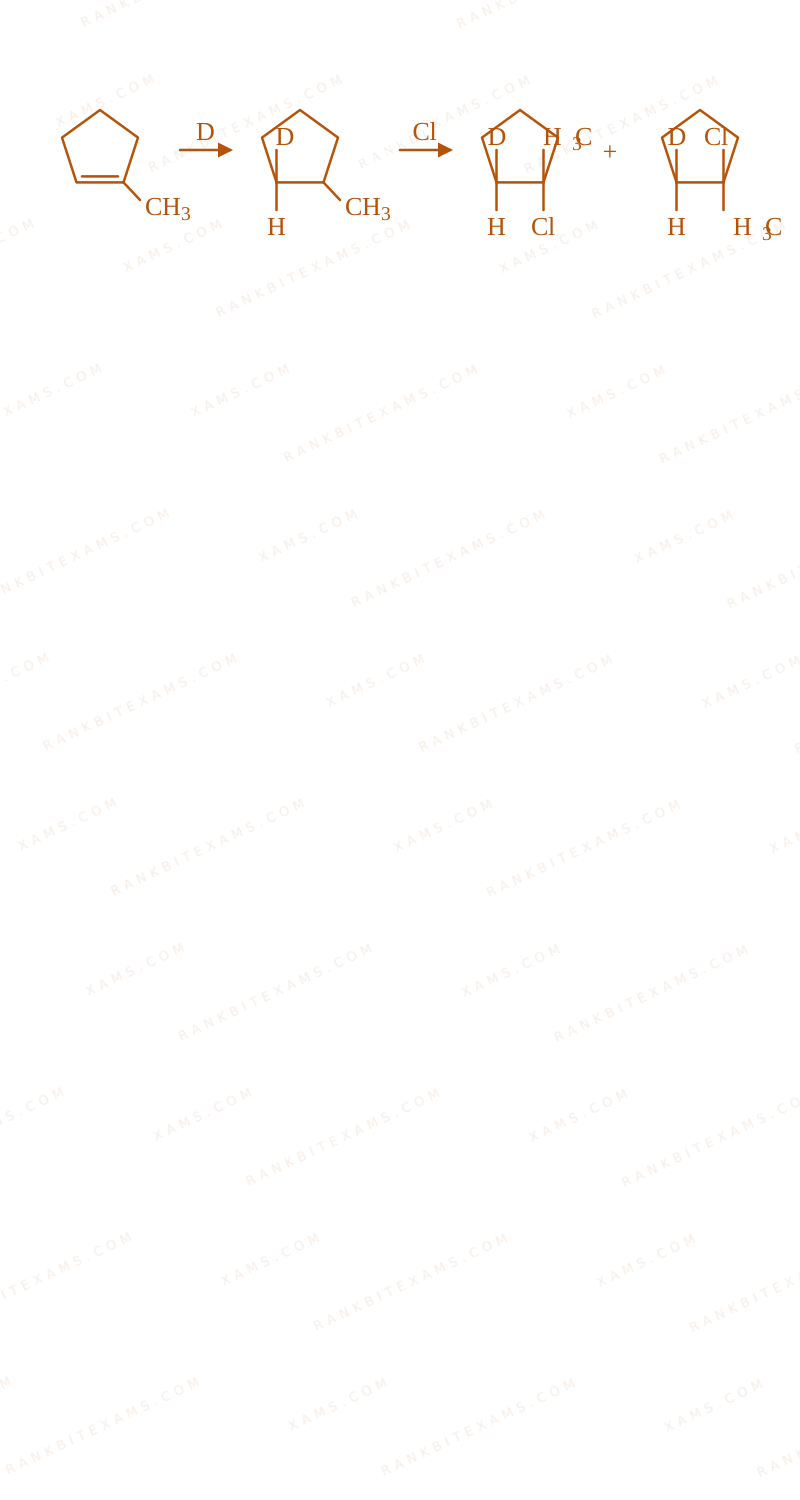
Major product of the following reaction is -
Electrophilic Addition to Alkenes diagram for Q66 - JEE Main 2024 Evening
The image shows a methylcyclopentene derivative reacting with D-Cl.
  • A. text(1) Product A
  • B. text(2) Product B
  • C. text(3) Product C
  • D. text(4) Product D

Solution

### Core Logic Addition of D-Cl across the double bond takes place via an electrophilic addition mechanism following Markovnikov's rule. 1) The electrophile D^+ attacks the double bond to generate the most stable carbocation. The tertiary carbocation formed at the methyl-substituted carbon is more stable than the secondary carbocation. 2) The nucleophile Cl^- then attacks the planar tertiary carbocation from either face (top or bottom), resulting in a racemic mixture if a new chiral center is fully free, but here the stereochemistry depends on the relative anti/syn addition logic or thermodynamic stability. A mixture of diastereomers can be formed, but standard electrophilic additions often yield predominantly the trans-product due to steric reasons or via a bridged intermediate depending on conditions, though pure HCl/DCl addition is non-stereospecific. However, based on the official answer key (Option 3), we identify the correct stereochemical representation provided by the examining body.
Electrophilic Addition to Alkenes diagram for Q66 - JEE Main 2024 Evening
The image shows a methylcyclopentene derivative reacting with D-Cl.
### Note on Discrepancy According to the official NTA key, Option 3 is correct. According to our experts, both options 3 and 4 can be formed as a mixture since the carbocation is planar and Cl^- can attack from both sides. We proceed with the officially accepted answer (3). ### Evaluation Rubric / Model Answer null ### Chapter Mix Class 11 Chemistry: Hydrocarbons
Q79 jee_main_2024_31_jan_evening Electrophilic Aromatic Substitution Reactivity
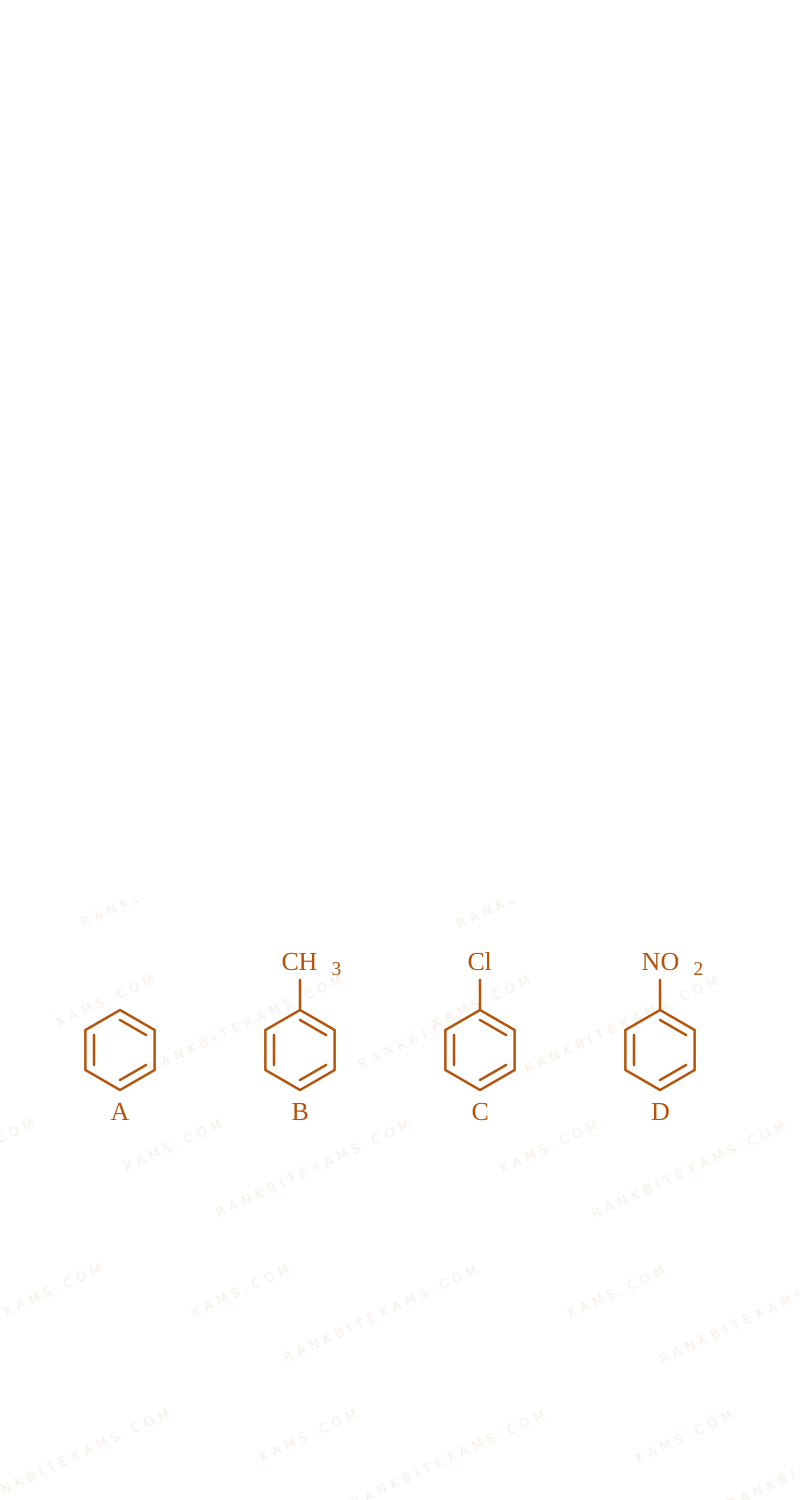
The correct order of reactivity in electrophilic substitution reaction of the following compounds is:
Electrophilic Aromatic Substitution Reactivity diagram for Q79 - JEE Main 2024 Evening
The image displays four aromatic compounds: Benzene (A), Toluene (B), Chlorobenzene (C), and Nitrobenzene (D).
  • A. text(1) B > C > A > D
  • B. text(2) D > C > B > A
  • C. text(3) A > B > C > D
  • D. text(4) B > A > C > D

Solution

### Core Logic Electrophilic substitution reactivity depends on the electron density of the aromatic ring, which is influenced by the inductive (I) and mesomeric (M) effects of the substituents. - Compound A (Benzene): Standard reference. - Compound B (Toluene): The -CH_3 group shows +I and hyperconjugation effects, activating the ring. Most reactive. - Compound C (Chlorobenzene): The -Cl group shows +M and -I effects, but the -I effect dominates, mildly deactivating the ring. - Compound D (Nitrobenzene): The -NO_2 group shows strong -M and -I effects, heavily deactivating the ring. Least reactive. Order of reactivity: Toluene (B) > Benzene (A) > Chlorobenzene (C) > Nitrobenzene (D). ### Step 1: Final Order Reactivity: B > A > C > D. This matches option (4). ### Evaluation Rubric / Model Answer null ### Chapter Mix Class 11 Chemistry: Hydrocarbons Class 12 Chemistry: Haloalkanes and Haloarenes
Rankbit System
JEE Physics: Waves (+15.5%) | Electrostatics: Concentric Shells (-29.7%) | Modern Physics: Photoelectric Clones (+34.2%) | Mathematics: Definite Integrals (+18.1%) | Chemistry: Coordination Splitting (-11.4%) | JEE Physics: Waves (+15.5%) | Electrostatics: Concentric Shells (-29.7%) | Modern Physics: Photoelectric Clones (+34.2%) | Mathematics: Definite Integrals (+18.1%) | Chemistry: Coordination Splitting (-11.4%)