Identify the diamagnetic octahedral complex ions from below; A. [mathrmMn(mathrmCN)_6]^3- B. [mathrmCo(mathrmNH_3)_6]^3+ C. [mathrmFe(mathrmCN)_6]^4- D. [mathrmCo(mathrmH_2mathrmO)_3mathrmF_3] Choose the correct answer from the options given below :

Solution & Explanation

### Related Formula According to Crystal Field Theory (CFT): - A complex is diamagnetic if all electrons are paired up (unpaired electrons, n=0). - Strong field ligands (like mathrmCN^-, mathrmNH_3 with Co^3+) cause pairing of electrons if Delta_o > P. {{SOLUTION_IMG}} ### Core Logic Analyze each complex: - **A. [mathrmMn(mathrmCN)_6]^3-**: - Mn^3+ has d^4 configuration. - Strong field ligand mathrmCN^- causes pairing in t_2g orbitals: t_2g^4 e_g^0. - There are 2 unpaired electrons rightarrow *Paramagnetic*. - **B. [mathrmCo(mathrmNH_3)_6]^3+**: - Co^3+ has d^6 configuration. - mathrmNH_3 acts as strong field ligand with Co^3+, causing complete pairing: t_2g^6 e_g^0. - No unpaired electrons rightarrow *Diamagnetic*. ### Step 1: Analyze complexes C and D - **C. [mathrmFe(mathrmCN)_6]^4-**: - Fe^2+ has d^6 configuration. - Strong field ligand mathrmCN^- causes complete pairing: t_2g^6 e_g^0. - No unpaired electrons rightarrow *Diamagnetic*. - **D. [mathrmCo(mathrmH_2mathrmO)_3mathrmF_3]**: - Co^3+ has d^6 configuration. - Weak field ligands (mathrmF^-, mathrmH_2mathrmO) do not cause pairing: t_2g^4 e_g^2. - There are 4 unpaired electrons rightarrow *Paramagnetic*. ### Step 2: Conclusion Only complexes B and C are diamagnetic, matching Option (4). ### Pattern Recognition Octahedral d^6 ions (such as Co^3+ or Fe^2+) coupled with strong-field ligands are exceptionally stable and always form low-spin, fully paired, diamagnetic complexes (t_2g^6 e_g^0). ### Evaluation Rubric / Model Answer null ### Chapter Mix Class 12 Chemistry: Coordination Compounds
Magnetic Properties and Hybridization of Complexes

More Coordination Compounds Previous-Year Questions — Page 3

Q41 jee_main_2025_08_april_evening Valence Bond Theory
Determine the total number of chemical species from the list below that are specifically involved in an sp^3d^2 hybridization state: [textCo(NH_3)_6]^3+, text SF_6, \, [textCrF_6]^3-, \, [textCoF_6]^3-, \, [textMn(CN)_6]^3-, text and [textMnCl_6]^3-
  • A. 5
  • B. 6
  • C. 4
  • D. 3

Solution

### Core Logic Let us systematically determine the hybridization configuration of each species: 1. **[textCo(NH_3)_6]^3+**: textCo^3+ has a 3d^6 configuration. Ammonia (textNH_3) acts as a Strong Field Ligand (SFL), forcing the pairing of 3d electrons. This leaves two internal 3d orbitals vacant, leading to an **inner orbital** d^2sp^3 hybridization. 2. **textSF_6**: Central sulfur has 6 valence electrons, forming 6 single bonds. Steric number = 6, resulting in a regular outer octahedral **sp^3d^2** hybridization. 3. **[textCrF_6]^3-**: textCr^3+ has a 3d^3 configuration. The t_2g subshell holds 3 unpaired electrons, leaving the two e_g orbitals empty regardless of ligand field strength. This results in a d^2sp^3 hybridization. 4. **[textCoF_6]^3-**: textCo^3+ has a 3d^6 configuration. Fluoride (F^-) is a Weak Field Ligand (WFL) and cannot induce spin pairing. Thus, the complex utilizes outer shell 4d orbitals, yielding an **outer orbital** **sp^3d^2** configuration. 5. **[textMn(CN)_6]^3-**: textMn^3+ has a 3d^4 configuration. Cyanide (textCN^-) is a Strong Field Ligand (SFL), inducing pairing to leave two 3d slots vacant, giving a d^2sp^3 hybridization. 6. **[textMnCl_6]^3-**: textMn^3+ has a 3d^4 configuration. Chloride (textCl^-) is a Weak Field Ligand (WFL) and cannot cause pairing. It utilizes the outer 4d shell, resulting in an **outer orbital** **sp^3d^2** hybridization. Counting the outer-orbital sp^3d^2 species: textSF_6, [textCoF_6]^3-, and [textMnCl_6]^3-. Total count = 3. ### Pattern Recognition Outer orbital complexes (sp^3d^2) require weak field ligands (like F^-, Cl^-) paired with metal configurations where internal d-orbitals cannot be cleared by pairing (d^4, d^5, d^6). SF_6 is a primary group molecule that always uses outer-shell d-orbitals. This brings our total to 3. ### Evaluation Rubric / Model Answer null ### Chapter Mix Class 12 Chemistry: Coordination Compounds Class 11 Chemistry: Chemical Bonding and Molecular Structure
Q44 jee_main_2025_08_april_evening Valence Bond Theory
Match the coordination complexes listed in LIST-I with their geometric shape and magnetic moment characteristics described in LIST-II:
LIST-I (Complex/Species)LIST-II (Shape & magnetic moment)
A. [textNi(CO)_4]I. Tetrahedral, 2.8 BM
B. [textNi(CN)_4]^2-II. Square planar, 0 BM
C. [textNiCl_4]^2-III. Tetrahedral, 0 BM
D. [textMnBr_4]^2-IV. Tetrahedral, 5.9 BM
Choose the correct answer from the options given below:
  • A. textA-III, B-IV, C-II, D-I
  • B. textA-I, B-II, C-III, D-IV
  • C. textA-III, B-II, C-I, D-IV
  • D. textA-IV, B-I, C-III, D-II

Solution

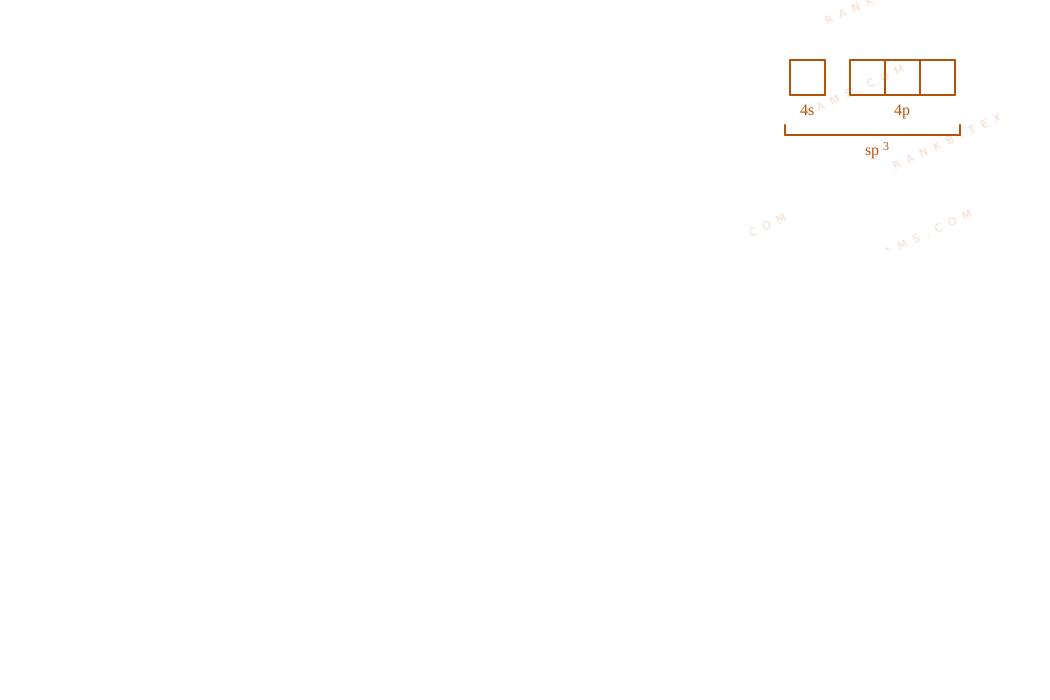
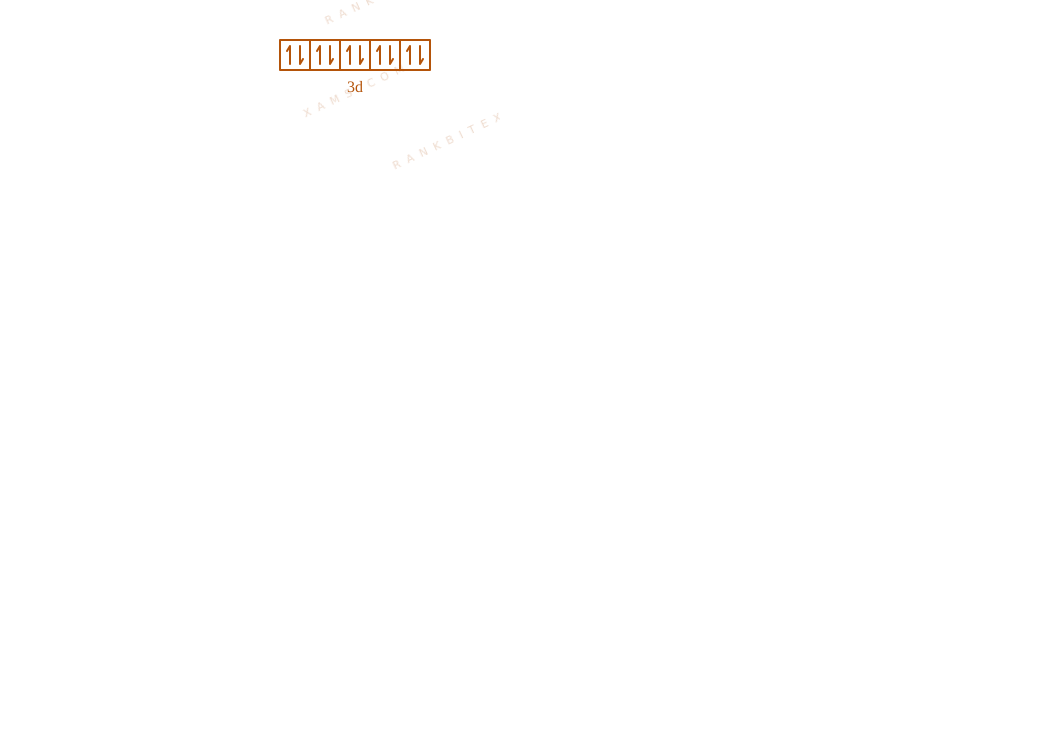
### Core Logic Let us apply Valence Bond Theory (VBT) and crystal field rules to evaluate each coordination complex: * **A. [textNi(CO)_4]**: Nickel is in the 0 oxidation state (3d^8 4s^2). Carbon monoxide (textCO) is a strong field ligand, forcing the 4s electrons into the 3d shell to produce a fully paired 3d^10 configuration. The vacant 4s and three 4p orbitals hybridize into an **sp^3 tetrahedral** geometry. All spins are paired, so mu = 0 text BM. Thus, textA rightarrow textIII.
Valence orbital diagram for nickel tetracarbonyl sp3 system
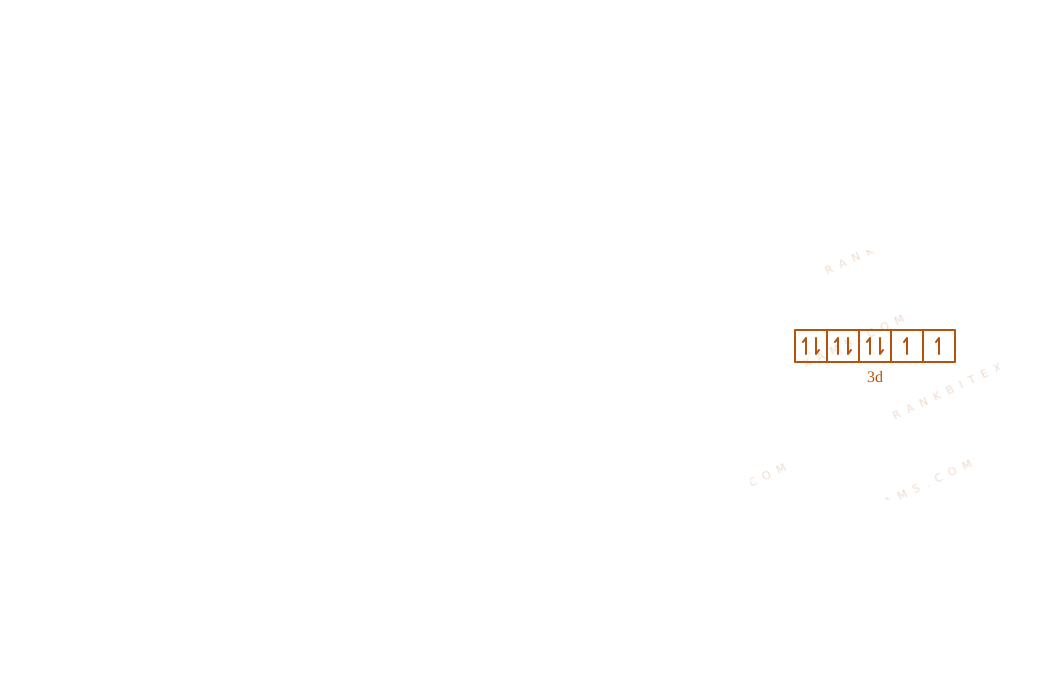
* **B. [textNi(CN)_4]^2-**: Nickel is in the +2 state (3d^8). Cyanide (textCN^-) is a strong field ligand, forcing the pairing of the two unpaired 3d electrons. This leaves one internal 3d orbital vacant, leading to **dsp^2 square planar** hybridization with zero unpaired electrons (mu = 0 text BM). Thus, textB rightarrow textII.
Valence orbital diagram for nickel tetracarbonyl sp3 system
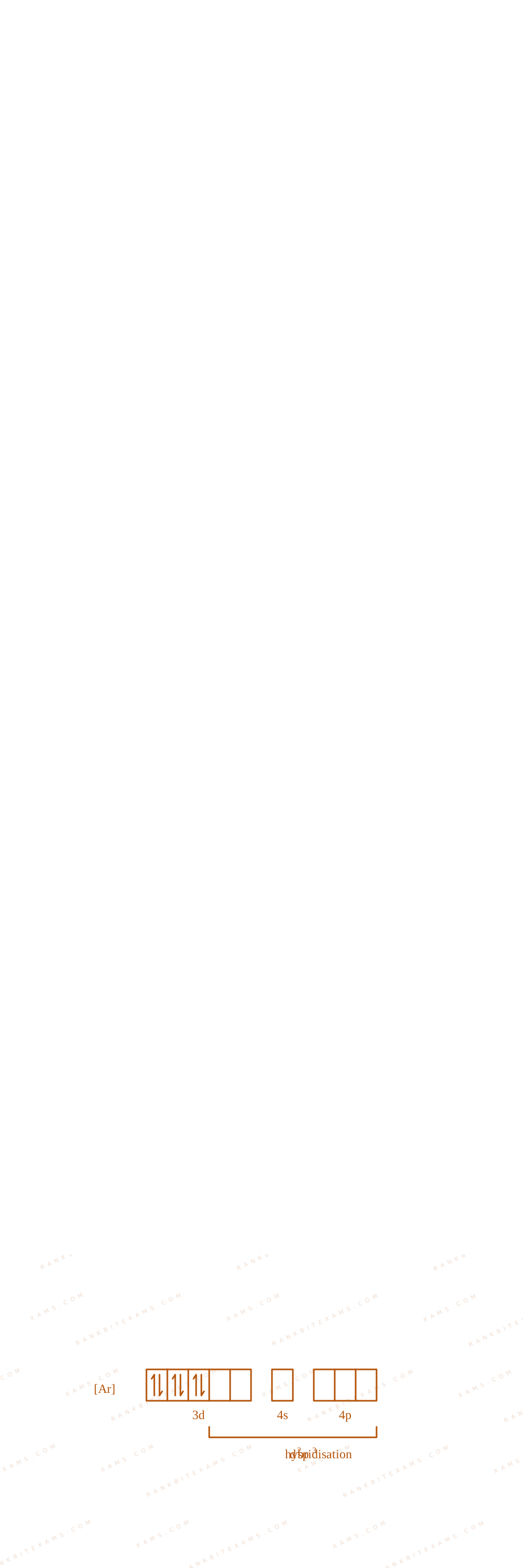
* **C. [textNiCl_4]^2-**: Nickel is in the +2 state (3d^8). Chloride (textCl^-) is a weak field ligand, leaving the two 3d electrons unpaired (n = 2). The system adopts **sp^3 tetrahedral** hybridization with a spin-only moment of mu = sqrt2(2+2) = sqrt8 approx 2.8 text BM. Thus, textC rightarrow textI.
Valence orbital diagram for nickel tetracarbonyl sp3 system
* **D. [textMnBr_4]^2-**: Manganese is in the +2 state (3d^5). Bromide (textBr^-) is a weak field ligand, preserving five unpaired parallel spins (n = 5). The geometry is **sp^3 tetrahedral** with a maximum spin-only moment of mu = sqrt5(5+2) = sqrt35 approx 5.9 text BM. Thus, textD rightarrow textIV.
Valence orbital diagram for nickel tetracarbonyl sp3 system
### Step 1: Alignment Summary Consolidating our results: textA-III, B-II, C-I, D-IV This matches Option (3). ### Pattern Recognition Nickel complexes provide classic benchmarks: Nickel zero tetracarbonyl is always tetrahedral diamagnetic. Nickel +2 tetracyanide is square planar diamagnetic due to strong ligand field pairing. Spotting these properties cuts down the problem solving time significantly. ### Evaluation Rubric / Model Answer null ### Chapter Mix Class 12 Chemistry: Coordination Compounds
Q26 jee_main_2025_29_jan_evening Magnetic Properties of Coordination Compounds
The calculated spin-only magnetic moments of K_3[Fe(OH)_6] and K_4[Fe(OH)_6] respectively are: (1) 4.90 and 4.90 B.M. (2) 5.92 and 4.90 B.M. (3) 3.87 and 4.90 B.M. (4) 4.90 and 5.92 B.M.
  • A. 4.90 and 4.90 B.M.
  • B. 5.92 and 4.90 B.M.
  • C. 3.87 and 4.90 B.M.
  • D. 4.90 and 5.92 B.M.

Solution

### Related Formula mu = sqrtn(n+2)text B.M. ### Core Logic In K_3[Fe(OH)_6], iron is in the +3 oxidation state (Fe^3+ = 3d^5). Since OH^- is a weak field ligand, no pairing of electrons takes place. The number of unpaired electrons (n) is 5. mu = sqrt5(5+2) = sqrt35 approx 5.92text B.M. In K_4[Fe(OH)_6], iron is in the +2 oxidation state (Fe^2+ = 3d^6). Since OH^- is a weak field ligand, no pairing occurs. The number of unpaired electrons (n) is 4. mu = sqrt4(4+2) = sqrt24 approx 4.90text B.M. ### Pattern Recognition Identify the ligand field strength first. OH^- is a weak field ligand in the spectrochemical series, so it does not cause pairing in either Fe^2+ or Fe^3+ configurations. ### Evaluation Rubric / Model Answer null ### Chapter Mix Class 12 Chemistry: Coordination Compounds
Q37 jee_main_2025_29_jan_evening Homoleptic Complexes and Electronic Configurations
Identify the homoleptic complexes with odd number of d electrons in the central metal. (A) [FeO_4]^2- (B) [Fe(CN)_6]^3- (C) [Fe(CN)_5NO]^2- (D) [CoCl_4]^2- (E) [Co(H_2O)_3F_3] Choose the correct answer from the options given below:
  • A. (B) and (D) only
  • B. (C) and (E) only
  • C. (A), (B) and (D) only
  • D. (A), (C) and (E) only

Solution

### Core Logic A complex is homoleptic if the metal is bound to only one kind of donor ligand group. * (A) [FeO_4]^2- is homoleptic, but Fe^+6 corresponds to a 3d^2 (even) electronic configuration. * (B) [Fe(CN)_6]^3- is homoleptic. Fe^+3 corresponds to a 3d^5 (odd) configuration. * (C) [Fe(CN)_5NO]^2- is heteroleptic (contains two types of ligands). * (D) [CoCl_4]^2- is homoleptic. Co^+2 corresponds to a 3d^7 (odd) configuration. * (E) [Co(H_2O)_3F_3] is heteroleptic. ### Pattern Recognition Filter by 'homoleptic' first to instantly eliminate multi-ligand mixed structures like options (C) and (E). ### Evaluation Rubric / Model Answer null ### Chapter Mix Class 12 Chemistry: Coordination Compounds
Q46 jee_main_2025_29_jan_evening Crystal Field Theory and Colors of Complexes
Consider the following low-spin complexes K_3[Co(NO_2)_6], K_4[Fe(CN)_6], K_3[Fe(CN)_6], Cu_2[Fe(CN)_6] and Zn_2[Fe(CN)_6]. The sum of the spin-only magnetic moment values of complexes having yellow colour is ________ B.M. (answer is nearest integer)
Numerical Answer. Answer: 0 to 0

Solution

### Core Logic From the given list, the complexes exhibiting a distinct yellow color are K_3[Co(NO_2)_6] and K_4[Fe(CN)_6]. Let's calculate the spin-only magnetic moments for these low-spin configurations: 1) For K_3[Co(NO_2)_6], cobalt is in +3 oxidation state (Co^3+ = 3d^6). In the presence of the strong ligand field (NO_2^-), all six electrons pair up completely in the t_2g orbitals: t_2g^6 e_g^0 implies n = 0 text unpaired electrons implies mu = 0text BM
Crystal Field Theory and Colors of Complexes diagram for Q46 - JEE Main 2025 Evening
2) For K_4[Fe(CN)_6], iron is in +2 oxidation state (Fe^2+ = 3d^6). In the strong field of cyanide ligands (CN^-), pairing is complete: t_2g^6 e_g^0 implies n = 0 text unpaired electrons implies mu = 0text BM Therefore, the sum of their spin-only magnetic moments is 0 + 0 = 0. ### Pattern Recognition Low-spin d^6 octahedral complexes always yield a fully closed-shell t_2g^6 arrangement with zero unpaired electrons, leading deterministically to a magnetic moment of 0 BM. ### Evaluation Rubric / Model Answer null ### Chapter Mix Class 12 Chemistry: Coordination Compounds
Rankbit System
JEE Physics: Waves (+15.5%) | Electrostatics: Concentric Shells (-29.7%) | Modern Physics: Photoelectric Clones (+34.2%) | Mathematics: Definite Integrals (+18.1%) | Chemistry: Coordination Splitting (-11.4%) | JEE Physics: Waves (+15.5%) | Electrostatics: Concentric Shells (-29.7%) | Modern Physics: Photoelectric Clones (+34.2%) | Mathematics: Definite Integrals (+18.1%) | Chemistry: Coordination Splitting (-11.4%)