Identify the diamagnetic octahedral complex ions from below; A. [mathrmMn(mathrmCN)_6]^3- B. [mathrmCo(mathrmNH_3)_6]^3+ C. [mathrmFe(mathrmCN)_6]^4- D. [mathrmCo(mathrmH_2mathrmO)_3mathrmF_3] Choose the correct answer from the options given below :

Solution & Explanation

### Related Formula According to Crystal Field Theory (CFT): - A complex is diamagnetic if all electrons are paired up (unpaired electrons, n=0). - Strong field ligands (like mathrmCN^-, mathrmNH_3 with Co^3+) cause pairing of electrons if Delta_o > P. {{SOLUTION_IMG}} ### Core Logic Analyze each complex: - **A. [mathrmMn(mathrmCN)_6]^3-**: - Mn^3+ has d^4 configuration. - Strong field ligand mathrmCN^- causes pairing in t_2g orbitals: t_2g^4 e_g^0. - There are 2 unpaired electrons rightarrow *Paramagnetic*. - **B. [mathrmCo(mathrmNH_3)_6]^3+**: - Co^3+ has d^6 configuration. - mathrmNH_3 acts as strong field ligand with Co^3+, causing complete pairing: t_2g^6 e_g^0. - No unpaired electrons rightarrow *Diamagnetic*. ### Step 1: Analyze complexes C and D - **C. [mathrmFe(mathrmCN)_6]^4-**: - Fe^2+ has d^6 configuration. - Strong field ligand mathrmCN^- causes complete pairing: t_2g^6 e_g^0. - No unpaired electrons rightarrow *Diamagnetic*. - **D. [mathrmCo(mathrmH_2mathrmO)_3mathrmF_3]**: - Co^3+ has d^6 configuration. - Weak field ligands (mathrmF^-, mathrmH_2mathrmO) do not cause pairing: t_2g^4 e_g^2. - There are 4 unpaired electrons rightarrow *Paramagnetic*. ### Step 2: Conclusion Only complexes B and C are diamagnetic, matching Option (4). ### Pattern Recognition Octahedral d^6 ions (such as Co^3+ or Fe^2+) coupled with strong-field ligands are exceptionally stable and always form low-spin, fully paired, diamagnetic complexes (t_2g^6 e_g^0). ### Evaluation Rubric / Model Answer null ### Chapter Mix Class 12 Chemistry: Coordination Compounds
Magnetic Properties and Hybridization of Complexes

More Coordination Compounds Previous-Year Questions — Page 2

Q40 jee_main_2025_02_april_morning Crystal Field Theory
Given below are two statements : Statement (I): In octahedral complexes, when Delta_0 < P high spin complexes are formed. When Delta_0 > P low spin complexes are formed. Statement (II) : In tetrahedral complexes because of Delta_mathrmt < mathrmP, low spin complexes are rarely formed. In the light of the above statements, choose the most appropriate answer from the options given below:
  • A. (1)\ textStatement I is correct but Statement II is incorrect.
  • B. (2)\ textBoth Statement I and Statement II are incorrect
  • C. (3)\ textStatement I is incorrect but Statement II is correct
  • D. (4)\ textBoth Statement I and Statement II are correct

Solution

### Related Formula Crystal field splitting values relation for matching configuration choices: Delta_mathrmt = frac49Delta_0 ### Core Logic Let's verify both rules based on Crystal Field Theory principles: * **Statement I**: In octahedral configurations, if pairing penalty energy P exceeds field split magnitude Delta_0, electrons prefer moving to upper sub-shells, creating high-spin states. Conversely, if Delta_0 > P, forced pairing occurs, creating low-spin complexes. (Statement I is accurate). * **Statement II**: Because tetrahedral configurations separate by an extremely narrow gap magnitude Delta_mathrmt (about half of octahedral field splits), the value almost never exceeds standard pairing energy P. Electrons consistently choose higher sub-levels rather than pairing up, meaning low-spin arrangements are extremely rare. (Statement II is accurate). ### Step 1: Verdict Therefore, both Statement I and Statement II are correct. ### Pattern Recognition Tetrahedral configurations are systematically assumed to be high-spin unless special structural properties dictate otherwise, due to the Delta_mathrmt < P constraint. ### Evaluation Rubric / Model Answer null ### Chapter Mix Class 12 Chemistry: Coordination Compounds
Q44 jee_main_2025_07_april_morning Isomerism in Coordination Compounds
An octahedral complex having molecular composition mathrmCo cdot 5NH_3 cdot Cl cdot SO_4 has two isomers A and B. The solution of A gives a white precipitate with mathrmAgNO_3 solution and the solution of B gives a white precipitate with mathrmBaCl_2 solution. The type of isomerism exhibited by the complex is:
  • A. textCoordination isomerism
  • B. textLinkage isomerism
  • C. textIonisation isomerism
  • D. textGeometrical isomerism

Solution

### Core Logic The complex molecular composition is mathrmCo cdot 5NH_3 cdot Cl cdot SO_4. Let's formulate the formulas for the two isomers: 1. **Isomer A**: Gives a white precipitate of mathrmAgCl when reacted with mathrmAgNO_3. This means free chloride ions (mathrmCl^-) are present in the outer ionization sphere: [mathrmCo(NH_3)_5(SO_4)]mathrmCl 2. **Isomer B**: Gives a white precipitate of mathrmBaSO_4 when reacted with mathrmBaCl_2. This means free sulphate ions (mathrmSO_4^2-) are present in the outer ionization sphere: [mathrmCo(NH_3)_5Cl]mathrmSO_4 Since these two isomers yield different ions in solution due to exchange of ligands between the coordination sphere and the ionization sphere, they exhibit **Ionisation isomerism**. ### Pattern Recognition Test for ions: - mathrmAgNO_3 PPT rightarrow free halide ion in outer sphere. - mathrmBaCl_2 PPT rightarrow free sulphate ion in outer sphere. - Outer-inner ion exchanges are always called **Ionisation isomerism**. ### Evaluation Rubric / Model Answer null ### Chapter Mix Class 12 Chemistry: Coordination Compounds

Q50 jee_main_2025_07_april_morning Valence Bond Theory
The number of paramagnetic complexes among [mathrmFeF_6]^3-, [mathrmFe(CN)_6]^3-, [mathrmMn(CN)_6]^3-, [mathrmCo(C_2mathrmO_4)_3]^3-, [mathrmMnCl_6]^3- and [mathrmCoF_6]^3-, which involve mathrmd^2mathrmsp^3 hybridization is ______.
Numerical Answer. Answer: 2 to 2

Solution

### Core Logic Let's systematically analyze the coordination, ligand strength, hybridization, and magnetic behavior of each complex: 1. **[mathrmFeF_6]^3-**: - mathrmFe^3+ (3mathrmd^5). mathrmF^- is a weak-field ligand (WFL). No pairing occurs. - Outer-orbital complex: mathrmsp^3mathrmd^2. - Paramagnetic (5 unpaired electrons). 2. **[mathrmFe(CN)_6]^3-**: - mathrmFe^3+ (3mathrmd^5). mathrmCN^- is a strong-field ligand (SFL). Pairing occurs. - Config: mathrmt_2mathrmg^5\ mathrme_mathrmg^0 (one unpaired electron remains implies **Paramagnetic**). - Inner-orbital complex: **mathrmd^2mathrmsp^3**. 3. **[mathrmMn(CN)_6]^3-**: - mathrmMn^3+ (3mathrmd^4). mathrmCN^- is an SFL. Pairing occurs. - Config: mathrmt_2mathrmg^4\ mathrme_mathrmg^0 (two unpaired electrons remain implies **Paramagnetic**). - Inner-orbital complex: **mathrmd^2mathrmsp^3**. 4. **[mathrmCo(C_2mathrmO_4)_3]^3-**: - mathrmCo^3+ (3mathrmd^6). Oxalate is a chelating SFL here. Full pairing occurs. - Config: mathrmt_2mathrmg^6\ mathrme_mathrmg^0 (zero unpaired electrons implies Diamagnetic). - Inner-orbital complex: mathrmd^2mathrmsp^3. 5. **[mathrmMnCl_6]^3-**: - mathrmMn^3+ (3mathrmd^4). mathrmCl^- is a WFL. No pairing occurs. - Outer-orbital complex: mathrmsp^3mathrmd^2. - Paramagnetic (4 unpaired electrons). 6. **[mathrmCoF_6]^3-**: - mathrmCo^3+ (3mathrmd^6). mathrmF^- is a WFL. No pairing occurs. - Outer-orbital complex: mathrmsp^3mathrmd^2. - Paramagnetic (4 unpaired electrons). Thus, only [mathrmFe(CN)_6]^3- and [mathrmMn(CN)_6]^3- are both **paramagnetic** and involve **mathrmd^2mathrmsp^3** hybridization. ### Pattern Recognition VBT shortcut: - Strong-field ligand complexes with d^4text--d^6 central ions form inner-orbital mathrmd^2mathrmsp^3 complexes. - Of those, check the number of electrons: d^6 is completely paired (diamagnetic), but d^5 ([Fe(CN)_6]^3-) and d^4 ([Mn(CN)_6]^3-) both leave unpaired electrons in the t_2g orbitals (paramagnetic). ### Evaluation Rubric / Model Answer Detailed individual classification of each complex based on VBT/CFT to yield the correct count of 2 inner-orbital paramagnetic complexes. ### Chapter Mix Class 12 Chemistry: Coordination Compounds
Q31 jee_main_2025_08_april_evening Isomerism in Coordination Compounds
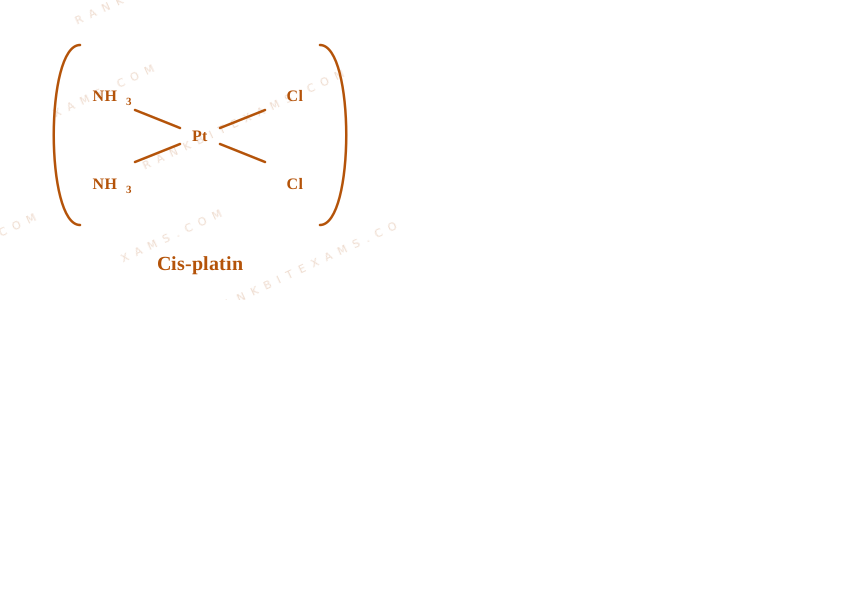
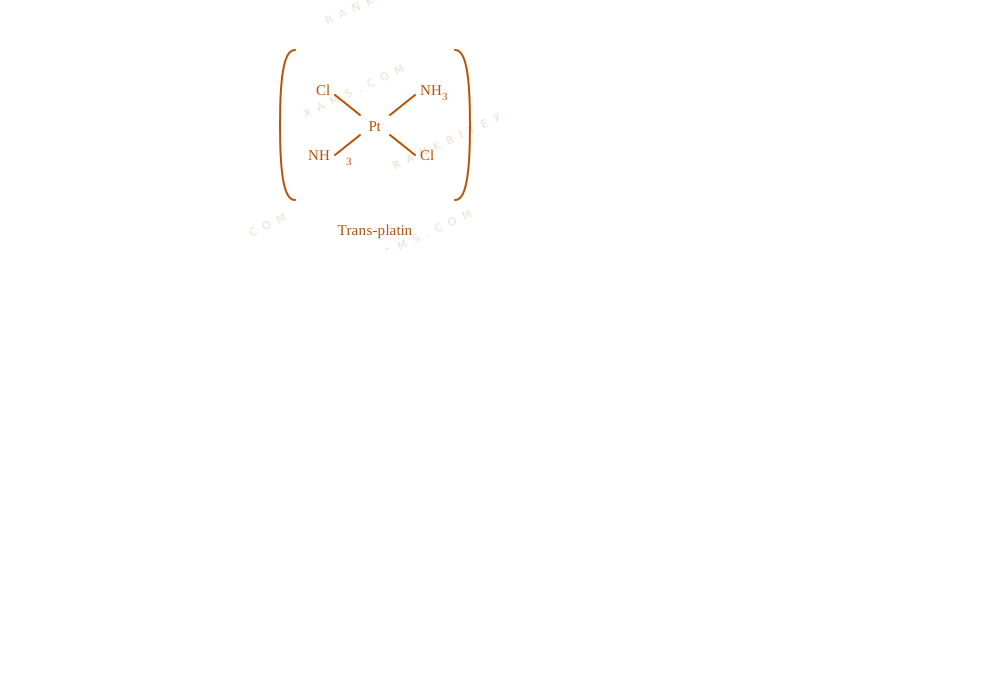
Given below are two statements: Statement I: A homoleptic octahedral complex, formed using monodentate ligands, will not show stereoisomerism. Statement II: cis- and trans-platin are heteroleptic complexes of Pd. In the light of the above statements, choose the correct answer from the options given below:
  • A. textBoth Statement I and Statement II are false.
  • B. textStatement I is false but Statement II is true.
  • C. textBoth Statement I and Statement II are true.
  • D. textStatement I is true but Statement II is false.

Solution

### Core Logic Let us evaluate both statements individually: * **Statement I**: A homoleptic complex contains only one type of ligand. For an octahedral complex using monodentate ligands, the general formula is [Ma_6]. Since all coordination positions are populated identically by the exact same ligand, swapping spatial positions produces no structural difference, hence it cannot demonstrate geometrical or optical isomerism. **Statement I is true.**
Stereochemical representation of octahedral homoleptic system
* **Statement II**: Cis-platin and trans-platin have the chemical formula [Pt(NH_3)_2Cl_2]. While they are indeed heteroleptic complexes, they are coordination coordinates of **Platinum (Pt)**, not Palladium (Pd). **Statement II is false.**
Stereochemical representation of octahedral homoleptic system
### Pattern Recognition Always read element symbols with immense focus in coordination chemistry. Changing a single letter from Pt to Pd creates a false assertion trap designed to test parsing alertness rather than chemical difficulty. ### Evaluation Rubric / Model Answer null ### Chapter Mix Class 12 Chemistry: Coordination Compounds
Rankbit System
JEE Physics: Waves (+15.5%) | Electrostatics: Concentric Shells (-29.7%) | Modern Physics: Photoelectric Clones (+34.2%) | Mathematics: Definite Integrals (+18.1%) | Chemistry: Coordination Splitting (-11.4%) | JEE Physics: Waves (+15.5%) | Electrostatics: Concentric Shells (-29.7%) | Modern Physics: Photoelectric Clones (+34.2%) | Mathematics: Definite Integrals (+18.1%) | Chemistry: Coordination Splitting (-11.4%)