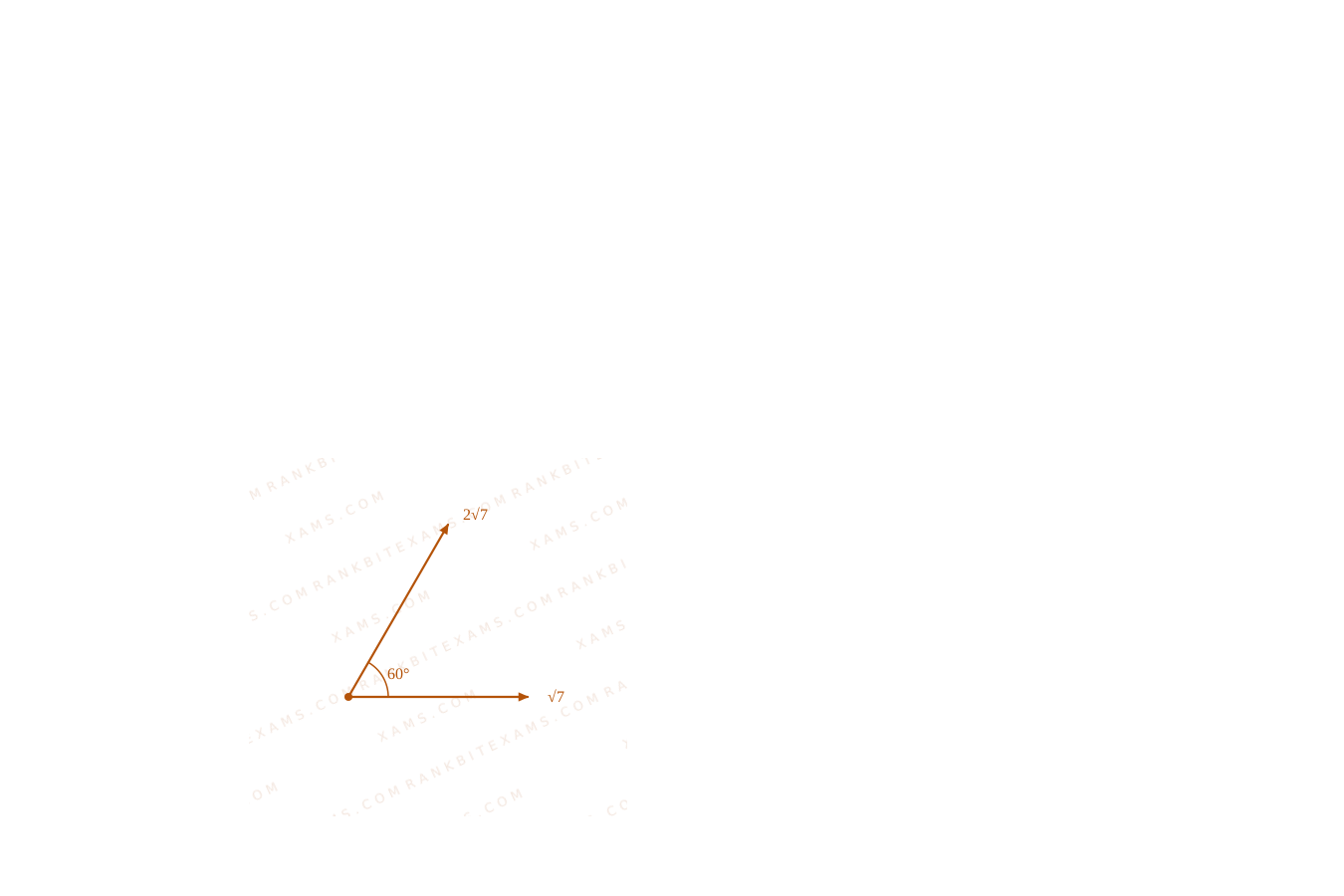
A particle is subjected to two simple harmonic motions as:
x_1 = sqrt7sin 5tmathrm~cm$$x_1 = \sqrt{7}\sin 5t\mathrm{~cm}$$
and
x_2 = 2sqrt7sinleft(5t + fracpi3right)mathrm~cm$$x_2 = 2\sqrt{7}\sin\left(5t + \frac{\pi}{3}\right)\mathrm{~cm}$$
where x$x$ is displacement and t$t$ is time in seconds. The maximum acceleration of the particle is x times 10^-2mathrm~ms^-2$x \times 10^{-2}\mathrm{~ms}^{-2}$. The value of x$x$ is:
A.175
B.25sqrt7$25\sqrt{7}$
C.5sqrt7$5\sqrt{7}$
D.125
Solution & Explanation
### Related Formula
A = sqrtA_1^2 + A_2^2 + 2 A_1 A_2 cosphi$$A = \sqrt{A_1^2 + A_2^2 + 2 A_1 A_2 \cos\phi}$$a_max = omega^2 A$$a_{\max} = \omega^2 A$$
### Core Logic
Both SHMs share the same frequency omega = 5mathrm~rad/s$\omega = 5\mathrm{~rad/s}$ with phase difference phi = fracpi3$\phi = \frac{\pi}{3}$.
Amplitudes: A_1 = sqrt7mathrm~cm$A_1 = \sqrt{7}\mathrm{~cm}$, A_2 = 2sqrt7mathrm~cm$A_2 = 2\sqrt{7}\mathrm{~cm}$.
The combined amplitude is:
A = sqrt(sqrt7)^2 + (2sqrt7)^2 + 2(sqrt7)(2sqrt7)cosleft(fracpi3right)$$A = \sqrt{(\sqrt{7})^2 + (2\sqrt{7})^2 + 2(\sqrt{7})(2\sqrt{7})\cos\left(\frac{\pi}{3}\right)}$$A = sqrt7 + 28 + 2(7)(2)left(frac12right) = sqrt35 + 14 = sqrt49 = 7mathrm~cm$$A = \sqrt{7 + 28 + 2(7)(2)\left(\frac{1}{2}\right)} = \sqrt{35 + 14} = \sqrt{49} = 7\mathrm{~cm}$$
Converting to meters:
A = 0.07mathrm~m$$A = 0.07\mathrm{~m}$$
The maximum acceleration is:
a_max = omega^2 A = (5)^2 times 0.07 = 25 times 0.07 = 1.75mathrm~ms^-2$$a_{\max} = \omega^2 A = (5)^2 \times 0.07 = 25 \times 0.07 = 1.75\mathrm{~ms}^{-2}$$
Equating to x times 10^-2mathrm~ms^-2$x \times 10^{-2}\mathrm{~ms}^{-2}$:
1.75 = x times 10^-2 implies x = 175$$1.75 = x \times 10^{-2} \implies x = 175$$
### Step 1: Final Conclusion
The value of x$x$ is 175.
### Pattern Recognition
When superposing two SHMs of identical frequency, use the standard phasor addition formula to obtain the combined amplitude A$A$. Then compute maximum velocity v_max = omega A$v_{\max} = \omega A$ or maximum acceleration a_max = omega^2 A$a_{\max} = \omega^2 A$ directly.
### Evaluation Rubric / Model Answer
null
### Chapter Mix
Class 11 Physics: Simple Harmonic Motion
Phasor addition of SHM amplitudes
More Simple Harmonic Motion Previous-Year Questions
Using a simple pendulum experiment g is determined by measuring its time period T. Which of the following plots represent the correct relation between the pendulum length L and time period T?
A. (1)
B. (2)
C. (3)
D. (4)
Solution
### Related Formula
T = 2pi sqrtfracLg$$T = 2\pi \sqrt{\frac{L}{g}}$$
### Core Logic
Squaring both sides of the simple pendulum equation:
T^2 = frac4pi^2 Lg$$T^2 = \frac{4\pi^2 L}{g}$$
Inverting T^2$T^2$ to express 1/T^2$1/T^2$ as a function of length L$L$:
frac1T^2 = fracg4pi^2 L$$\frac{1}{T^2} = \frac{g}{4\pi^2 L}$$
This demonstrates that frac1T^2 propto frac1L$\frac{1}{T^2} \propto \frac{1}{L}$. The relationship between 1/T^2$1/T^2$ and L$L$ represents a rectangular hyperbola curve decreasing asymptotically.
Simple Pendulum 1/T^2 vs L graph for Q27 - JEE Main 2026 Evening
### Step 1: Final Conclusion
Plot (2) correctly depicts the rectangular hyperbola curve for frac1T^2$\frac{1}{T^2}$ versus L$L$.
### Pattern Recognition
Sees: Graph of 1/T^2$1/T^2$ vs L$L$.
Formula check: T propto sqrtL implies T^2 propto L implies 1/T^2 propto 1/L$T \propto \sqrt{L} \implies T^2 \propto L \implies 1/T^2 \propto 1/L$, which is inversely proportional (hyperbolic curve).
### Evaluation Rubric / Model Answer
null
### Chapter Mix
Class 11 Physics: Simple Harmonic Motion
More Simple Harmonic Motion Questions — jee_main_2025_02_april_morning
We Map Every Repeating Question in Competitive Exams.
Say goodbye to generic mock test fatigue. RankBit uses smart analysis to group past exam questions into their foundational Repeating Question Types. Find chapter weightage, track repeating questions, and score higher with targeted practice.
Select Your Target Exam
Choose an exam track below to find formulas per chapter and patterns.
Syncing Exam Intelligence
Mapping formulas and patterns across all tracks…
PATH A — FULL LENGTH PRACTICE
Full Mock Test Hub
Simulate real NTA exam conditions with fully tracked mocks. Time yourself against past papers.
Practice past-year questions one chapter at a time. Pick an exam → subject → chapter and get every PYQ for that topic — pulled together from all past papers — with the chapter's key formulas alongside.