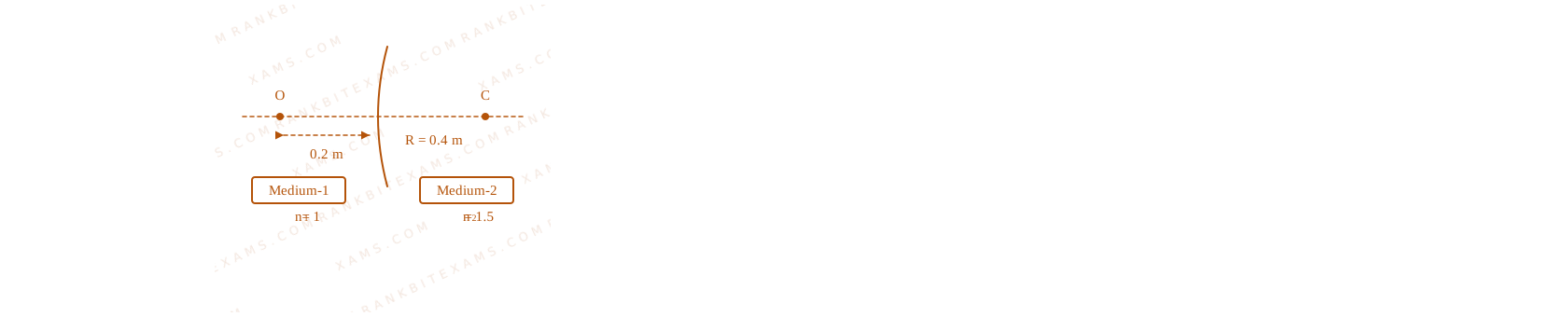
A spherical surface separates two media of refractive indices 1 and 1.5 as shown in the figure. Distance of the image of an object 'O', is: (C is the center of curvature of the spherical surface and R is the radius of curvature)
Spherical refracting surface separates two media for Q17
A spherical surface of radius 0.4 m separating media of n1 = 1 and n2 = 1.5, with object O at 0.2 m.

Solution & Explanation

### Related Formula $fracmu_2v - fracmu_1u = fracmu_2 - mu_1R ### Core Logic From the given diagram, using the standard Cartesian sign convention with the pole of the surface as origin: - Refractive index of first medium, \mu_1 = 1.0 - Refractive index of second medium, \mu_2 = 1.5 - Object distance, u = -0.2\mathrm{~m} (left of surface) - Radius of curvature, R = +0.4\mathrm{~m} (convex surface towards first medium, center C lies in second medium) Applying the formula for refraction at a spherical interface: frac1.5v - frac1-0.2 = frac1.5 - 10.4 frac1.5v + 5.0 = frac0.50.4 = 1.25 frac1.5v = 1.25 - 5.0 = -3.75 v = frac1.5-3.75 = -0.4mathrm~m The negative sign indicates that the image is formed to the left of the spherical refracting surface. ### Step 1: Final Conclusion The image of object 'O' is formed 0.4\mathrm{~m}$ left to the spherical surface. ### Pattern Recognition Ensure to strictly implement the coordinate sign conventions: the direction of incident light is positive. Since light goes from left to right, left-side points have a negative coordinate, and right-side points have a positive coordinate. ### Evaluation Rubric / Model Answer null ### Chapter Mix Class 12 Physics: Ray Optics

Reference Study Guides

More Ray Optics Previous-Year Questions — Page 5

Q20 jee_main_2025_03_april_morning Minimum Deviation in Prism
Consider following statements for refraction of light through prism, when angle of deviation is minimum. (A) The refracted ray inside prism becomes parallel to the base. (B) Larger angle prisms provide smaller angle of minimum deviation. (C) Angle of incidence and angle of emergence becomes equal. (D) There are always two sets of angle of incidence for which deviation will be same except at minimum deviation setting. (E) Angle of refraction becomes double of prism angle. Choose the correct answer from the options given below.
  • A. A, C and D Only
  • B. B, C and D Only
  • C. A, B and E Only
  • D. B, D and E Only

Solution

### Related Formula For a prism of angle A: - Deviation: delta = i + e - A - Minimum deviation delta_textmin occurs when: i = e quad textand quad r_1 = r_2 = fracA2 - Under minimum deviation, the ray inside an equilateral/isosceles prism travels symmetrically, making it parallel to the prism base. ### Core Logic Let's check the validity of each statement: - **Statement (A)**: The refracted ray inside the prism becomes parallel to the base at minimum deviation. (True for symmetric prisms) - **Statement (B)**: Larger angle prisms provide smaller minimum deviation. By minimum deviation equation: mu = fracsinleft(fracA+delta_textmin2right)sinleft(fracA2right) As A increases, delta_textmin generally increases, not decreases. (False) - **Statement (C)**: Angle of incidence i and angle of emergence e become equal (i = e) during the minimum deviation state. (True) - **Statement (D)**: The delta-i curve is asymmetric and parabolic-like; for any deviation delta > delta_textmin, there are always exactly two different incident angles (i and e) that yield the same deviation, except at the minimum deviation point (which has a single unique value). (True) - **Statement (E)**: Angle of refraction r = A/2, which is half of the prism angle, not double. (False) ### Step 1: Conclusion Since statements A, C, and D are true, the correct option is (1). ### Pattern Recognition Review the classic parabolic shape of the deviation vs. angle of incidence (delta-i) graph. Notice that any horizontal line above the minimum point intersects twice (representing i and e for that deviation). Minimum deviation is the unique local minimum, where i = e and r_1 = r_2 = A/2. ### Evaluation Rubric / Model Answer null ### Chapter Mix Class 12 Physics: Ray Optics and Optical Instruments: Refraction through Prism
Q19 jee_main_2025_04_april_evening Spherical Mirrors
A finite size object is placed normal to the principal axis at a distance of 30 cm from a convex mirror of focal length 30 cm. A plane mirror is now placed in such a way that the image produced by both the mirrors coincide with each other. The distance between the two mirrors is :
  • A. 45 cm
  • B. 7.5 cm
  • C. 22.5 cm
  • D. 15 cm

Solution

### Related Formula Mirror Formula: frac1v + frac1u = frac1f ### Core Logic For the convex mirror, u = -30text cm and f = +30text cm. frac1v - frac130 = frac130 implies frac1v = frac230 implies v = +15text cm So, the convex mirror forms a virtual image 15 cm behind its surface. ### Step 1: Align Plane Mirror Image The total distance from the object to the image location is 30 + 15 = 45text cm. For a plane mirror to create an image at this same exact location, it must be placed precisely midway between the object and the image. Distance from object to plane mirror: d = frac452 = 22.5text cm Therefore, the clearance distance between the convex mirror and the plane mirror surface is: textDistance = 30 - 22.5 = 7.5text cm ### Pattern Recognition Coinciding images imply identical coordinate endpoints. Calculate the convex position explicitly, find the total path length from the real source object, and slice it in half for the plane mirror location. ### Evaluation Rubric / Model Answer null ### Chapter Mix Class 12 Physics: Ray Optics and Optical Instruments
Q9 jee_main_2025_04_april_morning Spherical Mirrors and Magnification
When an object is placed 40mathrm~cm away from a spherical mirror an image of magnification frac12 is produced. To obtain an image with magnification of frac13, the object is to be moved:
  • A. 40 cm away from the mirror.
  • B. 80 cm away from the mirror.
  • C. 20 cm towards the mirror.
  • D. 20 cm away from the mirror.

Solution

### Related Formula Magnification formula in terms of focal length f and object position u: m = fracff - u ### Core Logic Case 1: u_1 = -40mathrm~cm and m_1 = frac12 (assuming real inverted image structure for typical convergence calculations): frac12 = fracff - (-40) implies f + 40 = 2f implies f = 40mathrm~cm (Taking the magnitude parameter yields focal distance benchmark value). ### Step 1: Calculate New Object Position Case 2: To establish m_2 = frac13: frac13 = frac4040 - u_2 implies 40 - u_2 = 120 implies u_2 = -80mathrm~cm ### Step 2: Determine Distance Shift Initial location: -40mathrm~cm Final location: -80mathrm~cm textShift = |u_2| - |u_1| = 80 - 40 = 40mathrm~cmtext away from the mirror. ### Pattern Recognition To reduce the magnification of a real image formed by a concave mirror, the object must always be translated further out away from the focal center point. ### Evaluation Rubric / Model Answer null ### Chapter Mix Class 12 Physics: Ray Optics and Optical Instruments
Q23 jee_main_2025_04_april_morning Spherical Mirrors
Distance between object and its image (magnified by -frac13) is 30 cm. The focal length of the mirror used is left(fracx4 ight) cm, where magnitude of value of x is
Numerical Answer. Answer: 45 to 45

Solution

### Related Formula Magnification relation for spherical mirrors: m = -fracvu Mirror equation: frac1f = frac1v + frac1u ### Core Logic Given m = -frac13: -fracvu = -frac13 implies u = 3v Since magnification is negative, a real inverted image is formed on the same side as the object in a concave mirror layout configuration.
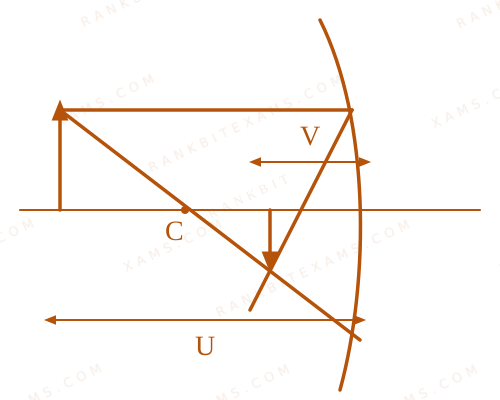
Concave mirror real image trace tracking for Q23 - JEE Main 2025 Morning
### Step 1: Formulate Position Distances The distance between the object and image is given as 30mathrm~cm: |u| - |v| = 30 implies 3v - v = 30 implies 2v = 30 implies v = 15mathrm~cm This gives u = 3(15) = 45mathrm~cm. ### Step 2: Solve for Focal Length and x Apply standard sign conventions (u = -45mathrm~cm, v = -15mathrm~cm): frac1f = -frac115 - frac145 = frac-3 - 145 = -frac445 |f| = frac454mathrm~cm Matching this with the prompt pattern form fracx4 yields: x = 45 ### Pattern Recognition Real inverted diminished images (|m| < 1) mean the image forms closer to the mirror surface than the object, situated between the focal center F and center of curvature C. ### Evaluation Rubric / Model Answer null ### Chapter Mix Class 12 Physics: Ray Optics and Optical Instruments
Q9 jee_main_2025_07_april_evening Spherical Mirrors
A mirror is used to produce an image with magnification of frac14 If the distance between object and its image is 40 cm, then the focal length of the mirror is [cite: 113, 114, 116]
  • A. 10 cm [cite: 117]
  • B. 12.7 cm [cite: 119]
  • C. 10.7 cm [cite: 118]
  • D. 15 cm [cite: 119]

Solution

### Related Formula m = -fracvu [cite: 700] frac1v + frac1u = frac1f [cite: 707] ### Core Logic Given magnification magnitude |m| = frac14[cite: 113]. Assuming a real image formed by a concave mirror: [cite: 701] fracvu = frac14 implies u = 4v [cite: 701] The distance between the object and the image is given as 40\ textcm [cite: 114, 116]: u - v = 40 implies 4v - v = 40 implies 3v = 40 implies v = frac403\ textcm u = 4 times frac403 = frac1603\ textcm Applying mirror sign conventions (u = -frac1603, v = -frac403): [cite: 701, 704] frac1f = -frac340 - frac3160 = -frac12 + 3160 = -frac15160 f = -frac16015 approx -10.67\ textcm [cite: 712] Rounding to the matching options choice gives 10.7\ textcm[cite: 118, 712]. ### Pattern Recognition Pay attention to sign conventions in mirror systems. A smaller real image formed by a concave mirror sits between the focus and center of curvature, resulting in u > v configurations. ### Evaluation Rubric / Model Answer null ### Chapter Mix Class 12 Physics: Ray Optics and Optical Instruments

More Ray Optics Questions — jee_main_2025_02_april_morning

Practice all Ray Optics previous-year questions →

Rankbit System
JEE Physics: Waves (+15.5%) | Electrostatics: Concentric Shells (-29.7%) | Modern Physics: Photoelectric Clones (+34.2%) | Mathematics: Definite Integrals (+18.1%) | Chemistry: Coordination Splitting (-11.4%) | JEE Physics: Waves (+15.5%) | Electrostatics: Concentric Shells (-29.7%) | Modern Physics: Photoelectric Clones (+34.2%) | Mathematics: Definite Integrals (+18.1%) | Chemistry: Coordination Splitting (-11.4%)
