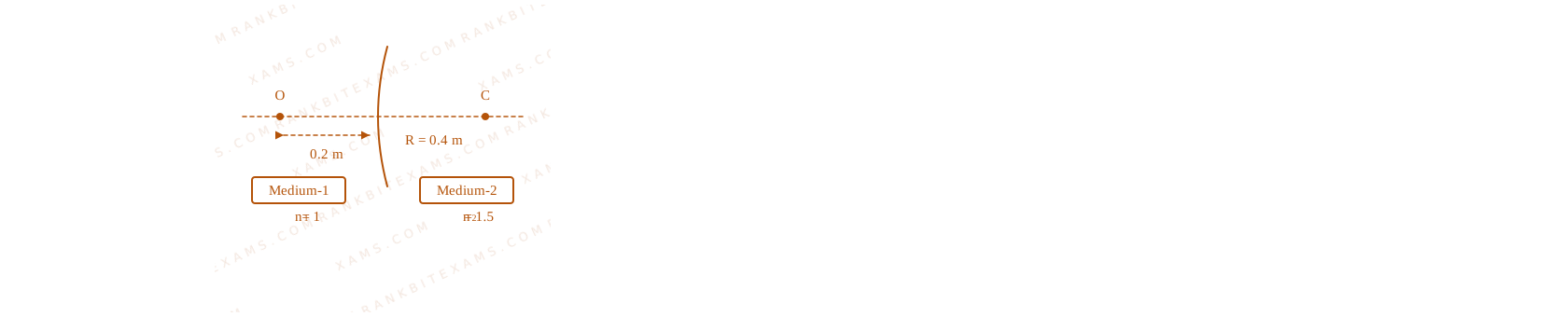
A spherical surface separates two media of refractive indices 1 and 1.5 as shown in the figure. Distance of the image of an object 'O', is: (C is the center of curvature of the spherical surface and R is the radius of curvature)
Spherical refracting surface separates two media for Q17
A spherical surface of radius 0.4 m separating media of n1 = 1 and n2 = 1.5, with object O at 0.2 m.

Solution & Explanation

### Related Formula $fracmu_2v - fracmu_1u = fracmu_2 - mu_1R ### Core Logic From the given diagram, using the standard Cartesian sign convention with the pole of the surface as origin: - Refractive index of first medium, \mu_1 = 1.0 - Refractive index of second medium, \mu_2 = 1.5 - Object distance, u = -0.2\mathrm{~m} (left of surface) - Radius of curvature, R = +0.4\mathrm{~m} (convex surface towards first medium, center C lies in second medium) Applying the formula for refraction at a spherical interface: frac1.5v - frac1-0.2 = frac1.5 - 10.4 frac1.5v + 5.0 = frac0.50.4 = 1.25 frac1.5v = 1.25 - 5.0 = -3.75 v = frac1.5-3.75 = -0.4mathrm~m The negative sign indicates that the image is formed to the left of the spherical refracting surface. ### Step 1: Final Conclusion The image of object 'O' is formed 0.4\mathrm{~m}$ left to the spherical surface. ### Pattern Recognition Ensure to strictly implement the coordinate sign conventions: the direction of incident light is positive. Since light goes from left to right, left-side points have a negative coordinate, and right-side points have a positive coordinate. ### Evaluation Rubric / Model Answer null ### Chapter Mix Class 12 Physics: Ray Optics

Reference Study Guides

More Ray Optics Previous-Year Questions — Page 10

Q34 jee_main_2024_31_jan_morning Prism Deviation
The refractive index of a prism with apex angle A is cot(A/2). The angle of minimum deviation is :
  • A. delta_mathrmm = 180^circ - A
  • B. delta_mathrmm = 180^circ - 3A
  • C. delta_mathrmm = 180^circ - 4A
  • D. delta_mathrmm = 180^circ - 2A

Solution

### Related Formula mu = fracsinleft(fracA + delta_m2right)sinleft(fracA2right) ### Core Logic Given that the refractive index mu = cotleft(fracA2right). Substituting this into the prism formula: cotleft(fracA2right) = fracsinleft(fracA + delta_m2right)sinleft(fracA2right) fraccosleft(fracA2right)sinleft(fracA2right) = fracsinleft(fracA + delta_m2right)sinleft(fracA2right) Equating the numerators: cosleft(fracA2right) = sinleft(fracA + delta_m2right) We can rewrite cosine in terms of sine: sinleft(fracpi2 - fracA2right) = sinleft(fracA + delta_m2right) ### Step 2: Solve for Deviation Comparing the angles inside the sine functions: fracpi2 - fracA2 = fracA2 + fracdelta_m2 Multiply the entire equation by 2: pi - A = A + delta_m delta_m = pi - 2A Converting radians to degrees: delta_m = 180^circ - 2A ### Pattern Recognition Whenever refractive index mu = cot(A/2), the relation sin(90^circ - A/2) strictly matches the prism sine equation, meaning minimum deviation delta_m is always 180^circ - 2A. ### Evaluation Rubric / Model Answer null ### Chapter Mix Class 12 Physics: Ray Optics And Optical Instruments

More Ray Optics Questions — jee_main_2025_02_april_morning

Practice all Ray Optics previous-year questions →

Rankbit System
JEE Physics: Waves (+15.5%) | Electrostatics: Concentric Shells (-29.7%) | Modern Physics: Photoelectric Clones (+34.2%) | Mathematics: Definite Integrals (+18.1%) | Chemistry: Coordination Splitting (-11.4%) | JEE Physics: Waves (+15.5%) | Electrostatics: Concentric Shells (-29.7%) | Modern Physics: Photoelectric Clones (+34.2%) | Mathematics: Definite Integrals (+18.1%) | Chemistry: Coordination Splitting (-11.4%)