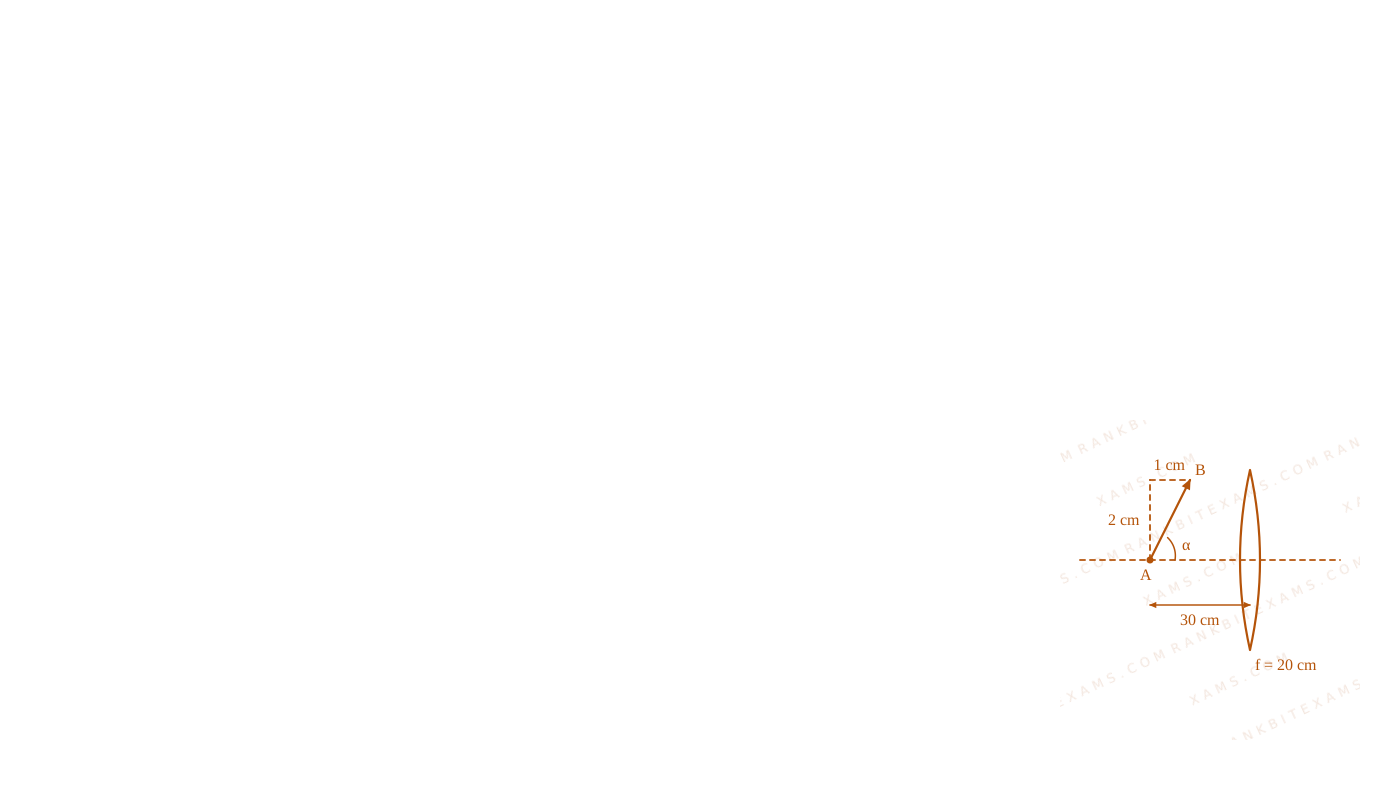
A slanted object AB is placed on one side of convex lens as shown in the diagram. The image is formed on the opposite side. Angle made by the image with principal axis is:
Slanted object diagram for Q4 - JEE Main 2025 Morning
A slanted object AB forming an angle alpha with the principal axis of a convex lens.

Solution & Explanation

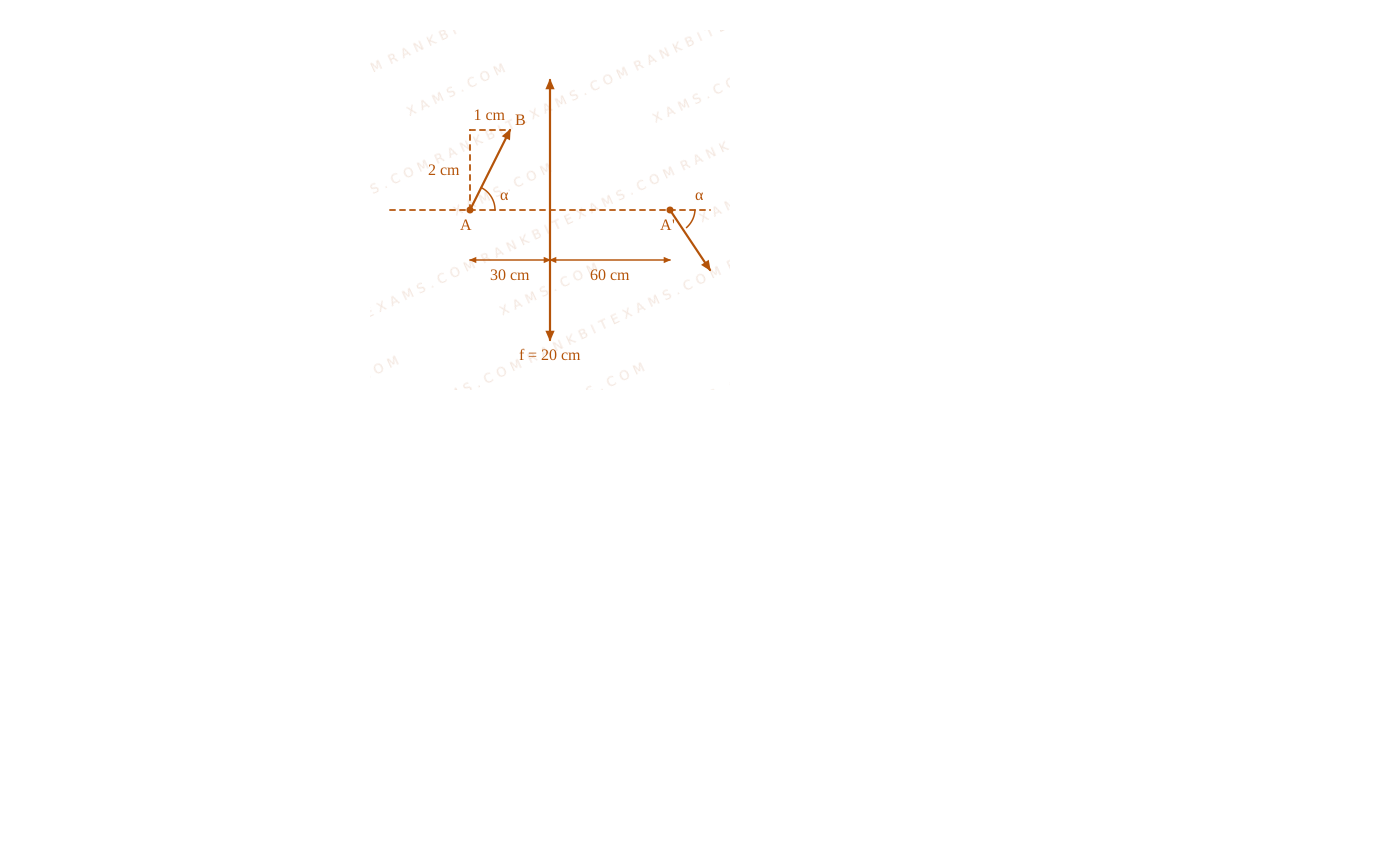
### Related Formula frac1v - frac1u = frac1f m = fracvu m_L = fracdvdu = m^2 ### Core Logic Let the pole of the lens be the origin. Point A of the slanted object lies on the principal axis at u = -30mathrm~cm from the convex lens (f = +20mathrm~cm). Let's locate the image of A: frac1v - frac1-30 = frac120 implies frac1v = frac120 - frac130 = frac160 implies v = +60mathrm~cm Thus, the transverse magnification m at point A is: m = fracvu = frac60-30 = -2 Since the longitudinal extension of the object is small (du = 1mathrm~cm along the axis): dv = m^2 du = (-2)^2 times 1 = 4mathrm~cm The height of the object at point B is h_o = 2mathrm~cm. Its image height is: h_i = m cdot h_o = (-2) times 2 = -4mathrm~cm Now, compute the angle beta made by the image with the principal axis: tanbeta = frach_idv = frac-4mathrm~cm4mathrm~cm = -1 beta = -45^circ ### Step 1: Final Conclusion The angle made by the image with the principal axis is -45^{\circ}. ### Pattern Recognition For small objects tilted with respect to the principal axis: 1. Axial displacement scales by m^2. 2. Transverse height scales by m. 3. Slope scales by \frac{m}{m^2} = \frac{1}{m}$. ### Evaluation Rubric / Model Answer null ### Chapter Mix Class 12 Physics: Ray Optics
Image formation geometry for Q4
A slanted object AB forming an angle alpha with the principal axis of a convex lens.

Reference Study Guides

More Ray Optics Previous-Year Questions — Page 10

Q34 jee_main_2024_31_jan_morning Prism Deviation
The refractive index of a prism with apex angle A is cot(A/2). The angle of minimum deviation is :
  • A. delta_mathrmm = 180^circ - A
  • B. delta_mathrmm = 180^circ - 3A
  • C. delta_mathrmm = 180^circ - 4A
  • D. delta_mathrmm = 180^circ - 2A

Solution

### Related Formula mu = fracsinleft(fracA + delta_m2right)sinleft(fracA2right) ### Core Logic Given that the refractive index mu = cotleft(fracA2right). Substituting this into the prism formula: cotleft(fracA2right) = fracsinleft(fracA + delta_m2right)sinleft(fracA2right) fraccosleft(fracA2right)sinleft(fracA2right) = fracsinleft(fracA + delta_m2right)sinleft(fracA2right) Equating the numerators: cosleft(fracA2right) = sinleft(fracA + delta_m2right) We can rewrite cosine in terms of sine: sinleft(fracpi2 - fracA2right) = sinleft(fracA + delta_m2right) ### Step 2: Solve for Deviation Comparing the angles inside the sine functions: fracpi2 - fracA2 = fracA2 + fracdelta_m2 Multiply the entire equation by 2: pi - A = A + delta_m delta_m = pi - 2A Converting radians to degrees: delta_m = 180^circ - 2A ### Pattern Recognition Whenever refractive index mu = cot(A/2), the relation sin(90^circ - A/2) strictly matches the prism sine equation, meaning minimum deviation delta_m is always 180^circ - 2A. ### Evaluation Rubric / Model Answer null ### Chapter Mix Class 12 Physics: Ray Optics And Optical Instruments

More Ray Optics Questions — jee_main_2025_02_april_morning

Practice all Ray Optics previous-year questions →

Rankbit System
JEE Physics: Waves (+15.5%) | Electrostatics: Concentric Shells (-29.7%) | Modern Physics: Photoelectric Clones (+34.2%) | Mathematics: Definite Integrals (+18.1%) | Chemistry: Coordination Splitting (-11.4%) | JEE Physics: Waves (+15.5%) | Electrostatics: Concentric Shells (-29.7%) | Modern Physics: Photoelectric Clones (+34.2%) | Mathematics: Definite Integrals (+18.1%) | Chemistry: Coordination Splitting (-11.4%)