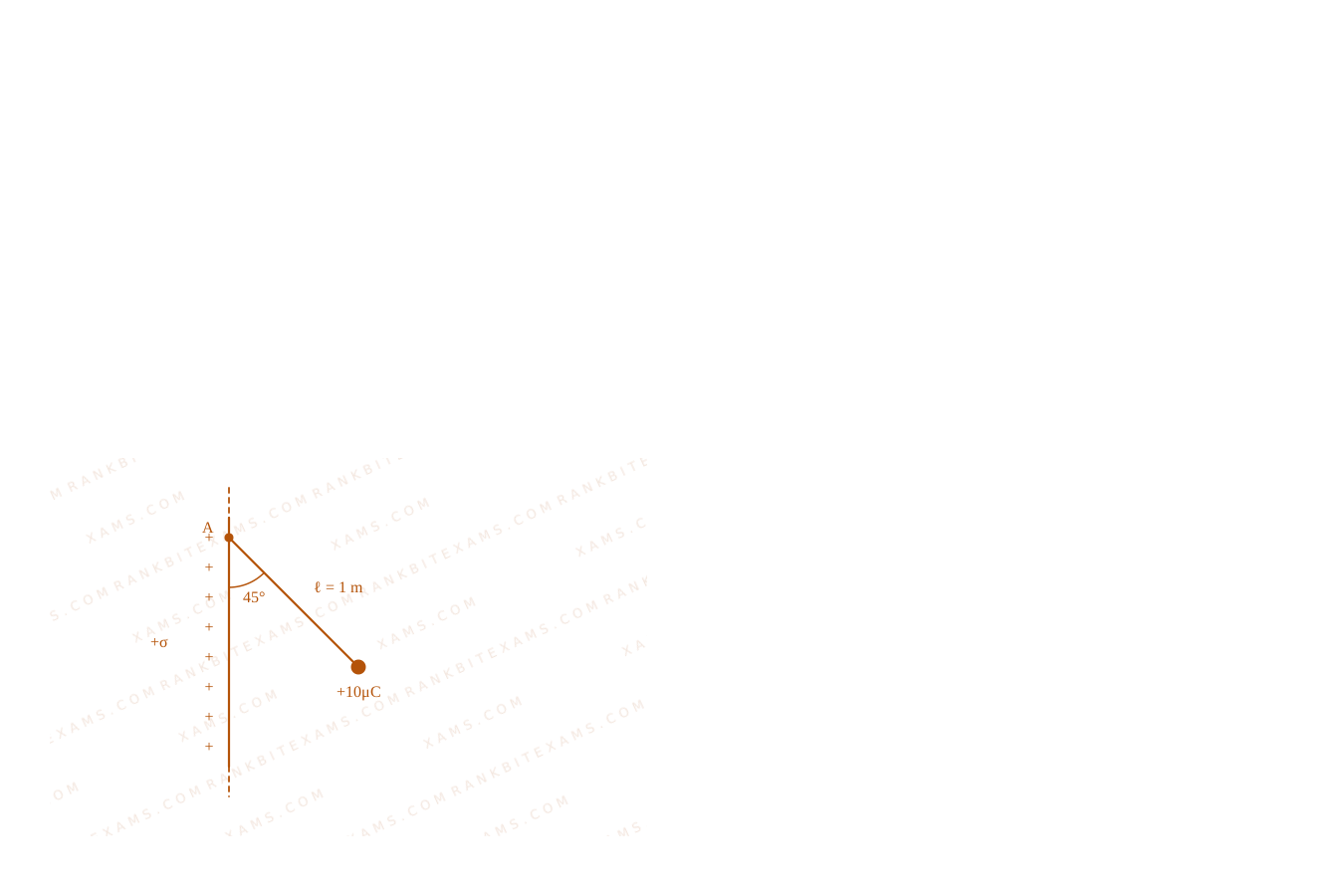
A small bob of mass 100mathrm~mg$100\mathrm{~mg}$ and charge +10mathrm~mu C$+10\mathrm{~\mu C}$ is connected to an insulating string of length 1mathrm~m$1\mathrm{~m}$. It is brought near to an infinitely long non-conducting sheet of charge density 'sigma$\sigma$' as shown in figure. If string subtends an angle of 45^circ$45^{circ}$ with the sheet at equilibrium the charge density of sheet will be:
(Given, epsilon_0 = 8.85times 10^-12fracmathrmFmathrmm$\epsilon_0 = 8.85\times 10^{-12}\frac{\mathrm{F}}{\mathrm{m}}$ and acceleration due to gravity, g = 10mathrm~m/s^2$g = 10\mathrm{~m/s^2}$)
A small charged bob hanging by a string of length 1 m subtending an angle of 45 degrees near a charged sheet.
### Related Formula
E = fracsigma2epsilon_0 quad text(field of infinite non-conducting charged sheet)$$E = \frac{\sigma}{2\epsilon_0} \quad \text{(field of infinite non-conducting charged sheet)}$$tantheta = fracF_emg$$\tan\theta = \frac{F_e}{mg}$$
### Core Logic
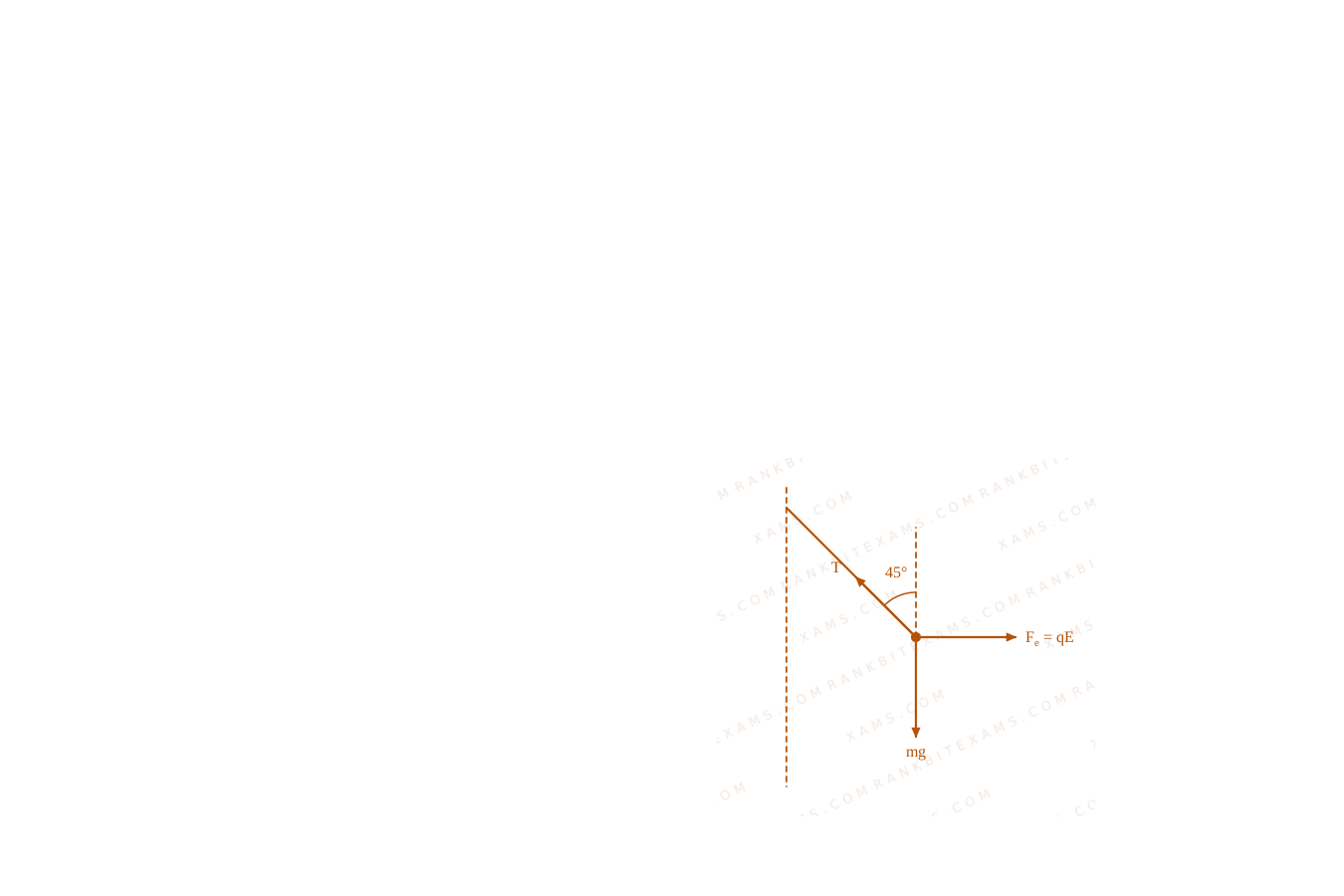
In equilibrium, three forces act on the suspended charged bob:
1. Tension T$T$ directed along the string at theta = 45^circ$\theta = 45^{circ}$ with the vertical sheet.
2. Weight mg$mg$ directed vertically downwards.
3. Electrostatic repulsion force F_e = qE$F_e = qE$ acting horizontally away from the sheet.
From the balance of forces in vertical and horizontal directions:
T cos(45^circ) = mg$$T \cos(45^{circ}) = mg$$T sin(45^circ) = q E$$T \sin(45^{circ}) = q E$$
Dividing the two equations:
tan(45^circ) = fracq Emg = 1 implies q E = mg$$\tan(45^{circ}) = \frac{q E}{mg} = 1 \implies q E = mg$$
Substitute the expression for E$E$:
q left(fracsigma2epsilon_0right) = mg implies sigma = frac2 epsilon_0 m gq$$q \left(\frac{\sigma}{2\epsilon_0}\right) = mg \implies \sigma = \frac{2 \epsilon_0 m g}{q}$$
Now plug in the given numerical values:
- m = 100mathrm~mg = 100 times 10^-6mathrm~kg = 10^-4mathrm~kg$m = 100\mathrm{~mg} = 100 \times 10^{-6}\mathrm{~kg} = 10^{-4}\mathrm{~kg}$
- q = +10mathrm~mu C = 10 times 10^-6mathrm~C = 10^-5mathrm~C$q = +10\mathrm{~\mu C} = 10 \times 10^{-6}\mathrm{~C} = 10^{-5}\mathrm{~C}$
- g = 10mathrm~m/s^2$g = 10\mathrm{~m/s^2}$
- epsilon_0 = 8.85 times 10^-12mathrm~F/m$\epsilon_0 = 8.85 \times 10^{-12}\mathrm{~F/m}$sigma = frac2 times (8.85 times 10^-12) times 10^-4 times 1010^-5$$\sigma = \frac{2 \times (8.85 \times 10^{-12}) \times 10^{-4} \times 10}{10^{-5}}$$sigma = 17.7 times 10^-10mathrm~C/m^2 = 1.77 times 10^-9mathrm~C/m^2 = 1.77mathrm~nC/m^2$$\sigma = 17.7 \times 10^{-10}\mathrm{~C/m}^2 = 1.77 \times 10^{-9}\mathrm{~C/m}^2 = 1.77\mathrm{~nC/m}^2$$
### Step 1: Final Conclusion
The charge density of the sheet is 1.77mathrm~nC/m^2$1.77\mathrm{~nC/m}^2$.
### Pattern Recognition
For a charge hanging near a vertical charged sheet, the equilibrium angle is governed by tantheta = fracF_emg$\tan\theta = \frac{F_e}{mg}$. For theta = 45^circ$\theta = 45^{circ}$, the horizontal force equals the vertical force (F_e = mg$F_e = mg$). Be careful to use the field of a non-conducting sheet: E = fracsigma2epsilon_0$E = \frac{\sigma}{2\epsilon_0}$.
### Evaluation Rubric / Model Answer
null
### Chapter Mix
Class 12 Physics: Electrostatics
A small charged bob hanging by a string of length 1 m subtending an angle of 45 degrees near a charged sheet.
Keywords:#charged pendulum near sheet equilibrium#JEE Main 2025 Morning Q19#Electrostatics JEE Main 2025#non-conducting sheet field formula#Electrostatic force#Tension#Infinite sheet of charge
More Electrostatics Previous-Year Questions — Page 2
Q1jee_main_2025_08_april_eveningElectric Potential and Potential Energy
Given below are two statements: one is labelled as Assertion A and the other is labelled as Reason R.
Assertion A: Work done in moving a test charge between two points inside a uniformly charged spherical shell is zero, no matter which path is chosen.
Reason R: Electrostatic potential inside a uniformly charged spherical shell is constant and is same as that on the surface of the shell.
In the light of the above statements, choose the correct answer from the options given below:
A.Atext is true but Rtext is false$A\text{ is true but }R\text{ is false}$
B.textBoth Atext and Rtext are true and Rtext is the correct explanation of A$\text{Both }A\text{ and }R\text{ are true and }R\text{ is the correct explanation of }A$
C.Atext is false but Rtext is true$A\text{ is false but }R\text{ is true}$
D.textBoth Atext and Rtext are true but Rtext is NOT the correct explanation of A$\text{Both }A\text{ and }R\text{ are true but }R\text{ is NOT the correct explanation of }A$
Solution
### Related Formula
W_A rightarrow B = q(V_B - V_A)$$W_{A \rightarrow B} = q(V_B - V_A)$$
where,
W_A rightarrow B$W_{A \rightarrow B}$ = work done in moving a test charge q$q$ from point A$A$ to B$B$V_A, V_B$V_A, V_B$ = electrostatic potentials at points A$A$ and B$B$
### Core Logic
For a uniformly charged spherical shell of radius R$R$ and charge Q$Q$, the electric field inside the shell is zero (E = 0$E = 0$).
Consequently, the electric potential V$V$ remains constant throughout the interior of the shell and equals its value on the surface:
V_textinside = V_textsurface = frac14pivarepsilon_0 fracQR$$V_{\text{inside}} = V_{\text{surface}} = \frac{1}{4\pi\varepsilon_0} \frac{Q}{R}$$
Since the potential is identical at all interior points (V_A = V_B$V_A = V_B$), the potential difference is zero:
Delta V = V_B - V_A = 0$$\Delta V = V_B - V_A = 0$$
Thus, the work done in moving any test charge inside is strictly zero:
W = q Delta V = 0$$W = q \Delta V = 0$$
### Step 1: Analyzing the Statements
1. **Assertion A**: "Work done in moving a test charge inside is zero..." - This is **True**.
2. **Reason R**: "Electrostatic potential inside is constant and same as on the surface..." - This is **True** and directly explains why the potential difference Delta V = 0$\Delta V = 0$, making the work done zero.
Therefore, both statements are true and R$R$ is the correct explanation of A$A$.
### Pattern Recognition
Sees: "Uniformly charged spherical shell" + "Work done inside" → Potential difference Delta V = 0 implies W = 0$\Delta V = 0 \implies W = 0$.
Shortcut: Since E_textinside = 0$E_{\text{inside}} = 0$, potential inside is flat/constant. No potential difference means zero work. Both statements are true and connected. ✓
### Evaluation Rubric / Model Answer
null
### Chapter Mix
Class 12 Physics: Electrostatics
Q4jee_main_2025_08_april_eveningConductors and Corona Discharge
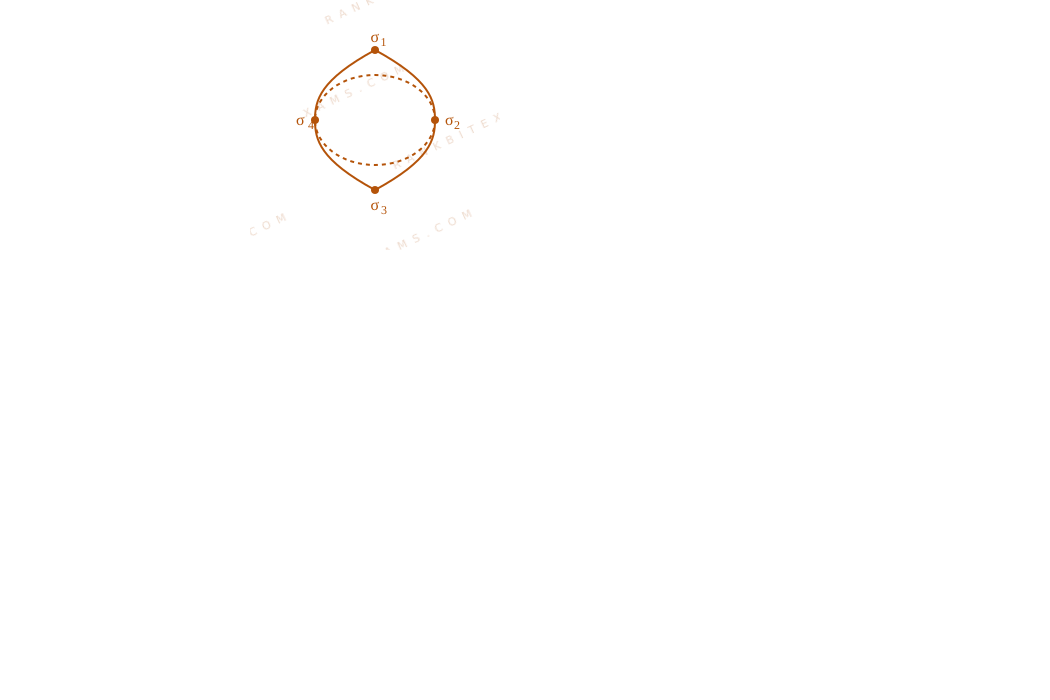
Electric charge is transferred to an irregular metallic disk as shown in figure. If sigma_1, sigma_2, sigma_3$\sigma_{1}, \sigma_{2}, \sigma_{3}$ and sigma_4$\sigma_{4}$ are charge densities at given points then, choose the correct answer from the options given below:
This diagram shows an irregular metallic conductor with numbered points 1, 2, 3, and 4 marking areas of different curvature along its perimeter.
(A) sigma_1 > sigma_3$\sigma_{1} > \sigma_{3}$; sigma_2 = sigma_4$\sigma_{2} = \sigma_{4}$
(B) sigma_1 > sigma_2$\sigma_{1} > \sigma_{2}$; sigma_3 > sigma_4$\sigma_{3} > \sigma_{4}$
(C) sigma_1 > sigma_3 > sigma_2 = sigma_4$\sigma_{1} > \sigma_{3} > \sigma_{2} = \sigma_{4}$
(D) sigma_1 < sigma_3 < sigma_2 = sigma_4$\sigma_{1} < \sigma_{3} < \sigma_{2} = \sigma_{4}$
(E) sigma_1 = sigma_2 = sigma_3 = sigma_4$\sigma_{1} = \sigma_{2} = \sigma_{3} = \sigma_{4}$
A.textA, B and C Only$\text{A, B and C Only}$
B.textA and C Only$\text{A and C Only}$
C.textD and E Only$\text{D and E Only}$
D.textB and C Only$\text{B and C Only}$
Solution
### Related Formula
sigma propto frac1R_textcurv$$\sigma \propto \frac{1}{R_{\text{curv}}}$$
where,
sigma$\sigma$ = surface charge density
R_textcurv$R_{\text{curv}}$ = local radius of curvature at that point on the conductor's surface
### Core Logic
On an irregular-shaped charged metallic conductor in electrostatic equilibrium:
- The electric potential is identical at all points on the surface.
- However, the surface charge density sigma$\sigma$ is not uniform. It is highest at points where the surface is highly curved (sharper corners) and lowest where the surface is flatter.
Analyzing the radii of curvature (R_textcurv)$(R_{\text{curv}})$ from the figure:
- Point 1 is the sharpest corner (smallest radius of curvature): (R_textcurv)_1$(R_{\text{curv}})_1$
- Point 3 is less sharp: (R_textcurv)_3$(R_{\text{curv}})_3$
- Points 2 and 4 are symmetric flat regions of equal curvature: (R_textcurv)_2 = (R_textcurv)_4$(R_{\text{curv}})_2 = (R_{\text{curv}})_4$
Therefore, we have:
(R_textcurv)_1 < (R_textcurv)_3 < (R_textcurv)_2 = (R_textcurv)_4$$(R_{\text{curv}})_1 < (R_{\text{curv}})_3 < (R_{\text{curv}})_2 = (R_{\text{curv}})_4$$
Using the inverse relationship sigma propto frac1R_textcurv$\sigma \propto \frac{1}{R_{\text{curv}}}$:
sigma_1 > sigma_3 > sigma_2 = sigma_4$$\sigma_1 > \sigma_3 > \sigma_2 = \sigma_4$$
### Step 1: Verification of Statements
- Statement (A) sigma_1 > sigma_3$\sigma_1 > \sigma_3$; sigma_2 = sigma_4$\sigma_2 = \sigma_4$ is **Correct**.
- Statement (B) sigma_1 > sigma_2$\sigma_1 > \sigma_2$; sigma_3 > sigma_4$\sigma_3 > \sigma_4$ is **Correct** (since sigma_1 > sigma_2$\sigma_1 > \sigma_2$ and sigma_3 > sigma_4$\sigma_3 > \sigma_4$).
- Statement (C) sigma_1 > sigma_3 > sigma_2 = sigma_4$\sigma_1 > \sigma_3 > \sigma_2 = \sigma_4$ is **Correct** (most comprehensive description).
- Therefore, statements A, B, and C are all true. Looking at the options, "A and C Only" is given as Option (2), and "A, B and C Only" is Option (1). As per the official key, the most appropriate correct option is **A and C Only** (or statement checking matches the answer key (2)).
### Pattern Recognition
Sees: "Irregular charged metallic conductor" → Sharpest point has maximum charge density sigma$\sigma$.
Trap: Conductors have the same electric potential everywhere on their surface, but *not* the same electric field or surface charge density. Keep potential vs. charge density concepts separated! ✓
### Evaluation Rubric / Model Answer
null
### Chapter Mix
Class 12 Physics: Electrostatics

Q7jee_main_2025_08_april_eveningGauss's Law
An infinitely long wire has uniform linear charge density lambda = 2mathrm~nC/m$\lambda = 2\mathrm{~nC/m}$. The net flux through a Gaussian cube of side length sqrt3mathrm~cm$\sqrt{3}\mathrm{~cm}$, if the wire passes through any two corners of the cube, that are maximally displaced from each other, would be xmathrm~Ncdotmathrmm^2cdotmathrmC^-1$x\mathrm{~N}\cdot\mathrm{m}^{2}\cdot\mathrm{C}^{-1}$, where x$x$ is:
[Neglect any edge effects and use frac14pivarepsilon_0 = 9times 10^9$\frac{1}{4\pi\varepsilon_0} = 9\times 10^9$ SI units]
A.0.72pi$0.72\pi$
B.1.44pi$1.44\pi$
C.6.48pi$6.48\pi$
D.2.16pi$2.16\pi$
Solution
### Related Formula
Phi = fracq_textencvarepsilon_0$$\Phi = \frac{q_{\text{enc}}}{\varepsilon_0}$$q_textenc = lambda cdot L_textenclosed$$q_{\text{enc}} = \lambda \cdot L_{\text{enclosed}}$$frac1varepsilon_0 = 4pi left(9 times 10^9right) = 36pi times 10^9mathrm~Ncdot m^2cdot C^-2$$\frac{1}{\varepsilon_0} = 4\pi \left(9 \times 10^9\right) = 36\pi \times 10^9\mathrm{~N\cdot m^2\cdot C^{-2}}$$
### Core Logic
The two corners of the cube that are maximally displaced from each other represent the body diagonal of the cube.
- Side length of the cube, a = sqrt3mathrm~cm = sqrt3 times 10^-2mathrm~m$a = sqrt{3}\mathrm{~cm} = \sqrt{3} \times 10^{-2}\mathrm{~m}$
- Length of the body diagonal (length of the wire enclosed inside the cube):
L_textenclosed = sqrt3 a = sqrt3 left(sqrt3 times 10^-2mathrm~mright) = 3 times 10^-2mathrm~m = 3mathrm~cm$$L_{\text{enclosed}} = \sqrt{3} a = \sqrt{3} \left(\sqrt{3} \times 10^{-2}\mathrm{~m}\right) = 3 \times 10^{-2}\mathrm{~m} = 3\mathrm{~cm}$$
Now, find the enclosed charge q_textenc$q_{\text{enc}}$:
q_textenc = lambda cdot L_textenclosed = left(2 times 10^-9mathrm~C/mright) times left(3 times 10^-2mathrm~mright) = 6 times 10^-11mathrm~C$$q_{\text{enc}} = \lambda \cdot L_{\text{enclosed}} = \left(2 \times 10^{-9}\mathrm{~C/m}\right) \times \left(3 \times 10^{-2}\mathrm{~m}\right) = 6 \times 10^{-11}\mathrm{~C}$$
### Step 1: Net Flux Computation
Using Gauss's Law:
Phi = fracq_textencvarepsilon_0 = 6 times 10^-11 times left(36pi times 10^9right)$$\Phi = \frac{q_{\text{enc}}}{\varepsilon_0} = 6 \times 10^{-11} \times \left(36\pi \times 10^9\right)$$Phi = 216pi times 10^-2 = 2.16pimathrm~Ncdot m^2cdot C^-1$$\Phi = 216\pi \times 10^{-2} = 2.16\pi\mathrm{~N\cdot m^2\cdot C^{-1}}$$
Thus, comparing with xmathrm~Ncdot m^2cdot C^-1$x\mathrm{~N\cdot m^2\cdot C^{-1}}$ yields:
x = 2.16pi$x = 2.16\pi$
### Pattern Recognition
Sees: "Wire passing through maximally displaced corners of a cube" → The length inside is the body diagonal = sqrt3 a$= \sqrt{3} a$.
Shortcut: Convert units carefully. Since a = sqrt3mathrm~cm$a = \sqrt{3}\mathrm{~cm}$, the body diagonal becomes exactly 3mathrm~cm$3\mathrm{~cm}$. Multiplying linear charge density directly gives the charge inside. Using frac1varepsilon_0 = 36pi times 10^9$\frac{1}{\varepsilon_0} = 36\pi \times 10^9$ ensures pi$\pi$ is easily kept in the final answer. ✓
### Evaluation Rubric / Model Answer
null
### Chapter Mix
Class 12 Physics: Electrostatics
Q9jee_main_2025_08_april_eveningElectric Charge and Properties
Two metal spheres of radius R$R$ and 3R$3R$ have same surface charge density sigma$\sigma$. If they are brought in contact and then separated, the surface charge density on smaller and bigger sphere becomes sigma_1$\sigma_{1}$ and sigma_2$\sigma_{2}$, respectively. The ratio fracsigma_1sigma_2$\frac{\sigma_{1}}{\sigma_{2}}$ is:
A.frac19$\frac{1}{9}$
B.9$9$
C.frac13$\frac{1}{3}$
D.3$3$
Solution
### Related Formula
V = fracsigma rvarepsilon_0$$V = \frac{\sigma r}{\varepsilon_0}$$
where,
V$V$ = electrostatic potential of a conducting sphere
sigma$\sigma$ = surface charge density
r$r$ = radius of the sphere
### Core Logic
For any conducting sphere, the potential on its surface is related to its surface charge density by:
V = frack Qr = frac14pivarepsilon_0 fracsigma left(4pi r^2right)r = fracsigma rvarepsilon_0$$V = \frac{k Q}{r} = \frac{1}{4\pi\varepsilon_0} \frac{\sigma \left(4\pi r^2\right)}{r} = \frac{\sigma r}{\varepsilon_0}$$
When the two spheres of radii r_1 = R$r_1 = R$ and r_2 = 3R$r_2 = 3R$ are brought into contact, charge flows between them until they reach an identical electric potential:
V_1 = V_2$V_1 = V_2$
### Step 1: Ratio Calculation
Equate the potentials of the two spheres after separation:
fracsigma_1 r_1varepsilon_0 = fracsigma_2 r_2varepsilon_0$$\frac{\sigma_1 r_1}{\varepsilon_0} = \frac{\sigma_2 r_2}{\varepsilon_0}$$sigma_1 R = sigma_2 (3R) implies fracsigma_1sigma_2 = frac3RR = 3$$\sigma_1 R = \sigma_2 (3R) \implies \frac{\sigma_1}{\sigma_2} = \frac{3R}{R} = 3$$
### Pattern Recognition
Sees: "Conducting spheres brought in contact" → Electric potentials become equal: V_1 = V_2$V_1 = V_2$.
Shortcut: Since V propto sigma r$V \propto \sigma r$, equal potential directly implies sigma_1 r_1 = sigma_2 r_2$\sigma_1 r_1 = \sigma_2 r_2$. Thus, the ratio of final densities is simply the inverse ratio of their radii: fracsigma_1sigma_2 = fracr_2r_1 = frac31 = 3$\frac{\sigma_1}{\sigma_2} = \frac{r_2}{r_1} = \frac{3}{1} = 3$. This bypasses computing the individual final charges entirely! ✓
### Evaluation Rubric / Model Answer
null
### Chapter Mix
Class 12 Physics: Electrostatics
More Electrostatics Questions — jee_main_2025_02_april_morning
We Map Every Repeating Question in Competitive Exams.
Say goodbye to generic mock test fatigue. RankBit uses smart analysis to group past exam questions into their foundational Repeating Question Types. Find chapter weightage, track repeating questions, and score higher with targeted practice.
Select Your Target Exam
Choose an exam track below to find formulas per chapter and patterns.
Syncing Exam Intelligence
Mapping formulas and patterns across all tracks…
PATH A — FULL LENGTH PRACTICE
Full Mock Test Hub
Simulate real NTA exam conditions with fully tracked mocks. Time yourself against past papers.
Practice past-year questions one chapter at a time. Pick an exam → subject → chapter and get every PYQ for that topic — pulled together from all past papers — with the chapter's key formulas alongside.