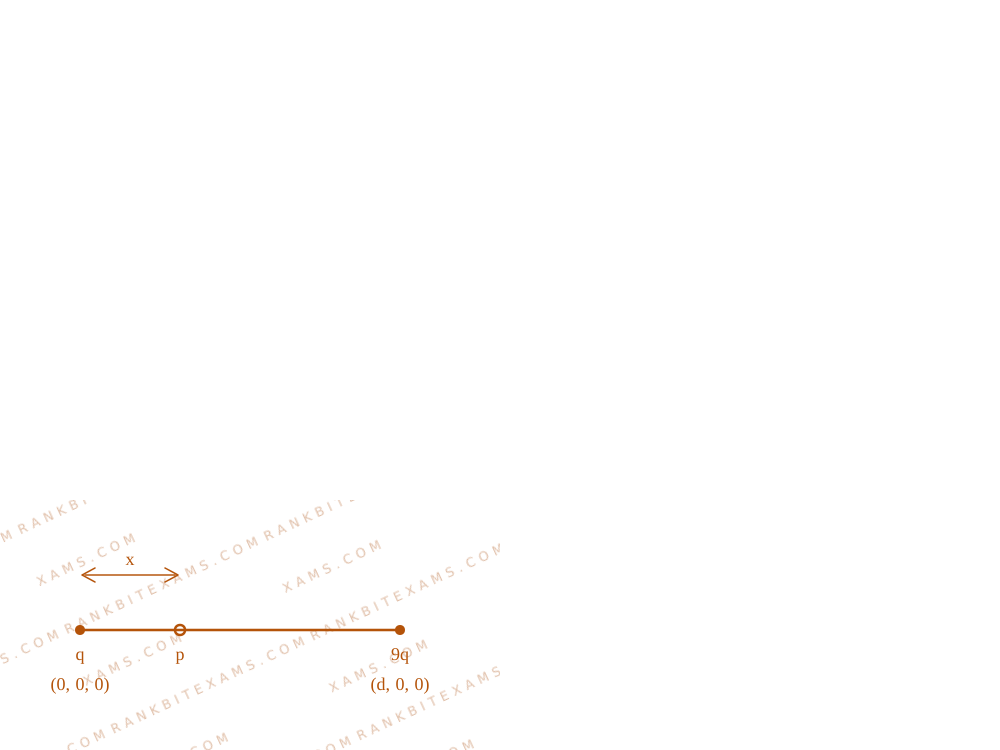
A point charge +q is placed at the origin. A second point charge +9q is placed at (d, 0, 0) in Cartesian coordinate system. The point in between them where the electric field vanishes is:

Solution & Explanation

### Related Formula E = frack Qr^2 x = fracd1 + sqrtfracq_2q_1 ### Core Logic Let the null point where the electric field is zero be at (x, 0, 0) where 0 < x < d. At this point, the fields due to both charges are equal in magnitude and opposite in direction: frack qx^2 = frack (9q)(d - x)^2 Taking the square root on both sides: frac1x = frac3d - x implies d - x = 3x 4x = d implies x = fracd4 Thus, the coordinates of the null point are left(fracd4, 0, 0right). ### Step 1: Final Conclusion The point where the electric field vanishes is left(fracd4, 0, 0right). ### Pattern Recognition For two like charges, the zero-field null point always lies along the line joining them and is closer to the smaller charge. Use the standard shortcut: x = fracd1 + sqrtq_2/q_1 measured from charge q_1. ### Evaluation Rubric / Model Answer null ### Chapter Mix Class 12 Physics: Electrostatics
Null point calculation coordinates diagram

Reference Study Guides

More Electrostatics Previous-Year Questions — Page 6

Q1 jee_main_2025_24_jan_morning Energy Stored in a Capacitor
Consider a parallel plate capacitor of area A (of each plate) and separation 'd' between the plates. If E is the electric field and epsilon_0 is the permittivity of free space between the plates, then potential energy stored in the capacitor is :-
  • A. frac12epsilon_0E^2Ad
  • B. frac34epsilon_0E^2Ad
  • C. frac14epsilon_0E^2Ad
  • D. epsilon_0E^2Ad

Solution

### Related Formula The electrostatic energy density u stored in an electric field E is given by: u = frac12epsilon_0E^2 The total potential energy U stored in a volume V is: U = u cdot V ### Core Logic For a parallel plate capacitor, the volume between the plates where the electric field exists is the product of the plate area A and the plate separation d: V = Ad ### Step 1: Calculating Stored Energy Substitute the volume expression into the total energy equation: U = left(frac12epsilon_0E^2 ight)(Ad) U = frac12epsilon_0E^2Ad ### Pattern Recognition Energy density times volume is a universal relation for field fields. Remember that volume is simply cross-sectional area multiplied by distance (Ad). ### Evaluation Rubric / Model Answer null ### Chapter Mix Class 12 Physics: Electrostatics
Q18 jee_main_2025_24_jan_morning Capacitance of a Parallel Plate Capacitor
A parallel plate capacitor was made with two rectangular plates, each with a length of l = 3 cm and breath of b = 1 cm. The distance between the plates is 3mu m Out of the following, which are the ways to increase the capacitance by a factor of 10? A. l = 30 cm, b = 1 cm, d=1mu m B. l = 3 cm, b=1 cm, d=30~mu m C. l = 6 cm, b=5 cm, d=3~mu m D. l = 1 cm, b=1textcm, d=10~mu m E. l = 5text cm, b=2 cm, d=1mu m Choose the correct answer from the options given below :
  • A. C and E only
  • B. B and D only
  • C. A only
  • D. C only

Solution

### Related Formula The capacitance of a parallel plate system is given by : C = fracepsilon_0Ad = fracepsilon_0lbd where l is length, b is breadth, and d is separation distance. ### Core Logic Evaluate the initial capacitance base scaling parameter : C_0 = fracepsilon_0 times 3text cm times 1text cm3mutextm = 1 times epsilon_0text units We want to increase this initial baseline capacitance value by a factor of 10, meaning our target capacitance is 10epsilon_0. ### Step 1: Audit Options Let's check the capacitance for options C and E : * Option C: l=6text cm, b=5text cm, d=3mutextm . C_C = fracepsilon_0 times 6 times 53 = 10epsilon_0text units (Correct) * Option E: l=5text cm, b=2text cm, d=1mutextm . C_E = fracepsilon_0 times 5 times 21 = 10epsilon_0text units (Correct) ### Pattern Recognition Capacitance scales matching the geometric factor fracl cdot bd. Look for options where this ratio scales up to exactly 10 times the initial baseline value. ### Evaluation Rubric / Model Answer null ### Chapter Mix Class 12 Physics: Electrostatics
Q21 jee_main_2025_24_jan_morning Gauss's Law and Electric Flux
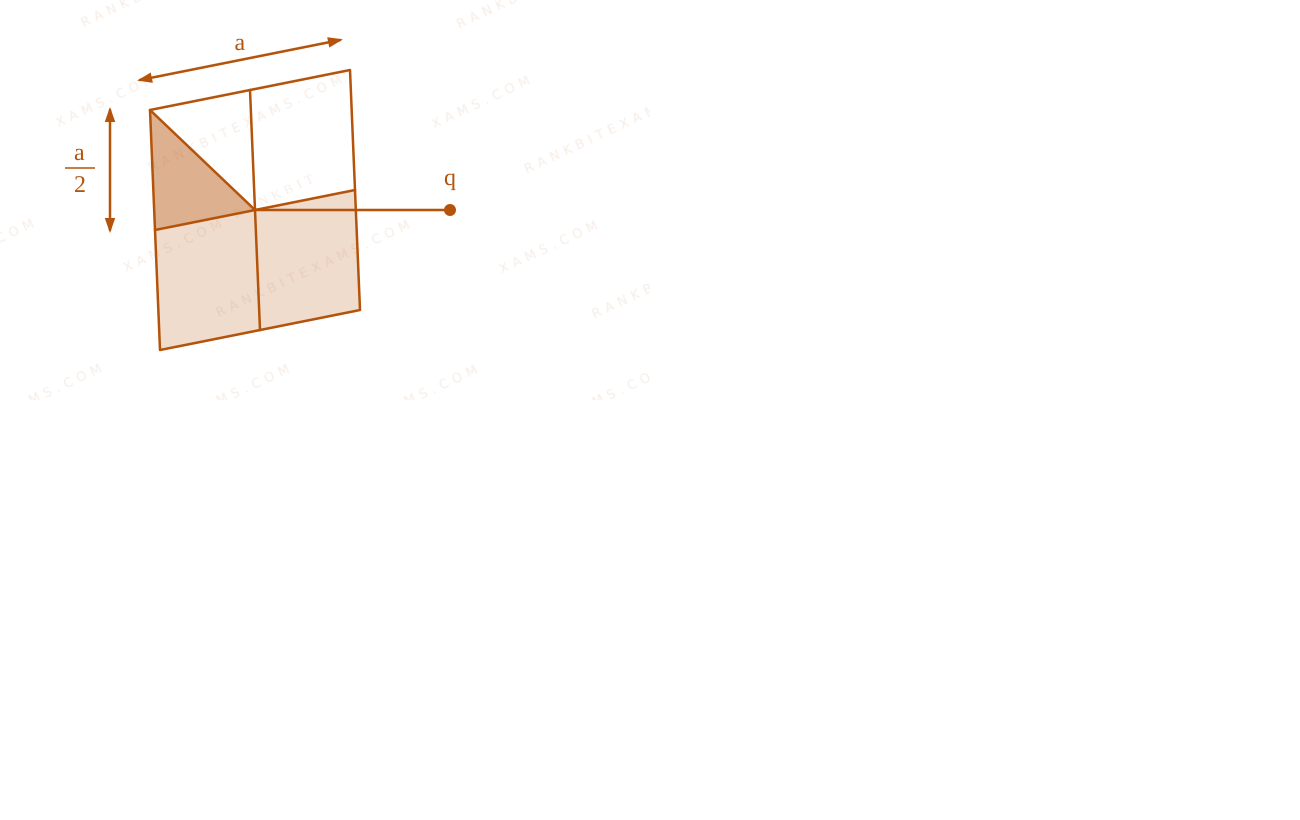
A square loop of sides a = 1 m is held normally in front of a point charge q = 1C The flux of the electric field through the shaded region is frac5p times frac1varepsilon_0 fracNm^2C , where the value of p is .
Gauss's Law and Electric Flux diagram for Q21 - JEE Main 2025 Morning
The diagram illustrates a square loop divided into 8 symmetric parts with a point charge positioned in front of its center.
Numerical Answer. Answer: 48 to 48

Solution

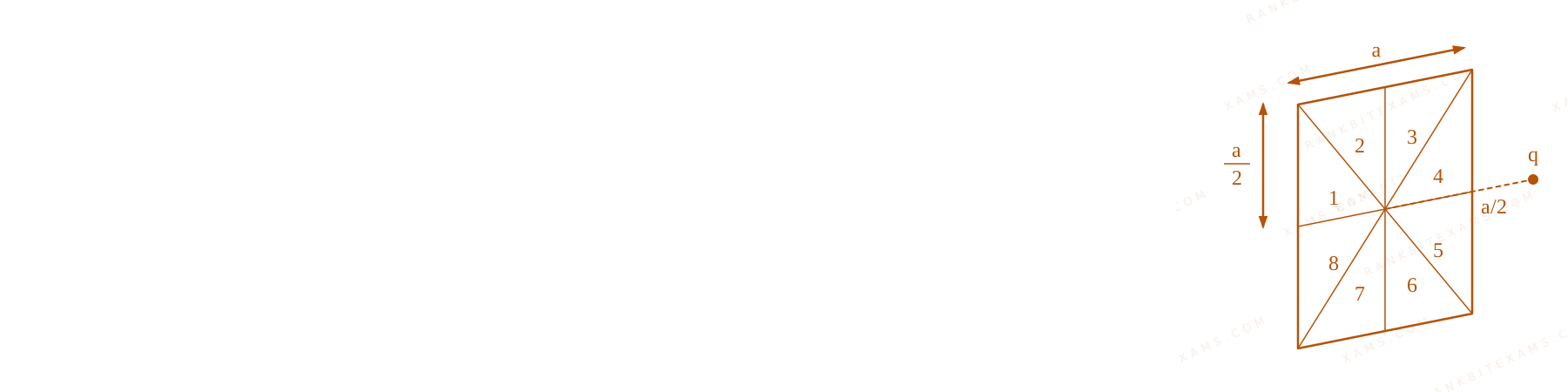
### Related Formula By Gauss's Law, the total flux emitted by a point charge q through a completely enclosing symmetric cube container surface is: Phitexttotal = fracqepsilon0 ### Core Logic Assuming the charge resides at a symmetric center distance fraca2 relative to the loop face [cite: 784, 786], this square loop represents one of the six identical faces of an enclosing cube system. Thus, the flux passing through the entire square loop face is[cite: 775, 776]: Phitextsquare = frac16 Phitexttotal = fracq6epsilon0 ### Step 1: Symmetric Partitioning As shown in the solution schematic
Gauss's Law and Electric Flux diagram for Q21 - JEE Main 2025 Morning
The diagram illustrates a square loop divided into 8 symmetric parts with a point charge positioned in front of its center.
, the square face can be divided into 8 identical symmetric right-angled triangle sections by drawing its diagonals and medians[cite: 771, 777]. Each individual part intercepts an equal portion of the flux field : Phitextpart = frac18 Phitextsquare = frac18 left(fracq6epsilon_0 ight) = fracq48epsilon_0 The shaded region covers exactly 5 of these individual triangle parts [cite: 779, 780]: Phi_textshaded = 5 times Phi_textpart = frac548 times fracqepsilon_0 Comparing this result with the given expression frac5p times frac1epsilon_0 , we find: p = 48 ### Pattern Recognition Exploit geometric symmetry to break solid angles down into equal fractions, avoiding complex surface integration. ### Evaluation Rubric / Model Answer null ### Chapter Mix Class 12 Physics: Electrostatics

Q2 jee_main_2025_28_jan_evening Energy Density in Capacitors
A parallel plate capacitor of capacitance 1mu mathrmF is charged to a potential difference of 20mathrmV. The distance between plates is 1mu mathrmm. The energy density between plates of capacitor is:
  • A. 1.8 times 10^3 \, mathrmJ/m^3
  • B. 2 times 10^-4 \, mathrmJ/m^3
  • C. 2 times 10^2 mathrm~J / mathrmm^3
  • D. 1.8 times 10^5 mathrm~J / mathrmm^3

Solution

### Related Formula The electric field E between the plates of a parallel plate capacitor is given by : E = fracVd The electrostatic energy density U in a medium is given by: U = frac12 epsilon_0 E^2 ### Core Logic Given values [cite: 662, 664, 665]: * Capacitance, C = 1 \ mutextF * Potential difference, V = 20 text V * Plate separation, d = 1 \ mutextm = 10^-6 text m First, calculate the electric field E : E = frac2010^-6 = 20 times 10^6 text V/m Now, calculate the energy density U using epsilon_0 approx 8.85 times 10^-12 text F/m : U = frac12 times (8.85 times 10^-12) times (20 times 10^6)^2 U = frac12 times 8.85 times 10^-12 times 400 times 10^12 U = 8.85 times 200 = 1770 text J/m^3 = 1.77 times 10^3 text J/m^3 Rounding to the nearest matching option gives 1.8 times 10^3 text J/m^3. ### Pattern Recognition Notice that energy density is completely independent of the total capacitance value C if the voltage and spacing are directly provided. Always check for redundant parameters included to distract candidates. ### Evaluation Rubric / Model Answer null ### Chapter Mix Class 12 Physics: Electrostatics
Q22 jee_main_2025_28_jan_evening Electric Dipole
An electric dipole of dipole moment 6 times 10^-6 mathrmCm is placed in uniform electric field of magnitude 10^6 mathrm~V/m. Initially, the dipole moment is \parallel to electric field. The work that needs to be done on the dipole to make its dipole moment opposite to the field, will be ______ J.
Numerical Answer. Answer: 12

Solution

### Related Formula The potential energy of an electric dipole aligned at an \angle theta inside a uniform electric field is given by: U = -p E cos theta The work done by an external agent to rotate the dipole equals its change in potential energy: W = Delta U = -pE (cos theta_f - cos theta_i) ### Core Logic Given parameters [cite: 805, 806]: * Dipole moment, p = 6 times 10^-6 text Cm * Electric field, E = 10^6 text V/m * Initial \angle (\parallel state), theta_i = 0^circ * Final \angle (opposite state), theta_f = 180^circ Substitute the values into the work equation [cite: 807, 808]: W = -pE (cos 180^circ - cos 0^circ) W = -pE (-1 - 1) = 2 p E quad text W = 2 times (6 times 10^-6) times 10^6 = 12 text J quad text ### Pattern Recognition Rotating a dipole from its most stable configuration (\parallel, theta=0^circ) to its most unstable position (anti-\parallel, theta=180^circ) always requires a maximum work value of exactly 2pE. ### Evaluation Rubric / Model Answer null ### Chapter Mix Class 12 Physics: Electrostatics

More Electrostatics Questions — jee_main_2025_02_april_morning

Practice all Electrostatics previous-year questions →

Rankbit System
JEE Physics: Waves (+15.5%) | Electrostatics: Concentric Shells (-29.7%) | Modern Physics: Photoelectric Clones (+34.2%) | Mathematics: Definite Integrals (+18.1%) | Chemistry: Coordination Splitting (-11.4%) | JEE Physics: Waves (+15.5%) | Electrostatics: Concentric Shells (-29.7%) | Modern Physics: Photoelectric Clones (+34.2%) | Mathematics: Definite Integrals (+18.1%) | Chemistry: Coordination Splitting (-11.4%)