Choose the correct tests with respective observations. (A) mathrmCuSO_4 (acidified with acetic acid) + mathrmK_4[mathrmFe(mathrmCN)_6] rightarrow Chocolate brown precipitate. (B) mathrmFeCl_3 + mathrmK_4[mathrmFe(mathrmCN)_6] rightarrow Prussian blue precipitate. (C) mathrmZnCl_2 + mathrmK_4[mathrmFe(mathrmCN)_6], neutralised with mathrmNH_4mathrmOH rightarrow mathrmWhite or bluish white precipitate. (D) mathrmMgCl_2 + mathrmK_4[mathrmFe(mathrmCN)_6] rightarrow mathrmBlue precipitate. (E) mathrmBaCl_2 + mathrmK_4[mathrmFe(mathrmCN)_6], neutralised with mathrmNaOH rightarrow mathrmWhite precipitate. Choose the correct answer from the options given below:

Solution & Explanation

### Related Formula Precipitation equations matching standard analytical profiles: mathrm2Cu^2+ + [Fe(CN)_6]^4- rightarrow Cu_2[Fe(CN)_6] downarrow \ (Chocolate\ Brown) mathrm4Fe^3+ + 3[Fe(CN)_6]^4- rightarrow Fe_4[Fe(CN)_6]_3 downarrow \ (Prussian\ Blue) ### Core Logic Let's examine each analytical chemistry reaction step row-by-row: * **Reaction (A)** produces mathrmCu_2[Fe(CN)_6], confirming a chocolate brown residue profile (Correct). * **Reaction (B)** forms complex mathrmFe_4[Fe(CN)_6]_3, yielding Prussian Blue coloration (Correct). * **Reaction (C)** yields potassium zinc ferrocyanide matrix mathrmK_2Zn_3[Fe(CN)_6]_2, appearing as a white or bluish-white solid precipitate (Correct). * **Reactions (D) & (E)** do not form the described colored precipitates with this reagent under regular analytical configurations. ### Step 1: Selection Thus, only tests A, B, and C provide correct observations. ### Pattern Recognition Potassium ferrocyanide mathrmK_4[Fe(CN)_6] is a vital reagent for identifying transition metal cations. Note the specific colors: Copper yields chocolate brown, Iron(III) gives Prussian blue, and Zinc forms a white solid. ### Evaluation Rubric / Model Answer null ### Chapter Mix Class 12 Chemistry: Practical Chemistry Class 12 Chemistry: Coordination Compounds

Reference Study Guides

More Practical Chemistry Previous-Year Questions — Page 2

Q74 jee_main_2024_29_january_evening Chromatographic Separations
Chromatographic technique/s based on the principle of differential adsorption is/are A. Column chromatography B. Thin layer chromatography C. Paper chromatography Choose the most appropriate answer from the options given below:
  • A. B only
  • B. A only
  • C. A & B only
  • D. C only

Solution

### Related Formula Classification of chromatography based on adsorption vs partition parameters. ### Core Logic Chromatography techniques are broadly divided into two main categories based on their operating principles: 1. **Adsorption Chromatography**: Relies on the differential adsorption of components on the surface of a stationary phase. Both Column Chromatography and Thin Layer Chromatography (TLC) operate on this principle. 2. **Partition Chromatography**: Relies on continuous differential partitioning of components between stationary and mobile liquid phases. Paper Chromatography is a prime example of this category. ### Step 1: Final Selection Thus, statements A and B are correct, matching choice (3). ### Pattern Recognition Remember: Column and Thin Layer chromatography are adsorption-based, while paper chromatography relies on partition mechanisms. ### Evaluation Rubric / Model Answer null ### Chapter Mix Class 11 Chemistry: Principles of Practical Chemistry
Q87 jee_main_2024_29_jan_morning Organic Functional Groups
Number of compounds among the following which contain sulphur as heteroatom is Furan, Thiophene, Pyridine, Pyrrole, Cysteine, Tyrosine
Numerical Answer. Answer: 2 to 2

Solution

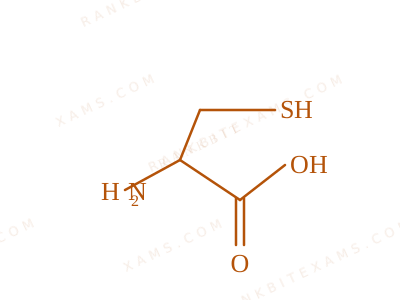
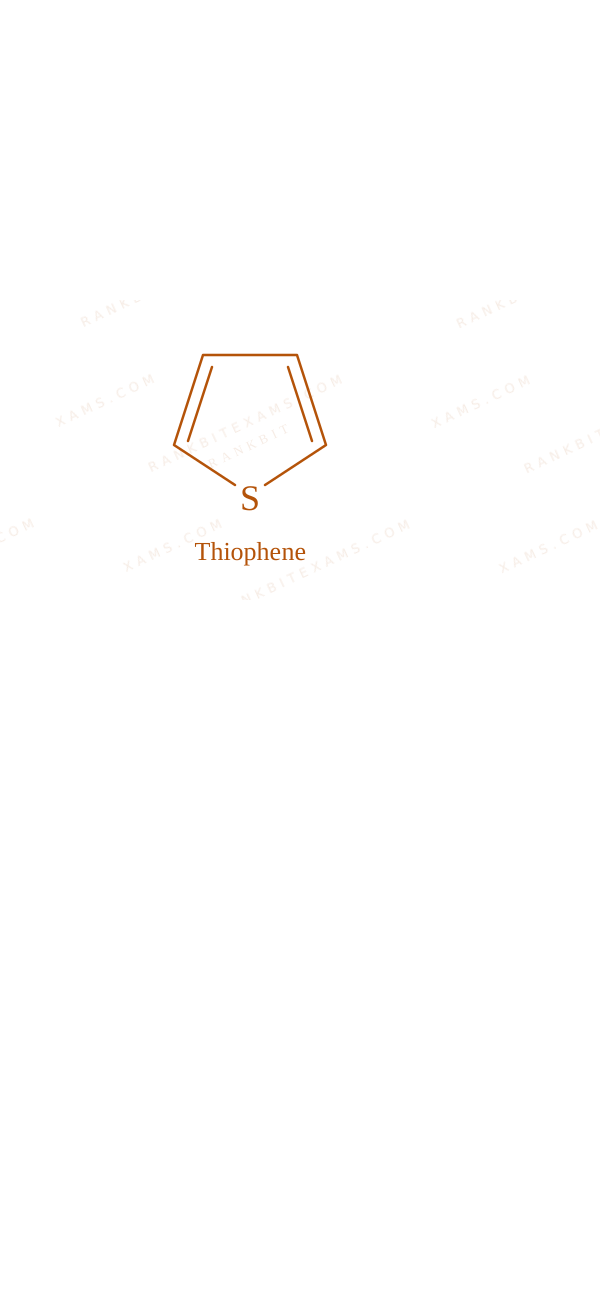
### Core Logic Let us check the chemical structure of each compound given in the list to determine if it contains a Sulphur (S) atom. 1. **Furan**: A 5-membered heterocyclic aromatic ring containing Oxygen (C_4H_4O). No Sulphur. 2. **Thiophene**: A 5-membered heterocyclic aromatic ring containing Sulphur (C_4H_4S). **Contains Sulphur**. 3. **Pyridine**: A 6-membered heterocyclic aromatic ring containing Nitrogen (C_5H_5N). No Sulphur. 4. **Pyrrole**: A 5-membered heterocyclic aromatic ring containing Nitrogen (C_4H_4NH). No Sulphur. 5. **Cysteine**: A naturally occurring alpha-amino acid with a thiol side chain (-CH_2-SH). **Contains Sulphur**. 6. **Tyrosine**: An alpha-amino acid with a phenol side chain. No Sulphur. ### Step 1: Final Count
Organic Functional Groups diagram for Q87 - JEE Main 2024 Morning
Only Thiophene and Cysteine contain a sulphur heteroatom. Total number = 2. ### Evaluation Rubric / Model Answer null ### Chapter Mix Class 11 Chemistry: Organic Chemistry Some Basic Principles and Techniques Class 12 Chemistry: Biomolecules

More Practical Chemistry Questions — jee_main_2025_02_april_morning

Practice all Practical Chemistry previous-year questions →

Rankbit System
JEE Physics: Waves (+15.5%) | Electrostatics: Concentric Shells (-29.7%) | Modern Physics: Photoelectric Clones (+34.2%) | Mathematics: Definite Integrals (+18.1%) | Chemistry: Coordination Splitting (-11.4%) | JEE Physics: Waves (+15.5%) | Electrostatics: Concentric Shells (-29.7%) | Modern Physics: Photoelectric Clones (+34.2%) | Mathematics: Definite Integrals (+18.1%) | Chemistry: Coordination Splitting (-11.4%)