Compounds that should not be used as primary standards in titrimetric analysis are:
A. mathrmNa_2mathrmCr_2mathrmO_7$\mathrm{Na}_{2}\mathrm{Cr}_{2}\mathrm{O}_{7}$
B. Oxalic acid
C. mathrmNaOH$\mathrm{NaOH}$
D. mathrmFeSO_4 cdot 6mathrmH_2mathrmO$\mathrm{FeSO}_{4} \cdot 6\mathrm{H}_{2}\mathrm{O}$
E. Sodium tetraborate
Choose the most appropriate answer from the options given below:
A.B and D Only
B.D and E Only
C.C, D and E Only
D.A, C and D Only
Solution & Explanation
### Related Formula
A primary standard is a highly pure, stable chemical substance with a known, definite composition that can be directly weighed. It must not be hygroscopic, deliquescent, or easily oxidized by air.
### Core Logic
Evaluate each substance:
- mathrmNa_2mathrmCr_2mathrmO_7$\mathrm{Na}_2\mathrm{Cr}_2\mathrm{O}_7$: Highly hygroscopic (unlike mathrmK_2mathrmCr_2mathrmO_7$\mathrm{K}_2\mathrm{Cr}_2\mathrm{O}_7$), absorbs water from air, composition varies rightarrow$\rightarrow$ *Cannot be used*.
- Oxalic acid: Highly stable, non-hygroscopic, definite composition rightarrow$\rightarrow$ *Can be used*.
- mathrmNaOH$\mathrm{NaOH}$: Extremely hygroscopic, absorbs moisture and mathrmCO_2$\mathrm{CO}_2$ from air rightarrow$\rightarrow$ *Cannot be used*.
- mathrmFeSO_4 cdot 6mathrmH_2mathrmO$\mathrm{FeSO}_4 \cdot 6\mathrm{H}_2\mathrm{O}$: Easily oxidized by air, unstable composition rightarrow$\rightarrow$ *Cannot be used*.
- Sodium tetraborate (Borax): Highly stable, clear hydration state rightarrow$\rightarrow$ *Can be used*.
### Step 1: Select incorrect standards
The compounds that should *not* be used are A, C, and D. This corresponds to Option (4).
### Pattern Recognition
Sodium salts of di-chromate (mathrmNa_2mathrmCr_2mathrmO_7$\mathrm{Na}_2\mathrm{Cr}_2\mathrm{O}_7$) are highly hygroscopic, whereas potassium di-chromate (mathrmK_2mathrmCr_2mathrmO_7$\mathrm{K}_2\mathrm{Cr}_2\mathrm{O}_7$) is non-hygroscopic and works as an excellent primary standard. Deliquescent bases like mathrmNaOH$\mathrm{NaOH}$ and easily oxidized transition metal salts like Mohr's salt counterparts can never serve as primary standards.
### Evaluation Rubric / Model Answer
null
### Chapter Mix
Class 11 Chemistry: Practical Chemistry
Keywords:#primary standard titrimetric analysis sodium dichromate NaOH#JEE Main 2025 Evening Q31#Practical Chemistry primary standards#hygroscopic substances volumetric analysis
More Practical Chemistry Previous-Year Questions
Q62jee_main_2026_28_january_morningGriss-Ilosvay Test for Nitrite
Given below are two statements:
Statement I: Griss-Ilosvay test is used for the detection of nitrite ion, which involves the use of sulphanilic acid and alpha$\alpha$-naphthylamine reagent.
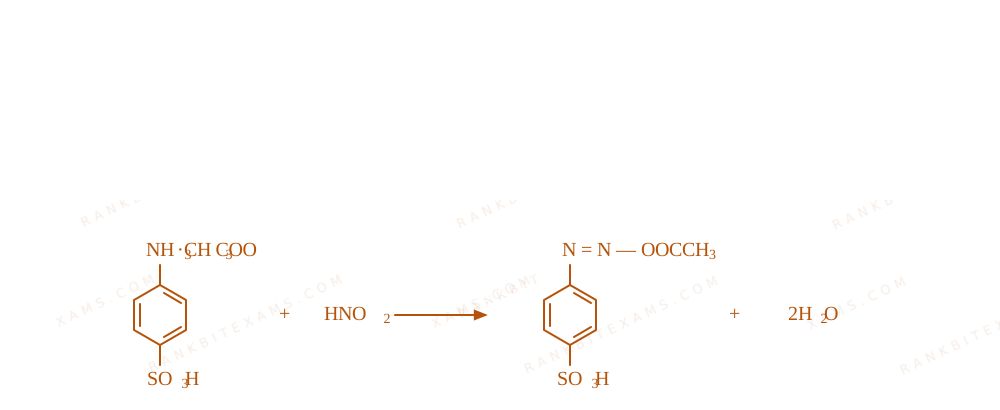
Statement II: In the above test, sulphanilic acid is diazotized by the acidified nitrite ion, which on further coupling with alpha$\alpha$-naphthylamine forms an azo-dye.
In the light of the above statements, choose the correct answer from the options given below
A. Statement I is false but Statement II is true
B. Both Statement I and Statement II are true
C. Statement I is true but Statement II is false
D. Both Statement I and Statement II are false
Solution
### Core Logic
The Griss-Ilosvay test is the standard diagnostic test for Nitrite ions (mathrmNO_2^-$\mathrm{NO_2^-}$).\nReaction sequence:\nNO_2^- + CH_3COOH rightarrow HNO_2 + CH_3COO^-$$NO_2^- + CH_3COOH \rightarrow HNO_2 + CH_3COO^-$$\n1. The nitrous acid (HNO_2$HNO_2$) diazotizes sulphanilic acid to form a diazonium salt.\n2. This diazonium salt then couples with alpha$\alpha$-naphthylamine (1-Naphthylamine) to produce a distinct red azo-dye.\nGriss-Ilosvay Test Mechanism
### Final Conclusion
Both statements perfectly describe the reaction mechanism and reagents for the Griss-Ilosvay test. Both are true.
### Pattern Recognition
Tests utilizing diazotization followed by coupling almost always produce colored azo dyes. Knowing the name-to-reagent mapping (Griss-Ilosvay = Sulphanilic acid + Naphthylamine) guarantees the answer.
### Evaluation Rubric / Model Answer
null
### Chapter Mix
Class 12 Chemistry: Principles Related to Practical Chemistry
Class 12 Chemistry: Amines
Qjee_main_2025_02_april_eveningQualitative Analysis of Anions
Formation of mathrmNa_4[mathrmFe(mathrmCN)_5mathrmNOS]$\mathrm{Na}_4[\mathrm{Fe}(\mathrm{CN})_5\mathrm{NOS}]$, a purple coloured complex formed by addition of sodium nitroprusside in sodium carbonate extract of salt indicates the presence of:
A.textSodium ion$\text{Sodium ion}$
B.textSulphate ion$\text{Sulphate ion}$
C.textSulphide ion$\text{Sulphide ion}$
D.textSulphite ion$\text{Sulphite ion}$
Solution
### Related Formula
textNa_2textS + textNa_2[textFe(textCN)_5textNO] rightarrow textNa_4[textFe(textCN)_5textNOS]$\text{Na}_2\text{S} + \text{Na}_2[\text{Fe}(\text{CN})_5\text{NO}] \rightarrow \text{Na}_4[\text{Fe}(\text{CN})_5\text{NOS}]$
AI responses may include mistakes.
### Core Logic
Sulphide ion (S^2-$S^{2-}$) undergoes a qualitative verification test when reacted with sodium nitroprusside. Sodium extract of the salt containing sulphide forms sodium sulphide (mathrmNa_2S$\mathrm{Na_2S}$).
When sodium nitroprusside solution is added to the sodium carbonate extract, the sulphide reacts to yield a deep violet/purple coloured complex called sodium thionitroprusside:
mathrmNa_2S + Na_2[Fe(CN)_5NO] rightarrow Na_4[Fe(CN)_5NOS]$$\mathrm{Na_2S + Na_2[Fe(CN)_5NO] \rightarrow Na_4[Fe(CN)_5NOS]}$$
### Step 1: Verification
This specific purple/violet reaction occurs exclusively for the identification of the **Sulphide ion** (S^2-$S^{2-}$).
### Pattern Recognition
Mnemonic: 'Nitroprusside turns purple for Sulphide'. This is a highly specific redox/substitution reaction of coordination complexes used inside analytical laboratory practices.
### Evaluation Rubric / Model Answer
null
### Chapter Mix
Class 11 Chemistry: Practical Chemistry
Q41jee_main_2025_02_april_morningQualitative Salt Analysis Reactions
Choose the correct tests with respective observations.
(A) mathrmCuSO_4$\mathrm{CuSO}_4$ (acidified with acetic acid) +$+$mathrmK_4[mathrmFe(mathrmCN)_6] rightarrow$\mathrm{K}_4[\mathrm{Fe}(\mathrm{CN})_6] \rightarrow$ Chocolate brown precipitate.
(B) mathrmFeCl_3 + mathrmK_4[mathrmFe(mathrmCN)_6] rightarrow$\mathrm{FeCl}_3 + \mathrm{K}_4[\mathrm{Fe}(\mathrm{CN})_6] \rightarrow$ Prussian blue precipitate.
(C) mathrmZnCl_2 + mathrmK_4[mathrmFe(mathrmCN)_6]$\mathrm{ZnCl}_2 + \mathrm{K}_4[\mathrm{Fe}(\mathrm{CN})_6]$, neutralised with mathrmNH_4mathrmOH rightarrow mathrmWhite$\mathrm{NH}_4\mathrm{OH} \rightarrow \mathrm{White}$ or bluish white precipitate.
(D) mathrmMgCl_2 + mathrmK_4[mathrmFe(mathrmCN)_6] rightarrow mathrmBlue$\mathrm{MgCl}_2 + \mathrm{K}_4[\mathrm{Fe}(\mathrm{CN})_6] \rightarrow \mathrm{Blue}$ precipitate.
(E) mathrmBaCl_2 + mathrmK_4[mathrmFe(mathrmCN)_6]$\mathrm{BaCl}_2 + \mathrm{K}_4[\mathrm{Fe}(\mathrm{CN})_6]$, neutralised with mathrmNaOH rightarrow mathrmWhite$\mathrm{NaOH} \rightarrow \mathrm{White}$ precipitate.
Choose the correct answer from the options given below:
A.text(1) A, D and E only$\text{(1) A, D and E only}$
B.text(2) B, D and E only$\text{(2) B, D and E only}$
C.text(3) A, B and C only$\text{(3) A, B and C only}$
D.text(4) C, D and E only$\text{(4) C, D and E only}$
Solution
### Related Formula
Precipitation equations matching standard analytical profiles:
mathrm2Cu^2+ + [Fe(CN)_6]^4- rightarrow Cu_2[Fe(CN)_6] downarrow \ (Chocolate\ Brown)$$\mathrm{2Cu^{2+} + [Fe(CN)_6]^{4-} \rightarrow Cu_2[Fe(CN)_6] \downarrow \ (Chocolate\ Brown)}$$mathrm4Fe^3+ + 3[Fe(CN)_6]^4- rightarrow Fe_4[Fe(CN)_6]_3 downarrow \ (Prussian\ Blue)$$\mathrm{4Fe^{3+} + 3[Fe(CN)_6]^{4-} \rightarrow Fe_4[Fe(CN)_6]_3 \downarrow \ (Prussian\ Blue)}$$
### Core Logic
Let's examine each analytical chemistry reaction step row-by-row:
* **Reaction (A)** produces mathrmCu_2[Fe(CN)_6]$\mathrm{Cu_2[Fe(CN)_6]}$, confirming a chocolate brown residue profile (Correct).
* **Reaction (B)** forms complex mathrmFe_4[Fe(CN)_6]_3$\mathrm{Fe_4[Fe(CN)_6]_3}$, yielding Prussian Blue coloration (Correct).
* **Reaction (C)** yields potassium zinc ferrocyanide matrix mathrmK_2Zn_3[Fe(CN)_6]_2$\mathrm{K_2Zn_3[Fe(CN)_6]_2}$, appearing as a white or bluish-white solid precipitate (Correct).
* **Reactions (D) & (E)** do not form the described colored precipitates with this reagent under regular analytical configurations.
### Step 1: Selection
Thus, only tests A, B, and C provide correct observations.
### Pattern Recognition
Potassium ferrocyanide mathrmK_4[Fe(CN)_6]$\mathrm{K_4[Fe(CN)_6]}$ is a vital reagent for identifying transition metal cations. Note the specific colors: Copper yields chocolate brown, Iron(III) gives Prussian blue, and Zinc forms a white solid.
### Evaluation Rubric / Model Answer
null
### Chapter Mix
Class 12 Chemistry: Practical Chemistry
Class 12 Chemistry: Coordination Compounds
Q49jee_main_2025_24_jan_morningQualitative Analysis of Cations
Among the following cations, the number of cations which will give characteristic precipitate in their identification tests with mathrmK_4[mathrmFe(mathrmCN)_6]$\mathrm{K}_4[\mathrm{Fe}(\mathrm{CN})_6]$ is:
mathrmCu^2+$\mathrm{Cu}^{2+}$ , mathrmFe^3+$\mathrm{Fe}^{3+}$ , mathrmBa^2+$\mathrm{Ba}^{2+}$ , mathrmCa^2+$\mathrm{Ca}^{2+}$ , mathrmNH_4^+$\mathrm{NH}_4^+$ , mathrmMg^2+$\mathrm{Mg}^{2+}$ , mathrmZn^2+$\mathrm{Zn}^{2+}$
Numerical Answer.Answer: 3 to 3
Solution
### Core Logic
Potassium ferrocyanide, K_4[Fe(CN)_6]$K_4[Fe(CN)_6]$, serves as a key reagent for identifying specific metal cations via diagnostic precipitation reactions:
- Cu^2+$Cu^{2+}$ yields a characteristic chocolate-brown precipitate: Cu_2[Fe(CN)_6]$Cu_2[Fe(CN)_6]$.
- Fe^3+$Fe^{3+}$ reacts to produce an intense Prussian blue precipitate: Fe_4[Fe(CN)_6]_3$Fe_4[Fe(CN)_6]_3$.
- Zn^2+$Zn^{2+}$ forms a distinct white/grey-white precipitate: Zn_2[Fe(CN)_6]$Zn_2[Fe(CN)_6]$.
*(Note: While Ca^2+$Ca^{2+}$ can form a complex under specific concentrated conditions, standard qualitative test protocols map the primary distinct precipitates to **3** principal metals).*
Therefore, the final integer count is **3**.
### Pattern Recognition
Remember the classic color transformations for ferrocyanide tests: copper shifts to chocolate brown, while iron transforms into Prussian blue.
### Evaluation Rubric / Model Answer
null
### Chapter Mix
Class 12 Chemistry: Practical Chemistry
More Practical Chemistry Questions — jee_main_2025_03_april_evening
We Map Every Repeating Question in Competitive Exams.
Say goodbye to generic mock test fatigue. RankBit uses smart analysis to group past exam questions into their foundational Repeating Question Types. Find chapter weightage, track repeating questions, and score higher with targeted practice.
Select Your Target Exam
Choose an exam track below to find formulas per chapter and patterns.
Syncing Exam Intelligence
Mapping formulas and patterns across all tracks…
PATH A — FULL LENGTH PRACTICE
Full Mock Test Hub
Simulate real NTA exam conditions with fully tracked mocks. Time yourself against past papers.
Practice past-year questions one chapter at a time. Pick an exam → subject → chapter and get every PYQ for that topic — pulled together from all past papers — with the chapter's key formulas alongside.