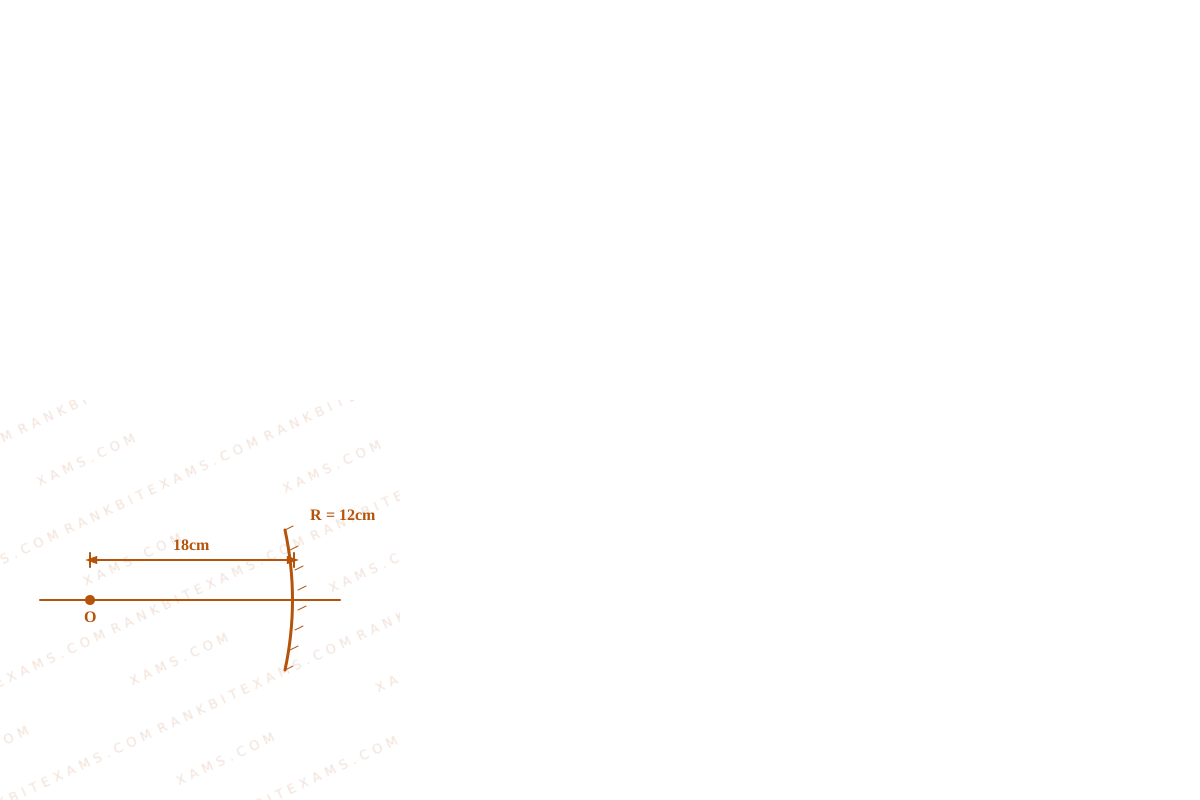
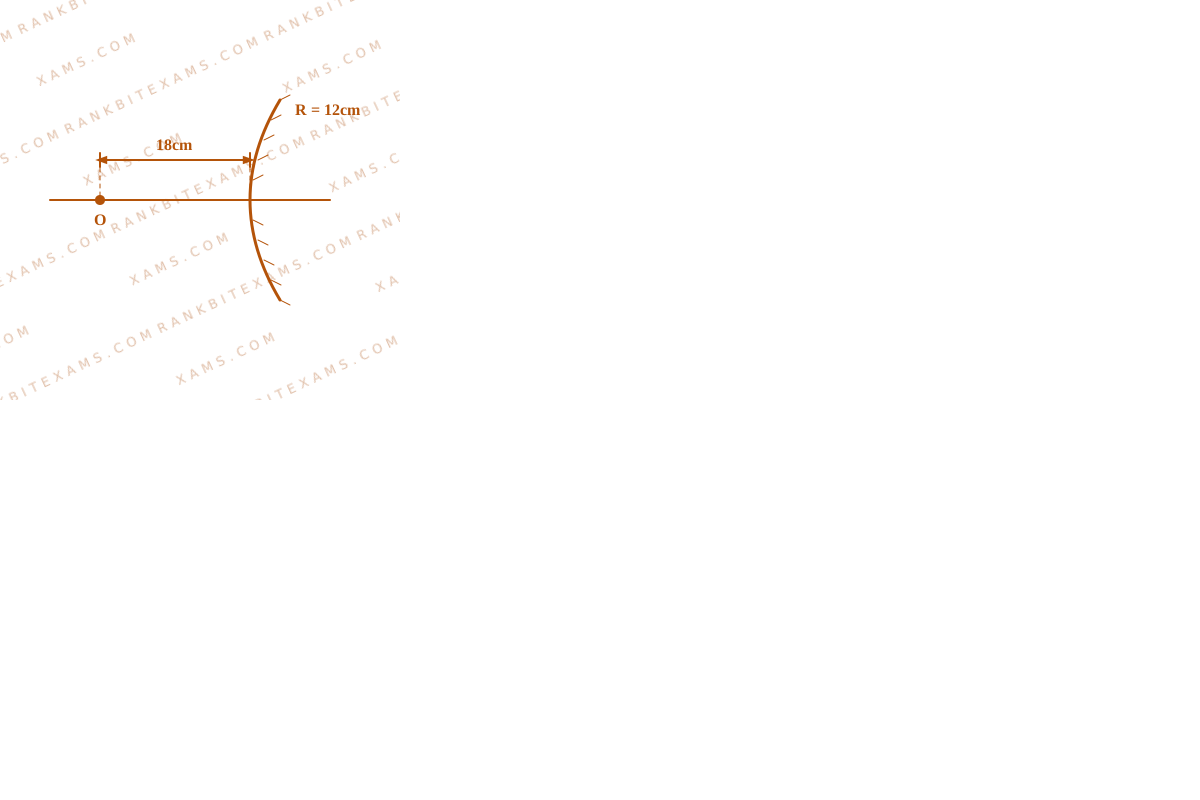
Two identical objects are placed in front of convex mirror and concave mirror having same radii of curvature of 12 \, textcm$12 \, \text{cm}$ , at the same distance of 18 \, textcm$18 \, \text{cm}$ from the respective mirrors. The ratio of sizes of the images formed by convex mirror and by concave mirror is:
A.1 / 2$1 / 2$
B.2$2$
C.3$3$
D.1 / 3$1 / 3$
Solution & Explanation
### Related Formula
1. Mirror focal length:
f = fracR2$$f = \frac{R}{2}$$
2. Magnification (image size relative to object size):
m = frach_ih_o = fracff - u$$m = \frac{h_i}{h_o} = \frac{f}{f - u}$$
where u$u$ is the object distance.
### Core Logic
Given parameters:
- Radius of curvature R = 12 \ mathrmcm implies |f| = 6 \ mathrmcm$R = 12 \ \mathrm{cm} \implies |f| = 6 \ \mathrm{cm}$
- Object distance u = -18 \ mathrmcm$u = -18 \ \mathrm{cm}$
Let's calculate magnification for both mirrors:
1. **For Convex Mirror:**
- Focal length f_textconvex = +6 \ mathrmcm$f_{\text{convex}} = +6 \ \mathrm{cm}$ (using Cartesian sign convention)
- Magnification:
m_1 = fracf_textconvexf_textconvex - u = frac66 - (-18) = frac624 = frac14$$m_1 = \frac{f_{\text{convex}}}{f_{\text{convex}} - u} = \frac{6}{6 - (-18)} = \frac{6}{24} = \frac{1}{4}$$
Thus, image size is frac14 h_o$\frac{1}{4} h_o$.
### Step 1: Calculate magnification of concave mirror
2. **For Concave Mirror:**
- Focal length f_textconcave = -6 \ mathrmcm$f_{\text{concave}} = -6 \ \mathrm{cm}$
- Magnification:
Convex and concave mirror ray diagram representationsm_2 = fracf_textconcavef_textconcave - u = frac-6-6 - (-18) = frac-612 = -frac12$$m_2 = \frac{f_{\text{concave}}}{f_{\text{concave}} - u} = \frac{-6}{-6 - (-18)} = \frac{-6}{12} = -\frac{1}{2}$$
Thus, image size is frac12 h_o$\frac{1}{2} h_o$.
### Step 2: Calculate the ratio of image sizes
Since the objects are identical (same height h_o$h_o$), the ratio of the sizes of the images is:
Convex and concave mirror ray diagram representationstextRatio = frac|h_i1||h_i2| = frac|m_1||m_2| = frac1/41/2 = frac12$$\text{Ratio} = \frac{|h_{i1}|}{|h_{i2}|} = \frac{|m_1|}{|m_2|} = \frac{1/4}{1/2} = \frac{1}{2}$$
Thus, the ratio of sizes is 1/2$1/2$.
### Pattern Recognition
Sees: Parallel convex vs concave mirror magnification.
Trap: Reversing the signs of focal lengths (Convex focal length is +$+$, Concave is -$-$ in standard coordinate systems).
Shortcut: Use direct magnification equation m = fracff-u$m = \frac{f}{f-u}$. For convex, m = frac624 = frac14$m = \frac{6}{24} = \frac{1}{4}$. For concave, m = frac-612 = -frac12$m = \frac{-6}{12} = -\frac{1}{2}$. Ratio of absolute values is frac1/41/2 = 1/2$\frac{1/4}{1/2} = 1/2$.
### Evaluation Rubric / Model Answer
null
### Chapter Mix
Class 12 Physics: Ray Optics and Optical Instruments
More Ray Optics and Optical Instruments Previous-Year Questions — Page 8
Qjee_main_2025_29_jan_morningRefraction
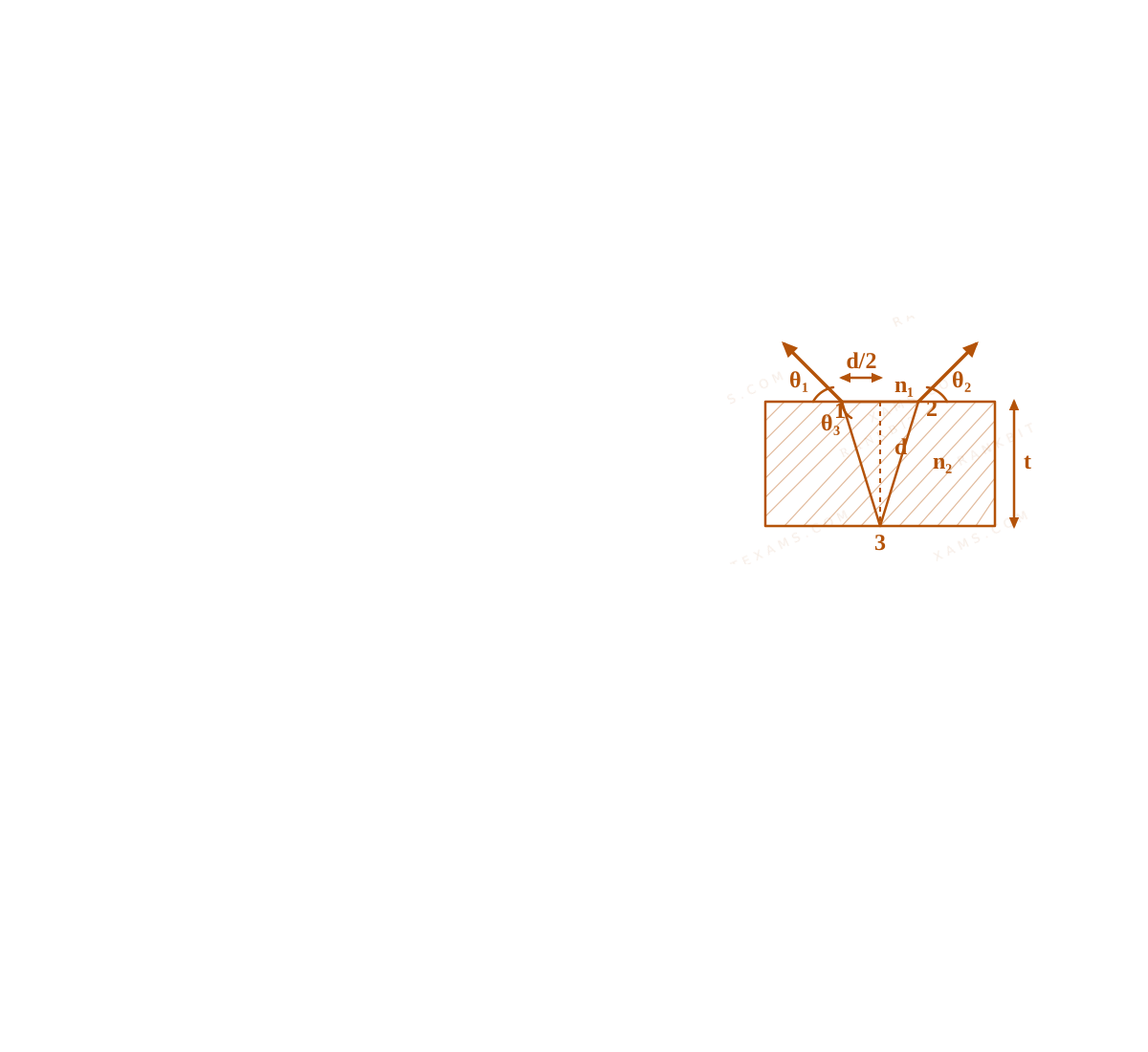
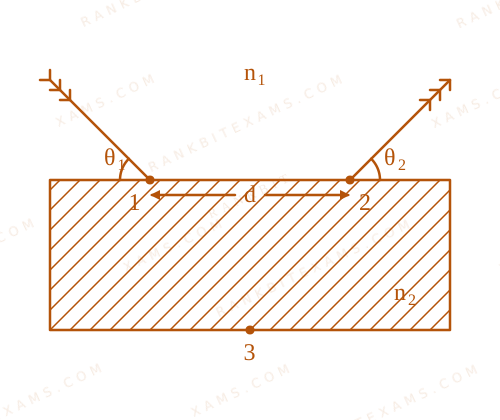
Two light beams fall on a transparent material block at point 1 and 2 with angle theta_1$\theta_{1}$ and theta_2$\theta_{2}$ , respectively, as shown in figure. After refraction, the beams intersect at point 3 which is exactly on the interface at other end of the block. Given: the distance between 1 and 2, d = 4sqrt3 mathrm~cm$d = 4\sqrt{3} \mathrm{~cm}$ and theta_1 = theta_2 = cos^-1left(fracn_22n_1right)$\theta_{1} = \theta_{2} = \cos^{-1}\left(\frac{n_{2}}{2n_{1}}\right)$ , where refractive index of the block n_2 >$n_{2} >$ refractive index of the outside medium n_1$n_{1}$ , then the thickness of the block is ______ cm.
The figure details dual incident light lines penetrating an index slab layer to converge perfectly at a pinpoint terminal base boundary position.
The figure details dual incident light lines penetrating an index slab layer to converge perfectly at a pinpoint terminal base boundary position.
Numerical Answer.Answer: 6 to 6
Solution
### Related Formula
n_1 sin i = n_2 sin r$$n_1 \sin i = n_2 \sin r$$
### Core Logic
The figure details dual incident light lines penetrating an index slab layer to converge perfectly at a pinpoint terminal base boundary position.
By Snell\'s law matching standard boundary normal configurations :
n_1 sin(90^circ - theta_1) = n_2 sin theta_3 implies n_1 cos theta_1 = n_2 sin theta_3$$n_1 \sin(90^{\circ} - \theta_1) = n_2 \sin \theta_3 \implies n_1 \cos \theta_1 = n_2 \sin \theta_3$$ [cite: 711, 712]
Substituting the angle identity macro given [cite: 2, 713]:
n_1 left(fracn_22n_1right) = n_2 sin theta_3 implies sin theta_3 = frac12 implies theta_3 = 30^circ$$n_1 \left(\frac{n_2}{2n_1}\right) = n_2 \sin \theta_3 \implies \sin \theta_3 = \frac{1}{2} \implies \theta_3 = 30^{\circ}$$
### Step 1: Geometrical Thickness Resolution
From the block triangles geometry :
tan 30^circ = fracd/2t implies frac1sqrt3 = fracd2t$$\tan 30^{\circ} = \frac{d/2}{t} \implies \frac{1}{\sqrt{3}} = \frac{d}{2t}$$t = fracdsqrt32 = frac4sqrt3 cdot sqrt32 = 6text cm$$t = \frac{d\sqrt{3}}{2} = \frac{4\sqrt{3} \cdot \sqrt{3}}{2} = 6\text{ cm}$$
### Chapter Mix
Class 12 Physics: Ray Optics and Optical Instruments
Q53jee_main_2024_01_february_morningLenses
The distance between object and its 3 times magnified virtual image as produced by a convex lens is 20mathrm~cm$20\mathrm{~cm}$. The focal length of the lens used is _______ mathrmcm$\mathrm{cm}$.
Numerical Answer.Answer: 15 to 15
Solution
### Related Formula
Lens magnification formula:
m = fracvu$$m = \frac{v}{u}$$
Thin lens equation:
frac1v - frac1u = frac1f$$\frac{1}{v} - \frac{1}{u} = \frac{1}{f}$$
### Core Logic
For a virtual image formed by a convex lens, both the object and the image lie on the same side of the lens. The image distance is three times the object distance:
v = 3u$v = 3u$
The distance between the object and its virtual image is given as 20mathrm~cm$20\mathrm{~cm}$:
v - u = 20mathrm~cm implies 3u - u = 20mathrm~cm$$v - u = 20\mathrm{~cm} \implies 3u - u = 20\mathrm{~cm}$$2u = 20mathrm~cm implies u = 10mathrm~cm$$2u = 20\mathrm{~cm} \implies u = 10\mathrm{~cm}$$
Applying Cartesian sign conventions: object distance u = -10mathrm~cm$u = -10\mathrm{~cm}$ and image distance v = -30mathrm~cm$v = -30\mathrm{~cm}$.
### Step 1: Calculate Focal Length
Substitute these values into the lens formula:
frac1-30 - frac1-10 = frac1f$$\frac{1}{-30} - \frac{1}{-10} = \frac{1}{f}$$-frac130 + frac110 = frac1f$$-\frac{1}{30} + \frac{1}{10} = \frac{1}{f}$$frac-1 + 330 = frac230 = frac115 = frac1f implies f = 15mathrm~cm$$\frac{-1 + 3}{30} = \frac{2}{30} = \frac{1}{15} = \frac{1}{f} \implies f = 15\mathrm{~cm}$$
### Pattern Recognition
A virtual image from a convex lens means the object is placed inside the focal point (u < f$u < f$). This serves as a quick sanity check for your final value (10mathrm~cm < 15mathrm~cm$10\mathrm{~cm} < 15\mathrm{~cm}$). ✓
### Evaluation Rubric / Model Answer
null
### Chapter Mix
Class 12 Physics: Ray Optics and Optical Instruments
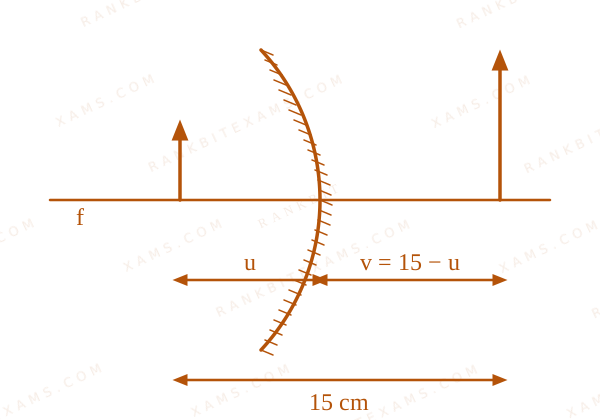
If the distance between object and its two times magnified virtual image produced by a curved mirror is 15text cm$15\text{ cm}$, the focal length of the mirror must be:
A.15text cm$15\text{ cm}$
B.-12text cm$-12\text{ cm}$
C.-10text cm$-10\text{ cm}$
D.10/3text cm$10/3\text{ cm}$
Solution
### Related Formula
Magnification formula for spherical mirrors:
m = -fracvu$$m = -\frac{v}{u}$$
Mirror formula:
frac1f = frac1v + frac1u$$\frac{1}{f} = \frac{1}{v} + \frac{1}{u}$$
where:
* u$u$ is the object distance
* v$v$ is the image distance
* f$f$ is the focal length
### Core Logic
Since the image is magnified (m = 2$m = 2$) and virtual, the mirror must be concave (f < 0$f < 0$).
Let us use standard coordinate geometry signs: object is on the left (u$u$ is negative, say -u_0$-u_0$), virtual image is on the right (v$v$ is positive, say +v_0$+v_0$).
Given magnification:
m = 2 = -fracvu implies v = -2u$$m = 2 = -\frac{v}{u} \implies v = -2u$$
In terms of magnitudes:
v_0 = 2u_0$v_0 = 2u_0$
### Step 1: Use Distance Condition
The distance between the object and virtual image is 15text cm$15\text{ cm}$. Since the object is in front of the mirror and the virtual image is behind it:
textDistance = u_0 + v_0 = 15text cm$$\text{Distance} = u_0 + v_0 = 15\text{ cm}$$
Substitute v_0 = 2u_0$v_0 = 2u_0$:
u_0 + 2u_0 = 15 implies 3u_0 = 15 implies u_0 = 5text cm$$u_0 + 2u_0 = 15 \implies 3u_0 = 15 \implies u_0 = 5\text{ cm}$$
Thus:
* u_0 = 5text cm implies u = -5text cm$u_0 = 5\text{ cm} \implies u = -5\text{ cm}$
* v_0 = 10text cm implies v = +10text cm$v_0 = 10\text{ cm} \implies v = +10\text{ cm}$Ray diagram for virtual image in concave mirror for Q38
### Step 2: Calculate Focal Length
Using the mirror formula:
frac1f = frac1v + frac1u$$\frac{1}{f} = \frac{1}{v} + \frac{1}{u}$$frac1f = frac110 + frac1-5$$\frac{1}{f} = \frac{1}{10} + \frac{1}{-5}$$frac1f = frac1 - 210 = -frac110 implies f = -10text cm$$\frac{1}{f} = \frac{1 - 2}{10} = -\frac{1}{10} \implies f = -10\text{ cm}$$
Thus, the focal length is -10text cm$-10\text{ cm}$.
### Pattern Recognition
Virtual and magnified image → always concave mirror. Distance D$D$ between object and virtual image is given by D = |u| + v$D = |u| + v$. Since v = m|u|$v = m|u|$, we can simplify to |u| = fracDm+1$|u| = \frac{D}{m+1}$.
### Evaluation Rubric / Model Answer
null
### Chapter Mix
Class 12 Physics: Ray Optics and Optical Instruments
Q33jee_main_2024_27_jan_morningPrism Deviation
If the refractive index of the material of a prism is cotleft(fracA2right)$\cot\left(\frac{A}{2}\right)$, where A$A$ is the angle of prism, then the angle of minimum deviation will be:
A.pi - 2A$\pi - 2A$
B.fracpi2 - 2A$\frac{pi}{2} - 2A$
C.pi - A$\pi - A$
D.fracpi2 - A$\frac{pi}{2} - A$
Solution
### Related Formula
mu = fracsinleft(fracA + delta_textmin2right)sinleft(fracA2right)$$\mu = \frac{\sin\left(\frac{A + \delta_{\text{min}}}{2}\right)}{\sin\left(\frac{A}{2}\right)}$$
### Core Logic
Given mu = cotleft(fracA2right) = fraccosleft(fracA2right)sinleft(fracA2right)$\mu = \cot\left(\frac{A}{2}\right) = \frac{\cos\left(\frac{A}{2}\right)}{\sin\left(\frac{A}{2}\right)}$. Equating this to the prism formula:
fraccosleft(fracA2right)sinleft(fracA2right) = fracsinleft(fracA + delta_textmin2right)sinleft(fracA2right)$$\frac{\cos\left(\frac{A}{2}\right)}{\sin\left(\frac{A}{2}\right)} = \frac{\sin\left(\frac{A + \delta_{\text{min}}}{2}\right)}{\sin\left(\frac{A}{2}\right)}$$cosleft(fracA2right) = sinleft(fracA + delta_textmin2right)$$\cos\left(\frac{A}{2}\right) = \sin\left(\frac{A + \delta_{\text{min}}}{2}\right)$$
### Step 1: Trigonometric Substitution
Convert the cosine term to sine:
sinleft(fracpi2 - fracA2right) = sinleft(fracA + delta_textmin2right)$$\sin\left(\frac{\pi}{2} - \frac{A}{2}\right) = \sin\left(\frac{A + \delta_{\text{min}}}{2}\right)$$fracpi2 - fracA2 = fracA + delta_textmin2$$\frac{\pi}{2} - \frac{A}{2} = \frac{A + \delta_{\text{min}}}{2}$$pi - A = A + delta_textmin$$\pi - A = A + \delta_{\text{min}}$$delta_textmin = pi - 2A$$\delta_{\text{min}} = \pi - 2A$$
### Pattern Recognition
When mu$\mu$ equals a cotangent function of half-angle, the sine dynamic simplifications lead directly to linear functions involving complements of angle A$A$.
### Evaluation Rubric / Model Answer
null
### Chapter Mix
Class 12 Physics: Ray Optics and Optical Instruments
Q54jee_main_2024_27_jan_morningApparent Depth
Two immiscible liquids of refractive indicesfrac32$\frac{3}{2}$ and frac85$\frac{8}{5}$ respectively are put in a beaker. The height of each column is 6text cm$6\text{ cm}$. A coin is placed at the bottom of the beaker. For near normal vision, the apparent depth of the coin is fracalpha4text cm$\frac{\alpha}{4}\text{ cm}$. The value of alpha$\alpha$ is ______.
Numerical Answer.Answer: 31 to 31
Solution
### Related Formula
h_textapparent = sum frach_imu_i$$h_{\text{apparent}} = \sum \frac{h_i}{\mu_i}$$
### Core Logic
Sum the contributions of both shifting mediums:
h_textapparent = frach_1mu_1 + frach_2mu_2$$h_{\text{apparent}} = \frac{h_1}{\mu_1} + \frac{h_2}{\mu_2}$$
Given h_1 = h_2 = 6text cm$h_1 = h_2 = 6\text{ cm}$, mu_1 = frac32$\mu_1 = \frac{3}{2}$, mu_2 = frac85$\mu_2 = \frac{8}{5}$:
### Step 1: Compute fraction value
h_textapparent = frac63/2 + frac68/5 = 4 + frac308 = 4 + frac154$$h_{\text{apparent}} = \frac{6}{3/2} + \frac{6}{8/5} = 4 + \frac{30}{8} = 4 + \frac{15}{4}$$h_textapparent = frac16 + 154 = frac314text cm$$h_{\text{apparent}} = \frac{16 + 15}{4} = \frac{31}{4}\text{ cm}$$
### Step 2: Match to target format
Comparing with fracalpha4$\frac{\alpha}{4}$ directly yields:
alpha = 31$\alpha = 31$
### Pattern Recognition
Apparent depth across multi-layered planar mediums expands additively via separate individual medium thickness-to-refractive-index ratios.
### Evaluation Rubric / Model Answer
null
### Chapter Mix
Class 12 Physics: Ray Optics and Optical Instruments
More Ray Optics and Optical Instruments Questions — jee_main_2025_02_april_evening
We Map Every Repeating Question in Competitive Exams.
Say goodbye to generic mock test fatigue. RankBit uses smart analysis to group past exam questions into their foundational Repeating Question Types. Find chapter weightage, track repeating questions, and score higher with targeted practice.
Select Your Target Exam
Choose an exam track below to find formulas per chapter and patterns.
Syncing Exam Intelligence
Mapping formulas and patterns across all tracks…
PATH A — FULL LENGTH PRACTICE
Full Mock Test Hub
Simulate real NTA exam conditions with fully tracked mocks. Time yourself against past papers.
Practice past-year questions one chapter at a time. Pick an exam → subject → chapter and get every PYQ for that topic — pulled together from all past papers — with the chapter's key formulas alongside.
.svg "refraction path, snell law block, thickness geometry")