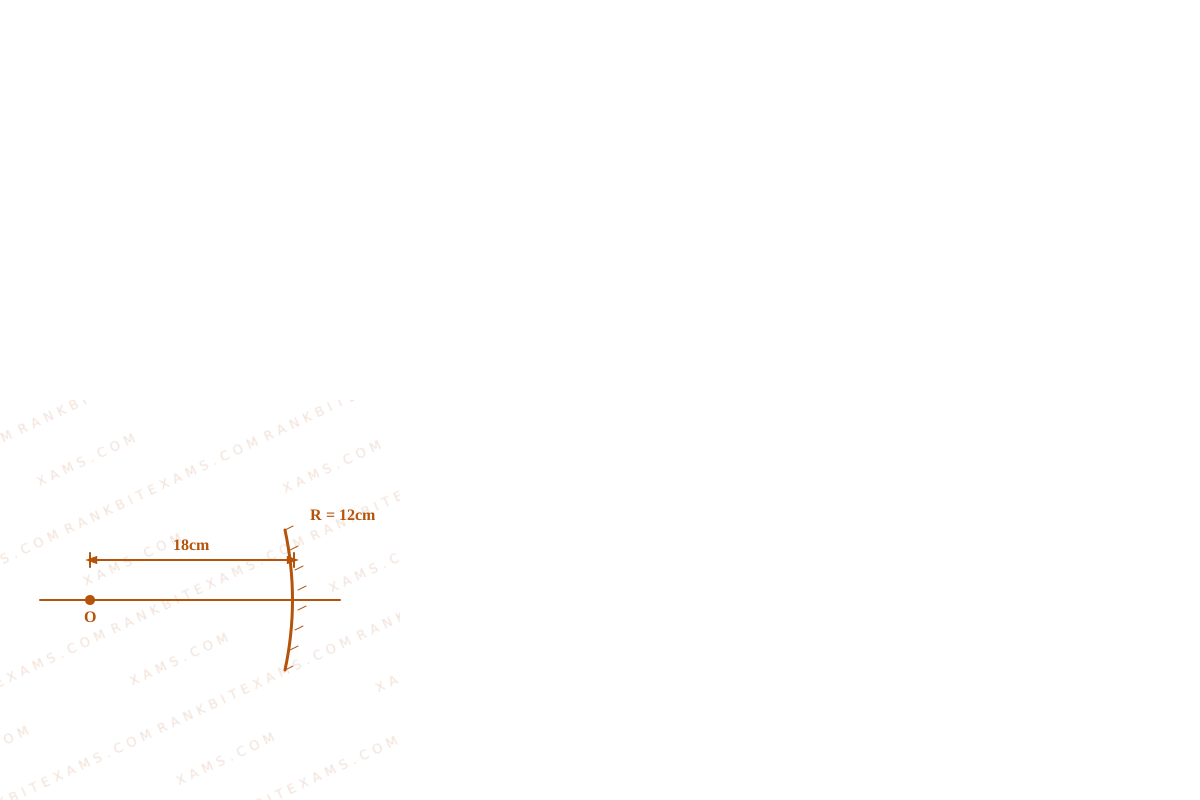
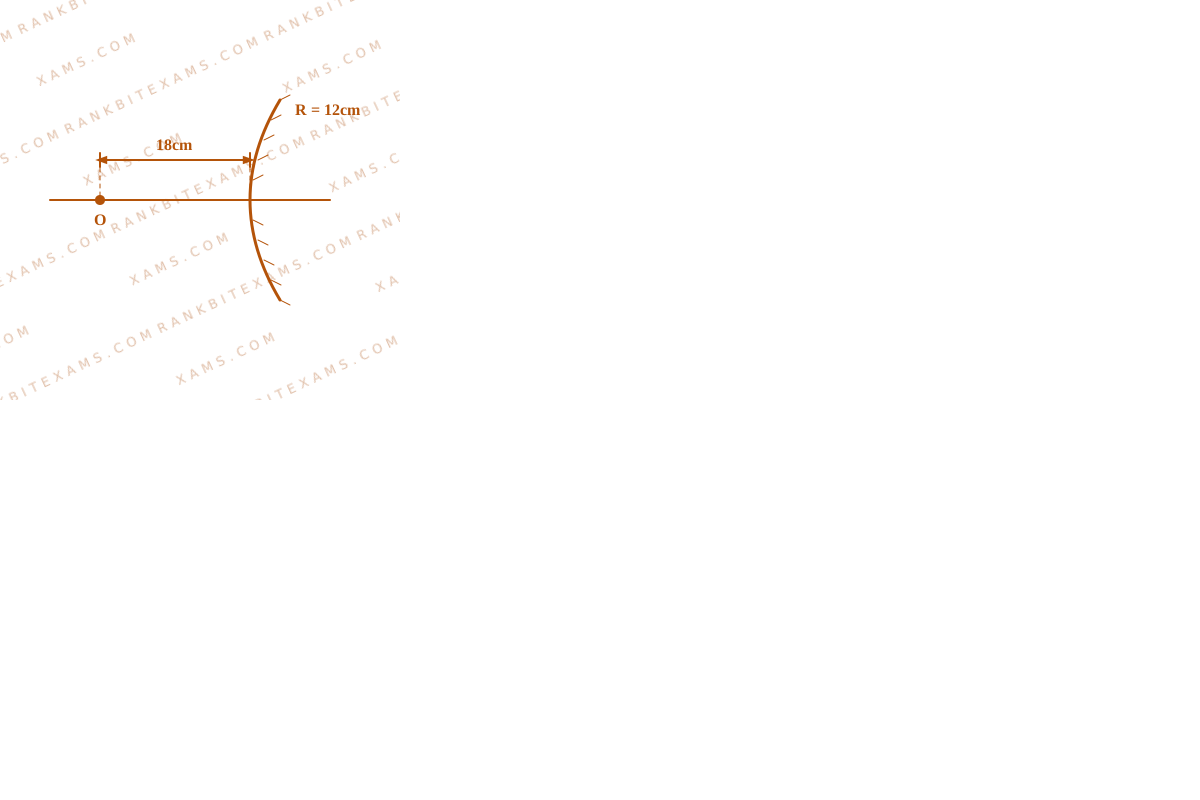
Two identical objects are placed in front of convex mirror and concave mirror having same radii of curvature of 12 \, textcm , at the same distance of 18 \, textcm from the respective mirrors. The ratio of sizes of the images formed by convex mirror and by concave mirror is:

Solution & Explanation

### Related Formula 1. Mirror focal length: f = fracR2 2. Magnification (image size relative to object size): m = frach_ih_o = fracff - u where u is the object distance. ### Core Logic Given parameters: - Radius of curvature R = 12 \ mathrmcm implies |f| = 6 \ mathrmcm - Object distance u = -18 \ mathrmcm Let's calculate magnification for both mirrors: 1. **For Convex Mirror:** - Focal length f_textconvex = +6 \ mathrmcm (using Cartesian sign convention) - Magnification: m_1 = fracf_textconvexf_textconvex - u = frac66 - (-18) = frac624 = frac14 Thus, image size is frac14 h_o. ### Step 1: Calculate magnification of concave mirror 2. **For Concave Mirror:** - Focal length f_textconcave = -6 \ mathrmcm - Magnification:
Convex and concave mirror ray diagram representations
m_2 = fracf_textconcavef_textconcave - u = frac-6-6 - (-18) = frac-612 = -frac12 Thus, image size is frac12 h_o. ### Step 2: Calculate the ratio of image sizes Since the objects are identical (same height h_o), the ratio of the sizes of the images is:
Convex and concave mirror ray diagram representations
textRatio = frac|h_i1||h_i2| = frac|m_1||m_2| = frac1/41/2 = frac12 Thus, the ratio of sizes is 1/2. ### Pattern Recognition Sees: Parallel convex vs concave mirror magnification. Trap: Reversing the signs of focal lengths (Convex focal length is +, Concave is - in standard coordinate systems). Shortcut: Use direct magnification equation m = fracff-u. For convex, m = frac624 = frac14. For concave, m = frac-612 = -frac12. Ratio of absolute values is frac1/41/2 = 1/2. ### Evaluation Rubric / Model Answer null ### Chapter Mix Class 12 Physics: Ray Optics and Optical Instruments

More Ray Optics and Optical Instruments Previous-Year Questions — Page 10

Q34 jee_main_2024_31_jan_morning Prism Deviation
The refractive index of a prism with apex angle A is cot(A/2). The angle of minimum deviation is :
  • A. delta_mathrmm = 180^circ - A
  • B. delta_mathrmm = 180^circ - 3A
  • C. delta_mathrmm = 180^circ - 4A
  • D. delta_mathrmm = 180^circ - 2A

Solution

### Related Formula mu = fracsinleft(fracA + delta_m2right)sinleft(fracA2right) ### Core Logic Given that the refractive index mu = cotleft(fracA2right). Substituting this into the prism formula: cotleft(fracA2right) = fracsinleft(fracA + delta_m2right)sinleft(fracA2right) fraccosleft(fracA2right)sinleft(fracA2right) = fracsinleft(fracA + delta_m2right)sinleft(fracA2right) Equating the numerators: cosleft(fracA2right) = sinleft(fracA + delta_m2right) We can rewrite cosine in terms of sine: sinleft(fracpi2 - fracA2right) = sinleft(fracA + delta_m2right) ### Step 2: Solve for Deviation Comparing the angles inside the sine functions: fracpi2 - fracA2 = fracA2 + fracdelta_m2 Multiply the entire equation by 2: pi - A = A + delta_m delta_m = pi - 2A Converting radians to degrees: delta_m = 180^circ - 2A ### Pattern Recognition Whenever refractive index mu = cot(A/2), the relation sin(90^circ - A/2) strictly matches the prism sine equation, meaning minimum deviation delta_m is always 180^circ - 2A. ### Evaluation Rubric / Model Answer null ### Chapter Mix Class 12 Physics: Ray Optics And Optical Instruments

More Ray Optics and Optical Instruments Questions — jee_main_2025_02_april_evening

Practice all Ray Optics and Optical Instruments previous-year questions →

Rankbit System
JEE Physics: Waves (+15.5%) | Electrostatics: Concentric Shells (-29.7%) | Modern Physics: Photoelectric Clones (+34.2%) | Mathematics: Definite Integrals (+18.1%) | Chemistry: Coordination Splitting (-11.4%) | JEE Physics: Waves (+15.5%) | Electrostatics: Concentric Shells (-29.7%) | Modern Physics: Photoelectric Clones (+34.2%) | Mathematics: Definite Integrals (+18.1%) | Chemistry: Coordination Splitting (-11.4%)