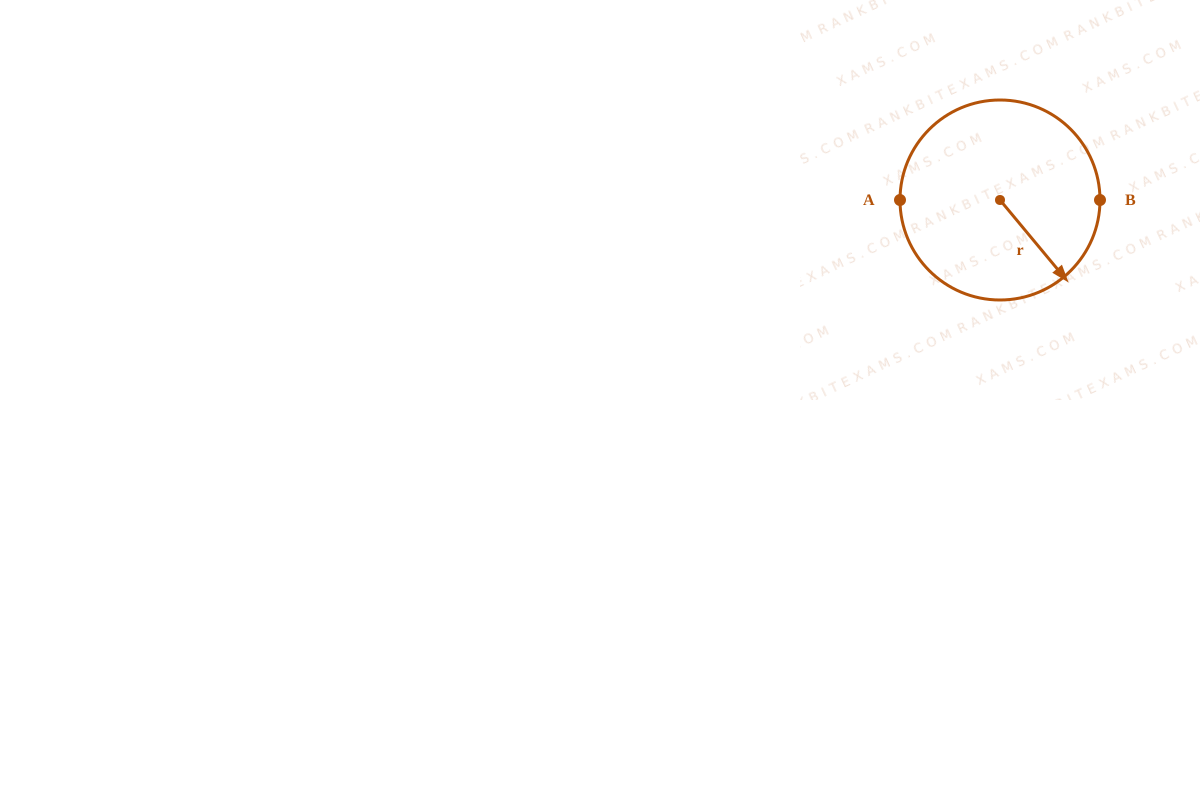
A sportsman runs around a circular track of radius r such that he traverses the path ABAB. The distance travelled and displacement, respectively, are
sportsman running along a circular track showing points A and B at opposite ends of a diameter
The diagram displays a circular track of radius r with diametrically opposite points A and B.

Solution & Explanation

### Related Formula 1. Distance: Total actual path length covered. 2. Displacement: Shortest straight-line distance connecting the initial and final position. 3. Circumference of a complete circle = 2pi r 4. Semicircular arc length = pi r ### Core Logic The trajectory is defined by the sequence of points A to B to A to B: 1. **Distance Travelled:** - Segment 1 (A to B): Semicircular path of length pi r - Segment 2 (B to A): Semicircular path of length pi r - Segment 3 (A to B): Semicircular path of length pi r - Total distance: textDistance = pi r + pi r + pi r = 3pi r 2. **Displacement:** - Initial position: A - Final position: B - Since points A and B represent diametrically opposite positions on the circle, the shortest distance between them is equal to the diameter of the circle: textDisplacement = 2r ### Step 1: Write result The actual distance travelled is 3pi r and the magnitude of displacement is 2r. ### Pattern Recognition Sees: Circular kinematics path tracing. Trap: Accidentally substituting straight chords for the distance arcs, or assuming the loop returns fully to A (which would yield a zero displacement). Shortcut: The path ends at B. Since 3 half-loops are made, distance = 3 times pi r = 3pi r. The direct path from start A to end B is just the diameter 2r. ### Evaluation Rubric / Model Answer null ### Chapter Mix Class 11 Physics: Motion in a Straight Line

Reference Study Guides

More Motion in a Straight Line Previous-Year Questions — Page 2

Q47 jee_main_2024_29_january_evening Kinematics of Linear Motion
A particle is moving in a straight line. The variation of position x as a function of time t is given as x = (t^3 - 6t^2 + 20t + 15)text m. The velocity of the body when its acceleration becomes zero is:
  • A. 4text m/s
  • B. 8text m/s
  • C. 10text m/s
  • D. 6text m/s

Solution

### Related Formula The relationship between position x, velocity v, and acceleration a is given by differentiation with respect to time t: v = fracdxdt a = fracdvdt ### Core Logic Given position: x = t^3 - 6t^2 + 20t + 15 Differentiating once to find velocity v: v = fracdxdt = 3t^2 - 12t + 20 Differentiating again to find acceleration a: a = fracdvdt = 6t - 12 ### Step 1: Determine Time when Acceleration is Zero Set the acceleration to zero: a = 0 implies 6t - 12 = 0 implies t = 2text seconds So, the acceleration becomes zero at t = 2text s. ### Step 2: Calculate Velocity at this Time Substitute t = 2text s into the velocity equation: v = 3(2)^2 - 12(2) + 20 v = 3(4) - 24 + 20 v = 12 - 24 + 20 = 8text m/s Thus, the velocity is 8text m/s. ### Pattern Recognition Sees: displacement function of degree 3 → acceleration is linear in time. The zero of a linear function of form At - B = 0 is easily calculated, and substituting back resolves to a basic quadratic. ### Evaluation Rubric / Model Answer null ### Chapter Mix Class 11 Physics: Motion in a Straight Line
Q36 jee_main_2024_29_jan_morning Kinematics Equations
A body starts moving from rest with constant acceleration covers displacement S_1 in first (p - 1) seconds and S_2 in first p seconds. The displacement S_1 + S_2 will be made in time:
  • A. (2 p + 1) mathrm~s
  • B. sqrt(2p^2 - 2p + 1) mathrm~s
  • C. (2p - 1) mathrm~s
  • D. (2p^2 - 2p + 1) mathrm~s

Solution

### Related Formula For a body starting from rest (u = 0) with constant acceleration a, displacement S in time t is: S = frac12 a t^2 ### Core Logic Let the constant acceleration be a. * Displacement S_1 covered in the first (p - 1) seconds: S_1 = frac12 a (p - 1)^2 * Displacement S_2 covered in the first p seconds: S_2 = frac12 a p^2 ### Step 1: Express Net Displacement Let the time taken to achieve a displacement of S_1 + S_2 be t. S_1 + S_2 = frac12 a t^2 Substituting the expressions of S_1 and S_2: frac12 a (p - 1)^2 + frac12 a p^2 = frac12 a t^2 ### Step 2: Solve for Time Dividing the entire equation by frac12a: (p - 1)^2 + p^2 = t^2 p^2 - 2p + 1 + p^2 = t^2 t^2 = 2p^2 - 2p + 1 t = sqrt2p^2 - 2p + 1 mathrm~s ### Pattern Recognition When dealing with equations of motion from rest, notice that displacement scales quadratically with time (S propto t^2). This means if displacement sums up (S_t = S_1 + S_2), the corresponding times will add in quadrature: t = sqrtt_1^2 + t_2^2. ### Evaluation Rubric / Model Answer null ### Chapter Mix Class 11 Physics: Motion in a Straight Line
Q56 jee_main_2024_30_jan_morning Equations of Motion
The displacement and the increase in the velocity of a moving particle in the time interval of t to (t + 1) mathrm~s are 125 mathrm~m and 50 mathrm~m / s, respectively. The distance travelled by the particle in (t + 2)^mathrmth mathrm~s is \_ \_ \_ \_ \_ mathrmm.
Numerical Answer. Answer: 175 to 175

Solution

### Related Formula v = u + at s = ut + frac12at^2 S_n^textth = u + fraca2(2n - 1) ### Core Logic Let the velocity at time t be u. The time interval Delta t = (t+1) - t = 1 mathrm~s. The increase in velocity over 1 second is exactly the acceleration a. The displacement in that 1-second interval acts as the (t+1)^textth second displacement equation. ### Step 1: Determine Acceleration Increase in velocity Delta v = 50 mathrm~m/s in 1 mathrm~s. v = u + at u + 50 = u + a(1) Rightarrow a = 50 mathrm~m/s^2 ### Step 2: Determine Velocity 'u' at time t Displacement in the 1-second interval from t to t+1 is 125 mathrm~m. Using s = ut' + frac12at'^2 where t' = 1 mathrm~s: 125 = u(1) + frac12a(1)^2 125 = u + frac502 125 = u + 25 Rightarrow u = 100 mathrm~m/s ### Step 3: Distance in the next second We need the distance travelled in the (t+2)^textth second, which corresponds to the 1-second interval starting with an initial velocity equal to the velocity at t+1. Alternatively, we can use the n^textth second formula directly by re-indexing. The velocity at start of this interval is u_new = u + a = 100 + 50 = 150 mathrm~m/s. Distance S_1textst using new parameters: s = 150(1) + frac12(50)(1)^2 = 150 + 25 = 175 mathrm~m Or using PDF logic from base u with n=2 (since n=1 was t+1^textth): S_2^textnd = u + fraca2[2n - 1] = 100 + 25[4 - 1] = 100 + 75 = 175 mathrm~m ### Pattern Recognition For 1-second interval mechanics, Delta v directly yields a. The displacement equation simplifies gracefully to s = u_start + a/2. ### Evaluation Rubric / Model Answer null ### Chapter Mix Class 11 Physics: Motion in a Straight Line

More Motion in a Straight Line Questions — jee_main_2025_02_april_evening

Practice all Motion in a Straight Line previous-year questions →

Rankbit System
JEE Physics: Waves (+15.5%) | Electrostatics: Concentric Shells (-29.7%) | Modern Physics: Photoelectric Clones (+34.2%) | Mathematics: Definite Integrals (+18.1%) | Chemistry: Coordination Splitting (-11.4%) | JEE Physics: Waves (+15.5%) | Electrostatics: Concentric Shells (-29.7%) | Modern Physics: Photoelectric Clones (+34.2%) | Mathematics: Definite Integrals (+18.1%) | Chemistry: Coordination Splitting (-11.4%)