Let (a, b)$(a, b)$ be the point of intersection of the curve x^2 = 2y$x^2 = 2y$ and the straight line y - 2x - 6 = 0$y - 2x - 6 = 0$ in the second quadrant. Then the integral I = int_a^b frac9x^21 + 5^x \, dx$I = \int_{a}^{b} \frac{9x^2}{1 + 5^x} \, dx$ is equal to:
A.24
B.27
C.18
D.21
Solution & Explanation
### Related Formula
textKing's Property: int_a^b f(x) dx = int_a^b f(a+b-x) dx$$\text{King's Property: } \int_{a}^{b} f(x) dx = \int_{a}^{b} f(a+b-x) dx$$
### Core Logic
First, we find the coordinates of intersection in the second quadrant to determine the integration limits a$a$ and b$b$.
### Step 1: Find points of intersection
Substitute y = fracx^22$y = \frac{x^2}{2}$ into the line equation y - 2x - 6 = 0$y - 2x - 6 = 0$:
fracx^22 - 2x - 6 = 0 implies x^2 - 4x - 12 = 0$$\frac{x^2}{2} - 2x - 6 = 0 \implies x^2 - 4x - 12 = 0$$(x - 6)(x + 2) = 0 implies x = 6 quad textor quad x = -2$$(x - 6)(x + 2) = 0 \implies x = 6 \quad \text{or} \quad x = -2$$
Since the point (a, b)$(a, b)$ lies in the second quadrant, x$x$ must be negative:
a = -2$a = -2$b = 2(a) + 6 = 2(-2) + 6 = 2$$b = 2(a) + 6 = 2(-2) + 6 = 2$$
Thus, the integration limits are a = -2$a = -2$ and b = 2$b = 2$.
### Step 2: Solve the Integral using King's Property
The integral is:
I = int_-2^2 frac9x^21 + 5^x dx quad text--- (1)$$I = \int_{-2}^{2} \frac{9x^2}{1 + 5^x} dx \quad \text{--- (1)}$$
Apply King's property, substituting x to -x$x \to -x$ (since -2 + 2 - x = -x$-2 + 2 - x = -x$):
I = int_-2^2 frac9(-x)^21 + 5^-x dx = int_-2^2 frac9x^2 cdot 5^x1 + 5^x dx quad text--- (2)$$I = \int_{-2}^{2} \frac{9(-x)^2}{1 + 5^{-x}} dx = \int_{-2}^{2} \frac{9x^2 \cdot 5^x}{1 + 5^x} dx \quad \text{--- (2)}$$
Adding equations (1) and (2):
2I = int_-2^2 9x^2 left( frac1 + 5^x1 + 5^x right) dx = int_-2^2 9x^2 dx$$2I = \int_{-2}^{2} 9x^2 \left( \frac{1 + 5^x}{1 + 5^x} \right) dx = \int_{-2}^{2} 9x^2 dx$$
Since 9x^2$9x^2$ is an even function:
2I = 2 int_0^2 9x^2 dx implies I = left[ 3x^3 right]_0^2 = 3(8) - 0 = 24$$2I = 2 \int_{0}^{2} 9x^2 dx \implies I = \left[ 3x^3 \right]_{0}^{2} = 3(8) - 0 = 24$$
### Pattern Recognition
Whenever you see an exponential denominator like 1 + c^x$1 + c^x$ inside a symmetric interval definite integral [-a, a]$[-a, a]$, applying King's property will almost always cancel the exponential factor cleanly when the remaining numerator is even.
### Evaluation Rubric / Model Answer
null
### Chapter Mix
Class 12 Mathematics: Integral Calculus
Keywords:#definite integral King property#JEE Main 2025 Evening Q57#even function integration symmetric#parabola line intersection points
More Integral Calculus Previous-Year Questions — Page 5
Let f:mathbbR to mathbbR$f:\mathbb{R} \to \mathbb{R}$ be a function defined f(x) = fracx(1 + x^4)^1/4$f(x) = \frac{x}{(1 + x^4)^{1/4}}$ and g(x) = f(f(f(f(x))))$g(x) = f(f(f(f(x))))$. Then 18int_0^sqrt2sqrt5 x^2 g(x) dx$18\int_{0}^{\sqrt{2\sqrt{5}}} x^2 g(x) dx$ is
A.33$33$
B.36$36$
C.42$42$
D.39$39$
Solution
### Related Formula
textComposite sequence relation: f^n(x) = fracx(1 + n x^4)^1/4$$\text{Composite sequence relation: } f^n(x) = \frac{x}{(1 + n x^4)^{1/4}}$$
### Core Logic
Evaluate the composition function step-by-step:
f(f(x)) = fracf(x)(1 + f(x)^4)^1/4 = fracfracx(1+x^4)^1/4left(1 + fracx^41+x^4right)^1/4 = fracx(1 + 2x^4)^1/4$$f(f(x)) = \frac{f(x)}{(1 + f(x)^4)^{1/4}} = \frac{\frac{x}{(1+x^4)^{1/4}}}{\left(1 + \frac{x^4}{1+x^4}\right)^{1/4}} = \frac{x}{(1 + 2x^4)^{1/4}}$$
Continuing this pattern n$n$ times yields:
f^n(x) = fracx(1 + nx^4)^1/4$$f^n(x) = \frac{x}{(1 + nx^4)^{1/4}}$$
Thus, g(x) = f(f(f(f(x)))) = f^4(x) = fracx(1 + 4x^4)^1/4$g(x) = f(f(f(f(x)))) = f^4(x) = \frac{x}{(1 + 4x^4)^{1/4}}$.
### Step 1: Setting up the Integral
The required integral is:
I = 18int_0^sqrt2sqrt5 fracx^3(1 + 4x^4)^1/4 dx$$I = 18\int_{0}^{\sqrt{2\sqrt{5}}} \frac{x^3}{(1 + 4x^4)^{1/4}} dx$$
We use substitution to solve this. Let 1 + 4x^4 = t^4$1 + 4x^4 = t^4$.
Differentiating gives:
16x^3 dx = 4t^3 dt Rightarrow x^3 dx = frac14 t^3 dt$$16x^3 dx = 4t^3 dt \Rightarrow x^3 dx = \frac{1}{4} t^3 dt$$
### Step 2: Modifying limits and Solving
Change limits:
When x = 0$x = 0$, 1 + 0 = t^4 Rightarrow t = 1$1 + 0 = t^4 \Rightarrow t = 1$.
When x = (2sqrt5)^1/2$x = (2\sqrt{5})^{1/2}$, x^4 = (2sqrt5)^2 = 20$x^4 = (2\sqrt{5})^2 = 20$.
Then 1 + 4(20) = 81 = t^4 Rightarrow t = 3$1 + 4(20) = 81 = t^4 \Rightarrow t = 3$.
Substitute into the integral:
I = 18 int_1^3 fracfrac14 t^3 dtt$$I = 18 \int_{1}^{3} \frac{\frac{1}{4} t^3 dt}{t}$$I = frac184 int_1^3 t^2 dt = frac92 left[ fract^33 right]_1^3$$I = \frac{18}{4} \int_{1}^{3} t^2 dt = \frac{9}{2} \left[ \frac{t^3}{3} \right]_1^3$$I = frac92 cdot frac13 [t^3]_1^3 = frac32 (27 - 1) = frac32 (26) = 39$$I = \frac{9}{2} \cdot \frac{1}{3} [t^3]_1^3 = \frac{3}{2} (27 - 1) = \frac{3}{2} (26) = 39$$
### Pattern Recognition
Repeated compositions of x(1+cx^k)^-1/k$x(1+cx^k)^{-1/k}$ follow a strict linearity in the coefficient of x^k$x^k$. Here, 4 compositions cleanly changed the x^4$x^4$ coefficient from 1 to 4, preparing a perfect variable substitution.
### Evaluation Rubric / Model Answer
null
### Chapter Mix
Class 11 Maths: Functions
Class 12 Maths: Integral Calculus
Q29jee_main_2024_30_january_eveningArea Under Curve
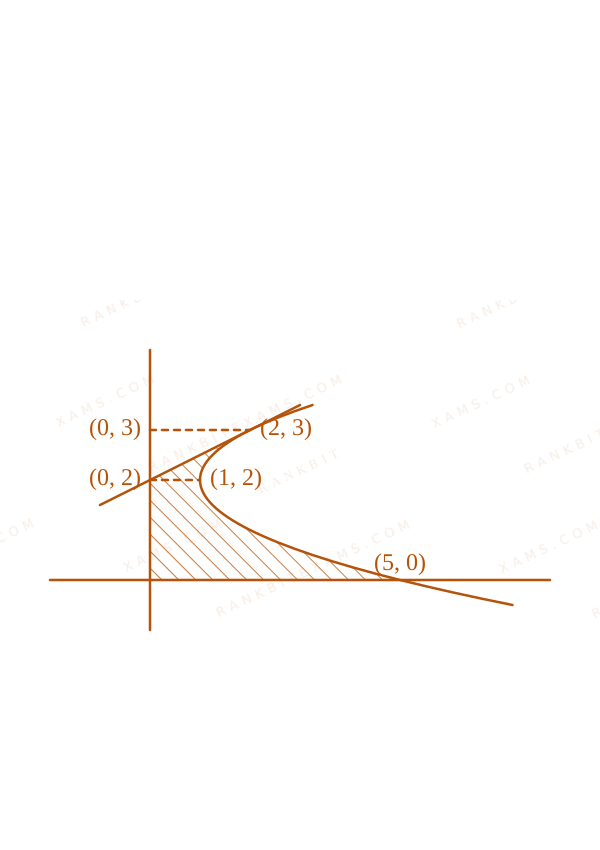
The area of the region enclosed by the parabola (y - 2)^2 = x - 1$(y - 2)^2 = x - 1$ , the line x - 2y + 4 = 0$x - 2y + 4 = 0$ and the positive coordinate axes is
Numerical Answer.Answer: 5 to 5
Solution
### Related Formula
textArea enclosed integrating w.r.t y-axis: int (x_textright - x_textleft) dy$$\text{Area enclosed integrating w.r.t y-axis: } \int (x_{\text{right}} - x_{\text{left}}) dy$$
### Core Logic
Find intersection points between the parabola x = (y-2)^2 + 1$x = (y-2)^2 + 1$ and the line x = 2y - 4$x = 2y - 4$.
Set them equal:
(y-2)^2 + 1 = 2y - 4$$(y-2)^2 + 1 = 2y - 4$$y^2 - 4y + 4 + 1 = 2y - 4$$y^2 - 4y + 4 + 1 = 2y - 4$$y^2 - 6y + 9 = 0 Rightarrow (y-3)^2 = 0$$y^2 - 6y + 9 = 0 \Rightarrow (y-3)^2 = 0$$
The line is tangent to the parabola at y = 3$y = 3$. At y = 3$y = 3$, x = 2(3) - 4 = 2$x = 2(3) - 4 = 2$.
We need the area enclosed by the parabola, the line, and the *positive coordinate axes*.
Let's trace the boundary intercepts.
The line x = 2y - 4$x = 2y - 4$ cuts the y-axis (x=0$x=0$) at y=2$y=2$.
Parabola vertex is at (1, 2)$(1, 2)$. Parabola cuts y-axis (x=0$x=0$) at (y-2)^2 = -1$(y-2)^2 = -1$ (No real y-intercept).
So the curve (y-2)^2 = x-1$(y-2)^2 = x-1$ only exists for x ge 1$x \ge 1$.
### Step 1: Setting up the Integral w.r.t y
Area Under Curve diagram for Q29 - JEE Main 2024 Evening
Because the area is bound by the positive coordinate axes, we track integration strictly in the first quadrant.
The required area is the area between the y-axis, the x-axis, the line, and the curve. Wait, the problem says "area enclosed by the parabola... line... and positive coordinate axes".
Let's integrate with respect to y$y$.
The boundary curves are x = (y-2)^2 + 1$x = (y-2)^2 + 1$ (which forms the rightmost boundary) and the axes.
The area bounded by the curve with y-axis is from y=0$y=0$ to y=3$y=3$ minus the triangular region cut by the line below y=2$y=2$.
The line intersects the x-axis (y=0$y=0$) at x=-4$x=-4$ and y-axis (x=0$x=0$) at y=2$y=2$.
The positive coordinate axes enforce boundaries at x ge 0, y ge 0$x \ge 0, y \ge 0$.
So the exact area is the integral of the parabola's x$x$-value from y=0$y=0$ to y=3$y=3$, minus the area of the small triangle outside the region bounded by the line x=2y-4$x=2y-4$ and the axes in the positive quadrant.
The area under the parabola (to the left towards the y-axis) from y=0$y=0$ to y=3$y=3$ is int_0^3 x_textparabola dy$\int_0^3 x_{\text{parabola}} dy$.
The line bounds the region on the left from y=2$y=2$ to y=3$y=3$. Between y=0$y=0$ and y=2$y=2$, the area goes fully to the y-axis.
So, area = int_0^3 x_textparabola dy - textArea of Delta text bounded by line and y-axis$\int_0^3 x_{\text{parabola}} dy - \text{Area of } \Delta \text{ bounded by line and y-axis}$.
The triangle bounded by x=2y-4, x=0, y=2, y=3$x=2y-4, x=0, y=2, y=3$ is: base is x=2(3)-4 = 2$x=2(3)-4 = 2$ at y=3$y=3$, height is 1$1$ (from y=2$y=2$ to y=3$y=3$). Triangle area = frac12 times 2 times 1 = 1$\frac{1}{2} \times 2 \times 1 = 1$.
Hence, Enclosed Area = int_0^3 ((y-2)^2 + 1) dy - 1$\int_{0}^{3} ((y-2)^2 + 1) dy - 1$.
### Step 2: Evaluating the Integral
textArea = int_0^3 (y^2 - 4y + 5) dy - 1$$\text{Area} = \int_{0}^{3} (y^2 - 4y + 5) dy - 1$$= left[ fracy^33 - 2y^2 + 5y right]_0^3 - 1$$= \left[ \frac{y^3}{3} - 2y^2 + 5y \right]_0^3 - 1$$= left( frac273 - 2(9) + 5(3) right) - 0 - 1$$= \left( \frac{27}{3} - 2(9) + 5(3) \right) - 0 - 1$$= (9 - 18 + 15) - 1 = 6 - 1 = 5$$= (9 - 18 + 15) - 1 = 6 - 1 = 5$$
### Pattern Recognition
Instead of evaluating horizontal strips with a broken left-bound, evaluate the total area mapped to the y-axis int_0^3 x dy$\int_0^3 x dy$ and simply subtract the basic geometric triangle removed by the straight line.
### Evaluation Rubric / Model Answer
null
### Chapter Mix
Class 12 Maths: Integral Calculus
Q6jee_main_2024_30_jan_morningDefinite Integral as Limit of a Sum
The value of lim_nto inftysum_k = 1^nfracn^3(n^2 + k^2)(n^2 + 3k^2)$\lim_{n\to \infty}\sum_{k = 1}^{n}\frac{n^3}{(n^2 + k^2)(n^2 + 3k^2)}$ is:
### Related Formula
lim_n to infty frac1n sum_k=1^n fleft(fracknright) = int_0^1 f(x) dx$$\lim_{n \to \infty} \frac{1}{n} \sum_{k=1}^n f\left(\frac{k}{n}\right) = \int_0^1 f(x) dx$$
### Core Logic
Rewrite the series by extracting n^4$n^4$ from the denominator:
L = lim_nto inftysum_k = 1^nfracn^3n^4left(1 + frack^2n^2right)left(1 + frac3k^2n^2right)$$L = \lim_{n\to \infty}\sum_{k = 1}^{n}\frac{n^3}{n^4\left(1 + \frac{k^2}{n^2}\right)\left(1 + \frac{3k^2}{n^2}\right)}$$L = lim_n rightarrow infty frac1n sum_k = 1^n frac1left(1 + frack^2n^2right)left(1 + frac3k^2n^2right)$$L = \lim_{n \rightarrow \infty} \frac{1}{n} \sum_{k = 1}^{n} \frac{1}{\left(1 + \frac{k^2}{n^2}\right)\left(1 + \frac{3k^2}{n^2}\right)}$$
Using the limit of a sum, we convert this to a definite integral by substituting x = frackn$x = \frac{k}{n}$ and dx = frac1n$dx = \frac{1}{n}$:
I = int_0^1 fracdx(1 + x^2)(1 + 3x^2)$$I = \int_{0}^{1} \frac{dx}{(1 + x^2)(1 + 3x^2)}$$
### Step 1: Partial Fractions
To integrate, we split the integrand using partial fractions. Notice that:
frac1(1+x^2)(1+3x^2) = fracA1+x^2 + fracB1+3x^2$$\frac{1}{(1+x^2)(1+3x^2)} = \frac{A}{1+x^2} + \frac{B}{1+3x^2}$$
Let x^2 = t$x^2 = t$. Then frac1(1+t)(1+3t) = fracA1+t + fracB1+3t$\frac{1}{(1+t)(1+3t)} = \frac{A}{1+t} + \frac{B}{1+3t}$.
1 = A(1+3t) + B(1+t)$$1 = A(1+3t) + B(1+t)$$
If t = -1$t = -1$, 1 = A(-2) Rightarrow A = -frac12$1 = A(-2) \Rightarrow A = -\frac{1}{2}$.
If t = -1/3$t = -1/3$, 1 = B(2/3) Rightarrow B = frac32$1 = B(2/3) \Rightarrow B = \frac{3}{2}$.
So,
frac1(1+x^2)(1+3x^2) = frac3/21+3x^2 - frac1/21+x^2$$\frac{1}{(1+x^2)(1+3x^2)} = \frac{3/2}{1+3x^2} - \frac{1/2}{1+x^2}$$
Alternatively, as formatted in the solution:
I = int_0^1 fracdx3(1 + x^2)left(frac13 + x^2right)$$I = \int_{0}^{1} \frac{dx}{3(1 + x^2)\left(\frac{1}{3} + x^2\right)}$$= int_0^1 frac13 times frac32 frac(x^2 + 1) - left(x^2 + frac13right)(1 + x^2)left(x^2 + frac13right) dx$$= \int_{0}^{1} \frac{1}{3} \times \frac{3}{2} \frac{(x^2 + 1) - \left(x^2 + \frac{1}{3}\right)}{(1 + x^2)\left(x^2 + \frac{1}{3}\right)} dx$$= frac12 int_0^1 left[ frac1x^2 + left(frac1sqrt3right)^2 - frac11 + x^2 right] dx$$= \frac{1}{2} \int_{0}^{1} \left[ \frac{1}{x^2 + \left(\frac{1}{\sqrt{3}}\right)^2} - \frac{1}{1 + x^2} \right] dx$$
### Step 2: Integration
Integrating both terms:
= frac12 left[ sqrt3 tan^-1 (sqrt3 x) right]_0^1 - frac12 left( tan^-1 x right)_0^1$$= \frac{1}{2} \left[ \sqrt{3} \tan^{-1} (\sqrt{3} x) \right]_{0}^{1} - \frac{1}{2} \left( \tan^{-1} x \right)_{0}^{1}$$
Evaluating the limits:
= fracsqrt32 left(fracpi3right) - frac12 left(fracpi4right)$$= \frac{\sqrt{3}}{2} \left(\frac{\pi}{3}\right) - \frac{1}{2} \left(\frac{\pi}{4}\right)$$= fracpi2 sqrt3 - fracpi8$$= \frac{\pi}{2 \sqrt{3}} - \frac{\pi}{8}$$= frac4pi - sqrt3pi8sqrt3 = fracpi(4 - sqrt3)8sqrt3$$= \frac{4\pi - \sqrt{3}\pi}{8\sqrt{3}} = \frac{\pi(4 - \sqrt{3})}{8\sqrt{3}}$$
Rationalizing and finding the common denominator to match options:
= frac13 pi8(4 sqrt3 + 3)$$= \frac{13 \pi}{8(4 \sqrt{3} + 3)}$$
(Note: Multiply numerator and denominator by (4sqrt3+3)$(4\sqrt{3}+3)$. Numerator becomes pi(4-sqrt3)(4sqrt3+3) = pi(16sqrt3 + 12 - 12 - 3sqrt3) = 13pisqrt3$\pi(4-\sqrt{3})(4\sqrt{3}+3) = \pi(16\sqrt{3} + 12 - 12 - 3\sqrt{3}) = 13\pi\sqrt{3}$. Wait, let's verify:
fracpi2sqrt3 - fracpi8 = fracpi(4-sqrt3)8sqrt3$\frac{\pi}{2\sqrt{3}} - \frac{\pi}{8} = \frac{\pi(4-\sqrt{3})}{8\sqrt{3}}$. Let's rationalize the denominator in the given option frac13pi8(4sqrt3+3) = frac13pi(4sqrt3-3)8(48-9) = frac13pi(4sqrt3-3)8(39) = fracpi(4sqrt3-3)24 = frac4sqrt3pi24 - frac3pi24 = fracpi2sqrt3 - fracpi8$\frac{13\pi}{8(4\sqrt{3}+3)} = \frac{13\pi(4\sqrt{3}-3)}{8(48-9)} = \frac{13\pi(4\sqrt{3}-3)}{8(39)} = \frac{\pi(4\sqrt{3}-3)}{24} = \frac{4\sqrt{3}\pi}{24} - \frac{3\pi}{24} = \frac{\pi}{2\sqrt{3}} - \frac{\pi}{8}$. Match is exact.)
### Pattern Recognition
Divide numerator and denominator by the highest power of n$n$ to convert the series into the standard form of Riemann Sum frac1n sum f(k/n)$\frac{1}{n} \sum f(k/n)$. Then use partial fractions for rational algebraic integrands.
### Evaluation Rubric / Model Answer
null
### Chapter Mix
Class 12 Maths: Integrals
Q25jee_main_2024_30_jan_morningDefinite Integrals
The value 9 int_0^9 left[ sqrtfrac10xx + 1 right] dx$9 \int_{0}^{9} \left[ \sqrt{\frac{10x}{x + 1}} \right] dx$, where [t] denotes the greatest integer less than or equal to t, is ______.
Numerical Answer.Answer: 155 to 155
Solution
### Related Formula
int_a^b [f(x)] dx text requires breaking the integral at points where f(x) in mathbbZ$$\int_{a}^{b} [f(x)] dx \text{ requires breaking the integral at points where } f(x) \in \mathbb{Z}$$
### Core Logic
Let f(x) = sqrtfrac10xx+1$f(x) = \sqrt{\frac{10x}{x+1}}$. We need to find the critical points where f(x)$f(x)$ takes integer values in the interval x in [0, 9]$x \in [0, 9]$.
f(x)^2 = frac10xx+1$$f(x)^2 = \frac{10x}{x+1}$$
Set frac10xx+1 = 1^2 Rightarrow 10x = x + 1 Rightarrow 9x = 1 Rightarrow x = frac19$\frac{10x}{x+1} = 1^2 \Rightarrow 10x = x + 1 \Rightarrow 9x = 1 \Rightarrow x = \frac{1}{9}$
Set frac10xx+1 = 2^2 = 4 Rightarrow 10x = 4x + 4 Rightarrow 6x = 4 Rightarrow x = frac23$\frac{10x}{x+1} = 2^2 = 4 \Rightarrow 10x = 4x + 4 \Rightarrow 6x = 4 \Rightarrow x = \frac{2}{3}$
Set frac10xx+1 = 3^2 = 9 Rightarrow 10x = 9x + 9 Rightarrow x = 9$\frac{10x}{x+1} = 3^2 = 9 \Rightarrow 10x = 9x + 9 \Rightarrow x = 9$
### Step 1: Splitting the integral
The integrand left[ sqrtfrac10xx + 1 right]$\left[ \sqrt{\frac{10x}{x + 1}} \right]$ evaluates to:
0$0$ for x in left[0, frac19right)$x \in \left[0, \frac{1}{9}\right)$1$1$ for x in left[frac19, frac23right)$x \in \left[\frac{1}{9}, \frac{2}{3}\right)$2$2$ for x in left[frac23, 9right]$x \in \left[\frac{2}{3}, 9\right]$
The integral I = 9 int_0^9 left[ sqrtfrac10xx + 1 right] dx$I = 9 \int_{0}^{9} \left[ \sqrt{\frac{10x}{x + 1}} \right] dx$ can be split as:
I = 9 left( int_0^1/9 0 \, dx + int_1/9^2/3 1 \, dx + int_2/3^9 2 \, dx right)$$I = 9 \left( \int_{0}^{1/9} 0 \, dx + \int_{1/9}^{2/3} 1 \, dx + \int_{2/3}^{9} 2 \, dx \right)$$
### Step 2: Evaluating sub-intervals
I = 9 left( 0 + 1 times left(frac23 - frac19right) + 2 times left(9 - frac23right) right)$$I = 9 \left( 0 + 1 \times \left(\frac{2}{3} - \frac{1}{9}\right) + 2 \times \left(9 - \frac{2}{3}\right) \right)$$I = 9 left( frac59 + 2 left(frac253right) right)$$I = 9 \left( \frac{5}{9} + 2 \left(\frac{25}{3}\right) \right)$$I = 9 left( frac59 + frac503 right)$$I = 9 \left( \frac{5}{9} + \frac{50}{3} \right)$$I = 9 left( frac5 + 1509 right)$$I = 9 \left( \frac{5 + 150}{9} \right)$$I = 155$I = 155$
### Pattern Recognition
For step functions inside integrals, immediately equate the inner continuous function to successive integers k^n$k^n$ to isolate the integration boundary conditions perfectly.
### Evaluation Rubric / Model Answer
null
### Chapter Mix
Class 12 Maths: Integrals
Q5jee_main_2024_31_jan_eveningDefinite Integrals and Leibnitz Rule
Let f, g: (0, infty) to mathbbR$f, g: (0, \infty) \to \mathbb{R}$ be two functions defined by f(x) = int_-x^x left( |t| - t^2 right) e^-t^2 dt$f(x) = \int_{-x}^{x} \left( |t| - t^2 \right) e^{-t^2} dt$ and g(x) = int_0^x^2 t^frac12 e^-t dt$g(x) = \int_0^{x^2} t^{\frac{1}{2}} e^{-t} dt$. Then the value of left( fleft( sqrtlog_e 9 right) + gleft( sqrtlog_e 9 right) right)$\left( f\left( \sqrt{\log_e 9} \right) + g\left( \sqrt{\log_e 9} \right) \right)$ is equal to
A.6$6$
B.9$9$
C.8$8$
D.10$10$
Solution
### Related Formula
textLeibnitz Rule: fracddxint_alpha(x)^beta(x) h(t)dt = h(beta(x))beta'(x) - h(alpha(x))alpha'(x)$$\text{Leibnitz Rule: } \frac{d}{dx}\int_{\alpha(x)}^{\beta(x)} h(t)dt = h(\beta(x))\beta'(x) - h(\alpha(x))\alpha'(x)$$
### Core Logic
For x>0$x>0$, f(x) = int_-x^x left( |t| - t^2 right) e^-t^2 dt$f(x) = \int_{-x}^{x} \left( |t| - t^2 \right) e^{-t^2} dt$.
f'(x) = left(|x|-x^2right)e^-x^2 cdot 1 - left(|-x|-(-x)^2right)e^-(-x)^2 cdot (-1) = 2(x-x^2)e^-x^2$$f'(x) = \left(|x|-x^2\right)e^{-x^2} \cdot 1 - \left(|-x|-(-x)^2\right)e^{-(-x)^2} \cdot (-1) = 2(x-x^2)e^{-x^2}$$
For g(x) = int_0^x^2 t^frac12 e^-t dt$g(x) = \int_0^{x^2} t^{\frac{1}{2}} e^{-t} dt$:
g'(x) = (x^2)^1/2 e^-x^2 cdot 2x = 2x^2 e^-x^2$$g'(x) = (x^2)^{1/2} e^{-x^2} \cdot 2x = 2x^2 e^{-x^2}$$
Sum of derivatives:
f'(x) + g'(x) = 2xe^-x^2 - 2x^2e^-x^2 + 2x^2e^-x^2 = 2xe^-x^2$$f'(x) + g'(x) = 2xe^{-x^2} - 2x^2e^{-x^2} + 2x^2e^{-x^2} = 2xe^{-x^2}$$
Integrate both sides with respect to x$x$:
f(x) + g(x) = int_0^x 2t e^-t^2 dt$$f(x) + g(x) = \int_0^x 2t e^{-t^2} dt$$
Let t^2 = u implies 2t dt = du$t^2 = u \implies 2t dt = du$:
f(x) + g(x) = int_0^x^2 e^-u du = [-e^-u]_0^x^2 = 1 - e^-x^2$$f(x) + g(x) = \int_0^{x^2} e^{-u} du = [-e^{-u}]_0^{x^2} = 1 - e^{-x^2}$$
Substitute x = sqrtlog_e 9$x = \sqrt{\log_e 9}$:
fleft(sqrtlog_e 9right) + gleft(sqrtlog_e 9right) = 1 - e^-log_e 9 = 1 - frac19 = frac89$$f\left(\sqrt{\log_e 9}\right) + g\left(\sqrt{\log_e 9}\right) = 1 - e^{-\log_e 9} = 1 - \frac{1}{9} = \frac{8}{9}$$
The question asks for 9(f+g)$9(f+g)$ based on typical JEE formatting of this problem (the PDF states "9(f(x)+g(x))$9(f(x)+g(x))$" in the solution line). So 9 times frac89 = 8$9 \times \frac{8}{9} = 8$.
### Pattern Recognition
When dealing with definite integrals with variable limits, apply Leibnitz rule to convert to differential form, combine terms, and integrate back.
### Evaluation Rubric / Model Answer
null
### Chapter Mix
Class 12 Maths: Integrals
More Integral Calculus Questions — jee_main_2025_02_april_evening
We Map Every Repeating Question in Competitive Exams.
Say goodbye to generic mock test fatigue. RankBit uses smart analysis to group past exam questions into their foundational Repeating Question Types. Find chapter weightage, track repeating questions, and score higher with targeted practice.
Select Your Target Exam
Choose an exam track below to find formulas per chapter and patterns.
Syncing Exam Intelligence
Mapping formulas and patterns across all tracks…
PATH A — FULL LENGTH PRACTICE
Full Mock Test Hub
Simulate real NTA exam conditions with fully tracked mocks. Time yourself against past papers.
Practice past-year questions one chapter at a time. Pick an exam → subject → chapter and get every PYQ for that topic — pulled together from all past papers — with the chapter's key formulas alongside.