Let (a, b) be the point of intersection of the curve x^2 = 2y and the straight line y - 2x - 6 = 0 in the second quadrant. Then the integral I = int_a^b frac9x^21 + 5^x \, dx is equal to:

Solution & Explanation

### Related Formula textKing's Property: int_a^b f(x) dx = int_a^b f(a+b-x) dx ### Core Logic First, we find the coordinates of intersection in the second quadrant to determine the integration limits a and b. ### Step 1: Find points of intersection Substitute y = fracx^22 into the line equation y - 2x - 6 = 0: fracx^22 - 2x - 6 = 0 implies x^2 - 4x - 12 = 0 (x - 6)(x + 2) = 0 implies x = 6 quad textor quad x = -2 Since the point (a, b) lies in the second quadrant, x must be negative: a = -2 b = 2(a) + 6 = 2(-2) + 6 = 2 Thus, the integration limits are a = -2 and b = 2. ### Step 2: Solve the Integral using King's Property The integral is: I = int_-2^2 frac9x^21 + 5^x dx quad text--- (1) Apply King's property, substituting x to -x (since -2 + 2 - x = -x): I = int_-2^2 frac9(-x)^21 + 5^-x dx = int_-2^2 frac9x^2 cdot 5^x1 + 5^x dx quad text--- (2) Adding equations (1) and (2): 2I = int_-2^2 9x^2 left( frac1 + 5^x1 + 5^x right) dx = int_-2^2 9x^2 dx Since 9x^2 is an even function: 2I = 2 int_0^2 9x^2 dx implies I = left[ 3x^3 right]_0^2 = 3(8) - 0 = 24 ### Pattern Recognition Whenever you see an exponential denominator like 1 + c^x inside a symmetric interval definite integral [-a, a], applying King's property will almost always cancel the exponential factor cleanly when the remaining numerator is even. ### Evaluation Rubric / Model Answer null ### Chapter Mix Class 12 Mathematics: Integral Calculus

More Integral Calculus Previous-Year Questions — Page 2

Q65 jee_main_2025_03_april_morning Methods of Integration by Substitution
Let f(x) = int x^3sqrt3 - x^2 \, mathrmdx[cite: 635, 637]. If 5f(sqrt2) = -4 [cite: 638], then f(1) is equal to[cite: 642]:
  • A. -frac2sqrt25
  • B. -frac8sqrt25
  • C. -frac4sqrt25
  • D. -frac6sqrt25

Solution

### Related Formula Method of algebraic parameter substitution: Set 3-x^2 = t^2 implies -2xmathrmdx = 2tmathrmdt implies xmathrmdx = -tmathrmdt ### Core Logic Perform the specified variable parameter replacement steps [cite: 1361, 1362]: 3 - x^2 = t^2 implies x \, mathrmdx = -t \, mathrmdt [cite: 1361, 1362] Rewrite the internal integral block components [cite: 1363]: f(x) = int x^2 cdot sqrt3-x^2 cdot (x \, mathrmdx) = int (3-t^2) cdot t cdot (-t \, mathrmdt) [cite: 1363] = int (t^4 - 3t^2) \, mathrmdt = fract^55 - t^3 + C [cite: 1363, 1366] Return to original reference variable x [cite: 1366]: f(x) = frac(3-x^2)^5/25 - (3-x^2)^3/2 + C [cite: 1366] ### Step 1: Constant integration resolving Evaluate function boundary conditions at x = sqrt2 [cite: 1366]: f(sqrt2) = frac(3-2)^5/25 - (3-2)^3/2 + C = frac15 - 1 + C = -frac45 + C [cite: 1366] Given 5f(sqrt2) = -4 implies f(sqrt2) = -frac45 [cite: 638, 1366]. -frac45 + C = -frac45 implies C = 0 [cite: 1366] ### Step 2: Numeric tracking value Evaluate final targeted definition state value at x=1 [cite: 1367]: f(1) = frac(3-1)^5/25 - (3-1)^3/2 = frac2^5/25 - 2^3/2 [cite: 1367] = 2^3/2left(frac25 - 1right) = 2sqrt2left(-frac35right) = -frac6sqrt25 [cite: 1367, 1368] ### Pattern Recognition Splitting powers of x to create a direct match with internal derivative differential flags speeds up the integration transformation sequence. ### Evaluation Rubric / Model Answer null ### Chapter Mix Class 12 Mathematics: Integrals
Q67 jee_main_2025_03_april_morning Definite Integral of Greatest Integer Function
Let the domain of the function f(x) = log_2log_4log_6(3 + 4x - x^2) be (a, b)[cite: 663]. If int_0^b-a[x^2]dx = p - sqrtq - sqrtr [cite: 664], where p, q, r in mathbbN [cite: 664] and gcd(p, q, r) = 1 [cite: 668], and [cdot] represents the greatest integer function [cite: 668], then p + q + r is equal to[cite: 668]:
  • A. 10
  • B. 8
  • C. 11
  • D. 9

Solution

### Related Formula Domain of log chain iterations: For log_2log_4(M) > 0, we require log_4(M) > 1 implies M > 4. ### Core Logic Trace internal arguments outward sequentially [cite: 1393, 1394]: log_4log_6(3 + 4x - x^2) > 0 implies log_6(3 + 4x - x^2) > 1 [cite: 1393, 1394] 3 + 4x - x^2 > 6^1 implies x^2 - 4x + 3 < 0 [cite: 1395, 1396] (x-1)(x-3) < 0 implies x in (1, 3) [cite: 1397, 1398] Thus, determine limits [cite: 1399]: a = 1, quad b = 3 implies b - a = 2 [cite: 1399] ### Step 1: Setting up the greatest integer function integration We need to evaluate int_0^2 [x^2] \, mathrmdx[cite: 1400]. Identify step boundary switch locations inside range [0, 2] [cite: 1400]: - For x in [0, 1): [x^2] = 0 - For x in [1, sqrt2): [x^2] = 1 - For x in [sqrt2, sqrt3): [x^2] = 2 - For x in [sqrt3, 2): [x^2] = 3 Set up separate boundary component integrations [cite: 1400]: int_0^2 [x^2] \, mathrmdx = int_0^1 0 \, mathrmdx + int_1^sqrt2 1 \, mathrmdx + int_sqrt2^sqrt3 2 \, mathrmdx + int_sqrt3^2 3 \, mathrmdx [cite: 1400] = 0 + (sqrt2 - 1) + 2(sqrt3 - sqrt2) + 3(2 - sqrt3) [cite: 1400] = sqrt2 - 1 + 2sqrt3 - 2sqrt2 + 6 - 3sqrt3 = 5 - sqrt2 - sqrt3 [cite: 1400] ### Step 2: Matching coefficients Compare values with requested answer template shape [cite: 1400]: 5 - sqrt2 - sqrt3 = p - sqrtq - sqrtr [cite: 1400] p = 5, quad q = 2, quad r = 3 [cite: 1400] textFinal Sum = p + q + r = 5 + 2 + 3 = 10 [cite: 1400] ### Pattern Recognition Integrals over greatest integer configurations change value exactly where the inner expression tracks through integer milestones. Mapping boundaries accurately resolves calculations smoothly. ### Evaluation Rubric / Model Answer null ### Chapter Mix Class 12 Mathematics: Integrals
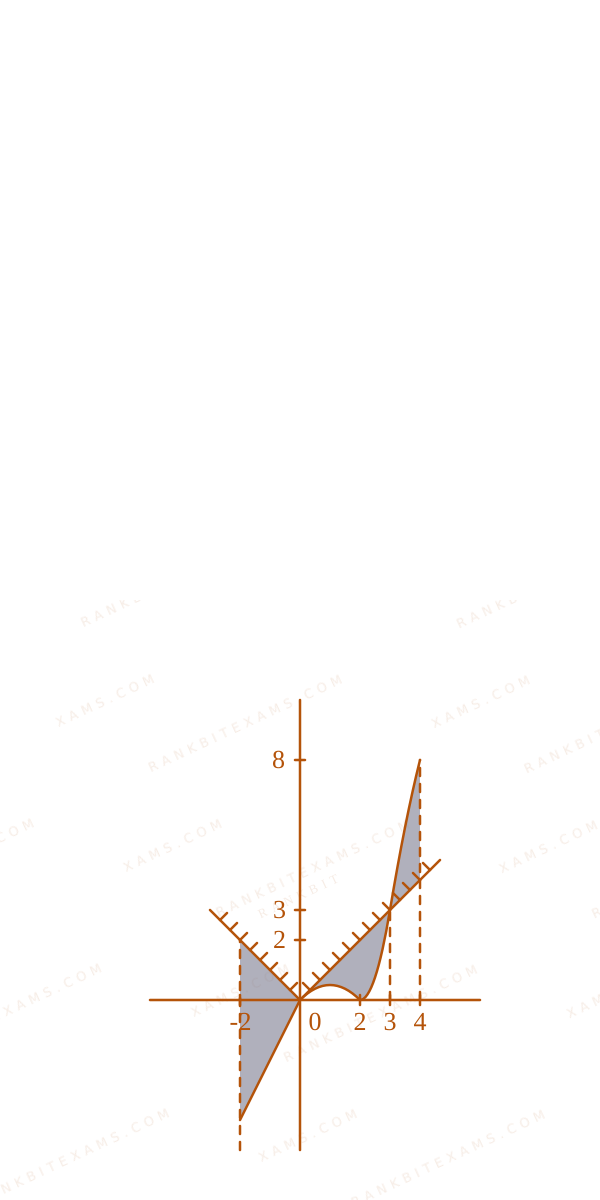
Q75 jee_main_2025_03_april_morning Area Under Bounded Curves
The area of the region bounded by the curve y = maxleft\|x|, x|x - 2|right\ [cite: 699], the x-axis and the lines x = -2 and x = 4 is equal to[cite: 699, 702]:
Numerical Answer. Answer: 12 to 12

Solution

### Related Formula Definite integration geometry area: Split boundary zones around intersections where functional dominant switches occur.
Area Under Bounded Curves diagram for Q75 - JEE Main 2025 Morning
### Core Logic Analyze intersection points between y_1 = |x| and y_2 = x|x-2| across required integration span regions: - For x in [-2, 0]: |x| = -x and x|x-2| = -x(2-x) = x^2 - 2x. Max curve tracks through distinct segments. - For positive sectors, compute intersections: x = x(2-x) implies x = 1 or x=0. Also check switch locations where graphs swap dominance. ### Step 1: Setting up separate area integral blocks Using geometric area partitions calculated across continuous regions [cite: 1495]: textArea = frac12 times 2 times 2 + frac12 times 3 times 3 + frac12 times 1 times 11 = 12 [cite: 1495] Alternatively, splitting the boundary metrics via continuous definite limits yields identical whole tracking blocks matching exactly to 12 total units[cite: 1495]. ### Pattern Recognition Plotting multiple curves dynamically highlights dominance shifts quickly. Computing distinct straight triangular chunks saves valuable integration time. ### Evaluation Rubric / Model Answer null ### Chapter Mix Class 12 Mathematics: Integrals (Application of Integrals)

Q72 jee_main_2025_04_april_evening Integration by Substitution
If int fracleft(sqrt1 + x^2 + xright)^10left(sqrt1 + x^2 - xright)^9mathrmdx = frac 1m left(left(sqrt 1 + x ^ 2 + xright) ^ n left(n sqrt 1 + x ^ 2 - xright)right) + C where C is the constant of integration and mathbfm,mathbfnin mathbfN, then mathfrakm + mathfrakn is equal to
Numerical Answer. Answer: 379 to 379

Solution

### Core Logic Let's simplify the integrand by rationalizing the denominator term block. Notice that: left(sqrt1+x^2 - xright)left(sqrt1+x^2 + xright) = (1+x^2) - x^2 = 1 frac1sqrt1+x^2 - x = sqrt1+x^2 + x Substituting this back into the denominator expression column: I = int left(sqrt1+x^2 + xright)^10 cdot left(sqrt1+x^2 + xright)^9 dx = int left(sqrt1+x^2 + xright)^19 dx ### Step 1: Implementing the Substitution Path Let t = sqrt1+x^2 + x. Then: dt = left( fracxsqrt1+x^2 + 1 right) dx = left( fracx + sqrt1+x^2sqrt1+x^2 right) dx = fractsqrt1+x^2 dx dx = fracsqrt1+x^2t dt Since sqrt1+x^2 + x = t and sqrt1+x^2 - x = frac1t, adding both gives: 2sqrt1+x^2 = t + frac1t implies sqrt1+x^2 = frac12left(t + frac1tright) Thus, dx = frac12tleft(t + frac1tright) dt = frac12left(1 + frac1t^2right) dt. ### Step 2: Integrating with respect to t Substitute these back into the integral: I = int t^19 cdot frac12left(1 + frac1t^2right) dt = frac12 int left(t^19 + t^17right) dt I = frac12 left( fract^2020 + fract^1818 right) + C = fract^184 left( fract^210 + frac19 right) + C = fract^18360 big(9t^2 + 10big) + C ### Step 3: Matching Form and Finding m + n To match the template format, let's pull out a factor of t: I = fract^19360 left( 9t + frac10t right) + C = fract^19360 left( 9left(sqrt1+x^2+xright) + 10left(sqrt1+x^2-xright) right) + C I = fracleft(sqrt1+x^2+xright)^19360 left( 19sqrt1+x^2 - x right) + C Comparing this directly with the given answer format, we identify: - m = 360 - n = 19 Computing m + n: m + n = 360 + 19 = 379 ### Pattern Recognition Expressions containing conjugate factors like sqrt1+x^2 pm x frequently simplify under rationalization because their product equals 1. This dynamic quickly reduces fractional components into single power blocks. ### Evaluation Rubric / Model Answer null ### Chapter Mix Class 12 Mathematics: Indefinite Integrals
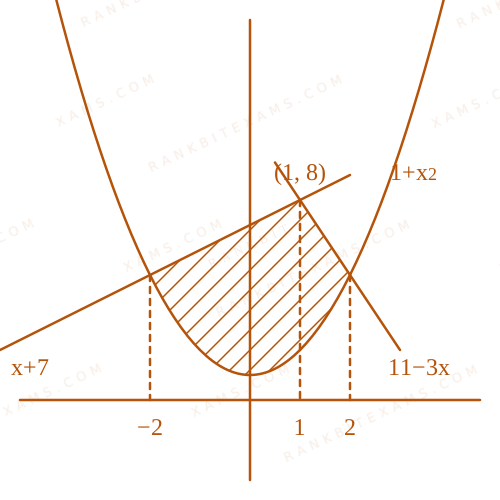
Q57 jee_main_2025_07_april_evening Area Under Curves
If the area of the region \(x,y):1 + x^2leq yleq min \x + 7,11 - 3x\ \ is A, then 3A is equal to
  • A. 50
  • B. 49
  • C. 46
  • D. 47

Solution

### Related Formula The area enclosed between upper bounding function y_textupper and lower function y_textlower is: textArea = int_a^b (y_textupper - y_textlower) \, dx ### Core Logic We need to find the intersection points of the curves to understand the min\x+7, 11-3x\ boundary transition: 1) x+7 = 11-3x implies 4x = 4 implies x = 1. Hence, the line switches behavior at x=1. 2) Intersecting 1+x^2 with x+7: x^2 - x - 6 = 0 implies (x-3)(x+2) = 0 implies x = -2 quad textor quad x = 3 3) Intersecting 1+x^2 with 11-3x: x^2 + 3x - 10 = 0 implies (x+5)(x-2) = 0 implies x = 2 quad textor quad x = -5
Area Under Curves diagram for Q57 - JEE Main 2025 Evening
### Step 1: Set up Integrals The transition points show that from x = -2 to 1, the upper line is x+7, and from x = 1 to 2, the upper line is 11-3x. A = int_-2^1 ((x + 7) - (1 + x^2)) \, dx + int_1^2 ((11 - 3x) - (1 + x^2)) \, dx A = int_-2^1 (x + 6 - x^2) \, dx + int_1^2 (10 - 3x - x^2) \, dx ### Step 2: Integration Evaluation Evaluating the first integral: left[ fracx^22 + 6x - fracx^33 right]_-2^1 = left(frac12 + 6 - frac13right) - left(2 - 12 + frac83right) = frac376 - left(-frac223right) = frac272 Evaluating the second integral: left[ 10x - frac3x^22 - fracx^33 right]_1^2 = left(20 - 6 - frac83right) - left(10 - frac32 - frac13right) = frac343 - frac496 = frac196 Total Area A: A = frac272 + frac196 = frac81 + 196 = frac1006 = frac503 ### Step 3: Calculate 3A Multiplying the total area by 3: 3A = 3 cdot left(frac503right) = 50 ### Pattern Recognition When a boundary contains a min\\ or max\\ component, always solve for their internal intersection first to identify the exact splitting point of your definite integrals. ### Evaluation Rubric / Model Answer null ### Chapter Mix Class 12 Mathematics: Integral Calculus

More Integral Calculus Questions — jee_main_2025_02_april_evening

Practice all Integral Calculus previous-year questions →

Rankbit System
JEE Physics: Waves (+15.5%) | Electrostatics: Concentric Shells (-29.7%) | Modern Physics: Photoelectric Clones (+34.2%) | Mathematics: Definite Integrals (+18.1%) | Chemistry: Coordination Splitting (-11.4%) | JEE Physics: Waves (+15.5%) | Electrostatics: Concentric Shells (-29.7%) | Modern Physics: Photoelectric Clones (+34.2%) | Mathematics: Definite Integrals (+18.1%) | Chemistry: Coordination Splitting (-11.4%)