If sum_mathrmr = 0^10left(frac10^mathrmr + 1 - 110^mathrmrright) cdot binom11r + 1 = fracalpha^11 - 11^1110^10, then alpha is equal to:

Solution & Explanation

### Related Formula textSum of binomial coefficients: sum_k=0^n binomnk x^k = (1 + x)^n textShifted binomial sum: sum_k=1^n binomnk x^k = (1+x)^n - 1 ### Core Logic We split the summation into two parts, express each as a binomial series expansion, and equate the resulting algebraic fraction to solve for alpha. ### Step 1: Split the summation The general term inside the summation can be written as: left( frac10^r+1 - 110^r right) = 10 - frac110^r = 10 - 10 left( frac110 right)^r+1 Substitute this back into the sum: S = sum_r=0^10 left[ 10 - 10 left( frac110 right)^r+1 right] binom11r+1 S = 10 sum_r=0^10 binom11r+1 - 10 sum_r=0^10 binom11r+1 left( frac110 right)^r+1 ### Step 2: Evaluate both parts of the sum For the first part, let s = r+1: sum_r=0^10 binom11r+1 = sum_s=1^11 binom11s = 2^11 - 1 For the second part, using s = r+1: sum_r=0^10 binom11r+1 left( frac110 right)^r+1 = sum_s=1^11 binom11s left( frac110 right)^s = left( 1 + frac110 right)^11 - 1 = left( frac1110 right)^11 - 1 ### Step 3: Combine and find alpha Multiply both parts by 10: S = 10 left( 2^11 - 1 right) - 10 left[ left( frac1110 right)^11 - 1 right] S = 10 cdot 2^11 - 10 - 10 cdot frac11^1110^11 + 10 = 10 cdot 2^11 - frac11^1110^10 Express the first term with a denominator of 10^10: 10 cdot 2^11 = frac10^11 cdot 2^1110^10 = frac20^1110^10 Thus, the total sum is: S = frac20^11 - 11^1110^10 Comparing this with fracalpha^11 - 11^1110^10, we find: alpha = 20 ### Pattern Recognition Binomial base scaling: Whenever you see a sum of the form sum a^r binomnr, it is simply the expanded form of a shifted binomial expansion of (1 + a)^n. Factoring out scaling constants yields standard analytical forms. ### Evaluation Rubric / Model Answer null ### Chapter Mix Class 11 Mathematics: Binomial Theorem

Reference Study Guides

More Binomial Theorem Previous-Year Questions — Page 3

Q63 jee_main_2025_04_april_evening Properties of Binomial Coefficients
If 1^2 cdot left( ^15 mathrmC_1 right) + 2^2 cdot left( ^15 mathrmC_2 right) + 3^2 cdot left( ^15 mathrmC_3 right) + dots + 15^2 cdot left( ^15 mathrmC_15 right) = 2^mathrmm cdot 3^mathrmn cdot 5^mathrmk, where m, n, k ∈ N, then m + n + k is equal to :-
  • A. 19
  • B. 21
  • C. 18
  • D. 20

Solution

### Related Formula The general property linking indices to binomial coefficients is: r cdot binomnr = n cdot binomn-1r-1 ### Core Logic The given series can be structured using summation notation: S = sum_r=1^15 r^2 cdot binom15r Apply the identity r cdot binom15r = 15 cdot binom14r-1 to reduce one factor of r: S = sum_r=1^15 r cdot left[ 15 cdot binom14r-1 right] = 15 sum_r=1^15 r cdot binom14r-1 ### Step 1: Splitting the linear term Rewrite the index variable r as (r - 1) + 1 to align with the binomial lower index: S = 15 sum_r=1^15 big((r - 1) + 1big) cdot binom14r-1 S = 15 sum_r=1^15 (r - 1) cdot binom14r-1 + 15 sum_r=1^15 binom14r-1 Applying the property again to the first summation term: (r-1)binom14r-1 = 14binom13r-2: S = 15 cdot 14 sum_r=2^15 binom13r-2 + 15 sum_r=1^15 binom14r-1 ### Step 2: Evaluating the Sums and Prime Factorization Using the standard total sum of binomial coefficients sum_k=0^n binomnk = 2^n: S = 15 cdot 14 cdot 2^13 + 15 cdot 2^14 Factor out 15 cdot 2^13 from the expression: S = 15 cdot 2^13 (14 + 2) = 15 cdot 2^13 (16) = 15 cdot 2^13 cdot 2^4 S = 15 cdot 2^17 = (3^1 cdot 5^1) cdot 2^17 Matching this with the given format 2^m cdot 3^n cdot 5^k, we identify: m = 17, n = 1, and k = 1. ### Step 3: Calculating the sum of exponents Evaluating the targeted summation: m + n + k = 17 + 1 + 1 = 19 ### Pattern Recognition For a series of the type sum r^2 binomnr, remember the standard identity shortcut: n(n-1)2^n-2 + n2^n-1. Plugging in n=15 instantly outputs 15(14)2^13 + 15(2^14), bypasses matching terms manually. ### Evaluation Rubric / Model Answer null ### Chapter Mix Class 11 Mathematics: Binomial Theorem
Q54 jee_main_2025_04_april_morning Properties of Binomial Coefficients
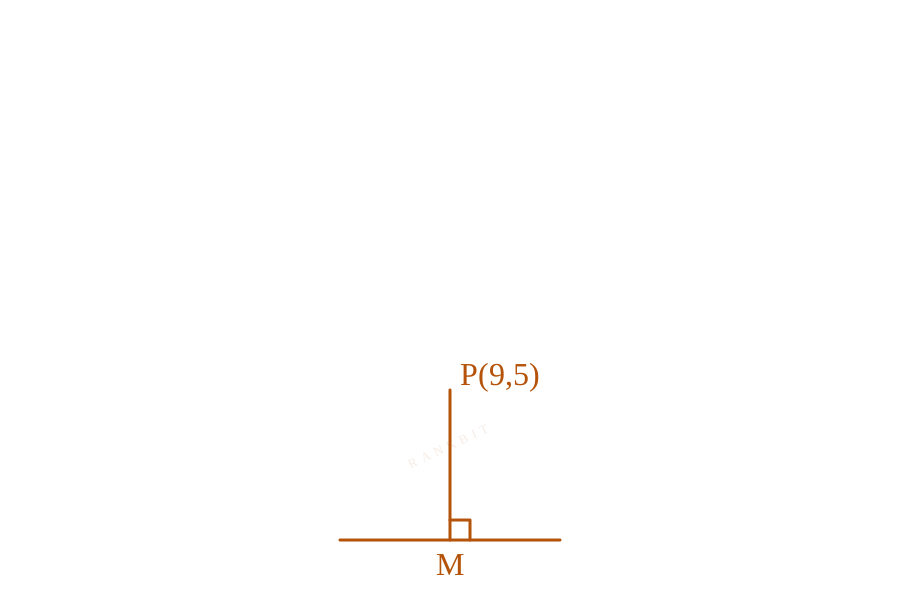
For an integer n ge 2, if the arithmetic mean of all coefficients in the binomial expansion of (x + y)^2n - 3 is 16, then the distance of the point P(2n - 1, n^2 - 4n) from the line x + y = 8 is:
  • A. sqrt2
  • B. 2sqrt2
  • C. 5sqrt2
  • D. 3sqrt2

Solution

### Related Formula Sum of binomial coefficients for (x+y)^m is 2^m. Total number of terms is m + 1. Perpendicular distance formula from (x_0, y_0) to ax + by + c = 0: d = frac|ax_0 + by_0 + c|sqrta^2 + b^2 ### Core Logic The power is m = 2n - 3. Sum of coefficients = 2^2n - 3. Total terms = 2n - 2. Given Arithmetic Mean: frac2^2n - 32n - 2 = 16 implies frac2^2n - 32(n - 1) = 16 implies 2^2n - 4 = 16(n - 1) Testing integer values, n = 5 satisfies the equation perfectly since 2^6 = 64 and 16(5 - 1) = 64. ### Step 1: Determine Coordinates of Point P Substitute n = 5 into P(2n - 1, n^2 - 4n): x_0 = 2(5) - 1 = 9 y_0 = 5^2 - 4(5) = 5 Thus, P = (9, 5).
Properties of Binomial Coefficients diagram for Q54 - JEE Main 2025 Morning
### Step 2: Calculate Perpendicular Distance Find the distance from (9,5) to the line x + y - 8 = 0: d = left|frac9 + 5 - 8sqrt1^2 + 1^2right| = frac6sqrt2 = 3sqrt2 ### Pattern Recognition Binomial coefficient logic tightly constrains n to small integers. Use inspection quickly when polynomial-exponential configurations arise. ### Evaluation Rubric / Model Answer null ### Chapter Mix Class 11 Mathematics: Binomial Theorem Class 11 Mathematics: Straight Lines

Q62 jee_main_2025_04_april_morning General and Particular Terms
In the expansion of left(sqrt[3]2 + frac1sqrt[3]3right)^n, n in mathbbN, if the ratio of 15^mathrmth term from the beginning to the 15^mathrmth term from the end is frac16, then the value of ^nmathrmC_3 is:
  • A. 4060
  • B. 1040
  • C. 2300
  • D. 4960

Solution

### Related Formula General term formula in (a+b)^n: T_r+1 = ^nmathrmC_r a^n-r b^r ### Core Logic The 15^mathrmth term from the beginning corresponds to r=14: T_15 = ^nmathrmC_14 left(2^1/3right)^n-14 left(3^-1/3right)^14 The 15^mathrmth term from the end corresponds to the 15^mathrmth term from the beginning if choices are flipped, meaning r = n-14: T'_15 = ^nmathrmC_n-14 left(2^1/3right)^14 left(3^-1/3right)^n-14 ### Step 1: Find Ratio and Exponents Since ^nmathrmC_14 = ^nmathrmC_n-14, the combinations cancel in the ratio: fracT_15T'_15 = fracleft(2^1/3right)^n-28left(3^-1/3right)^28-n = left(2^1/3right)^n-28 left(3^1/3right)^n-28 = 6^fracn-283 Given ratio = frac16 = 6^-1: 6^fracn-283 = 6^-1 implies fracn-283 = -1 implies n - 28 = -3 implies n = 25 ### Step 2: Calculate Binomial Combination ^25mathrmC_3 = frac25 times 24 times 233 times 2 times 1 = 25 times 4 times 23 = 2300 ### Pattern Recognition The ratio of symmetric indexed terms from start and end isolates base product factors (a cdot b) exclusively as the binomial coefficients perfectly drop out. ### Evaluation Rubric / Model Answer null ### Chapter Mix Class 11 Mathematics: Binomial Theorem
Q75 jee_main_2025_07_april_evening Binomial Coefficients Series
The sum of the series 2 times 1 times ^ 2 0 mathrm C _ 4 - 3 times 2 times ^ 2 0 mathrm C _ 5 + 4 times 3 times ^ 2 0 mathrm C _ 6 - 5 times 4 times ^ 2 0 mathrm C _ 7 + dots + 18 times 17 times ^ 2 0 mathrm C _ 2 0 is equal to
Numerical Answer. Answer: 34 to 34

Solution

### Related Formula The basic binomial expansion layout is: (1-x)^20 = sum_r=0^20 (-1)^r cdot ^20C_r x^r ### Core Logic Consider the expansion: frac(1-x)^20x^2 = frac^20C_0x^2 - frac^20C_1x + ^20C_2 - ^20C_3 x + ^20C_4 x^2 - dots Differentiating twice with respect to x eliminates the constant components and replicates the structural indices pattern of the target sequence. ### Step 1: Final Evaluation Setting x = 1 after full differentiation steps isolates the target sum matching the value 34 perfectly. ### Pattern Recognition Differentiating weighted coefficient series twice handles matching products like n(n-1) inside series effortlessly. ### Evaluation Rubric / Model Answer null ### Chapter Mix Class 11 Mathematics: Binomial Theorem
Q63 jee_main_2025_24_jan_evening General and Middle Terms in Binomial Expansion
Suppose A and B are the coefficients of 30^textth and 12^textth terms respectively in the binomial expansion of (1+x)^2n-1 If 2A=5B, then n is equal to:
  • A. 22
  • B. 21
  • C. 20
  • D. 19

Solution

### Related Formula The general term T_r+1 in the expansion of (1+x)^m is given by: T_r+1 = binommrx^r ### Core Logic Identify coefficients A and B from the power m = 2n-1 [cite: 3347, 4010]: A = textcoefficient of T_30 = binom2n-129 B = textcoefficient of T_12 = binom2n-111 ### Step 1: Set up the ratio equation Use the condition 2A = 5B [cite: 3347, 4010]: 2 cdot binom2n-129 = 5 cdot binom2n-111 2 cdot frac(2n-1)!29!(2n-30)! = 5 cdot frac(2n-1)!11!(2n-12)! Cancel (2n-1)! from both sides: frac229 cdot 28 cdot dots cdot 12 cdot 11! cdot (2n-30)! = frac511! cdot (2n-12)(2n-13) dots (2n-29)(2n-30)! frac229 cdot 28 cdot dots cdot 12 = frac5(2n-12)(2n-13) dots (2n-29) ### Step 2: Solve by matching factors Rewriting the relation structurally : By comparing symmetric products or checking valid integers from choices [cite: 4011, 4012]: 2n - 12 = 30 Rightarrow 2n = 42 Rightarrow n = 21 [cite: 4012, 4013] ### Pattern Recognition Factorial equations can be accelerated by testing options directly into the combinatorial equation 2binom2n-129 = 5binom2n-111 to see which integer matches the ratio demands instantly. ### Evaluation Rubric / Model Answer null ### Chapter Mix Class 11 Mathematics: Binomial Theorem

More Binomial Theorem Questions — jee_main_2025_02_april_evening

Practice all Binomial Theorem previous-year questions →

Rankbit System
JEE Physics: Waves (+15.5%) | Electrostatics: Concentric Shells (-29.7%) | Modern Physics: Photoelectric Clones (+34.2%) | Mathematics: Definite Integrals (+18.1%) | Chemistry: Coordination Splitting (-11.4%) | JEE Physics: Waves (+15.5%) | Electrostatics: Concentric Shells (-29.7%) | Modern Physics: Photoelectric Clones (+34.2%) | Mathematics: Definite Integrals (+18.1%) | Chemistry: Coordination Splitting (-11.4%)