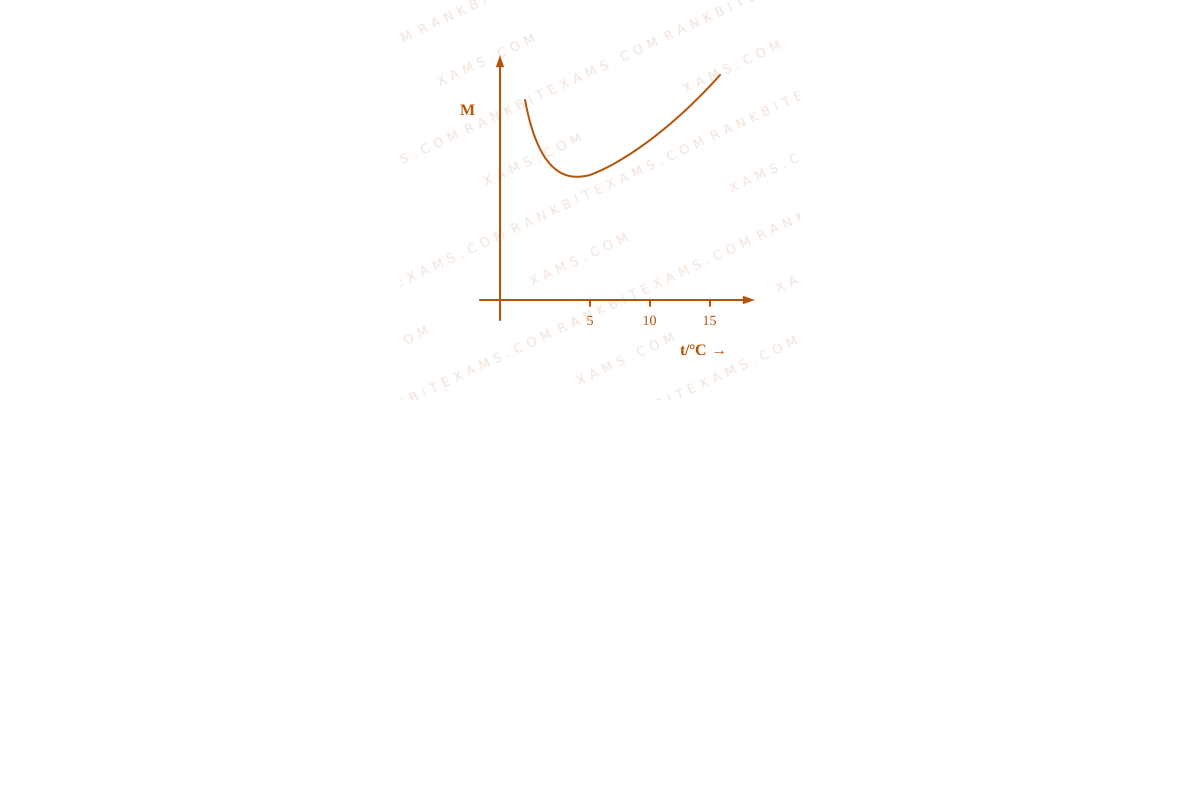
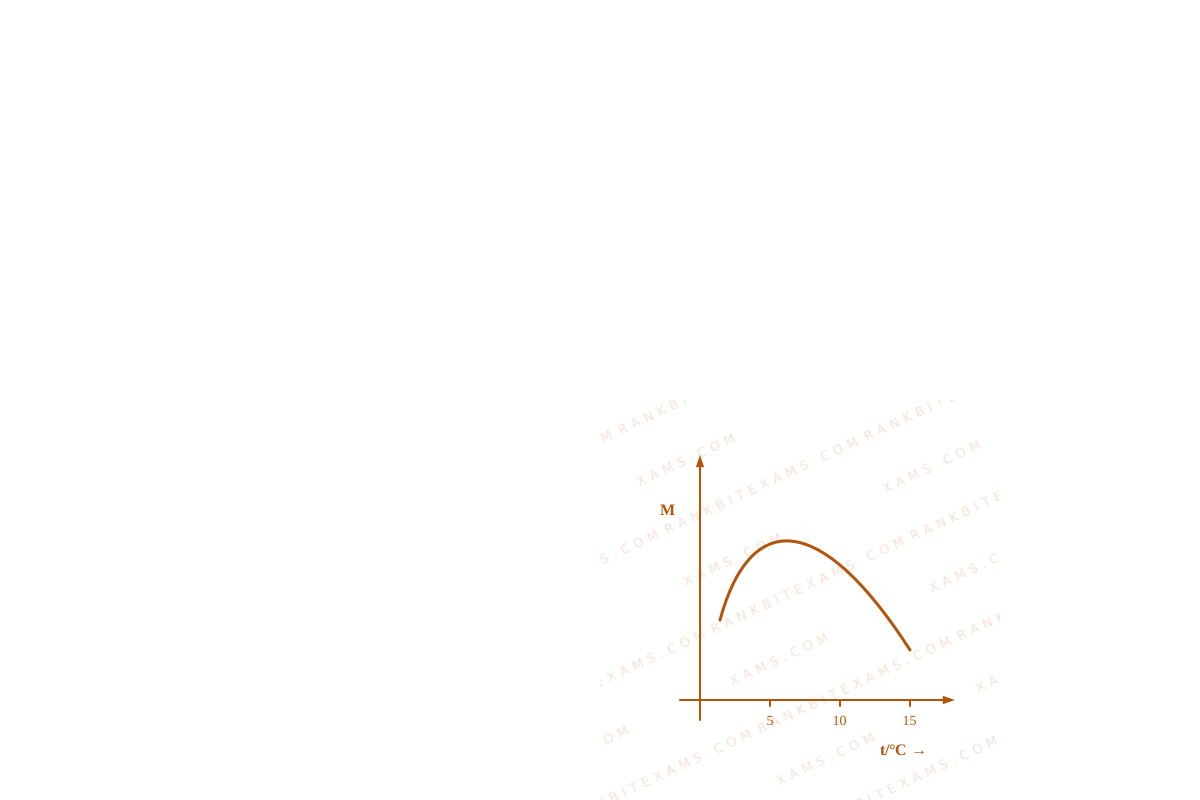
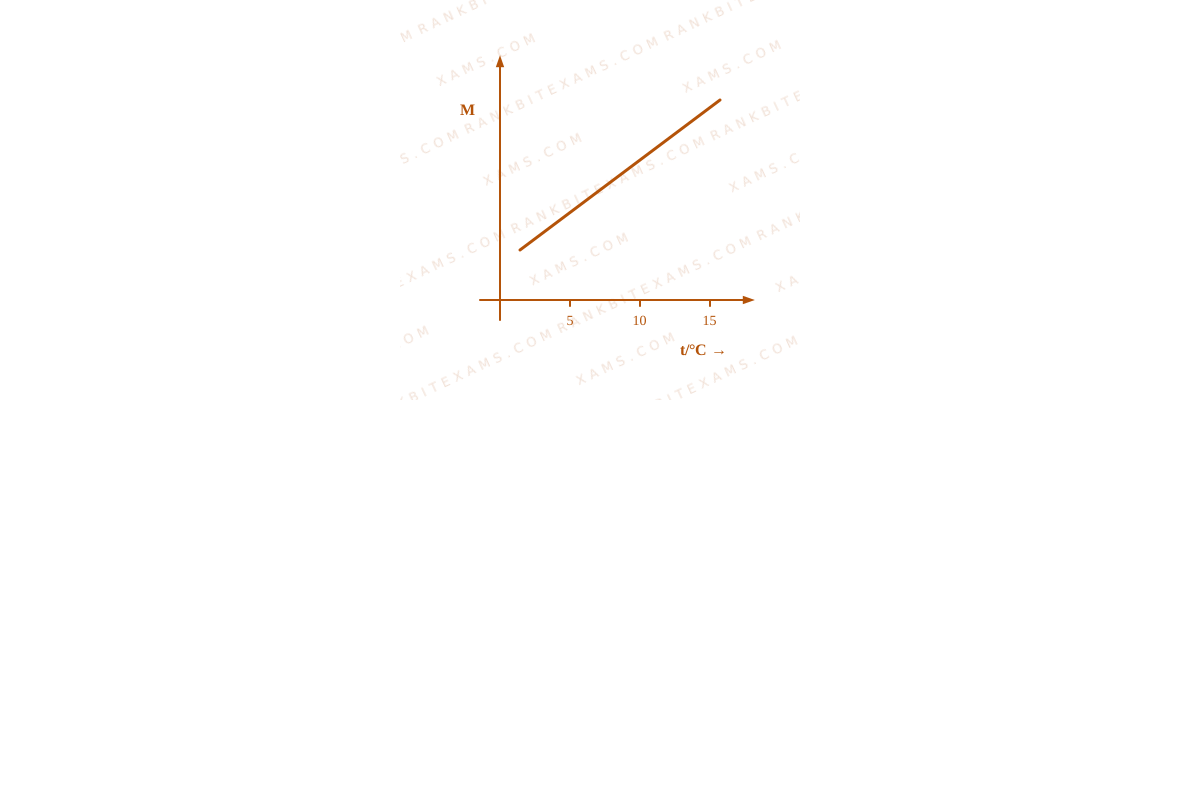
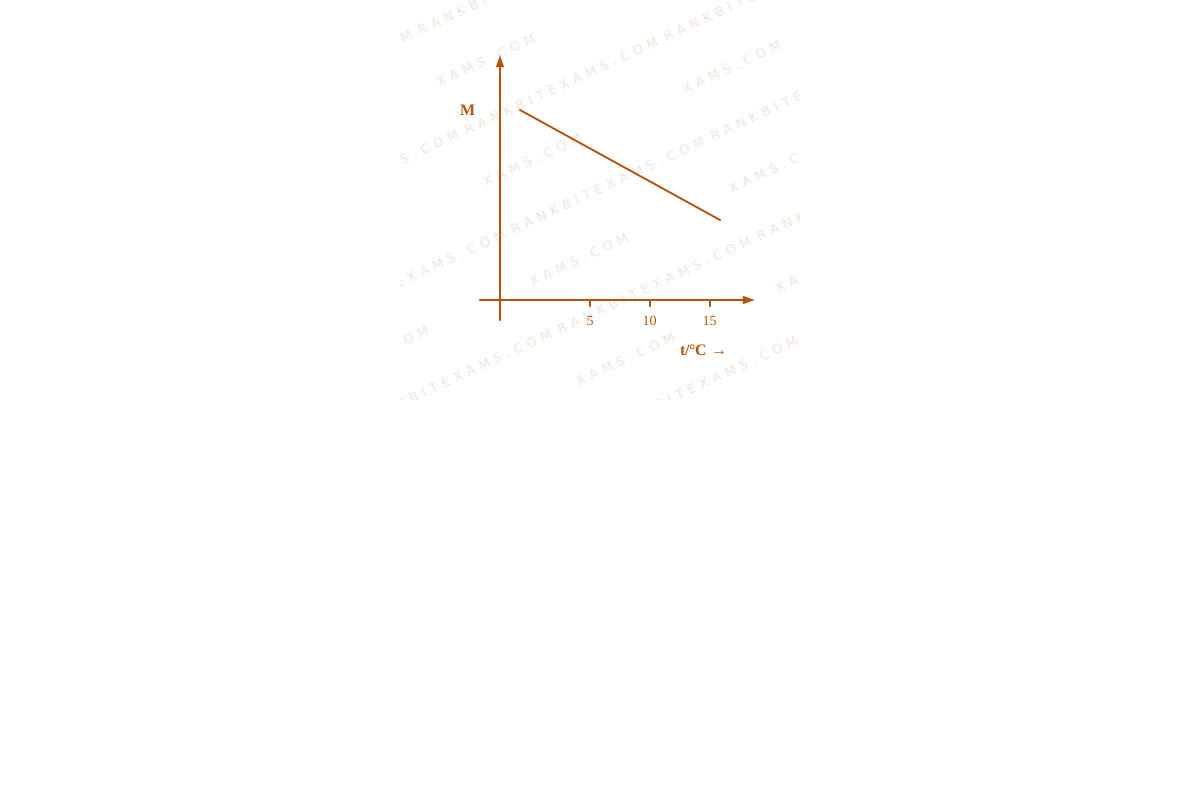
'x' g of NaCl is added to water in a beaker with a lid. The temperature of the system is raised from 1^circmathrmC to 25^circmathrmC. Which out of the following plots, is best suited for the change in the molarity (M) of the solution with respect to temperature? [Consider the solubility of NaCl remains unchanged over the temperature range]

Solution & Explanation

### Related Formula textMolarity (M) = fracn_textsoluteV_textsolution (mathrmL) ### Core Logic Since solubility of mathrmNaCl remains unchanged, the number of dissolved moles of mathrmNaCl solute (n_textsolute) remains strictly constant. Thus, molarity M is strictly dependent on the volume of water (solvent) as temperature changes: M propto frac1V_textsolution ### Step 1: Understand Water's Anomalous Expansion Water exhibits unique anomalous density behavior near freezing: - From 1^circmathrmC to 4^circmathrmC, the density of water **increases** to a maximum. This contraction means the volume (V) of water **decreases**. - From 4^circmathrmC to 25^circmathrmC, the density of water **decreases** due to standard thermal expansion. Consequently, the volume (V) **increases**. ### Step 2: Relate Volume to Molarity Because volume is in the denominator of the molarity equation: - From 1^circmathrmC to 4^circmathrmC: Volume decreases implies Molarity **increases**. - At 4^circmathrmC: Volume is minimum implies Molarity reaches a **maximum**. - From 4^circmathrmC to 25^circmathrmC: Volume increases implies Molarity **decreases**. This behavior is perfectly represented by **Plot (2)**, which features a distinct peak around 4^circmathrmC. ### Pattern Recognition Water is at its densest (and occupies minimum volume) at exactly 3.98^circmathrmC (4^circmathrmC). Any concentration unit based on volume (such as Molarity or Normality) will reach a corresponding maximum at this temperature. ### Evaluation Rubric / Model Answer null ### Chapter Mix Class 12 Chemistry: Solutions

Reference Study Guides

More Solutions Previous-Year Questions — Page 7

Q87 jee_main_2024_31_jan_evening Concentration Terms
The molarity of 1text L orthophosphoric acid (H_3PO_4) having 70\% purity by weight (specific gravity 1.54text g cm^-3) is ________ textM. (Molar mass of H_3PO_4 = 98text g mol^-1)
Numerical Answer. Answer: 11 to 11

Solution

### Related Formula M = frac\% text purity times textdensity times 10textMolar Mass ### Core Logic Specific gravity is numerically equivalent to density in textg/cm^3, so density = 1.54text g/mL. Volume of solution = 1text L = 1000text mL. Mass of solution = textVolume times textDensity = 1000 times 1.54 = 1540text g. ### Step 1: Finding Solute Mass and Molarity Since the purity is 70\% by weight, the mass of H_3PO_4 in the solution is: textMass of H_3PO_4 = 1540 times 0.70 = 1078text g. Moles of H_3PO_4 = frac107898 = 11text moles. Since this is dissolved in 1text L of solution, the Molarity is: M = frac11text moles1text L = 11text M ### Pattern Recognition Shortcut formula directly substitutes the values: M = frac70 times 1.54 times 1098 = frac107898 = 11. ### Evaluation Rubric / Model Answer null ### Chapter Mix Class 12 Chemistry: Solutions Class 11 Chemistry: Some Basic Concepts of Chemistry

Q63 jee_main_2024_31_jan_morning Non-Ideal Solutions
Identify the mixture that shows positive deviations from Raoult's Law
  • A. (CH_3)_2CO + C_6H_5NH_2
  • B. CHCl_3 + C_6H_6
  • C. CHCl_3 + (CH_3)_2CO
  • D. (CH_3)_2CO + CS_2

Solution

### Core Logic (CH_3)_2CO + CS_2 exhibits positive deviations from Raoult's Law because the interactions between acetone and carbon disulphide molecules are weaker than the respective pure component interactions. ### Pattern Recognition Mixtures like Acetone + Aniline or Chloroform + Benzene/Acetone form stronger hydrogen bonds after mixing, showing negative deviation. Acetone + CS_2 or Ethanol + Acetone break existing strong interactions, leading to positive deviation. ### Evaluation Rubric / Model Answer null ### Chapter Mix Class 12 Chemistry: Solutions

More Solutions Questions — jee_main_2025_02_april_evening

Practice all Solutions previous-year questions →

Rankbit System
JEE Physics: Waves (+15.5%) | Electrostatics: Concentric Shells (-29.7%) | Modern Physics: Photoelectric Clones (+34.2%) | Mathematics: Definite Integrals (+18.1%) | Chemistry: Coordination Splitting (-11.4%) | JEE Physics: Waves (+15.5%) | Electrostatics: Concentric Shells (-29.7%) | Modern Physics: Photoelectric Clones (+34.2%) | Mathematics: Definite Integrals (+18.1%) | Chemistry: Coordination Splitting (-11.4%)