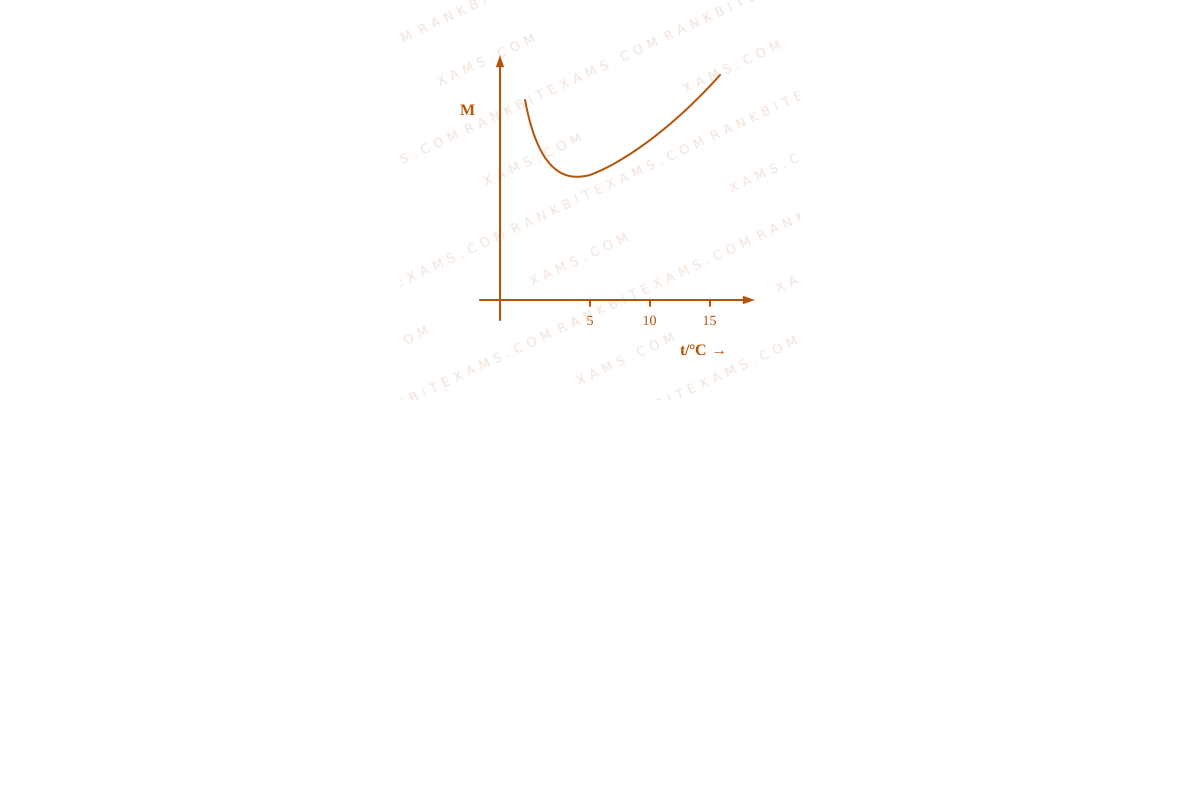
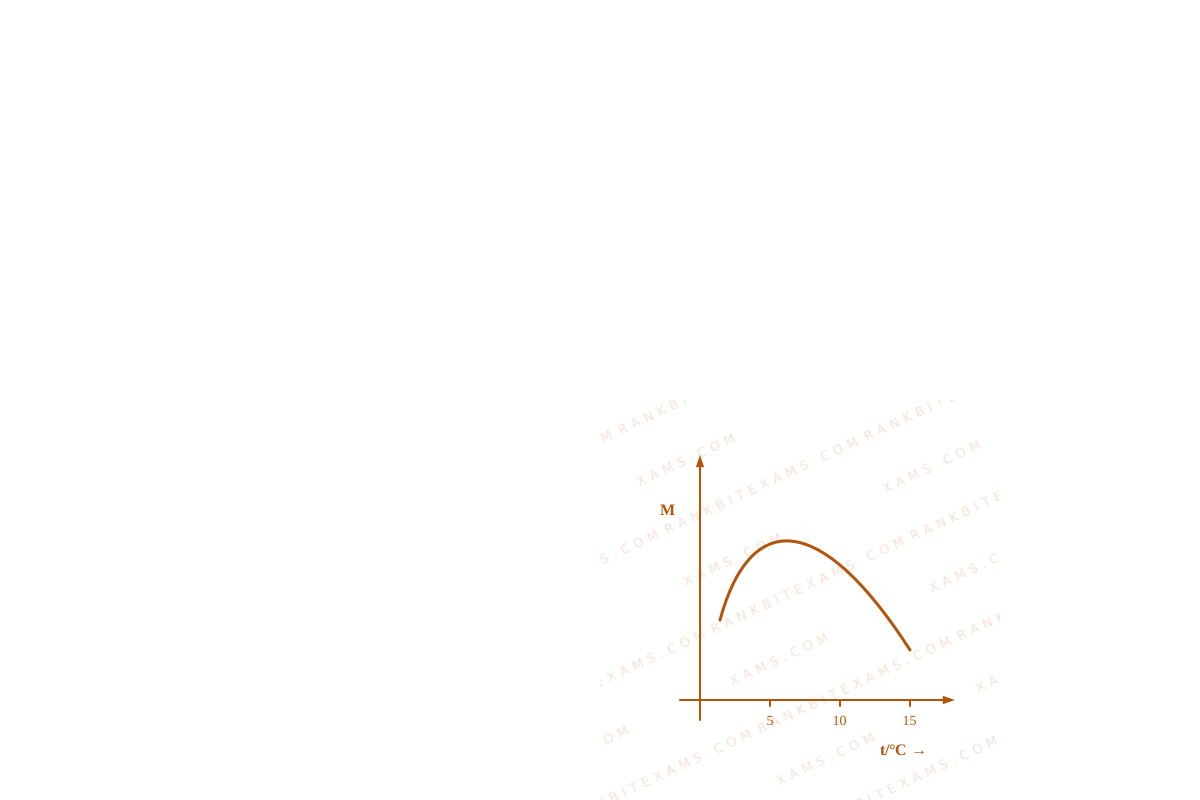
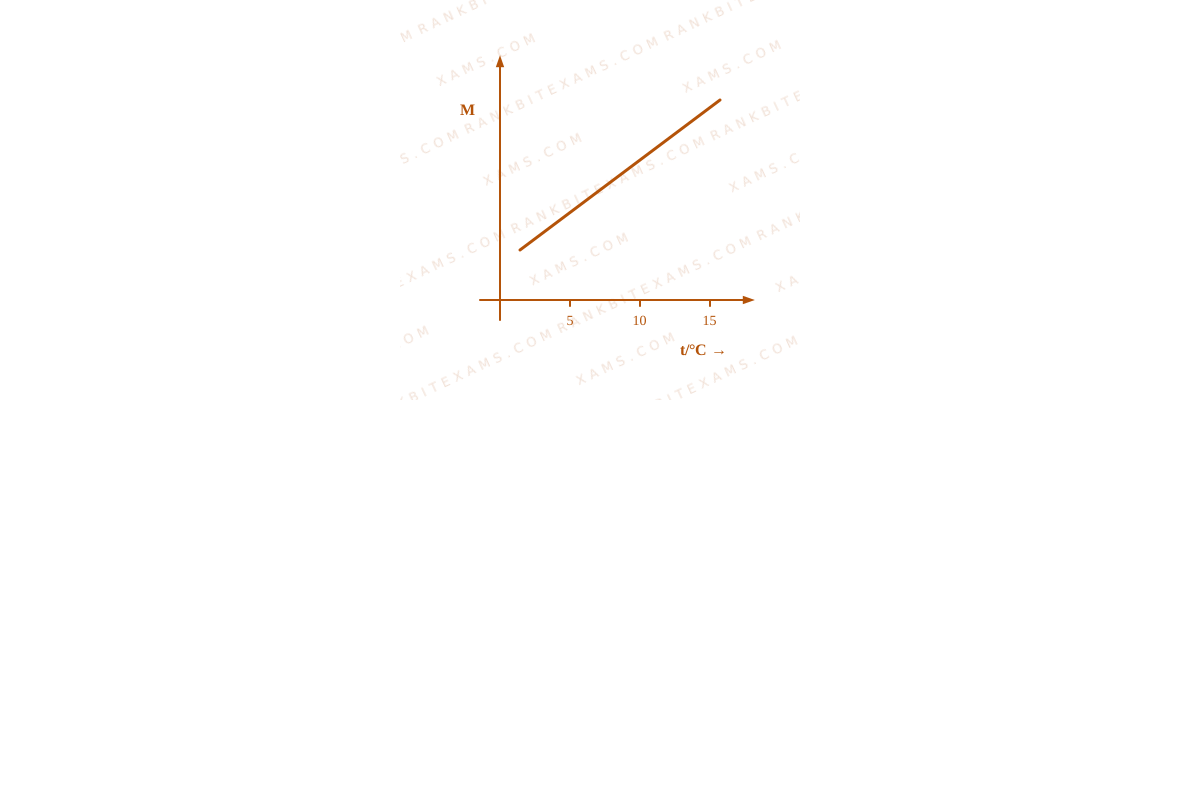
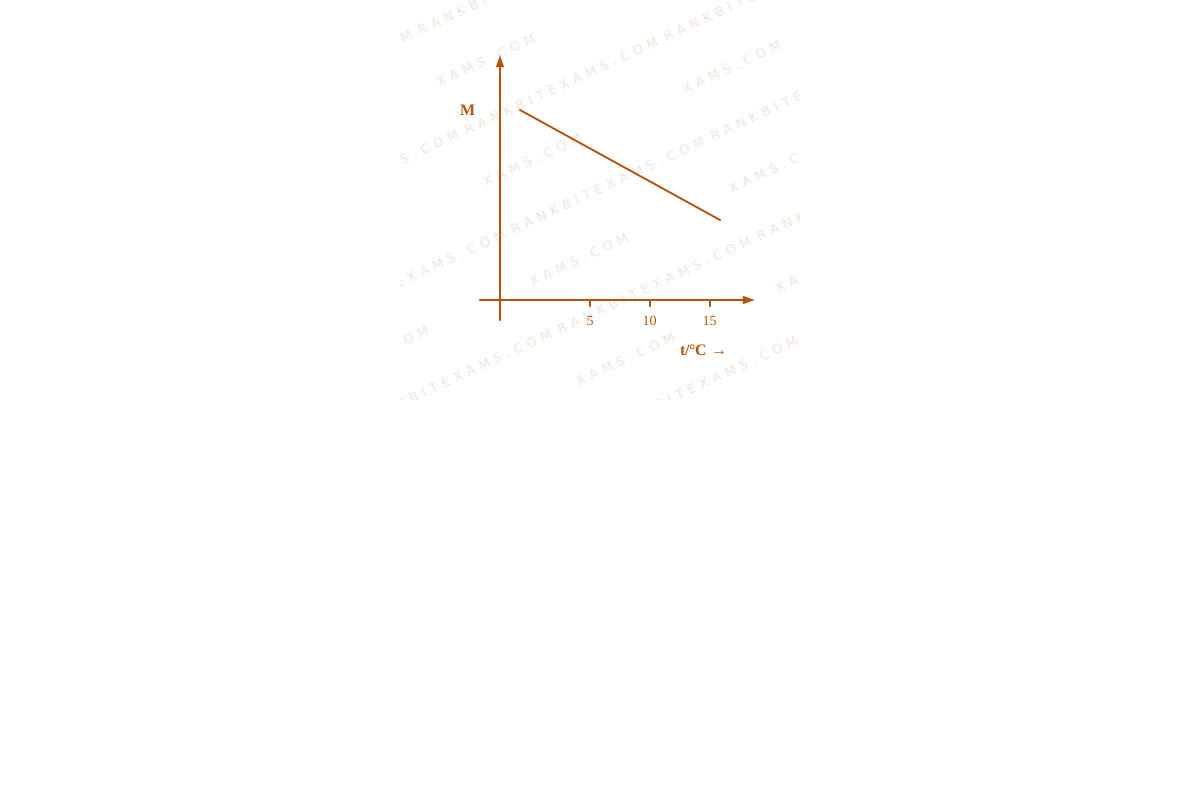
'x' g of NaCl is added to water in a beaker with a lid. The temperature of the system is raised from 1^circmathrmC to 25^circmathrmC. Which out of the following plots, is best suited for the change in the molarity (M) of the solution with respect to temperature? [Consider the solubility of NaCl remains unchanged over the temperature range]

Solution & Explanation

### Related Formula textMolarity (M) = fracn_textsoluteV_textsolution (mathrmL) ### Core Logic Since solubility of mathrmNaCl remains unchanged, the number of dissolved moles of mathrmNaCl solute (n_textsolute) remains strictly constant. Thus, molarity M is strictly dependent on the volume of water (solvent) as temperature changes: M propto frac1V_textsolution ### Step 1: Understand Water's Anomalous Expansion Water exhibits unique anomalous density behavior near freezing: - From 1^circmathrmC to 4^circmathrmC, the density of water **increases** to a maximum. This contraction means the volume (V) of water **decreases**. - From 4^circmathrmC to 25^circmathrmC, the density of water **decreases** due to standard thermal expansion. Consequently, the volume (V) **increases**. ### Step 2: Relate Volume to Molarity Because volume is in the denominator of the molarity equation: - From 1^circmathrmC to 4^circmathrmC: Volume decreases implies Molarity **increases**. - At 4^circmathrmC: Volume is minimum implies Molarity reaches a **maximum**. - From 4^circmathrmC to 25^circmathrmC: Volume increases implies Molarity **decreases**. This behavior is perfectly represented by **Plot (2)**, which features a distinct peak around 4^circmathrmC. ### Pattern Recognition Water is at its densest (and occupies minimum volume) at exactly 3.98^circmathrmC (4^circmathrmC). Any concentration unit based on volume (such as Molarity or Normality) will reach a corresponding maximum at this temperature. ### Evaluation Rubric / Model Answer null ### Chapter Mix Class 12 Chemistry: Solutions

Reference Study Guides

More Solutions Previous-Year Questions — Page 2

Q49 jee_main_2025_07_april_morning Van't Hoff Factor
The percentage dissociation of a salt (mathrmMX_3) solution at given temperature (van't Hoff factor texti = 2) is ______ %. (Nearest integer)
Numerical Answer. Answer: 33 to 33

Solution

### Related Formula i = 1 + (n - 1)alpha ### Core Logic For the salt mathrmMX_3: mathrmMX_3 rightarrow mathrmM^3+ + 3mathrmX^- - Number of ions formed per formula unit, n = 1 + 3 = 4. Given i = 2, let's find the degree of dissociation (alpha): i = 1 + (4 - 1)alpha 2 = 1 + 3alpha implies 3alpha = 1 implies alpha = frac13 approx 0.3333 Percentage dissociation: \% text dissociation = alpha times 100 = 33.33 \% approx 33 \% ### Pattern Recognition Shortcut: For MX_3 dissociating into 4 ions, alpha = (i - 1) / 3. Since i = 2, alpha = 1/3 = 33\% directly. ### Evaluation Rubric / Model Answer Simple formula application verifying the degree of dissociation to obtain a precise 33 percent. ### Chapter Mix Class 12 Chemistry: Solutions

Q33 jee_main_2025_08_april_evening Azeotropic Mixtures
Which of the following binary mixtures does not show the behaviour of minimum boiling azeotropes?
  • A. textH_2textO + textCH_3textCOC_2textH_5
  • B. textC_6textH_5textOH + textC_6textH_5textNH_2
  • C. textCS_2 + textCH_3textCOCH_3
  • D. textCH_3textOH + textCHCl_3

Solution

### Core Logic Let's connect deviation behaviors to azeotropic styles: * **Minimum Boiling Azeotropes**: Formed by liquid binary solutions that display a strong **positive deviation** from Raoult's Law. In these mixtures, inter-molecular forces between components (A-B) are weaker than pure self-interactions (A-A or B-B). * **Maximum Boiling Azeotropes**: Formed by liquid binary mixtures showing a notable **negative deviation** from Raoult's Law. Here, new inter-molecular interactions (A-B) become significantly stronger. Analyzing **Phenol (C_6H_5OH) + Aniline (C_6H_5NH_2)**: The phenolic -textOH proton forms strong intermolecular hydrogen bonds with the lone pair of the -textNH_2 group of aniline. These new forces exceed the initial individual fluid bonds, lowering vapor pressure below ideal expectations (negative deviation) and creating a **maximum boiling azeotrope**. ### Pattern Recognition Phenol + Aniline, and Chloroform + Acetone are classic textbook models of strong negative deviation from Raoult's Law. Negative deviation explicitly pairs with maximum boiling azeotropes, standing out instantly against minimum boiling selections. ### Evaluation Rubric / Model Answer null ### Chapter Mix Class 12 Chemistry: Solutions
Q34 jee_main_2025_08_april_evening Colligative Properties
For the weak acid dissociation equation: textHA(aq) rightleftharpoons textH^+text(aq) + textA^-text(aq) The freezing point depression of a 0.1 text m aqueous solution of this monobasic weak acid HA is found to be 0.20^circ textC. The dissociation constant (K_a) for the acid is: Given: K_f(textH_2textO) = 1.8 text K kg mol^-1, and assume molality approx molarity.
  • A. 1.38 times 10^-3
  • B. 1.1 times 10^-2
  • C. 1.90 times 10^-3
  • D. 1.89 times 10^-1

Solution

### Related Formula Depression in freezing point colligative relation: Delta T_f = i cdot K_f cdot m Van 't Hoff factor for a weak acid dissociation: i = 1 + alpha Dissociation constant formula: K_a = fracCalpha^21-alpha ### Execution Step 1: Calculate the Van 't Hoff factor i using experimental freezing data: 0.20 = i times 1.8 times 0.1 i = frac0.200.18 = frac2018 = frac109 Step 2: Solve for degree of dissociation alpha: i = 1 + alpha implies frac109 = 1 + alpha alpha = frac109 - 1 = frac19 Step 3: Compute K_a substituting concentration C = 0.1 text M and alpha = frac19: K_a = frac0.1 times left(frac19right)^21 - frac19 = frac0.1 times frac181frac89 = frac0.181 times frac98 = frac0.172 = frac1720 K_a approx 1.388 times 10^-3 ### Pattern Recognition When dealing with weak acids, always determine i first via colligative data, isolate alpha, and map directly to K_a = fracCalpha^21-alpha. Speed up computation by converting decimals into fractional fractions (0.2/0.18 = 10/9) to maintain clean, mistake-free algebra. ### Evaluation Rubric / Model Answer null ### Chapter Mix Class 12 Chemistry: Solutions Class 11 Chemistry: Ionic Equilibrium
Q32 jee_main_2025_29_jan_evening Depression of Freezing Point
Given below are two statements: Statement (I): NaCl is added to the ice at 0^circC, present in the ice cream box to prevent the melting of ice cream. Statement (II): On addition of NaCl to ice at 0^circC, there is a depression in freezing point. In the light of the above statements, choose the correct answer from the options given below:
  • A. Statement I is false but Statement II is true
  • B. Both Statement I and Statement II are true
  • C. Both Statement I and Statement II are false
  • D. Statement I is true but Statement II is false

Solution

### Related Formula Delta T_f = i cdot K_f cdot m ### Core Logic Statement I is true: Adding NaCl to ice creates a freezing mixture with temperatures below 0^circC, preventing the ice cream from melting rapidly. Statement II is true: The addition of a non-volatile solute like NaCl causes a depression in the freezing point of water, enabling ice to remain in the solid state at lower surrounding temperatures. ### Pattern Recognition This is a classic real-world application of colligative properties. Freezing point lowering keeps commercial refrigeration setups colder for a longer duration. ### Evaluation Rubric / Model Answer null ### Chapter Mix Class 12 Chemistry: Solutions
Q40 jee_main_2025_28_jan_morning Colligative Properties - Freezing Point Depression
What is the freezing point depression constant of a solvent, 50mathrmg of which contain 1mathrmg non-volatile solute (molar mass 256mathrmg\,mol^-1 ) and the decrease in freezing point is 0.40mathrmK ?
  • A. 5.12mathrm\,K\,kg\,mol^-1
  • B. 4.43mathrm\,K\,kg\,mol^-1
  • C. 1.86mathrm~K~kg~mol^-1
  • D. 3.72mathrm\,K\,kg\,mol^-1

Solution

### Related Formula Freezing point depression relationship: Delta T_f = K_f cdot m where m is the molality defined as: m = fractextmoles of solutetextmass of solvent in kg ### Step 1: Compute Molality Moles of non-volatile solute: textmoles = frac1\,mathrmg256\,mathrmg\,mol^-1 Mass of solvent in kg: textmass = 50\,mathrmg = 50 times 10^-3\,mathrmkg Therefore, molality values map to: m = frac1256 times 50 times 10^-3 = frac100012800 = frac564\,mathrmmol\,kg^-1 ### Step 2: Calculate K_f Substituting values into the core formula: 0.40 = K_f cdot left(frac564right) K_f = frac0.40 times 645 = 0.08 times 64 = 5.12\,mathrmK\,kg\,mol^-1 ### Pattern Recognition Sees: Direct calculation of cryogenic context constant (K_f). Shortcut: Isolate K_f = fracDelta T_f cdot M cdot W_textsolvent1000 cdot w_textsolute. Substituting instantly returns 5.12. ### Evaluation Rubric / Model Answer null ### Chapter Mix Class 12 Chemistry: Solutions

More Solutions Questions — jee_main_2025_02_april_evening

Practice all Solutions previous-year questions →

Rankbit System
JEE Physics: Waves (+15.5%) | Electrostatics: Concentric Shells (-29.7%) | Modern Physics: Photoelectric Clones (+34.2%) | Mathematics: Definite Integrals (+18.1%) | Chemistry: Coordination Splitting (-11.4%) | JEE Physics: Waves (+15.5%) | Electrostatics: Concentric Shells (-29.7%) | Modern Physics: Photoelectric Clones (+34.2%) | Mathematics: Definite Integrals (+18.1%) | Chemistry: Coordination Splitting (-11.4%)