When 1~mathrmg each of compounds AB and mathrmAB_2 are dissolved in 15~mathrmg of water separately, they increased the boiling point of water by 2.7~mathrmK and 1.5~mathrmK respectively. The atomic mass of A (in amu) is times 10^-1 (Nearest integer) (Given : Molal boiling point elevation constant is 0.5~mathrmK~kg~mol^-1)

Numerical Answer Type:
Enter a numerical value Answer: 25 to 25 +4 marks

Solution & Explanation

### Related Formula Delta T_mathrmb = K_mathrmb cdot m = K_mathrmb cdot left( fracw_textsoluteM_textsolute cdot frac1000w_textsolvent right) ### Core Logic Both dissolved compounds are non-electrolytes (van 't Hoff factor i = 1). We calculate the molar masses of mathrmAB and mathrmAB_2 individually, then solve for the individual atomic masses of elements A and B. ### Step 1: Determine Molar Mass of AB Given Delta T_mathrmb = 2.7~mathrmK, w_textsolute = 1~mathrmg, w_textsolvent = 15~mathrmg, and K_mathrmb = 0.5~mathrmK~kg~mol^-1: 2.7 = 0.5 times frac1M_mathrmAB times frac100015 M_mathrmAB = frac0.5 times 100015 times 2.7 = frac50040.5 approx 12.3457~mathrmg~mol^-1 ### Step 2: Determine Molar Mass of AB_2 Given Delta T_mathrmb = 1.5~mathrmK, w_textsolute = 1~mathrmg, w_textsolvent = 15~mathrmg, and K_mathrmb = 0.5: 1.5 = 0.5 times frac1M_mathrmAB_2 times frac100015 M_mathrmAB_2 = frac0.5 times 100015 times 1.5 = frac50022.5 approx 22.2222~mathrmg~mol^-1 ### Step 3: Solve for Atomic Mass of A Let the atomic masses of elements A and B be a and b respectively: a + b = 12.3457 quad text--- (1) a + 2b = 22.2222 quad text--- (2) Subtracting equation (1) from (2): b = 22.2222 - 12.3457 = 9.8765~mathrmamu Substituting b back into equation (1): a = 12.3457 - 9.8765 = 2.4692~mathrmamu Expressing a in the requested format (times 10^-1): a = 24.692 times 10^-1 approx 25 times 10^-1 ### Pattern Recognition Mathematical consistency checks: Since mathrmAB_2 has more atoms than mathrmAB of identical constituent mass, its molar mass should be higher, leading to a smaller elevation of boiling point for the same mass dissolved, which perfectly matches our 2.7~mathrmK rightarrow 1.5~mathrmK change. ### Evaluation Rubric / Model Answer null ### Chapter Mix Class 12 Chemistry: Solutions

Reference Study Guides

More Solutions Previous-Year Questions — Page 3

Q41 jee_main_2025_03_april_morning Elevation in Boiling Point
2 moles each of ethylene glycol and glucose are dissolved in 500 g of water. The boiling point of the resulting solution is: (Given: Ebullioscopic constant of water =0.52text K kg mol^-1)
  • A. 379.2 K
  • B. 377.3 K
  • C. 375.3 K
  • D. 277.3 K

Solution

### Related Formula The net boiling point elevation for multiple non-volatile solutes is given by: Delta T_b = (i_1 m_1 + i_2 m_2) K_b ### Core Logic Both ethylene glycol and glucose are non-electrolytes, so their van 't Hoff factors are equal to unity (i_1 = i_2 = 1). textTotal moles of solute = 2 + 2 = 4text moles textMass of solvent (water) = 500text g = 0.5text kg textTotal molality (m) = frac4text mol0.5text kg = 8text mol/kg ### Step 1: Compute Elevation and Final Temperature Delta T_b = 8 times 0.52 = 4.16text K textBoiling point of solution = T_b^circ + Delta T_b = 373.15text K + 4.16text K = 377.31text K approx 377.3text K ### Pattern Recognition Shortcut: Since both are molecular non-dissociating solutes, simply \sum their moles (2 + 2 = 4). Diluting 4 moles in 0.5text kg gives an effective concentration of 8text m. Multiplying 8 times 0.52 gives a shift value of 4.16text K. ### Evaluation Rubric / Model Answer null ### Chapter Mix Class 12 Chemistry: Solutions
Q32 jee_main_2025_04_april_evening Colligative Properties
Given below are two statements : Statement (I): Molal depression constant K_f is given by fracM_lRT_fDelta S_fus, where symbols have their usual meaning. Statement (II): K_f for benzene is less than the K_f for water. In the light of the above statements, choose the most appropriate answer from the options given below:
  • A. Statement I is incorrect but Statement II is correct
  • B. Both Statement I and Statement II are incorrect.
  • C. Both Statement I and Statement II are correct
  • D. Statement I is correct but Statement II is incorrect

Solution

### Related Formula K_f = fracM_1 R T_f^2Delta H_fus = fracM_1 R T_fleft(fracDelta H_fusT_fright) = fracM_1 R T_fDelta S_fus ### Core Logic - **Statement I is correct:** Substituting Delta S_fus = fracDelta H_fusT_f directly matches the given structural relationship formula. - **Statement II is incorrect:** Standard cryoscopic constants are: - For Benzene: K_f approx 5.12 mathrm~^circ C cdot kg cdot mol^-1 - For Water: K_f approx 1.86 mathrm~^circ C cdot kg cdot mol^-1 Therefore, K_f for benzene is greater than that of water, making Statement II false. ### Pattern Recognition Keep numerical benchmarks for common solvent colligative constants (K_b, K_f for water and benzene) memorized. Benzene has a far lower enthalpy of fusion and a higher freezing point, resulting in a significantly elevated K_f value. ### Evaluation Rubric / Model Answer null ### Chapter Mix Class 12 Chemistry: Solutions

Q46 jee_main_2025_04_april_evening Concentration Terms
Sea water, which can be considered as a 6 molar (6 M) solution of NaCl, has a density of 2mathrm~g~mL^-1 . The concentration of dissolved oxygen left(mathrmO_2right) in sea water is 5.8mathrm~ppm . Then the concentration of dissolved oxygen left(mathrmO_2right) in sea water, is mathrmx times 10^-4mathrmm . mathrmx = _______. (Nearest integer) Given: Molar mass of NaCl is 58.5mathrm~g~mol^-1 Molar mass of mathrmO_2 is 32mathrm~g~mol^-1
Numerical Answer. Answer: 1.9 to 2.1

Solution

### Related Formula textppm = fractextmass of solutetextmass of solution times 10^6 textMolality (m) = fractextmoles of solutetextmass of solvent in kg ### Core Logic 1. Consider 1000 mathrm~mL of seawater solution: textMass of solution = textVolume times textdensity = 1000 times 2 = 2000 mathrm~g textMass of NaCl = 6 text moles times 58.5 = 351 mathrm~g textMass of solvent (water) = 2000 - 351 = 1649 mathrm~g = 1.649 mathrm~kg 2. Compute the mass and moles of dissolved O_2 using the ppm value: textppm = 5.8 = fractextmass of O_22000 times 10^6 implies textmass of O_2 = 1.16 times 10^-2 mathrm~g textmoles of O_2 = frac1.16 times 10^-232 = 3.625 times 10^-4 text moles 3. Determine the molality (m) of oxygen: textmolality = frac3.625 times 10^-41.649 approx 2.19 times 10^-4 mathrm~m Matching the pattern mathbfx times 10^-4mathrmm, we get mathbfx approx 2.19. The nearest integer is **2**. ### Pattern Recognition For high concentration saline solutions, the mass of the solvent drops significantly below the total mass of the solution. Be careful to subtract the solute weight (351 mathrm~g) before computing molality. ### Evaluation Rubric / Model Answer null ### Chapter Mix Class 12 Chemistry: Solutions
Q26 jee_main_2025_04_april_morning Reverse Osmosis
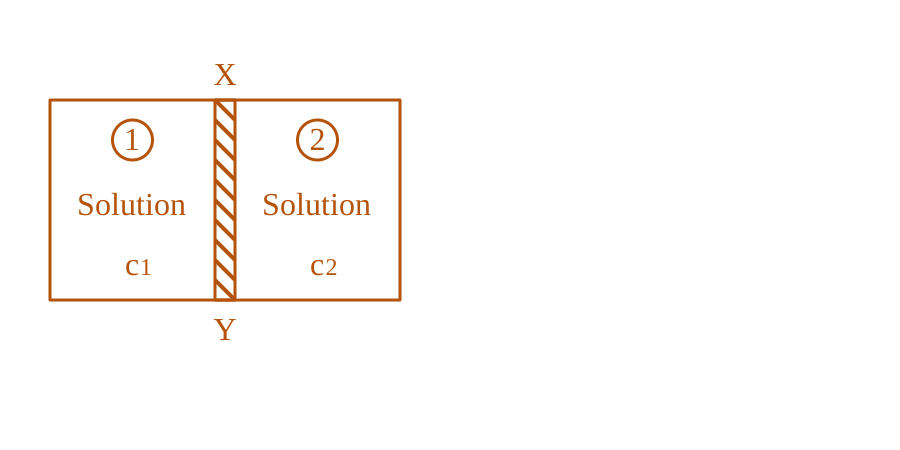
XY is the membrane / partition between two chambers 1 and 2 containing sugar solutions of concentration c_1 and c_2 (c_1 > c_2) mathrmmol~L^-1. For the reverse osmosis to take place identify the correct condition (Here p_1 and p_2 are pressures applied on chamber 1 and 2):
Reverse Osmosis cell partition diagram for Q26 - JEE Main 2025 Morning
The diagram illustrates two chambers separated by a membrane XY containing sugar solutions of concentrations c1 and c2.
  • A. text(B) and (D) only
  • B. text(A) and (D) only
  • C. text(A) and (C) only
  • D. text(C) only

Solution

### Related Formula pi = c R T where pi is the osmotic pressure of the solution. ### Core Logic Given that c_1 > c_2, chamber 1 has a higher concentration of solute than chamber 2. Under normal conditions, solvent molecules spontaneously flow from lower concentration (chamber 2) to higher concentration (chamber 1) via osmosis. To achieve **reverse osmosis**, the solvent must flow in the opposite direction—from chamber 1 to chamber 2. This requires applying an external pressure on the higher concentration side (chamber 1) that exceeds its osmotic pressure pi. textCondition for Reverse Osmosis: p_1 > pi Cellophane and parchment paper both act as suitable semi-permeable membranes for this setup. Thus, statements (A) and (C) are correct. ### Pattern Recognition Reverse osmosis always requires external pressure applied on the concentrated solution side (c_texthigh) such that P_textapplied > pi. ### Evaluation Rubric / Model Answer null ### Chapter Mix Class 12 Chemistry: Solutions
Q34 jee_main_2025_07_april_evening Raoult's Law and Liquid-Vapour Composition
Liquid textA and textB form an ideal solution. The vapour pressure of pure liquids textA and textB are 350 and 750text mm Hg respectively at the same temperature. If textx_textA and textx_textB are the mole fraction of textA and textB in solution while texty_textA and texty_textB are the mole fraction of textA and textB in vapour phase then:
  • A. fractextx_textAtextx_textB < fractexty_textAtexty_textB
  • B. fractextx_textAtextx_textB = fractexty_textAtexty_textB
  • C. fractextx_textAtextx_textB > fractexty_textAtexty_textB
  • D. (textx_textA - texty_textA) < (textx_textB - texty_textB)

Solution

### Related Formula P_textA = y_textA P_texttotal = x_textA P^0_textA P_textB = y_textB P_texttotal = x_textB P^0_textB Dividing both partial pressure formulations yields: fracy_textAy_textB = left(fracP^0_textAP^0_textB ight) cdot fracx_textAx_textB ### Core Logic Given pure saturation thresholds: P^0_textA = 350text mm Hg, quad P^0_textB = 750text mm Hg Comparing pure component volatility profiles: P^0_textA < P^0_textB implies fracP^0_textAP^0_textB < 1 Substituting this inequality into the ratio formula gives: fracy_textAy_textB < 1 cdot fracx_textAx_textB implies fracy_textAy_textB < fracx_textAx_textB ### Step 1: Rearranging Ratio Forms Inverting the inequality expression fields safely yields: fracx_textAx_textB > fracy_textAy_textB ### Pattern Recognition Konovalov's Rule Shortcut: The vapour phase is always enriched with the more volatile component. Since component textB has a higher pure vapour pressure (750 > 350), it will be preferentially enriched in the vapour phase, meaning y_textB/y_textA > x_textB/x_textA. Reversing the fractions directly matches option (3). ### Evaluation Rubric / Model Answer null ### Chapter Mix Class 12 Chemistry: Solutions

More Solutions Questions — jee_main_2025_02_april_evening

Practice all Solutions previous-year questions →

Rankbit System
JEE Physics: Waves (+15.5%) | Electrostatics: Concentric Shells (-29.7%) | Modern Physics: Photoelectric Clones (+34.2%) | Mathematics: Definite Integrals (+18.1%) | Chemistry: Coordination Splitting (-11.4%) | JEE Physics: Waves (+15.5%) | Electrostatics: Concentric Shells (-29.7%) | Modern Physics: Photoelectric Clones (+34.2%) | Mathematics: Definite Integrals (+18.1%) | Chemistry: Coordination Splitting (-11.4%)