JEE Main · Chemistry ↓ Falling

Coordination Compounds appeared 68 times across 3 years — 7.9% of Chemistry. This question is from Crystal Field Stabilization Energy.

Year 2026 2025 2024 Total
Questions 19 34 15 68

The d-orbital electronic configuration of the complex among [Co(en)₃]³⁺, [CoF₆]³⁻, [Mn(H₂O)₆]²⁺ and [Zn(H₂O)₆]²⁺ that has the highest CFSE is:

Solution & Explanation

Related Formula
CFSE = ( -0.4 n_t2g + 0.6 n_eg ) Δₒ + nₚ P
Core Logic

Crystal Field Stabilization Energy (CFSE) is maximized (becomes most negative) when electrons populate lower-energy t2g orbitals and stay out of higher-energy eg orbitals. This is favored by strong-field ligands (SFL) that induce large Δₒ splitting, leading to low-spin configurations.

Step 1: Analyze Ligand Strength and Configuration

Let us check each of the given complexes:

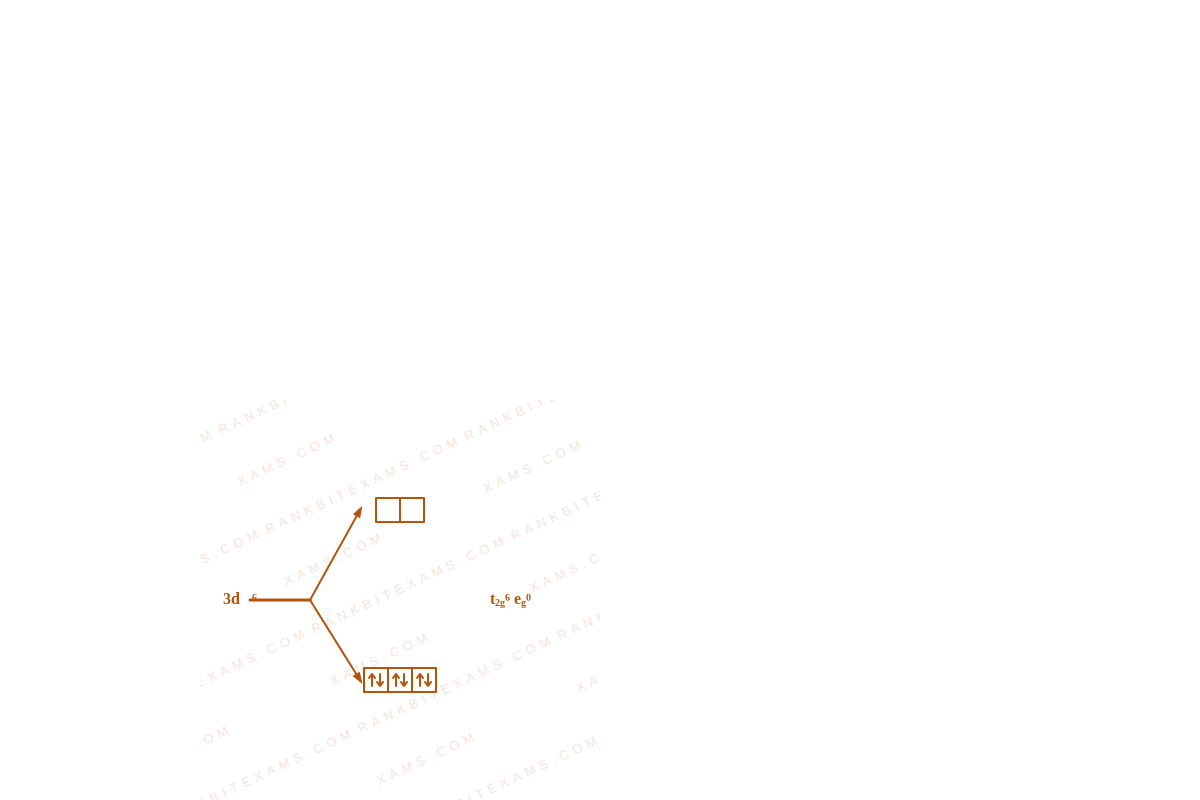
  • [Co(en)₃]³⁺: Here Co³⁺ has a 3d⁶ configuration. Since ethylenediamine (en) is a strong-field ligand, it causes pairing of all 6 electrons in the t2g subshell. The configuration is t2g⁶eg⁰.
  • d-orbital splitting diagram for low-spin Co3+ complex with t2g6 configuration
    d-orbital splitting diagram for low-spin Co3+ complex with t2g6 configuration

  • [CoF₆]³⁻: Co³⁺ is 3d⁶. Since F^- is a weak-field ligand (WFL), no pairing occurs. The configuration is t2g⁴eg².
  • [Mn(H₂O)₆]²⁺: Mn²⁺ is 3d⁵. Since H₂O is a weak-field ligand, the configuration is high-spin: t2g³eg².
  • [Zn(H₂O)₆]²⁺: Zn²⁺ is 3 d¹⁰. The d-subshell is fully filled, yielding t2g⁶eg⁴.
Step 2: Compare CFSE Values

Calculating CFSE (neglecting pairing energy term for simplicity):

  • For [Co(en)₃]³⁺: CFSE = 6 × (-0.4 Δₒ) = -2.4 Δₒ
  • For [CoF₆]³⁻: CFSE = [4(-0.4) + 2(0.6)] Δₒ = -0.4 Δₒ
  • For [Mn(H₂O)₆]²⁺: CFSE = [3(-0.4) + 2(0.6)] Δₒ = 0
  • For [Zn(H₂O)₆]²⁺: CFSE = [6(-0.4) + 4(0.6)] Δₒ = 0
  • Hence, [Co(en)₃]³⁺ has the highest crystal field stabilization energy, corresponding to the d-orbital electronic configuration t2g⁶eg⁰.

Pattern Recognition

For octahedral complexes of d⁶ metals, a low-spin configuration (t2g⁶eg⁰) achieves the theoretical maximum orbital stabilization since the eg levels are completely empty and t2g is fully filled.

Chapter Mix

Class 12 Chemistry: Coordination Compounds

Reference Study Guides

More Coordination Compounds Previous-Year Questions — Page 7

Q26 jee_main_2025_29_jan_evening Magnetic Properties of Coordination Compounds
The calculated spin-only magnetic moments of K₃[Fe(OH)₆] and K₄[Fe(OH)₆] respectively are: (1) 4.90 and 4.90 B.M. (2) 5.92 and 4.90 B.M. (3) 3.87 and 4.90 B.M. (4) 4.90 and 5.92 B.M.
  • A. 4.90 and 4.90 B.M.
  • B. 5.92 and 4.90 B.M.
  • C. 3.87 and 4.90 B.M.
  • D. 4.90 and 5.92 B.M.

Solution

Related Formula
mu = sqrtn(n+2) B.M.
Core Logic

In K₃[Fe(OH)₆], iron is in the +3 oxidation state (Fe³⁺ = 3d⁵). Since OH⁻ is a weak field ligand, no pairing of electrons takes place. The number of unpaired electrons (n) is 5.

mu = sqrt5(5+2) = sqrt35 approx 5.92 B.M.

In K₄[Fe(OH)₆], iron is in the +2 oxidation state (Fe²⁺ = 3d⁶). Since OH⁻ is a weak field ligand, no pairing occurs. The number of unpaired electrons (n) is 4.

mu = sqrt4(4+2) = sqrt24 approx 4.90 B.M.
Pattern Recognition

Identify the ligand field strength first. OH⁻ is a weak field ligand in the spectrochemical series, so it does not cause pairing in either Fe²⁺ or Fe³⁺ configurations.

Chapter Mix

Class 12 Chemistry: Coordination Compounds
Q37 jee_main_2025_29_jan_evening Homoleptic Complexes and Electronic Configurations
Identify the homoleptic complexes with odd number of d electrons in the central metal. (A) [FeO₄]²⁻ (B) [Fe(CN)₆]³⁻ (C) [Fe(CN)₅NO]²⁻ (D) [CoCl₄]²⁻ (E) [Co(H₂O)₃F₃] Choose the correct answer from the options given below:
  • A. (B) and (D) only
  • B. (C) and (E) only
  • C. (A), (B) and (D) only
  • D. (A), (C) and (E) only

Solution

Core Logic

A complex is homoleptic if the metal is bound to only one kind of donor ligand group.

  • (A) [FeO₄]²⁻ is homoleptic, but Fe⁺⁶ corresponds to a 3d² (even) electronic configuration.
  • (B) [Fe(CN)₆]³⁻ is homoleptic. Fe⁺³ corresponds to a 3d⁵ (odd) configuration.
  • (C) [Fe(CN)₅NO]²⁻ is heteroleptic (contains two types of ligands).
  • (D) [CoCl₄]²⁻ is homoleptic. Co⁺² corresponds to a 3d⁷ (odd) configuration.
  • (E) [Co(H₂O)₃F₃] is heteroleptic.
Pattern Recognition

Filter by 'homoleptic' first to instantly eliminate multi-ligand mixed structures like options (C) and (E).

Chapter Mix

Class 12 Chemistry: Coordination Compounds

Q46 jee_main_2025_29_jan_evening Crystal Field Theory and Colors of Complexes
Consider the following low-spin complexes K₃[Co(NO₂)₆], K₄[Fe(CN)₆], K₃[Fe(CN)₆], Cu₂[Fe(CN)₆] and Zn₂[Fe(CN)₆]. The sum of the spin-only magnetic moment values of complexes having yellow colour is ________ B.M. (answer is nearest integer)
Numerical Answer. Answer: 0 to 0

Solution

Core Logic

From the given list, the complexes exhibiting a distinct yellow color are K₃[Co(NO₂)₆] and K₄[Fe(CN)₆].

Let's calculate the spin-only magnetic moments for these low-spin configurations:

  • For K₃[Co(NO₂)₆], cobalt is in +3 oxidation state (Co³⁺ = 3d⁶).
  • In the presence of the strong ligand field (NO₂^-), all six electrons pair up completely in the t2g orbitals:

t2g⁶ eg⁰ implies n = 0 unpaired electrons implies mu = 0 BM

Crystal Field Theory and Colors of Complexes diagram for Q46 - JEE Main 2025 Evening

  • For K₄[Fe(CN)₆], iron is in +2 oxidation state (Fe²⁺ = 3d⁶).
  • In the strong field of cyanide ligands (CN^-), pairing is complete:

t2g⁶ eg⁰ implies n = 0 unpaired electrons implies mu = 0 BM

Therefore, the sum of their spin-only magnetic moments is 0 + 0 = 0.

Pattern Recognition

Low-spin d⁶ octahedral complexes always yield a fully closed-shell t2g⁶ arrangement with zero unpaired electrons, leading deterministically to a magnetic moment of 0 BM.

Chapter Mix

Class 12 Chemistry: Coordination Compounds

Q36 jee_main_2025_28_jan_morning Borax Bead Test and Crystal Field Split
The metal ion whose electronic configuration is not affected by the nature of the ligand and which gives a violet colour in non-luminous flame under hot condition in borax bead test is
  • A. Ti³⁺
  • B. Ni²⁺
  • C. Mn²⁺
  • D. Cr³⁺

Solution

Core Logic

Nickel (Ni²⁺) exhibits a d⁸ electronic profile. In regular octahedral complex splits: t2g⁶ eg² Because the lower t2g subshell is fully paired and the higher eg contains exactly 2 electrons matching Hund's rules, this orbital distribution remains configurationally identical under both strong-field and weak-field environments. Additionally, Ni²⁺ compounds produce a characteristic violet bead during hot cycles in a non-luminous flame within the qualitative borax matrix.

Pattern Recognition

Sees: Configuration invariant to ligand strength + qualitative test combination. Shortcut: A d⁸ structure in octahedral splitting always stays high-spin/low-spin identical, pointing strictly to Ni²⁺.

Chapter Mix

Class 12 Chemistry: Coordination Compounds Class 12 Chemistry: The d-and f-Block Elements

Q39 jee_main_2025_03_april_morning Crystal Field Theory and Spectrochemical Series
The correct order of the complexes [Co(NH₃)₅(H₂O)]³⁺ (A), [Co(NH₃)₆]³⁺ (B), [Co(CN)₆]³⁻ (C) and [CoCl(NH₃)₅]²⁺ (D) in terms of wavelength of light absorbed is:
  • A. D > A > B > C
  • B. C > B > D > A
  • C. D > C > B > A
  • D. C > B > A > D

Solution

Related Formula
E = Δₒ = (hc)/(λ) λ ∝ (1)/(Δₒ)
Core Logic

All complexes contain Co³⁺ ion (3d⁶). The crystal field splitting energy (CFSE, Δₒ) depends on the field strength of the ligands in the spectrochemical series:

CN^- > NH₃ > H₂O > Cl^-
Step 1: Wavelength Determination

Order of CFSE (Δₒ):

C > B > A > D

Since absorbed wavelength λ is inversely proportional to Δₒ, the wavelength order is reversed:

D > A > B > C
Pattern Recognition

Stronger ligand field arrow Larger Δₒ arrow Shorter absorbed wavelength λ.

Chapter Mix

Class 12 Chemistry: Coordination Compounds

More Coordination Compounds Questions — jee_main_2025_02_april_evening

Practice all Coordination Compounds previous-year questions →

Rankbit System
JEE Physics: Waves (+15.5%) | Electrostatics: Concentric Shells (-29.7%) | Modern Physics: Photoelectric Clones (+34.2%) | Mathematics: Definite Integrals (+18.1%) | Chemistry: Coordination Splitting (-11.4%) | JEE Physics: Waves (+15.5%) | Electrostatics: Concentric Shells (-29.7%) | Modern Physics: Photoelectric Clones (+34.2%) | Mathematics: Definite Integrals (+18.1%) | Chemistry: Coordination Splitting (-11.4%)